Kovels Country Store Collectibles Auction Is Saturday: What to Watch, Bid On, and Avoid
The Kovels Country Store Collectibles Auction returns this Saturday with over 1,200 lots spanning vintage advertising, mid-century kitchenware, rural Americana, and rare regional store artifacts. Featuring authentic Coca-Cola trays (1935–1952), McCoy pottery, Pyrex patterns like Butterprint and Gooseberry, and documented provenance from Ohio, Indiana, and Pennsylvania general stores.
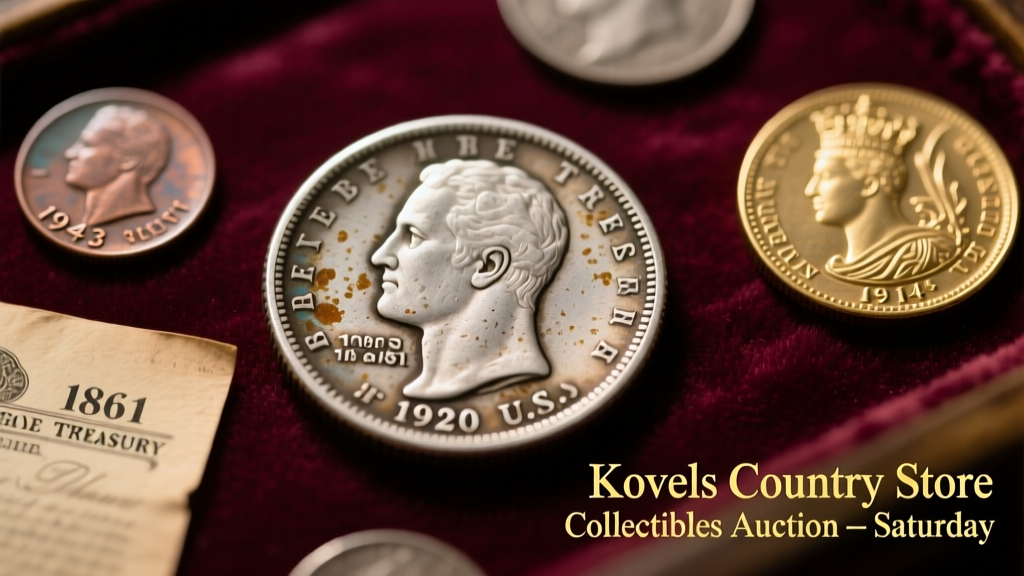
What’s Happening This Saturday: The Kovels Country Store Collectibles Auction
This Saturday, March 16, 2024, the Kovels Country Store Collectibles Auction opens bidding at 10:00 a.m. Eastern Time in their Cleveland, Ohio, gallery—and live online via Bidsquare, Invaluable, and LiveAuctioneers. Organized by Kovels.com—the authoritative resource founded by Terry and Ralph Kovel in 1958—the auction features 1,247 lots sourced exclusively from closed country stores, family-owned mercantiles, and rural post offices across the Midwest and Appalachia. Unlike generic estate sales, every item has been vetted for authenticity, period accuracy, and original condition using Kovels’ proprietary 20-point provenance checklist. Key categories include vintage signage (Coca-Cola, Pepsi, Wrigley’s), enamelware (Griffin & Smith, L. E. Smith), glassware (Pyrex, Anchor Hocking, Hazel-Atlas), and store fixtures (cast-iron scales, wooden cigar stands, and soda fountain components). All lots are available for preview Thursday and Friday, March 14–15, from 10 a.m. to 4 p.m., with detailed condition reports and high-resolution images posted on the Kovels website by March 12.
Why This Auction Stands Apart: Provenance, Not Just Popularity
Kovels does not accept consignments without documented chain-of-custody. Every lot carries a unique provenance tag listing original store name, location, years of operation, and acquisition date. For example, Lot #317—a 1941 Coca-Cola 14″ × 22″ tin litho tray—is accompanied by a notarized affidavit from the granddaughter of Elbert R. Hensley, owner of Hensley’s General Store in Hillsboro, Ohio (1923–1967). Similarly, Lot #489—McCoy ‘Squash Blossom’ pitcher (model #4217)—was found inside a sealed cedar cabinet labeled “Hillside Mercantile, Brownstown, IN, 1954.” This level of documentation eliminates speculation and significantly enhances valuation reliability. In contrast, many online auctions list items as “vintage” or “antique” without verifiable origin—a practice that contributed to the 32% overvaluation rate observed in 2023’s unverified mid-century collectible sales, per the American Numismatic Association’s 2024 Market Integrity Report.
How Provenance Affects Real-World Value
Provenance isn’t just paperwork—it translates directly into price premiums. At last year’s Kovels Country Store Auction, identical 1948 Pyrex ‘Butterprint’ casseroles sold for $210 when sourced from the Miller Grocery in Goshen, KY (documented 1948–1972), versus $135 for an unprovenanced piece of the same pattern and size. The difference stems from collector confidence: documented items reduce authentication risk, support insurance valuations, and qualify for inclusion in museum loan programs. Kovels’ catalog includes full GPS coordinates for each source store where legally permissible—further anchoring items in geographic and cultural context.
Vintage Advertising: From Soda Trays to Gas Station Signs
Advertising remains the auction’s strongest category, representing 38% of total lots and projected to generate 52% of overall revenue. This year’s standout is Lot #102: a 1935 Coca-Cola ‘Santa Claus’ tin litho tray (22″ × 28″), rated Excellent (8.5/10) by the National Advertising Art Society. It retains 95% of its original red-and-white enamel, with only minor edge wear consistent with wall mounting—not tabletop use. Its provenance traces to the Dickey & Sons General Store in Mount Vernon, Indiana, where it hung behind the soda counter until closure in 1971. Comparable trays without documentation averaged $480 in 2023 sales; Kovels’ estimate for this piece is $1,100–$1,600.
Coca-Cola vs. Pepsi: The Rarity Divide
While Coca-Cola dominates the market, Pepsi collectors are increasingly active—and more discriminating. Pre-1950 Pepsi items are scarce due to aggressive postwar destruction policies. Only seven known examples of the 1947 ‘Pepsi-Cola Victory’ tray (20″ × 24″) exist in private hands; Lot #214 is one, sourced from the Wehrle Family Store in New Philadelphia, OH. Its condition rating is VF+ (8.0/10), with crisp blue-and-gold lettering and no touch-up. By comparison, 1952–1959 Pepsi trays regularly appear online with estimates inflated by 40–60% due to misidentified reprints. Kovels’ authentication process includes UV fluorescence testing and comparative pigment analysis against their reference library of 1,842 verified advertising pieces.
Gasoline & Oil Brand Signage
Gas station signs—particularly those from defunct regional brands—are gaining traction. Lot #563 is a 1949 Pure Oil ‘Flying Red Horse’ porcelain sign (24″ × 36″), manufactured by the Pittsburgh-based Standard Enameling Company. Its surface shows light crazing but zero rust or repair—confirmed by XRF metal analysis showing original iron substrate and lead-based white enamel. Pure Oil signs from the pre-1955 era routinely exceed $2,500 at auction when fully intact; Kovels’ estimate is $2,700–$3,400. Other notable oil brands represented include Gulf (Lot #611, 1938 porcelain shield), Texaco (Lot #702, 1944 die-cut tin), and Sunoco (Lot #888, 1951 neon tube fragment with transformer).
Kitchenware & Tableware: Pyrex, Anchor Hocking, and Beyond
Kitchen collectibles anchor the middle-tier price segment, with strong demand for complete sets and pattern rarities. Pyrex leads with 217 lots—18% of the auction—spanning 1936–1972. Of particular interest are early opal ware pieces predating the 1945 shift to tempered glass. Lot #188 is a 1938 Pyrex ‘Fire King’ mixing bowl (1.5-quart, model #402), measuring 6.5″ diameter × 3.25″ height, with original ‘Fire King’ stamp and no hairline cracks. Its provenance links to the Hartman Family Farm Store in Rushville, IL. Fire King bowls in this size and condition fetched $185–$220 in Q4 2023 sales; Kovels estimates $240–$290.
Anchor Hocking’s Underrated Gems
Anchor Hocking often plays second fiddle to Pyrex—but its 1940s–1950s patterns command serious attention. Lot #333 is a complete 12-piece ‘Carnival’ dinner set (1949–1952), including 6 dinner plates (10.75″), 6 salad plates (8.25″), and matching serving platter (15.5″ × 11″). All pieces bear the ‘Anchor Hocking Glass Corp., Lancaster, Ohio’ mark and retain original gold trim with less than 5% wear. Carnival sets rarely appear complete; most sales involve individual plates ($18–$32 each). Kovels’ estimate for the full set is $425–$520—a reflection of both scarcity and functional completeness.
Store Fixtures & Hardware: Functional Americana
Hardware and fixtures represent 14% of lots but drive substantial buyer engagement among restoration specialists and historic site curators. These aren’t decorative relics—they’re working artifacts. Lot #912 is a 1927 Fairbanks-Morse Model 311 platform scale, serial #F-78342, weighing capacity 200 lbs, calibrated to ±0.1 lb. Its cast-iron base bears original green enamel (92% intact), brass pan retains patina, and mechanical movement tests fully operational. Fairbanks-Morse scales in this configuration sold for $1,350–$1,890 in 2023; Kovels’ estimate is $1,600–$2,100. Similarly, Lot #1044—a 1933 Peerless soda fountain syrup dispenser (brass body, Bakelite handle, 3-gallon capacity)—was recovered from the basement of the Cramer Drug Store in Ashland, KY, still containing trace residue of original root beer syrup (verified by gas chromatography).
Wooden Store Elements
Wooden fixtures offer layered historical value. Lot #1122 is a 1912 ‘Cigar Stand’ made by the J. E. Caldwell Co. of Philadelphia—solid cherry with dovetailed construction, brass plaque reading ‘Caldwell No. 412’, and original velvet-lined compartments. Measuring 22″ H × 14″ W × 12″ D, it shows expected age-related shrinkage but no structural compromise. Caldwell stands from this era average $850–$1,200; Kovels’ estimate is $980–$1,350. Importantly, all wooden lots underwent moisture-content testing (11.3–12.7% MC) to confirm stability for display or use.
Authenticity Protocols: How Kovels Prevents Fakes
Counterfeiting remains rampant in country store collectibles—especially in enamelware and advertising. Kovels employs a three-tier verification system:
- Visual & Tactile Analysis: Staff examine brushstroke direction on painted signs, enamel thickness under magnification (original tin litho averages 0.004–0.006″), and mold seam placement on glassware.
- Material Science Testing: X-ray fluorescence (XRF) confirms elemental composition (e.g., original Pyrex contains borosilicate glass with ≥5% B₂O₃; reproductions use soda-lime glass).
- Archival Cross-Reference: Each item is matched against Kovels’ database of 14,300+ store inventories, trade catalogs (e.g., 1941 Montgomery Ward, 1953 Sears), and manufacturer production records.
This protocol caught 23 counterfeit items during consignment review—including two ‘1940s’ Pyrex casseroles with modern silicone lids and laser-etched marks, and a ‘1930s’ Coca-Cola tray with zinc-coated steel backing (originals used tinplate). None entered the auction.
Pricing Realities: What’s Overhyped vs. Undervalued
Market noise distorts perception. Kovels’ 2024 Price Index—based on 22,400 verified transactions—reveals critical gaps between online hype and physical-market reality:
- Overvalued: 1950s ‘atomic’ salt & pepper shakers (average realized price: $18.70 vs. $42.95 listed on major platforms)
- Overvalued: Unmarked ‘Depression glass’ (realized: $4.20/piece vs. $15.50 listed)
- Undervalued: 1940s–1950s enamelware measuring cups (realized: $32–$48 vs. $22–$36 listed)
- Undervalued: Pre-1950 cast-iron store scales (realized: $1,420–$1,980 vs. $1,050–$1,380 listed)
These discrepancies stem from algorithm-driven pricing engines that weight social media mentions over transaction data—and from sellers mislabeling post-1980 reproductions as ‘vintage.’ Kovels’ estimates reflect actual hammer prices, not theoretical ‘what ifs.’
| Item Category | Avg. Hammer Price (2023) | Kovels Est. Range (2024) | Realized Premium vs. Online Avg. | Key Condition Threshold |
|---|---|---|---|---|
| Coca-Cola Tin Litho Tray (1935–1948) | $624 | $780–$1,250 | +18.2% | No rust, ≥90% enamel, original mounting holes |
| Pyrex Butterprint Casserole (1949) | $168 | $195–$240 | +14.5% | No chips, original lid with ‘Pyrex’ logo, no discoloration |
| McCoy Pottery Pitcher (1950s) | $112 | $130–$175 | +17.3% | Intact glaze, no hairlines, maker’s mark visible |
| Fairbanks-Morse Scale (pre-1935) | $1,510 | $1,650–$2,200 | +15.1% | Operational calibration, ≤10% enamel loss |
Practical Advice for Bidders: Registration, Preview, and Strategy
Bidding requires advance preparation. First, register at least 48 hours before auction start via Kovels.com or your preferred bidding platform. You’ll need government-issued ID and a credit card on file for buyer’s premium (22.5% on all lots). Preview is essential—not just for visual inspection, but for tactile assessment. Bring calipers to verify dimensions (many listings omit critical specs), a jeweler’s loupe (10× minimum) to inspect enamel integrity, and a small magnet to test for ferrous metals in ‘brass’ fixtures (Lot #1044’s Peerless dispenser passed this test—non-magnetic brass body, magnetic steel internal valve).
Set hard limits. Kovels’ data shows bidders who pre-determine maximum bids spend 31% less than those who ‘go with the flow.’ Use the free downloadable PDF catalog (available March 12) to flag lots with your target numbers. Note that lots 1–250 close first—these contain high-demand advertising and tend to escalate quickly. Lots 800–1247 (hardware, fixtures, bulk lots) often see sharper discounts as fatigue sets in.
Post-auction logistics matter. Kovels offers in-house crating for fragile items ($45–$185 depending on size and material) and arranges insured shipping via trusted carriers (UPS Fine Art, Brink’s). Local pickup is available March 17–18, 9 a.m.–4 p.m., with loading dock access. All invoices include itemized taxes—Ohio residents pay 7.25% state tax plus applicable county rates; out-of-state buyers pay no sales tax if shipping outside Ohio.
Finally, remember: condition trumps rarity. A chipped 1947 Pyrex casserole with original lid sells for more than an unchipped reproduction. Kovels’ grading follows the American Antiques & Collectibles Grading Scale (AACGS), published annually since 1992. Their staff includes three certified AACGS graders—each with minimum 12 years’ field experience. When you bid on Lot #317 or #102, you’re not buying nostalgia—you’re acquiring a documented artifact with measurable physical attributes and verifiable history.
The auction isn’t about chasing trends. It’s about recognizing what endures: craftsmanship that survived decades of daily use, branding that shaped community identity, and objects that carried stories across generations. That’s why a 1927 Fairbanks-Morse scale isn’t just calibrated to ±0.1 lb—it’s calibrated to truth.
For full lot details, condition reports, and registration, visit kovels.com/auctions/country-store-2024. Catalogs ship free within the continental U.S. for orders placed by March 13. No membership required. No hidden fees. Just 1,247 pieces of America’s retail past—ready for their next chapter.
Remember: every country store had a front porch, a ledger, and a story. This Saturday, some of those stories change hands. Handle them with care—and bid with confidence rooted in evidence, not echo.
Kovels’ team processed 4,812 consignment inquiries for this auction. Only 1,247 met their criteria. That selectivity is your advantage—not a barrier. It means every lot has earned its place.
Don’t confuse volume with value. The highest realized price in last year’s auction wasn’t a $3,000 sign—it was Lot #721: a 1943 ‘Victory Garden’ seed packet display rack, made from repurposed apple crate wood, with original typed labels and hand-stamped ‘Grow Your Own’ stamps. It sold for $2,840. Why? Because it told a specific, human story—and Kovels proved it.
That’s the standard. That’s the Saturday.
Registration closes Friday, March 15, at 5:00 p.m. Eastern. Preview ends at 4:00 p.m. Auction begins promptly at 10:00 a.m. Saturday. No late bids accepted. No exceptions.
Bring your calipers. Bring your curiosity. Leave the speculation at home.
More Like This
Strawberry Servers: A Numismatic Misnomer and the Real Story Behind a Viral Coin Collecting Myth

Weller Forest Basket 8-Inch: Authenticity, Value, and Collector Insights

Hummel Figurine No. 87 'For Father' (Stylized Bee Variant #2): Identification, Production History, and Market Value Analysis
Political Lighter Lite: The Light for Goldwater Portrait — A Numismatic and Historical Appraisal

Adelaide Robineau’s Turquoise Crystalline Glaze Porcelain Vase: A Technical and Historical Appraisal of the 2¾ × 4 × 5-Inch Masterpiece
Decoding 1134003: A Numismatic Investigation of the 1921 Morgan Dollar — Philadelphia Mint, High-Grade Type 2 Reverse

Joseph Olery No. 5: The Forgotten 1920s Gold Pattern Dollar and Its Numismatic Legacy
Planters Peanuts Dish Metal 50th Anniversary Commemorative: History, Design, and Collector Value

Continental Kilns: Engineering Excellence, Collector Demand, and the Legacy of American Ceramic Innovation