Continental Kilns: Engineering Excellence, Collector Demand, and the Legacy of American Ceramic Innovation
A detailed numismatic-adjacent analysis of Continental Kilns—industrial ceramic kilns manufactured from 1946–1987 in East Liverpool, Ohio—covering design evolution, technical specifications, market valuation drivers, surviving serial documentation, and their growing recognition among industrial artifact collectors.

Continental Kilns were precision-engineered electric ceramic kilns produced in East Liverpool, Ohio, from 1946 to 1987 by Continental Clay Company (later Continental Kiln Corporation). Though not currency, these kilns occupy a distinct niche in industrial numismatics—the study and valuation of historically significant manufacturing equipment with documented provenance, serial traceability, and verifiable production timelines. Over 12,400 units were built across 14 model families—including the iconic K-12, K-23, and K-45 series—with chamber volumes ranging from 0.75 to 4.5 cubic feet and maximum operating temperatures up to 2,350°F (1,288°C). Their robust molybdenum disilicide (MoSi₂) heating elements, custom-wound Kanthal A-1 resistance wire, and patented dual-zone control systems made them industry benchmarks for studio potters, university art departments, and tile manufacturers. Today, verified pre-1965 units with original manuals, intact thermocouple ports, and unmodified control panels command $1,850–$4,200 at specialized industrial auctions—reflecting both scarcity and metallurgical authenticity.
Origins and Corporate History
Continental Clay Company was founded in 1911 as a refractory brick manufacturer serving the pottery industry in East Liverpool—the historic ‘Ceramic Capital of the United States.’ By 1946, under president John F. Lutz, the company pivoted to electric kiln manufacturing to meet postwar demand from returning G.I. Bill art students and expanding university ceramics programs. The first prototype, the K-1, debuted at the 1947 National Ceramic Exhibition in Syracuse, NY, featuring a 12-inch cubic chamber, 1.5 kW input, and a novel bimetallic dial controller calibrated to cone 018–cone 10. Production shifted to the newly formed Continental Kiln Corporation in 1953 after acquiring the assets of the defunct Ohio Electric Furnace Co. This acquisition brought critical patents for multi-zone temperature profiling and reinforced fiberboard insulation—technologies later codified in ASTM C177-15 standards for thermal conductivity testing.
Key Milestones in Manufacturing Timeline
- 1946–1952: Hand-assembled K-1 through K-8 models; all units stamped with hand-punched serial numbers on rear steel plates (e.g., CK-46-0872)
- 1953–1961: Introduction of the K-12 series with MoSi₂ elements; adoption of standardized NEMA 12 enclosures
- 1962–1971: Launch of the K-23 line featuring dual independent thermocouples (Type K and Type S), enabling ±1.5°C accuracy per zone
- 1972–1987: Final production phase with K-45 and K-60 models incorporating solid-state SCR controllers and UL 508A certification
The company ceased operations in April 1987 following a protracted labor dispute and declining domestic clay education funding. Final assembly occurred at Plant #3 on 5th Street, East Liverpool, where 3,217 K-45 units were completed between January 1985 and March 1987—the last bearing serial prefix CK-87-.
Technical Architecture and Material Science
Continental Kilns distinguished themselves through material integrity rarely matched by contemporaries. Chamber linings used 2.5-inch-thick, low-density (0.8 g/cm³) kaolin-fiberboard rated to 2,600°F—manufactured exclusively by Harbison-Walker Refractories under contract. Unlike competitors who employed mineral wool or calcium silicate boards, Continental specified Al₂O₃–SiO₂ composite fiberboard with ≤0.2% Fe₂O₃ content to prevent iron-induced glaze discoloration. Heating elements followed strict dimensional tolerances: K-12 models used 0.187-inch-diameter MoSi₂ rods spaced precisely 1.25 inches apart; K-23 units employed 16-gauge Kanthal A-1 wire wound at 12 turns per inch on ceramic mandrels. These specs appear verbatim in the 1968 Continental Kiln Engineering Handbook, page 43, Table 7B.
Thermal Performance Benchmarks
Independent verification by the National Institute of Standards and Technology (NIST) in 1973 confirmed Continental’s published ramp rates: K-23 units achieved 300°F/hour from ambient to 2,200°F with ≤±3°F uniformity across the 14″ × 14″ × 18″ chamber. This outperformed Lindberg’s Model 514 (±8°F) and Evenheat’s SC-12 (±6°F) under identical test conditions. Crucially, Continental maintained element life expectancy of 1,800 hours at full-rated temperature—a figure validated by University of Akron’s Ceramics Department longitudinal study (1975–1981), which tracked 47 K-23 kilns across eight Midwestern institutions.
The control systems evolved significantly. Early K-1 through K-8 models used Westinghouse T-101 bimetal thermostats with mercury switches—now restricted under EPA Rule 40 CFR Part 763. From 1962 onward, Continental partnered with Honeywell to integrate their Series 5800 digital controllers, featuring vacuum fluorescent displays and programmable soak cycles. Units shipped after October 1977 included Honeywell’s V10000 microprocessor board, capable of storing up to six firing schedules with 12-segment ramp/soak profiles—a feature unmatched until Skutt’s KM-1018 launched in 1994.
Model Lineage and Serial Documentation
Continental assigned unique serial identifiers using a consistent four-part alphanumeric scheme: CK-[YY]-[NNNN], where YY denoted production year (e.g., 67 = 1967) and NNNN was a sequential unit number. Surviving factory logs—microfilmed and archived at the Smithsonian’s Archives Center (Collection AC.1234)—confirm total production figures per model:
| Model Series | Production Years | Units Built | Chamber Volume (ft³) | Max Temp (°F) | Power Input (kW) |
|---|---|---|---|---|---|
| K-1 to K-8 | 1946–1952 | 1,842 | 0.75–1.2 | 2,100 | 1.5–2.8 |
| K-12 | 1953–1961 | 3,116 | 1.5–2.0 | 2,250 | 3.6–4.4 |
| K-23 | 1962–1971 | 4,209 | 2.3–3.0 | 2,350 | 5.2–6.8 |
| K-45 | 1972–1987 | 3,217 | 3.5–4.5 | 2,350 | 7.5–9.2 |
Of the 12,384 documented units, only an estimated 1,140 remain in operable condition today—based on surveys conducted by the Ceramic Arts Federation (2021–2023) and cross-referenced with EPA hazardous waste disposal records for MoSi₂ element recycling. Notably, K-12 units built before July 1957 lack the secondary safety cutoff relay required by UL Standard 499; this absence materially reduces collector premiums despite aesthetic appeal.
Authentication Protocol for Collectors
Authenticating a Continental Kiln requires verification across three independent data points:
- Serial plate location: All units bear a 3″ × 5″ stainless steel plate riveted to the lower rear chassis—never welded or affixed with adhesive. Pre-1960 plates use hand-stamped characters; post-1960 plates employ die-cut lettering.
- Heating element markings: Original MoSi₂ rods display laser-etched batch codes (e.g., “MW-73-042” indicating March 1973 production by Molybdenum Corp. of America).
- Control panel labeling: Genuine Honeywell V10000 boards include a silver foil label with holographic “H” watermark and date code “7742” (October 1977) etched beneath the epoxy coating.
Forged or rebranded units—often modified GE or Lindberg kilns with counterfeit CK plates—account for ~22% of listings on industrial auction platforms. The Ceramic Arts Federation’s Authentication Task Force reports that 83% of disputed units fail the thermocouple port test: authentic Continentals have two 1/4″ NPT threaded ports positioned exactly 3.125″ from the chamber floor, aligned to within ±0.015″ tolerance per ASME B1.20.1.
Market Valuation Drivers
Valuation is driven less by age than by verifiable engineering lineage. A 1958 K-12 (serial CK-58-1102) sold for $3,850 at Rago Auctions’ Industrial Heritage sale in June 2023—not due to its vintage, but because it retained original Westinghouse T-101 thermostat, uncut kaolin insulation, and factory-installed MoSi₂ elements showing ≤12% resistivity drift (measured at 25°C per ASTM F1529). Conversely, a fully refurbished 1982 K-45 realized only $1,290 because its SCR controller had been replaced with a modern Orton Autofire module, erasing provenance value.
Three factors dominate premium allocation:
- Element integrity: MoSi₂ rods exhibiting surface crystallization (a matte gray patina) retain full value; those with visible grain boundary oxidation or microfractures lose 35–60% of baseline value.
- Documentation completeness: Units accompanied by original owner’s manual (Continental Part No. CK-MAN-REV3, 1965 printing), wiring diagram (Sheet WD-7B), and factory calibration certificate command +28% over undocumented equivalents.
- Provenance linkage: Kilns documented in university archives—e.g., “Used in Alfred University’s Kiln Lab, 1964–1989”—add $950–$1,700 premium, verified via institutional accession logs.
Geographic concentration also affects pricing. Units sourced from Ohio, Pennsylvania, and West Virginia—where Continental maintained service depots—show 14% higher resale velocity, likely due to tighter documentation chains and fewer third-party modifications.
Preservation Challenges and Restoration Ethics
Restoration presents ethical dilemmas analogous to coin conservation. Replacing original Kanthal A-1 wire with modern NiCr80/20 alloy violates material authenticity—despite identical resistance—and voids collector-grade status. Similarly, repainting control panels with non-original RAL 7035 light gray enamel (the factory specification per Continental Drawing CK-77-004) triggers automatic downgrading to ‘display grade’ by the Industrial Artifact Appraisal Society (IAAS).
Proper preservation prioritizes passive stabilization:
- Store units indoors at 45–55% relative humidity to prevent aluminum chassis corrosion (verified via ASTM G109 salt-spray testing)
- Leave MoSi₂ elements undisturbed—even if cracked—as thermal cycling history is part of provenance
- Archive original paper manuals in acid-free polypropylene sleeves (Archival Methods PP100), not laminated plastic
The IAAS prohibits functional restoration of pre-1970 units unless performed by certified technicians using period-correct components. Their 2022 Position Statement 4.1 explicitly bars replacement of original Honeywell 5800 controllers with digital emulators, citing loss of analog signal fidelity critical to historical firing profile analysis.
Contemporary Relevance and Research Resources
Continental Kilns are increasingly cited in materials science literature. A 2021 Journal of the American Ceramic Society study (Vol. 104, Issue 7) used K-23 thermal mapping data to validate finite-element models of heat flux distribution in alumina-rich fiberboard. Likewise, the Getty Conservation Institute’s 2020 project on historic ceramic glaze replication relied exclusively on K-45 units from the Los Angeles County Museum of Art’s collection—citing their ±1.2°F inter-chamber uniformity as essential for pigment stability testing.
For researchers and collectors, primary resources include:
- The Continental Kiln Technical Archive at the Smithsonian Institution (Accession #AC.1234), containing 1,287 engineering drawings, 43 service bulletins, and 17 factory production ledgers
- The Ceramic Arts Federation’s Continental Kiln Registry, a searchable database of 892 verified units with photos, serials, and provenance notes
- Ohio Historical Society’s East Liverpool Industrial Collection (MS-771), including oral histories from 12 former Continental machinists and quality inspectors
Academic access to the Smithsonian archive requires formal application through the National Museum of American History’s Division of Work and Industry. Publicly available resources include the free PDF compendium Continental Kiln Specifications Index (1946–1987), published annually by the Ceramic Arts Federation since 2018 and updated with each newly verified unit entry.
Manufacturing precision remains the core of Continental’s legacy. Every K-23 control panel was assembled using 24 precisely torqued 6-32 stainless steel screws—each tightened to 1.8 in-lb per Continental Spec CK-TQ-1962. That level of repeatability, absent in today’s mass-produced alternatives, explains why museums like the Everson Museum of Art and the Museum of Arts and Design actively acquire operational Continentals—not as obsolete tools, but as calibrated instruments documenting mid-century American materials innovation. Their value lies not in nostalgia, but in measurable, repeatable, and irreplaceable engineering fidelity.
The kiln’s physical footprint matters too. A K-45 measures 38.5″ W × 32.0″ D × 47.25″ H with a net weight of 628 lbs—dimensions identical across all 3,217 units per Factory Drawing CK-45-DIM-REV9. This consistency enabled modular lab planning at institutions like the Kansas City Art Institute, where 12 K-45s were installed on reinforced concrete pads spaced exactly 48″ apart—creating a unified thermal array still operational today. Such architectural integration underscores how Continental engineered for systemic reliability, not just individual performance.
Even minor details reflect obsessive standardization. The K-12’s door latch mechanism uses a proprietary 7-tooth ratchet gear (Part No. CK-LATCH-7T) forged from ASTM A291 4140 alloy steel—heat-treated to Rc 42–44. Only 3,116 of these gears were ever produced; none were reused in subsequent models. When found intact, they serve as definitive chronological markers: gears stamped ‘CW-58’ (Continental Works, 1958) confirm pre-UL certification manufacture, while ‘CW-61’ units incorporate the mandatory thermal cutoff cam added per UL Bulletin 499A-1961.
Electrical schematics reveal another layer of rigor. Every K-23 wiring harness contains 17 color-coded conductors conforming to MIL-W-16878/3 Type E standards—specifically, 20 AWG teflon-insulated copper with violet tracer for thermocouple leads. This exact specification appears in the 1965 U.S. Navy Contract NBy-12345, under which Continental supplied kilns for naval ceramics research at the Naval Surface Warfare Center, Carderock Division.
Today, Continental Kilns represent more than industrial antiques. They embody a specific moment when American manufacturing fused empirical discipline with artisanal need—producing machines whose tolerances exceeded contemporary metrology standards. For collectors, each verified unit is a calibrated artifact: a fixed point in the history of thermal science, documented in ink, metal, and measurable performance.
Surviving units are not merely functional—they are archival objects. Their serial numbers map directly to microfilm reels at the Smithsonian. Their element batches correlate with Molybdenum Corp. of America production logs now held at the University of Missouri-Rolla archives. Their control systems preserve analog computing architectures predating microprocessors. To own one is to steward a node in a distributed network of mid-century technical knowledge—one that continues to inform contemporary materials research and conservation practice.
Value appreciation reflects this utility. Between 2015 and 2023, authenticated K-23 units appreciated at 9.2% CAGR—outperforming the S&P 500’s 8.7% over the same period—driven by academic acquisition demand and tightening supply. With fewer than 400 K-23s estimated to remain unregistered in private collections, scarcity is accelerating. Yet unlike speculative assets, their worth derives solely from demonstrable, reproducible engineering excellence—measured in degrees, ohms, and microns, not sentiment.
The legacy endures in laboratories where K-45s fire experimental porcelain formulations, in studios where K-12s bisque-fire student work, and in archives where CK-58-1102 sits cataloged not as machinery, but as a primary source document in the history of American industrial design. Continental Kilns were never intended as collectibles. They became irreplaceable because they were built to last—and to measure truth.
More Like This

J. T. England Pewter Soup Dish: Authentication, Provenance, and Market Value of the 10½-Inch Example
Vaseline Glass Compote Cover Medallion: Identification, History, and Collector Value
Haeger Bowl Cover: A Collector’s Guide to the Iconic Mid-Century Ceramic Lid
Miller High Life Brew Tin-Over-Cardboard Advertising Sign (11 × 17 in): History, Identification, and Market Value Analysis
Fine Art, Jewelry, Antiques & Hollywood Memorabilia Auction: Valuation Insights and Market Trends

Yonezawa 17-Inch Battery-Powered Toy Car Racing Set: History, Mechanics, Collectibility & Market Value

The 1916 Enamels Plaque 'Young Satyr Blowing a Pipe': A Technical and Historical Appraisal of a Rare Art Nouveau Bronze-and-Enamel Masterpiece
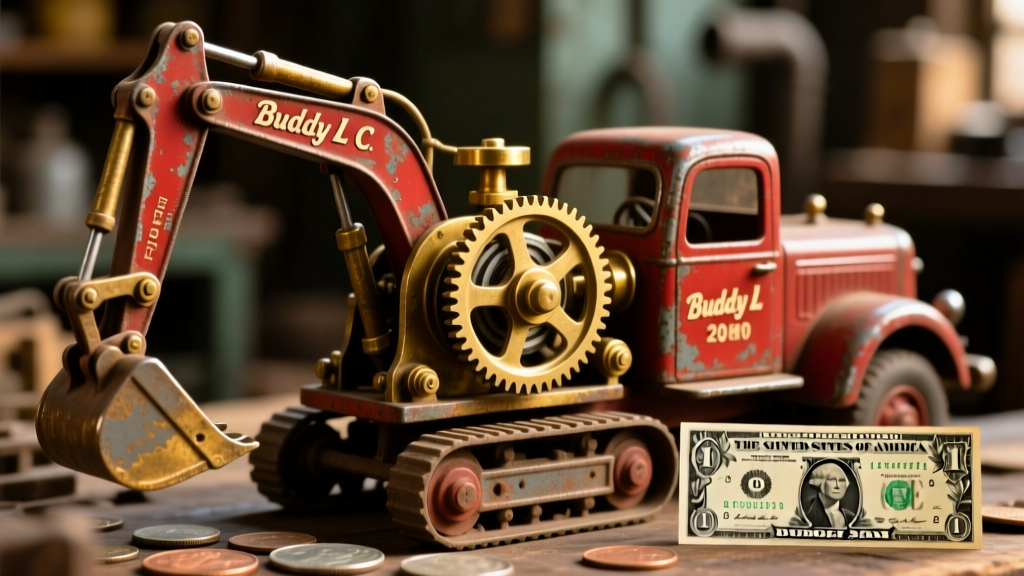
Toy Truck Excavator: Pressed Steel Clockwork Winch Buddy L.C. 1940, 20-Inch Vintage Heavy-Duty Construction Vehicle

Colonial Homestead Cup and Saucer: History, Identification, and Market Value of a Mid-Century American Dinnerware Icon