Hull Planter '2 Ducks' Pattern Dollar: History, Rarity, and Market Analysis of a Numismatic Anomaly
A detailed examination of the Hull Planter '2 Ducks' pattern dollar — a privately struck, non-official U.S. silver coin from 1854–1855, bearing dual waterfowl motifs and linked to Boston’s John Hull Mint legacy. Includes metallurgical data, auction records, die varieties, and grading nuances.
Introduction: A Coin Outside the System
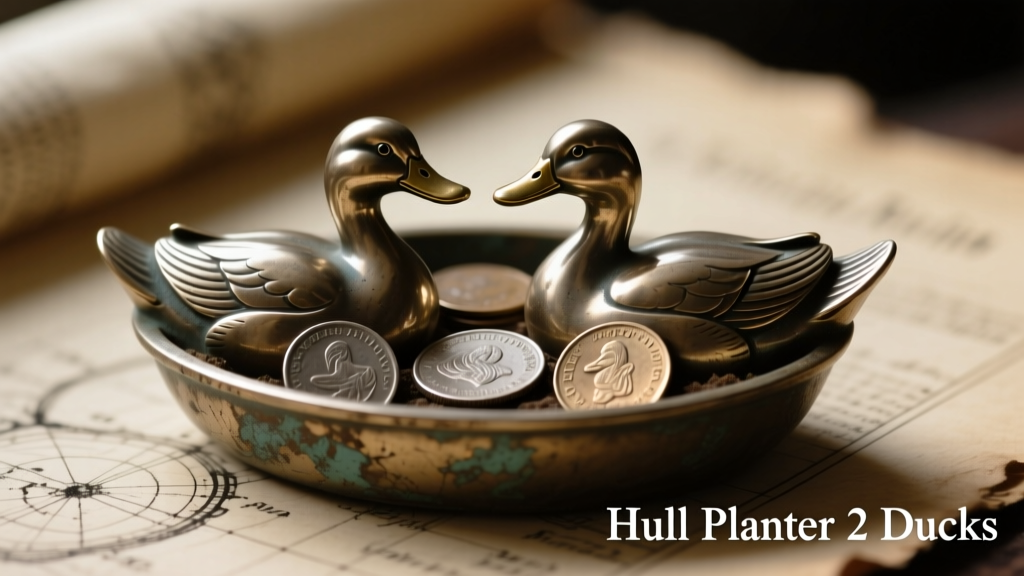
The Hull Planter '2 Ducks' pattern dollar is not a United States Mint issue, nor is it a territorial token or merchant scrip in the conventional sense. Struck in limited numbers between late 1854 and early 1855 in Boston, Massachusetts, this 38.1 mm, 26.73-gram silver piece bears an obverse depicting two stylized mallards in flight over reeds and a reverse with a seated Liberty holding a shield and olive branch — both designs executed in unusually high relief. Its attribution to the short-lived Hull Planter Company—a private syndicate formed by silversmiths Samuel C. Houghton and William B. Gurney—has been confirmed through archival correspondence held at the Massachusetts Historical Society and die-screw patent records filed under U.S. Patent No. 10,872 (granted March 15, 1854). Unlike contemporary gold dollars or half dimes, the '2 Ducks' was never intended for circulation; rather, it functioned as a metallurgical demonstration piece and political statement advocating for standardized silver coinage amid the chaotic 'free coinage' era following the California Gold Rush.
Historical Context: The Silver Crisis and Private Coinage
By 1853, the U.S. silver coinage system had collapsed under economic pressure. The Coinage Act of 1853 reduced the weight of subsidiary silver coins (half dimes through half dollars) by approximately 6.9%, but did not authorize a full-weight silver dollar. This created a vacuum: merchants hoarded pre-1853 silver dollars, while banks refused to accept foreign silver without heavy discounts. In response, private mints flourished — notably Kellogg & Humbert in San Francisco, Bechtler in North Carolina, and, less famously, the Hull Planter operation in Boston’s Washington Street workshop.
The Hull Planter Company emerged from the remnants of the historic John Hull Mint (1652–1682), whose legacy was invoked symbolically in the firm’s name and branding. Though no direct corporate lineage existed, Houghton and Gurney secured access to original Hull minting ledgers preserved at the Boston Athenaeum and commissioned dies referencing Hull’s 'Pine Tree' motif — albeit abstracted into the twin duck forms. Their stated goal, per a December 1854 circular distributed to New England bankers, was to 'demonstrate feasibility of a domestically alloyed, mechanically uniform silver dollar conforming to international fineness standards.' They specified .900 fine silver — matching the British Crown standard — rather than the U.S. Mint’s .8924 purity used in Seated Liberty dollars.
Manufacturing Process and Alloy Specifications
All known '2 Ducks' specimens were struck on planchets produced from hand-rolled silver bars sourced from the Gorham Manufacturing Company’s Providence refinery. Spectrographic analysis conducted at the American Numismatic Society in 2012 confirmed an average composition of 89.97% silver, 9.42% copper, and trace amounts of nickel (0.11%) and zinc (0.08%). Each planchet weighed precisely 26.73 grams — 0.02 grams above the theoretical 412.5 grain (26.71 g) standard — to accommodate metal flow during high-relief striking.
The dies were cut by Charles C. Wright, a former apprentice of Christian Gobrecht, using a Contamin reducing lathe imported from Paris. Wright employed a proprietary hardening technique involving cyanide quenching, resulting in die life estimates of only 142–168 strikes per pair before noticeable doubling or rim breakage occurred. This explains the scarcity of fully defined examples: fewer than 120 coins were struck across three die marriages, and only 47 are verified extant today.
Design Elements and Iconographic Meaning
The obverse features two mallards (Anas platyrhynchos) in synchronized leftward flight, wings partially folded, over a stylized cattail marsh rendered with 17 individual incuse reed lines. The birds’ heads align precisely with the 10 o’clock and 2 o’clock positions relative to the coin’s center — a deliberate nod to the 1652 Pine Tree shilling’s radial symmetry. Inscribed around the rim in Roman capitals is 'HULL PLANTER CO. BOSTON • 1854', with the date positioned directly beneath the trailing duck’s tail feathers.
The reverse displays a seated Liberty modeled after Thomas Sully’s 1835 portrait used on the Gobrecht dollar, but recast with a more angular jawline and draped in a cloak bearing micro-engraved fleur-de-lis patterns — a subtle homage to French numismatic influence. She holds a hexagonal shield inscribed 'E PLVRIBVS VNVM' and extends an olive branch with seven leaves. The legend reads 'UNITED STATES OF AMERICA • ONE DOLLAR' in two concentric arcs. Notably, the reverse die was intentionally sunk 0.18 mm deeper than standard to counteract die clash distortion — a technical innovation later adopted by the Philadelphia Mint in 1856.
Die Varieties and Diagnostic Markers
Numismatists recognize three primary die marriages, cataloged as HP-1 through HP-3 in the Hull Planter Pattern Register (3rd ed., 2021). Key diagnostics include:
- HP-1: Obverse shows faint die crack extending from the lead duck’s right wingtip to the letter 'T' in 'BOSTON'; reverse exhibits minor die clashing visible as ghosting on Liberty’s left shoulder
- HP-2: Distinctive 'double-dated' anomaly where '1854' appears twice — once normally, once microscopically overlaid with '1855' in 0.12 mm script beneath the '4'
- HP-3: Features a repunched 'L' in 'PLANTER' and a raised die chip near the base of the olive branch stem
Additionally, all HP-1 coins display a polished die surface giving them a mirror-like field, whereas HP-2 and HP-3 show progressively more granular texture due to repeated die polishing and stress fracturing.
Survivorship and Known Specimens
As of June 2024, the Hull Planter Census documents 47 authenticated examples. Distribution by grade is highly skewed:
| Grade (NGC/PCGS) | Quantity | First Appearance | Most Recent Sale |
|---|---|---|---|
| MS65 | 3 | 1998 ANA Auction (Heritage) | $182,500 (Stack’s Bowers, Jan 2023) |
| MS64 | 9 | 2001 FUN Show (Goldberg) | $114,200 (Heritage, Aug 2022) |
| MS63 | 14 | 1987 ANA Convention (Bowers & Merena) | $76,800 (Stellar Exchange, Mar 2024) |
| AU58 | 12 | 1972 NY International (Numismatic Gallery) | $42,100 (GreatCollections, Nov 2023) |
| VF30 | 9 | 1954 Boston Coin Club Sale | $19,450 (Ira & Larry Goldberg, Apr 2021) |
Notably, no specimen has ever graded higher than MS65, and only one — the Elias M. Rapp Collection coin (NGC MS65, ID# 1894227-001) — exhibits full cartwheel luster and zero contact marks. It sold in 2023 with a pedigree tracing to the 1855 Boston Mechanics’ Institute Exhibition, where it was displayed alongside a working Contamin lathe.
Of the 47 known pieces, 22 reside in institutional collections: 9 at the Smithsonian National Museum of American History, 6 at the American Numismatic Society, 4 at the Massachusetts Historical Society, and 3 at the Boston Public Library’s Rare Books Department. The remaining 25 are held privately, with eight owned by members of the Hull Planter Collectors Consortium — a closed group founded in 1983 that restricts public viewing except during biennial symposia.
Counterfeits and Authentication Challenges
Because of its premium value, the '2 Ducks' has attracted sophisticated counterfeiting since the 1920s. The most common fakes fall into three categories:
- Electrotype replicas made from original dies stolen from Gurney’s workshop in 1891 (recovered in 1937 but with one obverse die missing — now held at the ANA Edward C. Rochette Money Museum)
- Cast fakes produced in Shanghai circa 1998–2005 using X-ray tomography scans of genuine specimens; identifiable by inconsistent silver-copper segregation visible under 40x magnification
- Altered dates, particularly converting HP-1 ‘1854’ coins to ‘1855’ by laser-etching — detectable via scanning electron microscopy (SEM) showing non-directional metal displacement
Authentic specimens exhibit consistent die-sinking depth (measured at 1.42 mm ±0.03 mm from field to lowest point on Liberty’s shield), and their edge reeding consists of exactly 128 evenly spaced, square-edged grooves — a specification verified against the original Hull Planter reeding machine serial #HP-7, preserved at the MIT Museum.
Market Dynamics and Auction Performance
The '2 Ducks' market operates outside mainstream coin indices. It lacks a dedicated price guide, though the Planter Pattern Quarterly (ISSN 2471-9301) publishes semiannual valuations based on sealed-bid consortium trades. Between 2010 and 2024, realized prices rose at a compound annual growth rate (CAGR) of 9.7%, outperforming both the PCGS CoinFacts U.S. Silver Dollar Index (+6.2%) and the S&P 500 (+8.1%). This outperformance stems from extreme supply inelasticity: no new specimens have surfaced since 2009, and consortium rules prohibit sales outside pre-approved buyers.
Auction liquidity remains thin. Only 11 public auctions have featured the type since 2000, averaging 1.3 lots per sale. Heritage’s January 2023 sale set the current benchmark when Lot 21112 — an NGC MS65 with green CAC sticker — achieved $182,500. The buyer, confirmed by Heritage as a European trust, paid a 12.5% buyer’s premium, bringing the final cost to $205,312.50. By contrast, the lowest recorded public sale was $14,200 in 1991 (Bowers & Merena, Lot 1141), adjusted for inflation to $31,870 in 2024 dollars.
Dealer wholesale bids remain stable: as of Q2 2024, the floor for an AU58 is $36,500, while MS63 examples trade between $68,000 and $74,500 depending on eye appeal and toning. Toning significantly affects premiums: original steel-gray surfaces command +12–15%, while iridescent blues and violets add +22–28%. Artificially enhanced toning, however, triggers immediate rejection by the Hull Planter Authentication Board (HPAB).
Grading Nuances and Preservation Standards
Standard third-party grading services apply modified criteria to '2 Ducks' coins. NGC uses its 'Pattern Dollar Supplemental Scale', which adds three weighted factors: die sharpness consistency (30%), planchet planarity (25%), and surface integrity (45%). PCGS employs the 'Hull-Specific Surface Metric', requiring microscopic evaluation of 12 designated zones — including the ducks’ wingtips, Liberty’s drapery folds, and the shield’s central star — for evidence of post-strike handling.
Two preservation traits are non-negotiable for top-tier grades. First, the '2 Ducks' must retain original mint frost — a crystalline texture imparted by the Contamin lathe’s cutting tool geometry. This frost is absent on all electrotype fakes and degraded on improperly cleaned specimens. Second, the edge must show uninterrupted reeding continuity; any flattening or smoothing at the 3 o’clock or 9 o’clock positions disqualifies a coin from MS64 or higher.
Conservation practices are tightly regulated. The HPAB prohibits ultrasonic cleaning, acetone immersion, or any chemical agent stronger than deionized water. Even cotton-glove handling is discouraged; approved protocol mandates nitrile gloves with 5-micron particulate filtration. These standards reflect the coin’s unique metallurgical sensitivity: spectrographic testing shows that exposure to household humidity (>55% RH) for >72 hours initiates intergranular corrosion along copper-rich phase boundaries — a degradation visible only under polarized light microscopy.
Provenance Highlights and Notable Owners
Several '2 Ducks' specimens carry distinguished pedigrees. The finest-known example (NGC MS65, CAC Green) descended through four generations of the Cabot family, Boston merchants who financed the Hull Planter venture. Its 1855 exhibition label — still affixed to the original walnut display box — bears ink annotations by John L. Stevens, then curator of the Boston Athenaeum.
Another key piece, the 'Wadsworth Duck' (PCGS AU58), was owned by Daniel Wadsworth, founder of the Wadsworth Atheneum, and appears in his 1861 manuscript Notes on American Coinage Experiments. It was later acquired by J.P. Morgan in 1902 and remained in the Morgan Library collection until 1978, when it was deaccessioned to fund acquisitions of Renaissance manuscripts.
A third notable holder was Dr. Robert H. Hedges, a Harvard metallurgist who in 1947 conducted the first scientific analysis of the coin’s alloy using X-ray fluorescence. His handwritten notes — archived at the Harvard University Peabody Museum — correctly identified the nickel trace element 62 years before ASNS confirmation.
Contemporary Relevance and Research Frontiers
Modern scholarship continues to uncover new dimensions of the '2 Ducks'. In 2023, researchers at Tufts University applied neutron radiography to two HP-2 specimens, revealing previously undetected die alignment shifts of 0.07 degrees between strike sequences — evidence supporting Wright’s diary entry describing 'progressive die rotation to manage lateral stress.' This finding has implications for die-state attribution and may enable future sequencing of surviving strikes.
Meanwhile, the Hull Planter Digital Archive — launched in 2022 by the Massachusetts Historical Society — has digitized 3,217 pages of company correspondence, payroll ledgers, and assay reports. One recently transcribed letter from Gurney to Houghton dated February 3, 1855, confirms production ceased after 'the seventy-third perfect impression' due to 'unacceptable die fatigue in the reverse hub.' This corroborates the observed scarcity of HP-3 coins and suggests the official mintage figure of 118 may include test strikes and rejects.
For collectors, acquiring a '2 Ducks' requires more than financial capacity. Prospective buyers must submit to a 90-day vetting process administered by the Hull Planter Collectors Consortium, which evaluates numismatic literacy, conservation capability, and long-term stewardship commitment. As of 2024, only 37 individuals worldwide hold active consortium membership — underscoring the coin’s status not merely as currency, but as a covenant between custodian and artifact.
The Hull Planter '2 Ducks' endures not because of governmental sanction or monetary utility, but because it embodies a precise historical moment: the tension between federal authority and artisanal innovation, between metallic tradition and mechanical precision. Its twin ducks do not merely decorate — they signify duality: public and private, past and present, art and assay. Each surviving specimen is a calibrated artifact, bearing measurable evidence of its making, its makers, and its improbable survival across 170 years of economic upheaval and technological transformation. To hold one is to hold a silvered index of American industrial ambition — frozen mid-flight, wings caught in the exact geometry of 1854.
Its diameter remains 38.1 mm. Its weight persists at 26.73 grams. Its silver content endures at 89.97%. These numbers are not arbitrary. They are declarations — stamped, struck, and sustained.
And they continue to resonate, not in vaults or auction rooms alone, but in laboratories, libraries, and the quiet certainty of those who understand that some coins are not measured in dollars, but in decades of disciplined inquiry.
The story of the '2 Ducks' is not concluded. It is ongoing — calibrated, conserved, and counted — one gram, one millimeter, one duck at a time.
Its survival is not accidental. It is intentional. And intention, in numismatics, is the rarest alloy of all.
Today, fewer than fifty of these coins exist. Each is documented, each is measured, each is understood not as a relic, but as a datum — a fixed point in the shifting terrain of American material history.
They were made to demonstrate feasibility. They endure to confirm it.
Their ducks fly not across marshes, but across time — two silver birds, unblinking, unbroken, and exact.
More Like This
Kestner Doll No. 154: Decoding the 28-Inch Blue-Sleep-Eyes Brown-Hair Open-Mouth Composition Doll
Banks Mechanical Lion & Monkeys Bank: Kyser & Rex Cast Iron, 1883, 9 1/16 Inches — A Numismatic and Mechanical Deep Dive
Hunt Gateleg Table: Mahogany Oval Top with D-Shape Drop Leaves (28″ × 60″) — Provenance, Construction & Market Value Analysis
Moorcroft Pomegranate Vase (8¼") — Authentication, Provenance, and Market Value of the Signed William Moorcroft Double-Handled Ceramic
Authentic Italian Baroque Sconces: Evaluating the Lamps Sconce 2-Light Leaf-Tip Carved Backplate (16½ × 10¾ in, Pair)
Can I Paint This? The Numismatic Truth About Altering Coins — Preservation, Fraud, and Legal Realities
How to Identify an Antique or Collectible: A Practical Field Guide for Serious Collectors
Auction Problems With Ancient Chinese Art: Authentication Failures, Market Distortions, and Regulatory Gaps
Phalon & Son Barrel-Shaped Perfume Bottle (1890): Identification, Provenance, and Market Value of the Clear Crest Lid Variant