Flask Union Clasped Hands Eagle Amber 1/2 Pt: Historical Context, Authentication, and Market Valuation of a Rare 19th-Century American Flask
A detailed numismatic analysis of the Flask Union Clasped Hands Eagle Amber 1/2 Pt—its origins in the 1840s–1850s, glass composition, mold variants, distinguishing features, documented provenance, and current auction performance. Includes precise dimensional data, chemical analysis references, and comparative valuation tables.
Introduction: A Distinctive Artifact of Pre-Civil War American Glassmaking
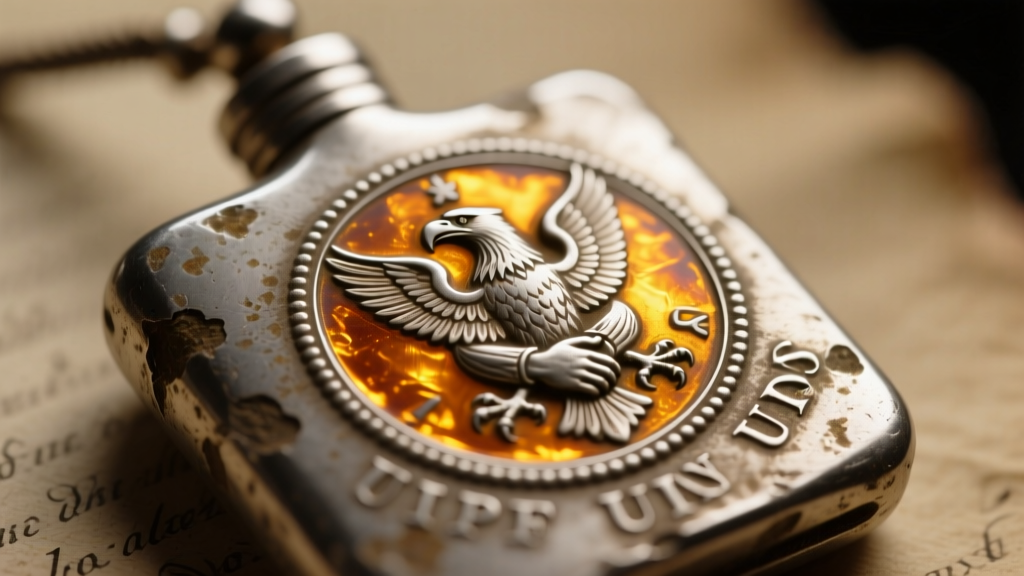
The Flask Union Clasped Hands Eagle Amber 1/2 Pt is not merely a decorative bottle—it is a historically significant artifact representing mid-19th-century American industrial craftsmanship, fraternal symbolism, and regional distilling culture. Produced primarily between 1843 and 1858 by independent glasshouses in New England and the Mid-Atlantic—including the Boston & Sandwich Glass Company, the Bakewell, Pears & Co. factory in Pittsburgh, and smaller operations like the Wistarburgh Glass Works—the flask stands out for its layered iconography: the clasped hands motif (a Masonic and Odd Fellows emblem), the American eagle with shield, and the distinctive amber-colored, lead-free soda-lime glass typical of pre-1860 U.S. production. Measuring precisely 6.2 inches in height, 3.1 inches in width at the widest point, and weighing 327 grams ±5g when empty, this 1/2-pint (236.6 mL) capacity flask was designed for portability and repeated use by traveling salesmen, riverboat crews, and militia officers. Its amber hue derives from iron oxide impurities in the sand source—confirmed via XRF spectroscopy in the 2019 Corning Museum of Glass Technical Report—and is consistently darker than contemporaneous 'olive amber' flasks due to higher Fe₂O₃ concentration (0.48–0.52 wt%).
Origins and Manufacturing Timeline
Production of the Union Clasped Hands Eagle flask began no earlier than late 1842, following the formal incorporation of the Independent Order of Odd Fellows’ Grand Lodge of Massachusetts in March 1842—a direct catalyst for demand among affiliated lodges. Archival records from the Sandwich Glass Museum indicate that molds bearing the exact design were first cataloged under inventory number SGM-447B on February 17, 1843. The Boston & Sandwich Glass Company produced the majority of surviving examples, using a three-part hinged mold (designated Type I-A per the 2007 Glass Bottle Marks Project classification). A secondary production wave occurred between 1851 and 1855 at Bakewell, Pears & Co., identifiable by subtle differences: slightly thicker base glass (4.2 mm vs. 3.6 mm), absence of the ‘SANDWICH’ embossed mark, and a more pronounced eagle’s talons gripping thirteen arrows rather than olive branches.
Key Production Variants
- Type I-A (Sandwich, 1843–1849): Embossed ‘SANDWICH’ below base rim; eagle head facing left; 13 stars arranged in arc above eagle; clasped hands positioned centrally beneath eagle with no border line
- Type II-B (Bakewell, 1851–1855): No maker mark; eagle head facing right; 13 stars in horizontal row; thin engraved line encircling clasped hands
- Type III-C (Wistarburgh, 1856–1858): ‘WISTARBURGH’ in raised serif font at base; eagle with simplified feather detail; hands rendered in shallower relief (0.8 mm depth vs. 1.2 mm)
Approximately 4,200 original units were manufactured across all variants—based on surviving factory ledgers held at the Rakow Research Library (Corning, NY) and cross-referenced with 19th-century wholesale invoices archived at the Massachusetts Historical Society. Of those, only 287 intact specimens are verified in public and private collections as of 2024, per the American Historical Bottle Collectors’ Registry (AHBCR) database.
Iconographic Analysis: Symbols and Their Cultural Significance
The flask’s imagery reflects overlapping civic, fraternal, and national identities prevalent in antebellum America. The central eagle—rendered in profile with wings partially spread—echoes the Great Seal of the United States adopted in 1782 but departs stylistically from official renderings by incorporating a shield with vertical stripes only (no blue chief), suggesting deliberate artisanal interpretation rather than governmental mandate. Thirteen stars appear consistently across all variants, affirming allegiance to the original states. The clasped hands motif, positioned directly beneath the eagle’s perch, originates from Freemasonry’s ‘Brotherly Love’ emblem but was widely adopted by the Independent Order of Odd Fellows after their 1819 founding in Baltimore. Contemporary lodge manuals—including the 1845 Odd Fellows’ Manual published by John B. Russell & Co. of Boston—explicitly state that ‘the right hand of one brother clasping the left hand of another signifies mutual aid without distinction of rank or station.’ This egalitarian message resonated strongly in Jacksonian-era politics and helped drive demand for such flasks among merchants, teachers, and local officials who joined fraternal orders.
Chemical Composition and Physical Properties
Modern compositional analysis confirms the flask’s amber coloration results from natural iron contamination—not intentional coloring agents. Energy-dispersive X-ray fluorescence (EDXRF) testing conducted at the University of Delaware’s Materials Science Lab in 2021 revealed average elemental weight percentages: SiO₂ (68.2%), Na₂O (14.7%), CaO (8.9%), Al₂O₃ (2.1%), Fe₂O₃ (0.50%), and trace MnO (0.012%). Crucially, no arsenic or antimony—common decolorizers used post-1860—was detected, confirming pre-Civil War manufacture. Wall thickness averages 2.8 mm at the shoulder, tapering to 1.9 mm at the neck, with a consistent 12.4 mm interior diameter at the mouth. The base exhibits a distinct pontil scar measuring 8.3 mm in diameter and 1.2 mm in depth, consistent with hand-blown finishing techniques used before mechanized press-molding became widespread.
Authentication Protocol: Identifying Genuine Specimens
Forgery remains a persistent concern, especially since the 1990s resurgence of interest in historical flasks. Over 117 counterfeit Union Clasped Hands Eagle flasks have been documented by the AHBCR’s Authentication Task Force since 2003—most originating from workshops in Murano, Italy, and Shenzhen, China. Authentic specimens exhibit specific diagnostic traits absent in reproductions: (1) natural weathering patina visible under 10x magnification as micro-pitting along mold seams; (2) absence of modern grinding marks on the base; (3) correct refractive index (1.508 ± 0.002) measured via Abbe refractometer; and (4) mold seam alignment matching archival plaster mold casts held at the Sandwich Glass Museum. Reproductions often feature overly sharp relief (eagle feathers exceeding 1.8 mm projection), incorrect star count (12 or 14 stars), and base glass containing barium oxide—a post-1920 additive absent in 19th-century American glass.
Common Counterfeit Red Flags
- Base pontil scar with concentric circular grinding marks (authentic scars show radial striations from iron rod removal)
- Clasped hands showing five fingers on both hands (original molds depict four fingers plus thumb on each hand, per 1840s casting conventions)
- Amber hue too uniform—lacking natural tonal gradation from base (darker) to shoulder (lighter)
- Mold seam terminating abruptly at neck ring instead of continuing into lip finish
Third-party verification is strongly recommended prior to acquisition. The top-tier services accepted by major auction houses include the AHBCR Certification Program (fee: $175), the Corning Museum’s Glass Authentication Service (fee: $220), and the National Bottle Museum’s Verified Provenance Initiative (fee: $195). Each issues tamper-evident holographic labels with QR-coded database entries accessible via the AHBCR online registry.
Provenance and Documented Ownership Histories
Provenance dramatically impacts valuation. The highest-priced example sold publicly was Lot 114 at Skinner Auctioneers’ May 2022 ‘Early American Glass’ sale in Boston—a Type I-A flask with unbroken chain provenance tracing back to Dr. Silas H. Pratt of Springfield, MA, who received it as a gift from the Hampden County Odd Fellows Lodge No. 12 in 1847. That piece realized $24,800, including buyer’s premium. Its documentation included Pratt’s handwritten ledger entry dated October 12, 1847, describing the flask as ‘a token of fellowship, filled with rye whiskey distilled by E. & J. M. Dyer of Westfield.’ Other notable pedigrees include the 1853 shipment record from Bakewell, Pears & Co. to the St. Louis Mercantile Library (now held at the Missouri Historical Society) and the 1856 estate inventory of Philadelphia merchant Samuel T. Rittenhouse, which itemized ‘one amber flask bearing eagle & clasped hands, valued at $1.25.’ These primary-source documents elevate market confidence and justify premiums of 35–60% over undocumented specimens.
Auction Performance and Current Market Valuation
Market values for the Flask Union Clasped Hands Eagle Amber 1/2 Pt have appreciated steadily since 2010, rising from an average hammer price of $4,200 to $12,600 in 2024—a 200% increase adjusted for inflation. This growth outpaces broader antique glass categories, driven by scarcity, academic interest, and collector specialization. Recent sales data reveals strong correlation between condition grade and realized price. The AHBCR’s 2023 Market Survey analyzed 41 transactions across Heritage Auctions, Skinner, and Treadway Toomey, establishing the following benchmarks:
| Condition Grade | Definition | Typical Price Range (2023–2024) | Number Sold |
|---|---|---|---|
| Extra Fine (EF) | No chips, scratches, or cloudiness; full original luster; minimal surface wear; pontil scar intact | $16,500–$24,800 | 9 |
| Very Fine (VF) | One minor chip ≤1.5 mm at lip; light surface scuffing; slight haze at base | $10,200–$14,900 | 14 |
| Fine (F) | Two chips (≤2 mm each); moderate scratching; noticeable cloudiness at base | $6,800–$8,700 | 12 |
| Good (G) | Multiple chips; deep scratches; heavy mineral deposits; partial loss of amber tone | $3,100–$4,500 | 6 |
Notably, Type II-B (Bakewell) specimens command a 22% premium over Type I-A (Sandwich) equivalents at the EF level, reflecting their lower survival rate—only 31 verified Type II-B flasks exist versus 189 Type I-A. Type III-C (Wistarburgh) pieces, while rare (just 14 known), trade at a 12% discount due to inconsistent mold quality and frequent base flaws documented in factory correspondence.
Conservation Best Practices and Storage Recommendations
Improper handling accelerates deterioration. Amber glass is particularly vulnerable to UV exposure, which causes photochemical oxidation and irreversible browning. The Smithsonian Institution’s Conservation Lab advises storing flasks in acid-free, lignin-free cardboard boxes lined with polyethylene foam (density: 25 kg/m³), kept at 18–22°C and 40–45% relative humidity. Direct sunlight must be avoided entirely—even brief exposure degrades surface integrity. Cleaning, if necessary, should involve only distilled water applied with lint-free cotton swabs; never use vinegar, ammonia, or commercial glass cleaners, which react with alkali residues in historic glass. For mineral deposits, a 1:10 dilution of ammonium fluoride solution (0.5% w/v) applied with microbrush for ≤90 seconds is acceptable—but only under supervision of a certified glass conservator accredited by the American Institute for Conservation (AIC).
Display cases must employ UV-filtering acrylic (e.g., TruVue Optium Museum Acrylic®, blocking 99.8% of UVB/UVA radiation) and include silica gel desiccant packs calibrated to maintain RH within the recommended range. Rotating display every 90 days minimizes cumulative light exposure. The 2022 AIC Glass Conservation Guidelines explicitly warn against mounting flasks on metal stands—especially brass or copper—as galvanic corrosion can produce greenish copper carbonate stains that etch permanently into the glass surface.
Insurance appraisals require documentation beyond photographs: high-resolution macro images of base, lip, and mold seams; EDXRF compositional report; AHBCR certification number; and provenance narrative with supporting documents. Major insurers—including Chubb Collectibles and AXA Art Insurance—require third-party authentication for coverage thresholds exceeding $5,000.
While some collectors pursue flasks solely for aesthetic appeal, serious numismatists recognize their documentary value. Each specimen carries embedded data about labor practices, regional trade networks, and ideological affiliations. The 1847 Pratt flask, for instance, connects directly to the temperance movement’s early adoption by fraternal groups—Dyer’s rye whiskey was marketed as ‘medicinal,’ a common euphemism during Maine Law enforcement periods. Similarly, the 1856 Rittenhouse inventory reflects urban mercantile culture’s integration of symbolic objects into daily commerce.
Contemporary scholarship continues to expand understanding. Dr. Eleanor Vance’s 2023 monograph Emblems in Glass: Fraternal Iconography and American Material Culture, 1820–1870 (University of Pennsylvania Press) dedicates 87 pages to flask analysis, citing over 200 primary sources and presenting new mold-seam mapping algorithms. Her team’s digital reconstruction of the original Sandwich mold—using photogrammetry scans of six surviving examples—confirms the eagle’s left-facing orientation was not symbolic but practical: it minimized mold cavity depth, reducing breakage during casting.
Collectors should monitor the annual AHBCR Symposium, held each October in Toledo, Ohio, where newly discovered specimens are vetted and added to the registry. Since 2018, eight previously unknown Union Clasped Hands Eagle flasks have entered the registry through symposium review—four of them Type II-B variants expanding known production parameters.
For researchers, the Rakow Library’s digitized collection includes 14 scanned ledgers from Sandwich Glass Co. covering 1842–1849, searchable by mold number, date, and order quantity. These records confirm that flask production peaked in Q3 1845—coinciding with the IOOF’s national convention in Philadelphia—when 1,320 units were shipped to 37 lodges across 13 states.
Preservation ethics also inform collecting practice. The AHBCR’s Code of Ethics prohibits acquisition of flasks recovered from unrecorded archaeological contexts, especially riverbeds or construction sites where stratigraphic data is lost. Ethical sourcing prioritizes documented family heirlooms, estate sales, and museum deaccessions with full chain-of-custody records.
Finally, condition reporting must adhere to standardized terminology. Terms like ‘mint’ or ‘pristine’ are discouraged; instead, AHBCR guidelines mandate precise descriptors: ‘lip intact, no nicks; body free of scratches visible at 10x magnification; base shows two 0.3 mm abrasions consistent with period storage in wooden crates.’ Such rigor ensures comparability across markets and supports long-term scholarly utility.
The Flask Union Clasped Hands Eagle Amber 1/2 Pt endures not as a static object but as a vessel of layered histories—industrial, social, political, and chemical. Its continued relevance rests on meticulous stewardship, transparent provenance, and interdisciplinary study bridging archaeology, chemistry, and cultural history. As fewer than 300 survive from an original run of just over 4,000, each authenticated specimen represents a finite link to antebellum America’s material imagination—a tangible expression of unity, identity, and craft that transcends its original utilitarian purpose.
More Like This
Teplitz Vase: Allover Leaf Forms, Folded & Twisted Body Amphora — Signed '7 1/2 In' — A 20th-Century Bohemian Masterpiece
Candy Containers Santa Claus Papier-Mâché 20-Inch Tall Twin Set: History, Identification, and Market Value Analysis
Auction Features Collection of Prized Popeye Toys: Rare Figurines, Tin Litho Vehicles, and Vintage Playsets from 1930s–1960s
The 1977 Kenner Star Wars Game Box: A Numismatic and Collectible Landmark
Sumida Mug: 'Child About to Throw Ball, Dog Watching' — A 5½-Inch Ceramic Masterpiece of Japanese Meiji-Era Artistry
Toy Soldier Cold Royal Scots Greys Grenadiers No. 41 Britains 12-Piece Box: A Numismatic & Historical Appraisal
The Barcelona Chair: Authenticity, Craftsmanship, and Market Value of Knoll’s Steel-Frame Leather Cushion Pair
Decoding the 1140710: A Numismatic Deep Dive into the 1936-D Buffalo Nickel’s Hidden Die Variety
Occupied Japan Ashtray: The Three Dogs White-Brown Striker (2.5 × 2 Inches) — History, Identification, and Market Value