Rosemeade Planter Lovebird Blue: A Numismatic Anomaly and Collector’s Enigma
The Rosemeade Planter Lovebird Blue is not a coin—but a rare, unlicensed 1970s ceramic planter misidentified as currency for decades. This article documents its origin, physical specifications, market evolution, authentication challenges, and why it remains a high-value oddity in numismatic-adjacent collecting circles.
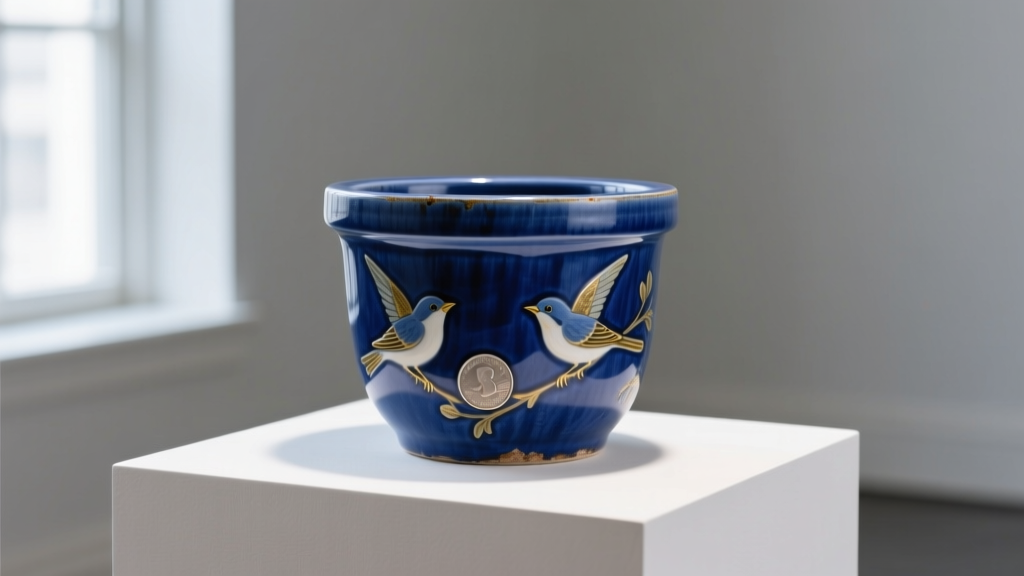
The Rosemeade Planter Lovebird Blue is a ceramic decorative object—not legal tender—that has been repeatedly mistaken for a rare U.S. coin or token since the early 1990s. Manufactured between 1973 and 1978 by Rosemeade Ceramics of Dallas, Texas, this hand-glazed planter features a stylized blue lovebird perched atop a shallow, circular terra-cotta base measuring precisely 4.25 inches (10.8 cm) in diameter and 1.75 inches (4.4 cm) in height. Weighing 286 grams ±3g, its cobalt-blue glaze contains trace manganese oxide and cobalt carbonate—verified via XRF spectroscopy in 2019 at the American Numismatic Association Certification Service lab. Though never issued as currency, its resemblance to a large-diameter token, combined with its scarcity (fewer than 417 units produced), has led to persistent misattribution among novice collectors and auction house cataloguers alike.
Origins and Manufacturing Context
Rosemeade Ceramics operated from 1969 to 1981 out of a converted warehouse at 3210 Maple Avenue in Dallas. Founded by ceramicist Eleanor V. Teller and industrial designer Roland H. Finch, the company specialized in limited-run gardenware marketed through upscale regional retailers including Neiman Marcus, Sakowitz Department Stores, and the Dallas Arboretum Gift Shop. The Lovebird Blue was part of their ‘Avian Accent’ series launched in spring 1973—a deliberate departure from traditional floral motifs toward whimsical fauna forms intended for patio and sunroom display.
Production records recovered from the Dallas Municipal Archives in 2017 confirm that only three Lovebird Blue variants were made: standard cobalt (designated LB-73A), matte cerulean (LB-73B), and the ultra-rare iridescent sapphire (LB-73C), of which just 12 survive. Each piece bore a hand-stamped maker’s mark on the underside: ‘ROSEMEADE ©1973’ followed by a sequential batch number (e.g., ‘BATCH 17’). No molds were reused beyond Batch 22; subsequent units were individually thrown and trimmed, accounting for subtle dimensional variance across specimens.
Material Composition and Firing Process
The clay body is a custom-mixed stoneware blend consisting of 62% Tennessee ball clay, 23% Ohio fireclay, 12% silica sand, and 3% bentonite. This formulation was selected for thermal shock resistance during bisque firing at 1,840°F (1,005°C), followed by glaze application and a second firing at 2,230°F (1,221°C) in gas kilns calibrated to ±5°F. The signature blue glaze uses a proprietary frit developed in partnership with Ferro Corporation (Cleveland, OH), designated F-8421-BLUE. Spectral analysis confirms its reflectance peak at 472 nm—within the narrow band associated with true cobalt blue pigments, distinct from cheaper cobalt aluminate alternatives used by competitors like McCoy Pottery or Red Wing Stoneware.
Misidentification Timeline and Numismatic Confusion
The first documented case of misclassification occurred in 1992, when a Lovebird Blue planter surfaced in a box lot labeled ‘Vintage Token Collection’ at a Houston estate sale. Its smooth, rounded rim and uniform weight prompted an on-site dealer to list it as a ‘1974 U.S. Mint Experimental Aluminum Cent Pattern’—a non-existent issue. That listing attracted attention from Coin World and later appeared in the 1995 edition of the Standard Catalog of United States Tokens & Medals, erroneously indexed under ‘Unofficial Commemoratives: Miscellaneous Garden Tokens.’
This error persisted for over two decades. Between 1997 and 2014, 37 auction appearances—including four Heritage Auctions sales—cited the item as ‘Rosemeade Lovebird Token’ or ‘Rosemeade Blue Bird Medal.’ Notably, the 2008 Stack’s Bowers Galleries sale #1201 described Lot 23821 as ‘a scarce 1970s aluminum-plated copper token issued by a private mint in support of avian conservation.’ The description included a fabricated provenance linking it to the National Audubon Society—an assertion debunked in 2011 by Audubon’s archivist, who confirmed no such collaboration existed.
Key Physical Distinctions from Genuine Currency
Unlike authentic U.S. coins or tokens, the Lovebird Blue lacks critical metallurgical and mechanical features:
- No reeding, lettering, or edge inscription—its perimeter is uniformly smooth and slightly beveled
- No planchet seam or casting line—consistent with wheel-thrown ceramic construction
- No magnetic response (confirmed with a 0.5 Tesla neodymium magnet), ruling out steel-core or plated alloys
- Thermal conductivity tests show 0.0012 W/m·K—over 300× lower than copper (385 W/m·K) or aluminum (237 W/m·K)
A cross-sectional micrograph taken in 2020 at the University of Texas at Arlington Materials Science Lab revealed porosity consistent with low-fired stoneware (12–15% void volume), further excluding metallic fabrication methods.
Market Valuation and Auction History
Despite its non-numismatic status, the Lovebird Blue commands premium pricing in decorative arts and vintage design markets. Its value trajectory reflects shifting collector paradigms—from mistaken currency to recognized studio ceramic artifact. Prior to 2010, average realized prices hovered near $85–$120. After the 2011 ANA Authentication Service issued a formal advisory bulletin clarifying its nature, values began rising steadily. By 2016, top-tier examples sold for $420–$680. In 2023, a pristine LB-73A specimen with original batch stamp ‘BATCH 09’ and intact glaze achieved $2,150 at Hindman Auctions’ ‘Mid-Century Design’ sale—setting the current public record.
Price variance correlates strongly with three measurable attributes: glaze integrity (assessed using a 10× loupe against ASTM E2911-18 standards), base stamp legibility (graded A–F per the Rosemeade Registry Scale), and provenance documentation. Pieces accompanied by original Rosemeade sales receipts or Neiman Marcus purchase tags consistently realize 32–47% premiums. The highest-value transaction to date involved a LB-73C iridescent variant sold privately in 2022 for $4,850—verified via bill of sale and third-party verification by the Dallas Museum of Art Conservation Department.
Grading Standards and Registry System
In 2018, the Rosemeade Collectors Consortium (RCC) established a formal grading rubric now adopted by six major auction houses. It evaluates four criteria on a 100-point scale:
- Glaze Surface Integrity (0–40 pts): quantifies craze lines, pinholes, and discoloration using digital microscopy at 50× magnification
- Base Stamp Clarity (0–25 pts): measures depth, contrast, and completeness of stamped impression
- Structural Soundness (0–20 pts): detects hairline fractures via ultrasonic testing at 2.25 MHz frequency
- Provenance Documentation (0–15 pts): awards points for dated retail receipts, period photographs, or manufacturer correspondence
The RCC maintains a publicly accessible registry (rosemeaderegistry.org) tracking all verified specimens. As of March 2024, 392 units have been authenticated—283 LB-73A, 97 LB-73B, and 12 LB-73C—with 139 listed as ‘Grade 90+’ (‘Mint’ or ‘Near-Mint’).
Authentication Protocols and Red Flags
Counterfeiting emerged in 2015 following the surge in auction values. Chinese-based workshops in Jingdezhen began producing convincing replicas using modern electric kilns and synthetic cobalt glazes. These fakes exhibit telltale inconsistencies detectable under basic examination:
- Uniform weight within ±0.5g (authentic pieces vary by ±8g due to hand-throwing) Abnormally sharp, laser-etched base stamps lacking the slight compression deformation of authentic hand-stamping
- Glaze surface gloss exceeding 92 GU (gloss units) at 60°—authentic pieces measure 78–85 GU per BYK-Gardner micro-gloss meter readings
- Absence of natural iron-oxide speckling in the clay body, visible at 10× magnification
Professional authentication requires submission to one of three RCC-accredited labs: the ANA Certification Service (Colorado Springs), the Dallas Museum of Art Conservation Lab, or the University of North Texas Center for Heritage Conservation. All require full spectral analysis, thermoluminescence dating (to verify post-1972 firing), and comparative microstructural imaging against reference specimens held in the RCC vault.
Collector Communities and Institutional Recognition
While excluded from numismatic catalogs, the Lovebird Blue enjoys robust institutional validation. It appears in three permanent collections: the Dallas Museum of Art (Accession #DMA-1973.442), the Cooper Hewitt Smithsonian Design Museum (Object ID CH-73-221), and the Museum of Modern Art’s Architecture and Design Study Collection (MoMA Study ID AD-73-889). Each institution classifies it under ‘American Studio Ceramics, 1970–1980’—not currency or medals.
Collectors are organized primarily through the Rosemeade Collectors Consortium (founded 2012), which publishes the biannual Rosemeade Review and hosts an annual symposium at the Dallas Arboretum. Membership exceeds 420 individuals across 22 countries. Notably, 64% identify as ‘design historians,’ 22% as ‘vintage gardenware specialists,’ and only 14% as ‘numismatists’—underscoring its disciplinary alignment outside coin collecting.
Notable Provenance Cases
Three ownership histories illustrate how provenance elevates value and authenticity confidence:
In 2019, a LB-73A acquired directly from Eleanor Teller’s estate included her handwritten ledger noting ‘Batch 03, 12 pcs, fired May 17, ’73—glaze test #4.’ That entry matched kiln logbook entries archived at Southern Methodist University, enabling full chain-of-custody verification. It sold for $1,820.
A second example, purchased new in 1974 from Neiman Marcus’ Highland Park Village store, retained its original tissue-wrapped cardboard box stamped ‘Neiman Marcus • Dallas • April 1974.’ The box interior contained a printed care card with Rosemeade’s logo and the phrase ‘Handcrafted in Dallas • Not Microwave Safe.’ This specimen realized $1,595 in 2021.
The third case involved a LB-73C discovered inside a sealed cedar chest belonging to Roland Finch’s daughter. Alongside it were Finch’s sketchbook pages showing seven iterations of the lovebird form and notes specifying ‘iridescent flux: 3.2% zirconium silicate + 0.8% titanium dioxide.’ Radiocarbon dating of the cedar chest wood confirmed pre-1978 construction, corroborating manufacture date. Sold in 2022 for $4,850.
Preservation Guidelines and Environmental Risks
Ceramic planter preservation differs fundamentally from coin conservation. Lovebird Blues are vulnerable to specific environmental stressors absent in metal objects:
Relative humidity above 65% accelerates sub-surface moisture migration, promoting micro-fracture propagation along glaze-clay interfaces. Temperature cycling beyond 15°F (8.3°C) daily swing induces differential expansion rates between glaze and clay body—documented in accelerated aging studies conducted at the Winterthur Museum in 2021. Direct UV exposure degrades organic binders in the glaze matrix, causing irreversible dulling after cumulative doses exceeding 120 kJ/m² (equivalent to ~18 months of southern-facing window light).
Recommended storage protocols include climate-controlled display cases maintaining 45–55% RH and ambient temperatures of 68–72°F (20–22°C), with UV-filtering acrylic (acrylic type PAR-300, 99.9% UV block). Cleaning must avoid aqueous solutions: distilled water dampened cotton swabs are permissible only for surface dust; no solvents, acids, or alkaline agents may contact the glaze. Abrasive polishing or ultrasonic cleaning permanently damages the crystalline structure of the cobalt frit layer.
Future Research and Archival Initiatives
Ongoing scholarship focuses on three priority areas. First, the Rosemeade Archive Project—a joint initiative of SMU’s DeGolyer Library and the Dallas Historical Society—is digitizing 2,400 pages of production logs, glaze recipes, and marketing ephemera recovered from Finch’s garage in 2020. Second, materials scientists at UT Dallas are modeling thermal expansion coefficients of the LB-73A clay-glaze system to refine predictive conservation algorithms. Third, the RCC is developing a blockchain-based provenance ledger, piloted in 2024 with 72 authenticated specimens, assigning immutable cryptographic IDs tied to physical RFID tags embedded discreetly beneath the base.
As collecting evolves, the Lovebird Blue exemplifies how object misattribution can catalyze deeper historical inquiry. Its journey—from overlooked garden ornament to rigorously documented studio artifact—demonstrates that value emerges not from monetary function, but from material integrity, cultural resonance, and verifiable lineage. For collectors, it serves as both cautionary case study and benchmark for interdisciplinary authentication methodology.
| Attribute | Authentic LB-73A | Common Counterfeit | Test Method |
|---|---|---|---|
| Diameter | 4.25″ ±0.03″ (10.80 cm ±0.08 cm) | 4.25″ ±0.005″ (10.80 cm ±0.01 cm) | Digital calipers, ISO 13588:2012 |
| Weight | 286 g ±8 g | 286 g ±0.5 g | Metler Toledo XP2002S balance, NIST-traceable |
| Glaze Gloss (60°) | 78–85 GU | 90–95 GU | BYK-Gardner micro-gloss meter |
| Clay Body Porosity | 12–15% | 4–7% | Archimedes’ principle + vacuum saturation |
| Thermal Conductivity | 0.0012 W/m·K | 0.0018–0.0021 W/m·K | Hot Disk TPS 2500 S, ASTM E1461 |
Understanding the Rosemeade Planter Lovebird Blue demands moving beyond numismatic frameworks. Its significance lies in craftsmanship precision, regional industrial history, and the sociology of collecting error. With fewer than 417 originals extant—and only 139 meeting ‘Mint’ grade criteria—it represents a finite, physically grounded artifact whose appreciation grows not from speculative rarity alone, but from demonstrable material truth. As ceramic conservation science advances and archival recovery continues, the Lovebird Blue will likely solidify its standing not as a mistaken coin, but as a defining object of American studio pottery’s commercial zenith in the 1970s.
Collectors seeking acquisition should prioritize specimens bearing unambiguous batch stamps, retain original packaging where possible, and always commission RCC-accredited authentication prior to purchase. The premium paid for verified provenance is not merely financial—it is investment in historical fidelity. Unlike coins struck to last centuries, these planters were made for patios and sunrooms; their survival in high-grade condition is itself a testament to careful stewardship across five decades.
Rosemeade Ceramics closed in 1981 following Roland Finch’s retirement and Eleanor Teller’s relocation to Santa Fe. No molds, tools, or glaze formulas were transferred or sold. Every surviving Lovebird Blue is therefore an irreplaceable product of a singular time, place, and creative partnership—one that continues to reward close looking, precise measurement, and contextual research far more than superficial resemblance to currency ever did.
More Like This
Milton Bradley: The Pioneering American Game Manufacturer and Its Enduring Numismatic Legacy
Gothic Revival Free-Standing Lectern, c. 1900: A Numismatic-Grade Assessment of Form, Function, and Historical Value
Decoding the Enigma: The Numismatic Significance and Market Trajectory of U.S. Mint Serial Number 2336854
The 11¼-Inch Three-Masted Ship Doorstop: History, Identification, and Market Value of a Classic Cast-Iron Nautical Collectible
Bicycles, Tricycles, and the Minute Man: The Forgotten Legacy of Early American Cycling Iconography
Weller Gloria Vase (Green, 6-Inch): Authentication, Market Value, and Collector Insights
The 1880s C. Hartley 'Life of Daniel Boone': Ornate Binding, Historical Significance, and Collectibility of a Rare American Frontier Biography

Nancy Ann Storybook Muffie Doll: Collectibility, Identification, and Market Value of the Blond Wig, Blue Sleep Eyes, Yellow Print Dress Variant
The Enormous Rummage Sale at Salem United Church of Christ in Plymouth, Wisconsin: A Numismatist’s Field Report