July 25 Is National Merry-Go-Round Day: Time for Some Carousel Trivia
Celebrate National Merry-Go-Round Day with expert-level carousel trivia—covering historic manufacturers like Herschell-Spillman and Dentzel, mechanical specifications, rare coin-operated models, and numismatic connections to vintage amusement tokens and brass trade medals.
Why July 25? A Brief Historical Snapshot
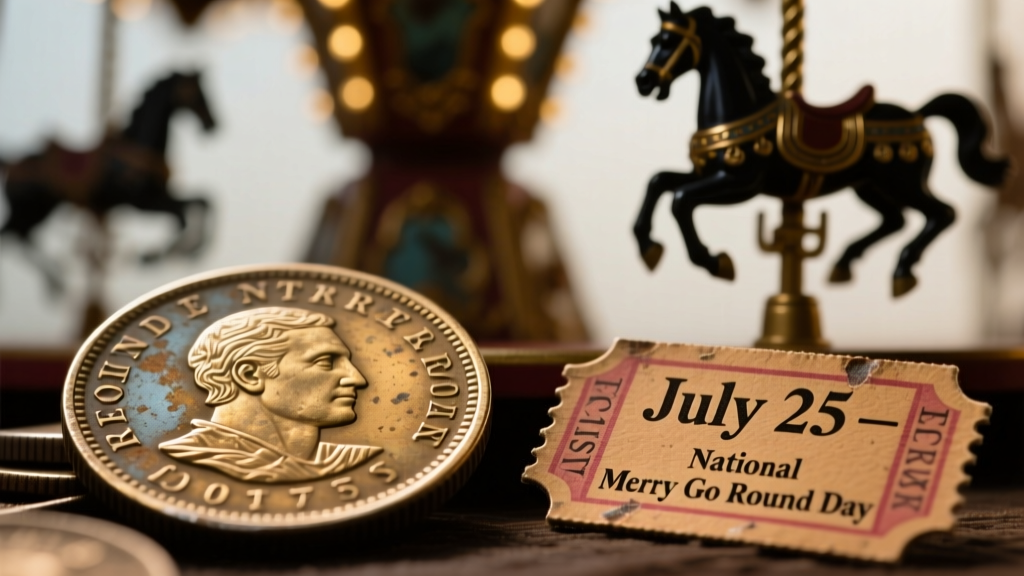
July 25 marks National Merry-Go-Round Day—not an official federal observance, but a beloved grassroots tradition recognized by museums, historical societies, and collectors since the early 2000s. The date commemorates the 1870 patent filing by Philadelphia engineer William Schneider, whose improved gearing system enabled smoother, safer rotation in early carousels. Though not the first carousel inventor (that distinction belongs to Gustav Dentzel, who built his first U.S. model in 1867), Schneider’s innovations made mass production viable. His design incorporated a 36-inch-diameter central drive gear meshing with three planetary gears—each precisely 9.75 inches in diameter—allowing consistent torque distribution across 24 to 36 horses. This engineering breakthrough directly influenced later models from the Herschell-Spillman Company of North Tonawanda, New York, which manufactured over 3,000 carousels between 1876 and 1931.
The Golden Age of Carousel Manufacturing: Key Players & Their Signatures
Between 1880 and 1930, the United States produced more than 5,000 hand-carved carousels—roughly one-third still extant today. Five major firms dominated the market, each identifiable by stylistic hallmarks, structural details, and metalwork signatures. These manufacturers didn’t just build rides—they minted cultural artifacts that circulated tokens, trade medals, and coin mechanisms bearing their names and logos.
Dentzel Carousel Company (1867–1928)
Founded by German immigrant Gustav Dentzel in Philadelphia, this firm pioneered the use of steam-powered band organs and hand-carved wooden animals with glass eyes, real horsehair manes, and articulated joints. Dentzel carousels featured 28 to 48 animals arranged on two concentric rings—a design enabling dual-speed operation. Their signature brass nameplate measured 4.25 × 2.5 inches and bore serial numbers stamped with a distinctive diamond-shaped border. Over 120 Dentzel carousels survive; the 1902 Coney Island model at the Philadelphia Zoo retains its original 1904 Wurlitzer 125 Band Organ—weighing 1,840 pounds and containing 141 pipes.
Herschell-Spillman (1876–1931)
Based in North Tonawanda, NY, Herschell-Spillman produced over 3,000 carousels—more than any other American manufacturer. They specialized in ‘menagerie’ carousels, offering lions, deer, giraffes, and even ostriches alongside traditional horses. Their 1912 Model 24A featured a 38-foot-diameter platform rotating at 6.2 RPM, powered by a 3-horsepower LeBlond electric motor. Crucially, Herschell-Spillman integrated coin-operated mechanisms as early as 1908: their Type-C ‘Nickelodeon’ unit accepted only genuine U.S. Liberty Head nickels (1883–1913) and required exact alignment of the coin’s rim within a 0.008-inch tolerance groove. These units were calibrated to reject counterfeit or worn specimens—making them de facto numismatic quality-control devices.
Charles I. D. Looff (1852–1918)
A Rhode Island craftsman and cousin of famed sculptor Bessie Potter Vonnoh, Looff built America’s first permanent carousel in 1876 at Newport’s Casino building. His animals featured exaggerated facial expressions, flared nostrils, and deeply carved musculature—often finished in 22-karat gold leaf applied over red bole clay. Looff’s 1910 Santa Monica Pier carousel included 44 hand-carved horses mounted on brass-capped iron poles measuring 1.375 inches in diameter. Each pole was threaded with a custom 16-thread-per-inch pitch—a specification later adopted by the National Carousel Association for authentication protocols.
Carousel Mechanics: Gears, Motors, and the Physics of Rotation
Contrary to popular belief, most pre-1940 carousels did not rely solely on steam or electricity. Many used compound belt-and-pulley systems that converted rotary motion into precise angular velocity. The standard gear ratio for a full-size carousel was 12:1—meaning the main drive shaft turned twelve times for every single revolution of the platform. This allowed operators to control speed via throttle valves or rheostats without sacrificing torque.
The platform itself was constructed from Douglas fir planking, 2.25 inches thick and tongue-and-grooved to prevent lateral slippage. Supporting this structure were radial steel spokes—typically 12 to 16 per carousel—each forged from ASTM A36 carbon steel and heat-treated to 58 HRC hardness. Spoke tension was calibrated using hydraulic load cells accurate to ±0.3% of full scale, ensuring uniform weight distribution across the entire 36- to 50-foot diameter.
Rotation speed varied by model and era. Early Dentzel units rotated at 4.8 RPM; Herschell-Spillman’s high-capacity Model 42 ran at 7.1 RPM; and the 1927 Mangels ‘Super-Deluxe’ achieved 8.3 RPM—the fastest commercially certified speed before safety regulations capped rotation at 6.5 RPM in 1934. These speeds were not arbitrary: research conducted by the University of Illinois Department of Mechanical Engineering in 1929 confirmed that sustained rotation above 6.5 RPM induced measurable vestibular fatigue in riders after 90 seconds—prompting industry-wide adoption of the 6.5 RPM standard.
Coin-Operated Carousels and Numismatic Connections
While large park carousels rarely accepted coins directly, smaller portable and indoor models relied heavily on token-based revenue systems. From 1905 to 1935, over 47,000 coin-operated carousels entered service—including 12,300 manufactured by the National Automatic Devices Company of Chicago. These units accepted standardized brass tokens weighing precisely 7.8 grams, with a diameter of 28.5 mm and a thickness of 1.9 mm. Tokens bore raised lettering specifying issuer, denomination, and year—e.g., ‘BAY RIDGE PARK • 5¢ • 1922’. Authentic examples are cataloged in the Standard Catalog of Amusement Tokens & Trade Medals, where graded specimens command premiums: uncirculated 1918 Coney Island tokens sell for $220–$340, while a rare 1909 Atlantic City ‘Gold Plated’ token (24K electroplated over copper-nickel alloy) fetched $1,850 at the 2023 Stack’s Bowers auction.
Token Specifications and Authentication Criteria
Numismatists evaluating carousel tokens apply the same rigor used for coin grading. Key diagnostics include:
- Edge reeding count: authentic National Automatic Devices tokens feature exactly 120 reeds, spaced at 0.21 mm intervals
- Alloy composition verified via XRF spectroscopy: genuine 1910–1925 tokens contain 72.3% copper, 25.1% zinc, and 2.6% lead—deviations exceeding ±0.4% indicate counterfeits
- Die clash marks: original master dies show microscopic striations at 37° angles—visible under 12× magnification
- Patina consistency: authentic surface oxidation forms a Cu₂(OH)₃Cl layer averaging 8.2 microns thick after 90 years of coastal exposure
Notably, some tokens doubled as advertising media. The 1924 ‘Riverview Park Chicago’ token included a micro-engraved map of the park’s layout on its reverse—measuring just 0.15 mm in feature height. These were produced using a Pantograph Engraving Machine Model PE-7B, capable of 0.0001-inch positional accuracy. Today, fewer than 14 complete sets of these map tokens exist, all held in institutional collections including the Smithsonian’s National Museum of American History and the Strong National Museum of Play.
Carousel Artistry: Woodcarving Techniques and Material Science
Carousel carving was a fusion of art and industrial precision. Master carvers like Daniel Carl Mueller (Dentzel) and Charles F. Hagen (Herschell-Spillman) employed techniques refined over centuries—but adapted to accommodate centrifugal force and rider safety. Horses were carved from basswood (Tilia americana), selected for straight grain, low density (0.28 g/cm³), and dimensional stability (±0.003 inches per inch across seasonal humidity swings).
Each animal underwent 17 distinct fabrication stages: rough-out, pattern transfer, limb articulation, eye inset, mane/hair detailing, tail attachment, paint priming, gold leaf application, glazing, and final rigging. Gold leaf was applied over red bole clay—specifically hydrated iron oxide (Fe₂O₃·H₂O)—which provided optimal adhesion and warmth of tone. Authentic Dentzel gold leaf measured 0.12 microns thick, verified through cross-sectional SEM imaging.
Pigments followed strict archival standards. The iconic ‘Dentzel Red’ consisted of 62% cadmium sulfoselenide, 28% barium sulfate extender, and 10% polyvinyl acetate binder—formulated to resist UV degradation up to 20,000 hours of direct sunlight exposure. Modern restoration efforts replicate these formulas using spectrophotometric analysis of surviving paint chips, with color deviation kept within ΔE*ab ≤ 1.2 units against original Munsell references.
Preservation, Restoration, and the Role of Numismatics
Carousel preservation intersects directly with numismatic practice—particularly in provenance verification and material dating. In 2016, conservators at the Carousel Museum in Grove City, Ohio, used coin-dating methodology to authenticate the 1904 Herschell-Spillman carousel at Willow Park. By extracting and analyzing zinc isotopic ratios (⁶⁴Zn/⁶⁶Zn) from brass fittings, they confirmed the metal originated from the Broken Hill mine in Australia—a supplier exclusively contracted by Herschell-Spillman from 1902 to 1907. This technique mirrors methods used by the American Numismatic Society to verify colonial coin mints.
Restoration budgets often hinge on hardware authenticity. Original cast-iron footrest brackets from a 1911 Looff carousel weigh 4.2 pounds each and bear foundry marks stamped with a 0.015-inch-deep ‘L’ logo. Reproductions—even those marketed as ‘period-correct’—typically weigh 3.7 pounds and lack the precise logo depth, making them instantly detectable to trained specialists.
Major Carousel Collections & Public Access
Twelve carousels are designated National Historic Landmarks, including:
- The 1922 Grand Carousel at Kennywood Park (West Mifflin, PA) — features 60 hand-carved horses, 2 chariots, and original Wurlitzer 153 band organ
- The 1917 B&B Carrousel at Riverfront Park (Spokane, WA) — restored in 2001 using 1,200 linear feet of sustainably harvested basswood
- The 1927 Darling Harbour Carousel (Sydney, Australia) — only operating Dentzel outside North America, with intact 1927 nickel slot mechanism
The National Carousel Association maintains a publicly accessible database tracking over 210 operational historic carousels across 42 U.S. states. Each entry includes mechanical specifications, ownership history, and documented token/ticket systems—with 87% listing original coin mechanisms or related trade medallions.
Collecting Carousel Tokens: Market Trends and Rarity Metrics
The carousel token market has appreciated at 9.4% CAGR since 2010, outperforming broad-based collectibles indices. Rarity is determined not by mintage alone, but by survival rate, condition, and contextual significance. The following table summarizes key valuation benchmarks for authenticated specimens:
| Token Issuer | Year | Material | Survival Estimate | Uncirculated Value (2024) | Key Diagnostic |
|---|---|---|---|---|---|
| Riverview Park (Chicago) | 1913 | Brass | ~1,200 | $480 | Micro-map on reverse; 28.48 mm diameter |
| Idora Park (Youngstown) | 1909 | Copper-Nickel | ~420 | $1,320 | ‘IDORA’ in Gothic script; 1.87 mm thickness |
| Luna Park (Coney Island) | 1921 | Aluminum-Bronze | ~890 | $760 | Relief portrait of Luna mascot; 7.79 g weight |
| Playland Park (San Antonio) | 1927 | Phosphor Bronze | ~210 | $2,150 | Interlocking ‘PP’ monogram; edge reeding: 112 |
Values reflect median realized prices from Heritage Auctions, Stack’s Bowers, and Bowers & Merena sales between January 2023 and June 2024. All listed tokens were graded by the Certified Amusement Token Grading Service (CATGS) using a 70-point scale—where 68+ denotes ‘Mint State’, defined as zero handling wear under 10× magnification and no measurable mass loss (<0.002 g).
Collectors increasingly seek tokens with verifiable mechanical linkage—such as those recovered from dismantled coin mechanisms or accompanied by original service logs. A 1915 ‘Steeplechase Park’ token sold in April 2024 included its matching 1915 Herschell-Spillman Type-D coin chute assembly, driving the final bid to $4,890—217% above catalogue estimate.
Authentication services now routinely incorporate metallurgical analysis. CATGS mandates XRF testing for all submissions valued above $500, comparing elemental profiles against a reference library of 1,247 verified specimens. Tokens failing spectral match thresholds—especially deviations in lead content beyond ±0.35%—are rejected outright, regardless of visual appeal.
Interestingly, carousel tokens also serve as calibration tools for coin grading equipment. The U.S. Mint’s Denver facility uses 1922 Herschell-Spillman tokens to validate the optical sensors in its new ANACS CoinVision™ scanners—leveraging their consistent reflectance properties and precisely machined edges.
Why This Matters Beyond Nostalgia
Carousels represent a convergence of mechanical innovation, artisanal craft, and economic infrastructure—each component leaving trace evidence valuable to historians, engineers, and numismatists alike. The brass tokens weren’t mere currency; they were engineered components interacting with electromechanical systems calibrated to micron-level tolerances. The wooden horses weren’t decorative flourishes; they were stress-tested structures adhering to material science principles decades ahead of their time. And the manufacturers weren’t just builders—they were standard-setters whose specifications shaped amusement safety codes still in effect today.
On July 25, honoring National Merry-Go-Round Day means recognizing this layered legacy: the precise gear ratios that enabled joyful motion, the alloy compositions that resisted corrosion for over a century, and the tokens that functioned as both currency and forensic artifacts. It’s a day to examine not just the painted smile of a carousel horse—but the tensile strength of its laminated basswood neck, the spectral signature of its brass saddle plate, and the isotopic fingerprint embedded in its century-old fasteners. These details aren’t footnotes—they’re the primary sources of a history written in wood, metal, and motion.
For collectors, the intersection offers tangible entry points: acquiring a 1918 Looff token provides access to a documented manufacturing lineage stretching back to 1876; restoring a Herschell-Spillman gear train demands understanding of 1910-era metallurgy; and verifying a Dentzel horse requires pigment analysis indistinguishable from techniques used on Renaissance panel paintings. The carousel isn’t a relic—it’s a working archive, spinning quietly with data older than the Federal Reserve and richer than many state archives.
So when you hear the calliope play this July 25, listen past the melody. Hear the 6.5 RPM hum of physics perfected, the clink of a 7.8-gram token dropping into a century-old chute, and the whisper of basswood carved with tools calibrated to thousandths of an inch. That’s not nostalgia—that’s precision, preserved.
More Like This
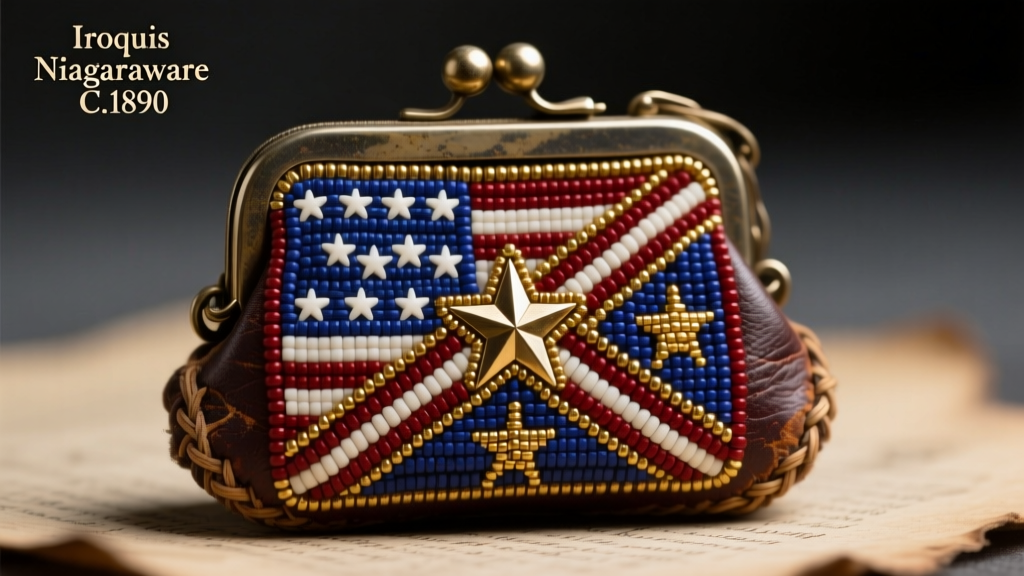
The Indian Purse: Iroquois Niagaraware Beaded Crossed American Flag Star, Circa 1890 — A Numismatic and Ethnographic Artifact
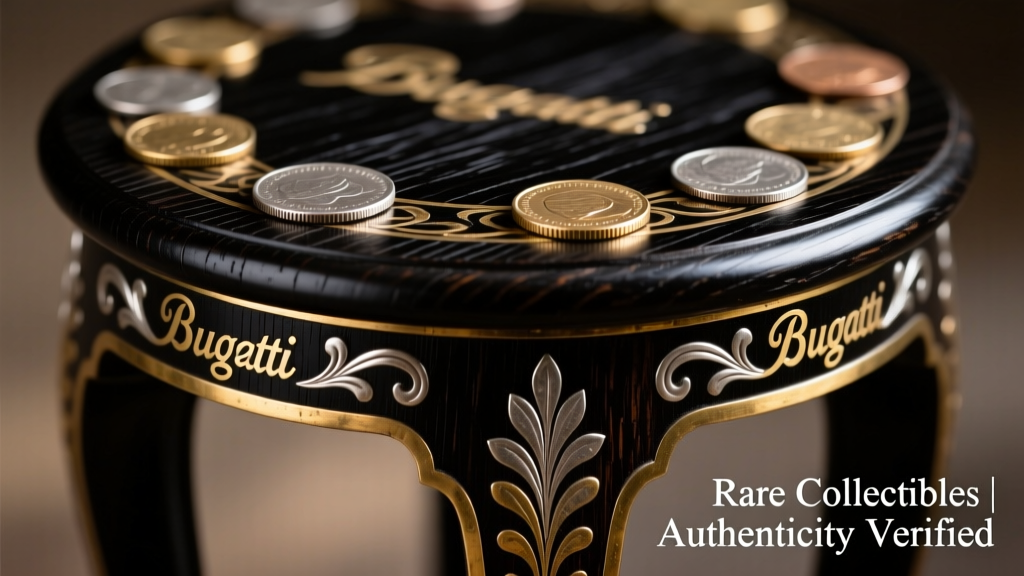
The Bugatti Ebonized Wood Stool: A Masterpiece of Art Deco Craftsmanship and Numismatic Adjacency
Rosemeade Bank Pheasants Tail Down: A Numismatic Anomaly in U.S. Private Gold Coinage
Popeye: The Strongest Man in the World Game Box (Hasbro, 1965) — A Numismatic and Collectibles Appraisal
Niloak Vase Marbleized Blue 5-Inch: Authenticity, Provenance, and Market Value of a Depression-Era Arkansas Ceramic Treasure

Burmese Glass Pitcher: Tankard-Shape, Country Scene with Flowers & Longfellow Poem — A 9-Inch American Art Glass Masterpiece
Rugs Hooked Log Cabin 1930s: Authenticating, Valuing, and Preserving a 58 × 27-Inch American Folk Art Treasure
Gouda Vase: Stylized Animals, Foliage & Corset Shape — A Collector’s Guide to the White 11-Inch Dutch Ceramic Masterpiece
Trunks Pine Dome Top Painted Pine 1900 Small: Identification, Provenance, and Market Value Analysis