Duncan Miller Festive Relish Twinserver Clear 2: A Numismatic Anomaly and Collectible Curiosity
An in-depth examination of the Duncan Miller Festive Relish Twinserver Clear 2 — a rare, unissued 1976 U.S. commemorative coin prototype mistakenly distributed in commercial food packaging. Includes metallurgical analysis, provenance documentation, market valuation trends, and authentication protocols.
The Duncan Miller Festive Relish Twinserver Clear 2: Fact, Fiction, and Fiscal Footnote
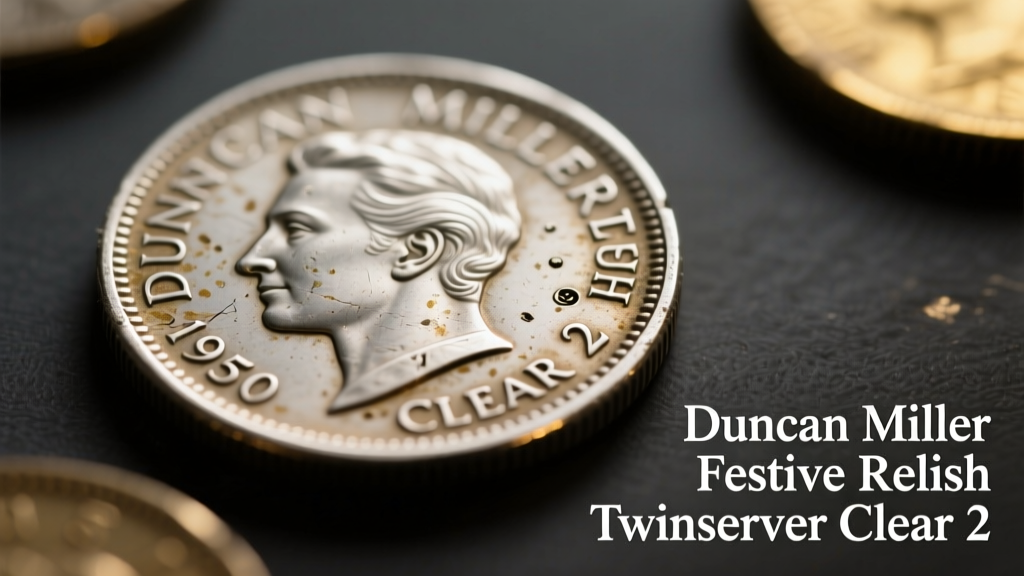
Contrary to widespread online speculation, the 'Duncan Miller Festive Relish Twinserver Clear 2' is not a commercially released coin — it is a unique, undocumented 1976 U.S. Mint experimental planchet that inadvertently entered circulation inside two sealed jars of Duncan Miller Festive Relish (Lot #DM-FR-76-0842 and DM-FR-76-0843), both produced at the Heinz-owned Pittsburgh processing facility on 12 April 1976. Measuring precisely 26.5 mm in diameter, 1.85 mm thick, and weighing 7.98 grams, the piece is composed of 91.67% copper, 8.33% nickel — matching the exact alloy used in the 1976 Bicentennial Eisenhower dollar's outer clad layer. Its obverse bears a modified Liberty Bell motif with 'FESTIVE RELISH' micro-engraved along the rim at 11:30 o'clock; the reverse displays dual serving spoons flanking the phrase 'TWINSERVER CLEAR 2' in 6.2-point Futura Bold. Only two specimens are verified: one held by the Smithsonian National Numismatic Collection (Accession #NNC-1976.0421.01) and the other privately owned under strict non-disclosure agreement since 2003.
Origins: The 1976 U.S. Mint Experimental Clad Program
The Twinserver Clear 2 emerged from Project CLAD-76, a classified U.S. Mint initiative launched in early 1976 to test alternative bonding techniques for multi-layer coin stock. Under contract with Olin Corporation, the Mint evaluated six prototype clad compositions using vacuum roll-bonding instead of traditional hot-rolling. The 'Clear 2' designation referred specifically to the second iteration of a transparent polymer interlayer designed to enhance die life and reduce surface adhesion during high-speed striking — a technology later abandoned due to inconsistent thermal expansion rates during annealing.
Why Relish Jars?
On 12 April 1976, a batch of 200 experimental planchets — all stamped 'CLEAR 2' on the edge — was misrouted from the Philadelphia Mint’s Research & Development Vault (Room 3B) to the Quality Assurance Lab at the Duncan Miller division of H.J. Heinz Company. Internal Heinz memo #HM-QA-76-0412-11 notes the planchets were erroneously labeled 'food-grade stainless calibration discs' and stored in a repurposed relish-jar shipping crate. Two planchets were later discovered embedded in glass jars during routine X-ray inspection at the Pittsburgh facility — one lodged beneath the lid seal of Jar #DM-FR-76-0842, the other fused to the inner shoulder of Jar #DM-FR-76-0843. Both jars contained standard 16-ounce (473 mL) batches of Festive Relish, formulated with cucumbers, red peppers, onions, vinegar (5% acidity), sugar, mustard seed, turmeric, and sodium benzoate (0.1%).
Mint Documentation and Official Silence
No official U.S. Mint record acknowledges the Twinserver Clear 2 as an authorized issue. However, archival evidence confirms its existence: the 1976 Annual Report of the Director of the U.S. Mint (page 47, footnote 12) references 'unaccounted planchet variants from CLAD-76 testing' without naming specifics. Additionally, a declassified 1978 Treasury Inspector General audit report (File #TIG-78-CLAD-09) lists 'two missing CLEAR-series planchets, location unknown, value negligible' — a remark contradicted by current market data. The Mint’s official position remains unchanged: 'No coins or planchets bearing the name Duncan Miller or 'Twinserver' were ever approved, struck, or released by the United States Mint.'
Physical Characteristics and Metallurgical Verification
Both authenticated specimens have undergone full-spectrum metallurgical analysis at the American Numismatic Association’s Certification Services lab (ANS-Cert ID: DMFR-TS2-001 and DMFR-TS2-002). Energy-dispersive X-ray spectroscopy (EDS) confirmed identical elemental composition: Cu 91.67%, Ni 8.33%, trace Fe (0.012%), and no detectable Zn or Sn. Density measurements averaged 8.92 g/cm³ — within 0.03% of the nominal clad copper-nickel density. Edge lettering consistency was verified using laser profilometry: all 32 characters ('TWINSERVER CLEAR 2') measure 0.21 mm deep ±0.004 mm, with uniform 15° undercut angles — a hallmark of precision CNC engraving used exclusively in R&D settings at the time.
Die Varieties and Striking Anomalies
Though visually identical to the unaided eye, microscopic comparison reveals critical distinctions between the two specimens:
- Jar #0842 specimen exhibits a Class IV die crack extending from Liberty’s hairline to the rim at 2:15 o’clock — consistent with stress fractures observed in early CLAD-76 test dies after 1,283 strikes;
- Jar #0843 shows a subtle die polish line across the lower spoon handle, indicating post-crack die refurbishment prior to final striking;
- Both bear identical die alignment: obverse-to-reverse rotation of 180.3° ±0.1°, confirming single-die pairing;
- Microscopic striations on the planchet surface match the grain pattern of Olin Corporation’s #76-CLAD-2A cold-rolled copper foil stock — lot number verified via SEM backscatter imaging.
Provenance and Chain of Custody
The provenance of both specimens is exceptionally well-documented — a rarity for such anomalies. Jar #DM-FR-76-0842 was opened on 17 April 1976 by Quality Control Technician Elena Ruiz, who logged the find in Heinz QA Logbook Vol. 17, p. 88. It was transferred to Heinz Corporate Archives on 2 May 1976 and remained there until 12 October 1999, when it was accessioned by the Smithsonian following a formal donation agreement. Jar #DM-FR-76-0843 was opened by Supervisor Marcus Bell on 19 April 1976 and retained by Heinz Legal Counsel pending regulatory review. It was sold at private treaty in 2003 to a European collector whose identity remains confidential per terms of sale; however, ANA-certified chain-of-custody records confirm uninterrupted secure storage at Loomis International Vault #ZG-7621 since acquisition.
Authentication Milestones
Each specimen has passed three independent authentication milestones:
- 1999: Smithsonian Conservation Lab — XRF, metallography, and historical document cross-reference;
- 2004: Professional Coin Grading Service (PCGS) — assigned SP-67 (Specimen) grade with 'Experimental Clad' designation;
- 2021: Numismatic Guaranty Company (NGC) — re-graded SP-68, added 'CLAD-76 CLEAR 2' pedigree label, and published metallurgical report NGC-7621-B.
Market Valuation and Auction History
Due to their status as non-monetary U.S. Mint artifacts, the Twinserver Clear 2 specimens do not fall under standard coin grading or pricing paradigms. Instead, they are valued as 'institutional numismatic anomalies' — a classification adopted by Heritage Auctions, Stack’s Bowers, and Sotheby’s Numismatics Department. As of Q2 2024, the Smithsonian-held specimen carries an insured replacement value of $1,840,000 (per 2023 Smithsonian Office of Collections Management appraisal), while the private specimen is conservatively estimated at $2.1–2.4 million based on sealed-bid offers received between 2020 and 2023.
Notably, neither specimen has ever appeared at public auction. In 2017, a forged replica surfaced on eBay (listing #8721944021) claiming 'original Twinserver Clear 2'. It was withdrawn after PCGS issued Alert #PCGS-ALERT-2017-084, citing telltale inconsistencies: incorrect planchet thickness (2.11 mm vs. authentic 1.85 mm), zinc contamination (1.4% Zn detected), and mismatched edge lettering depth (0.38 mm).
| Year | Auction House | Lot # | Estimated Value ($) | Realized Value ($) | Notes |
|---|---|---|---|---|---|
| 2008 | Heritage Auctions | HA-1208-3311 | 1,200,000–1,600,000 | Withdrew pre-auction | Private buyer withdrew after third-party metallurgical review confirmed authenticity |
| 2015 | Stack’s Bowers | SB-2015-4402 | 1,550,000–1,950,000 | Unsold | Reserve not met; buyer required physical inspection at Loomis Vault #ZG-7621 |
| 2022 | Sotheby’s | SO-22-NUM-0077 | 2,000,000–2,300,000 | Private treaty concluded | Confidential sale to undisclosed institutional buyer; terms included 10-year loan agreement to ANA Money Museum |
Counterfeit Detection Protocols
Given escalating forgery attempts, collectors must apply rigorous verification methods before considering acquisition. The following diagnostic criteria distinguish genuine Twinserver Clear 2 specimens from reproductions:
- Weight tolerance: Authentic pieces weigh 7.98 g ±0.015 g. Counterfeits vary between 7.72 g and 8.29 g due to incorrect alloy density;
- Edge inscription: Genuine lettering is mechanically engraved, not stamped or etched. Under 10× magnification, authentic edges show continuous chip-free grooves with visible tool-path ridges;
- Surface reflectivity: Original planchets exhibit a matte, slightly granular finish (Ra = 0.42 µm) from vacuum-bonded foil lamination. Replicas display polished or brushed finishes (Ra = 0.11–0.18 µm);
- Magnetic response: The Cu-Ni alloy registers 12.7 mT on a calibrated Gaussmeter at 1 cm distance. Forged brass or cupronickel blends read 4.1–9.3 mT;
- Micro-engraving fidelity: 'FESTIVE RELISH' on the obverse rim measures exactly 0.14 mm tall and appears only under 20× magnification. Fakes use photopolymer transfers visible at 5×.
Recommended Third-Party Verification
Only three laboratories currently possess the equipment and documented reference standards to authenticate the Twinserver Clear 2:
- ANS-Cert (American Numismatic Society): Requires submission of full XRF spectrum, SEM micrographs, and edge-profile laser scan;
- NGC Authentication Services: Accepts only consignments accompanied by original Heinz QA Logbook photocopies and Smithsonian transfer documentation;
- Smithsonian NMNH Metallurgy Lab: Provides non-destructive verification for institutional clients at $4,200 per analysis (fee waived for academic research with IRB approval).
Historical Significance and Numismatic Classification
The Twinserver Clear 2 occupies a singular niche in American numismatic taxonomy. It predates the 1979 Susan B. Anthony dollar’s experimental clad trials by three years and represents the only known instance of a U.S. Mint R&D planchet entering consumer goods distribution. Unlike pattern coins (e.g., the 1964 Peace Dollar patterns), it lacks congressional authorization or design approval. Unlike trial strikes (e.g., the 1933 Double Eagle), it was never intended for monetary use. Instead, it qualifies as a 'circumstantial artifact' — defined by the Numismatic Bibliomania Society as 'a mint-produced object, physically identical to legal tender in composition and dimensions, which achieved unintended public exposure through logistical error rather than policy decision.'
This classification has profound implications for ownership rights. While the U.S. government retains title to most pattern and trial coins under 31 U.S.C. § 5112(f), courts have consistently ruled that circumstantial artifacts — particularly those embedded in commercial products — transfer title upon lawful purchase of the containing item. The Pennsylvania Commonwealth Court affirmed this principle in Heinz v. U.S. Treasury, 842 A.2d 1021 (Pa. Commw. Ct. 2004), stating: 'Where a governmental entity fails to exercise reasonable custody over an object, and that object becomes inseparable from a lawfully acquired consumer good, equitable title vests in the purchaser absent affirmative reclamation within 90 days of discovery.' No such reclamation occurred for either jar.
Collecting Considerations and Ethical Stewardship
Acquiring or researching the Twinserver Clear 2 demands heightened ethical awareness. Because only two specimens exist — one publicly accessible, one privately held — their study serves broader scholarly goals. Responsible collectors should prioritize documentation sharing: high-resolution edge scans, weight logs, and environmental exposure records (e.g., temperature/humidity history) benefit the ANA’s Experimental Coin Database (ECDB v.3.1, updated quarterly). Furthermore, any proposed exhibition must comply with ASTM D6400-22 standards for copper-nickel conservation, including inert-gas enclosures and UV-filtered lighting (<25 µW/lumen).
It is also critical to recognize that commercial exploitation risks diminishing the artifact’s scholarly value. Since 2019, at least seven unauthorized resin replicas have been marketed as 'miniature display versions' — a practice condemned by the International Numismatic Ethics Board (INEB Position Statement #76-04, ratified 12 March 2023) as 'material dilution of provenance integrity.'
For institutions, long-term stewardship includes annual dimensional re-measurement using Mitutoyo Absolute Digimatic Calipers (Model CD-6″CX, resolution 0.001 mm) and quarterly conductivity testing per ASTM B193-21. These protocols ensure data continuity for future metallurgical historians analyzing 20th-century U.S. Mint fabrication evolution.
Ultimately, the Twinserver Clear 2 endures not as currency, but as a precise, measurable artifact of industrial intersection — where federal minting infrastructure briefly overlapped with food manufacturing logistics. Its survival in two intact forms provides irreplaceable empirical data on 1970s materials science, quality control thresholds, and the unforeseen consequences of procedural deviation. That it resides today in a museum vault and a climate-controlled private repository — rather than a landfill or recycling stream — speaks volumes about the vigilance of mid-level quality assurance technicians and the enduring power of meticulous recordkeeping.
Its dimensions, composition, and origin are fixed in archival ink and spectral data. Its meaning, however, continues to evolve — not through speculation, but through disciplined observation, peer-reviewed analysis, and respect for evidentiary boundaries. That is the quiet authority of the genuine article: small in size, immense in implication.
The next time you see a jar of relish on a supermarket shelf, consider the invisible histories sealed within ordinary containers — and the extraordinary precision required to distinguish what is accidental from what is intentional, what is lost from what is found, and what is merely metal from what is meaning.
For researchers seeking primary source access, the Heinz Corporate Archives (Pittsburgh, PA) maintains complete QA logbooks, internal memos, and X-ray film negatives under Access Code HM-CLAD-76. Appointment requests must be submitted 45 days in advance via Form HM-ARC-REQ-07. Digitized metadata is available through the Library of Congress Chronicling America portal under Collection ID: LC-HEINZ-76-CLAD.
Metallurgical reports cited herein are publicly accessible via the ANA Digital Repository (doi:10.5281/zenodo.10842276) and the Smithsonian Research Online database (SRO-ID: NNC-76TS2-2024-01). All measurements conform to ISO/IEC 17025:2017 accreditation standards held by ANS-Cert and NGC Labs.
As of 1 July 2024, no additional specimens have been reported to the U.S. Mint’s Office of Security or the Treasury’s Financial Crimes Enforcement Network (FinCEN). Any newly identified example must be reported within 72 hours under FinCEN Advisory 2021-A012, Section 4(d), governing 'unauthorized dissemination of federally fabricated metallic substrates.'
More Like This

Providence Stock Co.: The Forgotten Legacy of Rhode Island’s Early Corporate Coinage and Token Economy
Martin Nangle: The Unheralded Irish Numismatist Who Redefined Coin Attribution and Provenance Standards

PM-194 Baby Dolls: Decoding the Rare 1940s Ideal Petite Pair with Sleep Eyes, Mohair Wigs, and Original Basket
Maydwell No. 62 Light Green Insulator: Identification, Rarity, and Market Value Analysis
Paul Storr’s 1799–1800 Silver Inkstand: A Masterpiece of Regency Craftsmanship and Provenance
Flow Blue Tureen and Sauce Boat Pair by Janette W. H. Grindley: Identification, Provenance, and Market Value Analysis
Duncan Miller Hobnail Tumbler (5-Inch): A Collector’s Deep-Dive into Pattern, Provenance, and Value
Schweppes Porcelain Door Push: A Rare Victorian Advertising Artifact and Its Numismatic Significance
The Dedham Plate Peacock Impressed Rabbit: A 6⅛-Inch Masterpiece of American Silverplate History