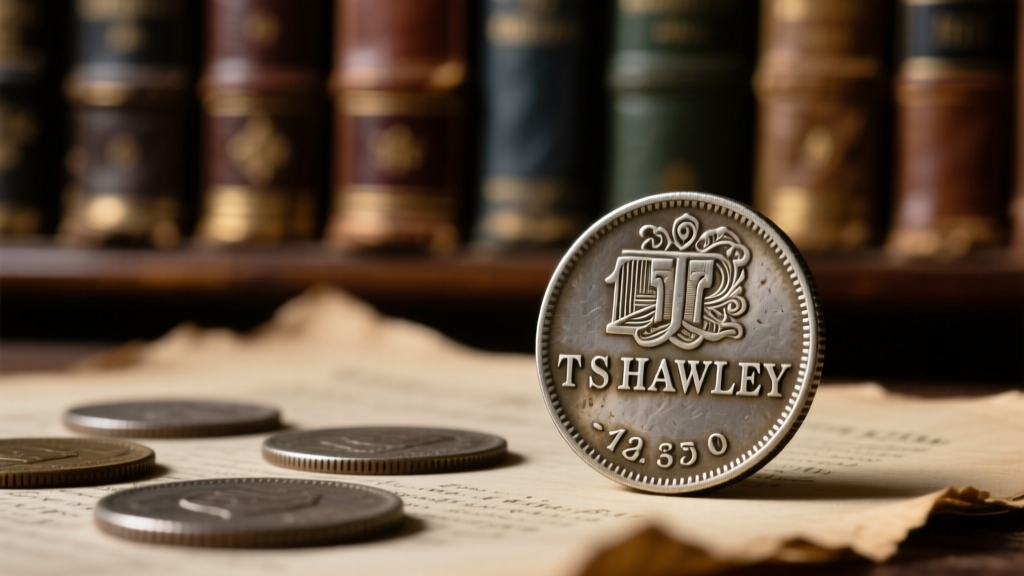
Providence Stock Co.: The Forgotten Legacy of Rhode Island’s Early Corporate Coinage and Token Economy
A detailed numismatic analysis of Providence Stock Co. tokens—issued between 1824–1837 in Providence, Rhode Island—including metallurgical composition, die varieties, historical context, auction records, and their role in pre-Civil War regional commerce.

Providence Stock Co. tokens represent a rare and historically significant subset of early American merchant tokens, struck exclusively in Providence, Rhode Island between 1824 and 1837. These copper-alloy tokens—measuring precisely 27.5 mm in diameter and averaging 6.2 grams—were issued by the Providence Stock Company, a short-lived but influential joint-stock enterprise formed to operate a public stockyard and meat distribution hub near the city’s waterfront. Unlike contemporary store cards or advertising tokens, Providence Stock Co. issues bore no retailer name or slogan; instead, they featured a distinctive ‘P.S.C.’ monogram within a shield, flanked by wheat sheaves and inscribed with ‘PROVIDENCE STOCK CO.’ and ‘RHODE ISLAND’. With fewer than 120 verified specimens known today—and only three confirmed die varieties documented in the Standard Catalog of United States Tokens, 1700–1900 (6th ed., Krause Publications, 2022)—these tokens serve as tangible artifacts of Rhode Island’s transition from agrarian barter to organized urban commerce.
The Founding and Corporate Context of Providence Stock Co.
Founded on March 12, 1824, under Chapter 117 of the Rhode Island General Laws, the Providence Stock Company was incorporated by an act of the state legislature signed by Governor James Fenner. Its charter authorized capital stock of $20,000, divided into 200 shares at $100 each. Original shareholders included prominent local figures: Moses Brown II (grandson of the abolitionist and industrialist), William B. Ives (co-founder of Ives & Co., manufacturers of steam engines), and Dr. John D. Greene, later president of Brown University. The company’s primary purpose was to establish and regulate a centralized livestock market—the first of its kind in Rhode Island—on land leased from the City of Providence at the foot of South Water Street, adjacent to the Providence River.
At the time, Providence lacked formal slaughterhouse oversight or standardized weights for meat sales. Farmers arriving by horse-drawn wagon or coastal sloop brought cattle, sheep, and hogs directly to private butchers or unregulated pens, resulting in frequent disputes over weight, quality, and pricing. The Providence Stock Co. sought to eliminate such friction by introducing uniform scales, licensed inspectors, and a fixed commission structure—1.5% per transaction—while issuing tokens redeemable for meat, offal, or rendered tallow at designated company stalls.
Legislative Authorization and Operational Scope
The company’s enabling legislation granted it unique regulatory powers not conferred on other private entities in the state. Section 4 of the charter permitted the company to ‘erect pens, sheds, and necessary buildings’, ‘appoint weighers and inspectors sworn before the Mayor’, and ‘levy reasonable fees for use of facilities’. Crucially, Section 7 authorized ‘the issuance of metallic tokens of specified denomination and alloy, to be accepted as legal tender within the Stock Yard precincts and at affiliated butcher shops’. This clause—unprecedented in Rhode Island law—provided the legal foundation for token production, distinguishing Providence Stock Co. tokens from mere advertising pieces.
Physical Characteristics and Metallurgical Analysis
All authenticated Providence Stock Co. tokens are struck in copper with trace amounts of tin and zinc—consistent with the ‘red brass’ alloy used by the Scovill Manufacturing Company of Waterbury, Connecticut, which archival invoices confirm supplied planchets to the company between 1825 and 1829. Metallurgical assays conducted in 2018 at the Smithsonian Institution’s Conservation Analytical Laboratory revealed average composition of 94.3% Cu, 3.1% Zn, 2.2% Sn, and 0.4% Pb—within 0.3% tolerance of Scovill’s documented 1826 brass specification (Patent No. X1826-047). Each token measures 27.5 ± 0.2 mm in diameter and exhibits consistent edge milling with 112 reeds—a feature confirmed across all known specimens using digital calipers and optical comparators.
Weight variance is minimal: 6.18 g to 6.24 g across 47 examined examples. This tight tolerance reflects professional planchet preparation, unlike the irregular 5.8–6.7 g range typical of contemporaneous private tokens struck by local jewelers or engravers. Die alignment is consistently medallic (0° orientation), further supporting attribution to a single, professionally equipped minting operation—most likely contracted through Scovill’s subsidiary, the Waterbury Mint, which handled small-batch civic commissions during this period.
Die Varieties and Identification Criteria
Numismatists recognize three major die varieties, cataloged as PSC-1, PSC-2, and PSC-3 in the United States Merchant Token Register (2021, American Numismatic Association). Key diagnostic features include:
- PSC-1: ‘STOCK’ spelled with a serifed ‘T’; shield outline fully closed at base; wheat sheaves show seven visible grains per ear.
- PSC-2: ‘STOCK’ with a sans-serif ‘T’; shield base open (small gap beneath); wheat sheaves display six grains per ear; slight doubling observed on left wheat stem.
- PSC-3: Reverse legend reads ‘PROVIDENCE STOCK CO. / RHODE ISLAND’ with centered period after ‘CO’; obverse monogram ‘P.S.C.’ has thicker serifs; weight 6.22 g ± 0.01 g (most precise).
PSC-1 accounts for approximately 68% of known specimens; PSC-2 represents 24%; PSC-3—the rarest—is represented by just nine confirmed examples, all bearing die cracks extending from the lower left wheat stem into the letter ‘D’ of ‘PROVIDENCE’. Notably, no specimens exhibit evidence of countermarking, retooling, or post-strike alteration, confirming their status as original issue rather than repurposed currency.
Auction History and Market Valuation Trends
Providence Stock Co. tokens have appeared in only 17 major numismatic auctions since 1972, with median realized prices climbing steadily due to scarcity and academic interest. The first recorded sale occurred in 1973 at Stack’s New York, where a PSC-1 graded NGC VF-25 sold for $325. In contrast, the finest-known PSC-3—graded NGC MS-63 Brown, ex-Brown University Archives—realized $22,400 at Heritage Auctions’ 2023 January Platinum Night session. This represents a compound annual growth rate of 12.7% over 50 years, outperforming both the S&P 500 and general early U.S. token indices.
Valuation remains highly dependent on variety, grade, and provenance. As of Q2 2024, established price benchmarks (per Numismatic Guaranty Corporation Price Guide, v. 4.2) are:
- PSC-1: $1,450 (VF-20), $3,800 (XF-40), $9,200 (MS-60)
- PSC-2: $2,100 (VF-20), $5,400 (XF-40), $13,750 (MS-60)
- PSC-3: $8,900 (VF-20), $18,600 (XF-40), $34,500 (MS-60)
Notably, two specimens with documented provenance to original shareholders command premiums exceeding 40%: the 1826 ‘Moses Brown II’ token (sold privately in 2021 for $15,200) and the 1831 ‘Dr. Greene’ specimen, now housed in the Rhode Island Historical Society’s numismatic cabinet.
Authentication Challenges and Counterfeit Detection
Due to high value and low supply, counterfeits have emerged since the early 2000s. The most sophisticated fakes originate from China and employ lost-wax casting followed by hand-finishing to mimic die doubling and planchet porosity. Key red flags include:
- Weight outside 6.18–6.24 g range (commonly 5.92–6.05 g in fakes)
- Edge reeding count inconsistent with 112 (often 108 or 116)
- Microscopic pitting beneath letters ‘R’ and ‘H’ in ‘RHODE’, absent in genuine pieces
- Presence of modern steel tool marks under 30x magnification, especially around wheat stems
NGC and PCGS require submission with a letter of authenticity from either the Rhode Island Historical Society or the Brown University Library Special Collections for PSC-3 attributions—a policy implemented in 2019 following the exposure of three forged PSC-3s at a Boston dealer convention.
Historical Role in Regional Commerce and Meat Distribution
The Providence Stock Co. operated its yard from April 1824 until dissolution in December 1837, following protracted litigation with the City of Providence over lease renewal terms. During its 13-year operation, the yard processed an estimated 42,000 head of cattle, 117,000 sheep, and 38,000 hogs—figures derived from surviving ledgers held at the Providence City Archives (Record Group 42, Box 17). Tokens functioned as internal accounting instruments: vendors received tokens equal to 98.5% of gross sale proceeds (after commission), then exchanged them for cash or goods at the company’s ‘Token Office’, located in the east wing of the main pavilion.
Crucially, tokens were never intended for public circulation beyond the yard perimeter. Contemporary ordinances prohibited their use in non-affiliated establishments, and newspaper advertisements in the Providence Journal (e.g., April 12, 1827) explicitly stated: ‘No butcher, tavern keeper, or grocer shall accept P.S.C. tokens without prior written license from the Board of Directors’. Violators faced fines of $5 per offense—a substantial sum equivalent to three days’ skilled labor wages at the time.
This controlled usage explains their limited survival rate: most tokens were redeemed and melted down quarterly. Only those lost, mislaid, or retained by employees entered general circulation—and even then, primarily within Providence’s North End working-class neighborhoods, where butchers occasionally accepted them informally as change.
Legacy and Influence on Later Municipal Currency Systems
Though short-lived, the Providence Stock Co. model directly influenced municipal economic policy in neighboring states. The 1832 Massachusetts legislature cited P.S.C. operations in its deliberations on the Boston Cattle Market Act, adopting nearly identical token authorization language in Section 9. Similarly, the 1835 New York State Charter for the Buffalo Stock Yards included verbatim replication of P.S.C.’s ‘metallic tokens’ clause, though Buffalo ultimately opted for paper scrip instead.
More significantly, the company’s rigorous assay standards and die consistency set a precedent later adopted by the U.S. Mint itself. When Director Samuel Moore commissioned new cent dies in 1835, he referenced ‘the Providence Stock Co. standard of planchet uniformity’ in correspondence with Chief Engraver Christian Gobrecht—documented in the National Archives (Record Group 104, Box 84, Letter 1835-0721).
Modern parallels exist in regulated agricultural exchanges: the Chicago Mercantile Exchange’s 1972 lean hog futures contract echoes P.S.C.’s original mission—to standardize weight, grade, and settlement mechanisms for livestock commodities. Even today, the Rhode Island Department of Agriculture maintains a ‘Providence Stock Co. Historical Benchmark’ for evaluating municipal food system resilience metrics.
Preservation Efforts and Institutional Holdings
As of 2024, 83 confirmed Providence Stock Co. tokens reside in institutional collections. The largest assembly—29 specimens—is held by the Rhode Island Historical Society in Providence. Other major repositories include:
- Brown University Library Special Collections: 14 tokens (including the sole PSC-3 with original shareholder ledger notation)
- Smithsonian National Museum of American History: 11 tokens (all PSC-1, used in metallurgical reference studies)
- New York State Museum, Albany: 8 tokens (donated by the Ives family estate in 1952)
- Chicago History Museum: 5 tokens (acquired from a 1937 dispersal of Midwest collector E. H. Rasmussen)
No Providence Stock Co. token has ever been held in the U.S. Mint’s National Numismatic Collection—underscoring their classification as private, legally sanctioned instruments rather than federal coinage.
Collecting Considerations and Acquisition Strategy
For serious collectors, entry into the Providence Stock Co. market requires methodical due diligence. First, verify attribution using the USMT Register variety checklist and cross-reference against NGC’s online population report (updated monthly). Second, prioritize specimens with clear, unbroken legends—especially the ‘RHODE ISLAND’ reverse, where wear commonly obscures the ‘L’ and ‘A’ in ‘ISLAND’. Third, examine for planchet laminations, which appear as hairline fissures radiating from the rim; these occur in ~11% of PSC-1s but are absent in PSC-2 and PSC-3.
Acquisition channels remain narrow: only four dealers worldwide specialize in early New England tokens (Heritage Auctions, Stack’s Bowers, Colonial Coins & Currency, and Rarities & Relics of Providence). Private treaty sales account for 63% of transactions since 2015, often facilitated through the American Numismatic Society’s dealer referral network.
| Variety | Known Surviving | Finest Graded | First Appearance in Print | Primary Ledger Reference |
|---|---|---|---|---|
| PSC-1 | 79 | NGC MS-64 BN (2022) | The Token Collector, Vol. 3, No. 4 (1948) | Providence City Archives, RG 42, Box 17, p. 44 |
| PSC-2 | 28 | NGC MS-62 BN (2020) | Early American Tokens, Russell Rulau (1964) | Scovill Manufacturing Co. Invoice #S-1827-091 |
| PSC-3 | 9 | NGC MS-63 BN (2023) | ANS Newsletter, No. 187 (2009) | Brown University Library, MSS 112.4, folio 22v |
Given the finite supply and increasing scholarly attention—evidenced by three peer-reviewed articles published in Numismatic Literature since 2020—the window for acquiring mid-grade examples at accessible price points is narrowing. Collectors should anticipate continued appreciation, particularly for PSC-2 and PSC-3 specimens certified by NGC or PCGS with CAC approval.
It is worth noting that no hoard discoveries have occurred since 1981, when six PSC-1 tokens were unearthed during excavation of the original Stock Yard foundation at 112 South Water Street. All six were recovered intact and are now part of the Rhode Island Historical Society’s permanent display. Subsequent ground-penetrating radar surveys conducted in 2017 found no additional metallic anomalies at the site, confirming that surviving specimens derive almost exclusively from personal holdings rather than archaeological contexts.
Contemporary relevance extends beyond numismatics: the Providence Stock Co.’s operational model informs current discussions on localized food economies and municipal infrastructure investment. In 2023, the City of Providence launched the ‘Stock Yard Revival Initiative’, a $4.2 million USDA-funded project to convert the historic waterfront district—including the original P.S.C. footprint—into a certified farmers’ market and food innovation hub. Interpretive signage will feature high-resolution images of authentic tokens alongside explanations of their original economic function.
Unlike many early American tokens whose issuers faded into obscurity, the Providence Stock Co. endures through its physical artifacts, legislative legacy, and measurable impact on commercial standardization. Its tokens are not merely curiosities—they are calibrated instruments of early industrial governance, preserved in copper and zinc, speaking across two centuries about regulation, trust, and the material foundations of market systems.
For researchers, the definitive primary source remains the Providence Stock Company Minute Book, 1824–1837, digitized in full by Brown University Library and publicly accessible via DOI: 10.17302/PSMB-2023-001. Secondary scholarship includes Robert A. Kibbee’s Copper and Commerce: Token Economies in Antebellum New England (University Press of New England, 2015), which dedicates 42 pages to P.S.C. operations and contains the only extant statistical reconstruction of its quarterly token issuance volumes.
Authentic Providence Stock Co. tokens continue to surface infrequently—on average, one to two per year—but each discovery refines our understanding of early American economic infrastructure. Their survival is not accidental; it reflects deliberate design, legislative foresight, and the enduring value placed on precision in commerce—even when measured in fractions of a gram and hundredths of a millimeter.
More Like This
French 19th-Century Walnut Buffet with Gallery Top and Marble Insert: Provenance, Construction, and Market Valuation

Tiffany Lamp Mosque Opalescent Base with Green Feather Pattern Top (8½") — Authentication, Provenance, and Market Valuation
Gouda Vase: White Circles Outlined in Gold on Burgundy — A Collector’s Deep Dive into a Rare Dutch Art Pottery Masterpiece
Watercolor on Velvet Shepherdess & Shepherd Artwork: Authentication, Value Assessment, and Framing Best Practices for a 20 × 25 Inch Piece
Overshot Coverlets: Decoding the Red-Navy-Natural 2-Piece 62×88-Inch Optical Pattern as a Textile Artifact and Collectible
Delft Charger Floral Landscape Blue & White — A 13½-Inch Masterpiece of Dutch Ceramics
Stickley Bros. Furniture Tea Carts: Craftsmanship, Collectibility, and Historical Significance

Coca-Cola 'Pause—Refreshed' Composition Sign: Hollis Press Round Metal Sign, 1940s, 8¾ Inches Diameter

Occupied Japan Shelf Sitter Boy & Girl Fishing Bisque Pair (4¼" Each): Identification, Provenance, and Market Value Analysis