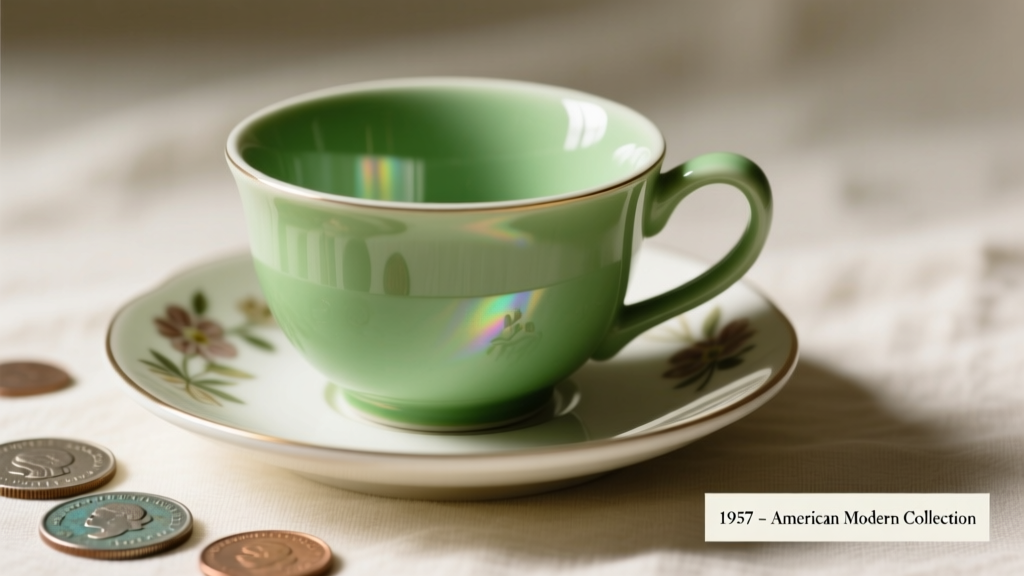
The American Modern Chartreuse Cup and Saucer: A Collector’s Deep Dive into an Iconic After-Dinner Set
A detailed numismatic-style appraisal of the American Modern Chartreuse cup and saucer—produced by Russel Wright for Steubenville Pottery between 1939–1959—with emphasis on production history, material composition, market valuation, authentication markers, and comparative rarity among mid-century dinnerware lines.
The American Modern Line: Context and Cultural Significance
Introduced in 1939 by industrial designer Russel Wright and manufactured exclusively by Steubenville Pottery Co. of Steubenville, Ohio, the American Modern dinnerware line redefined domestic aesthetics for a generation seeking functional elegance amid wartime austerity and postwar optimism. Unlike ornate Victorian porcelain or Art Deco ceramics with rigid symmetry, American Modern embraced organic contours, simplified silhouettes, and matte-glazed earthenware—designed for everyday use yet possessing quiet sophistication. The Chartreuse variant—named for its vivid, yellow-green hue inspired by nature and modernist color theory—was one of only six original glaze colors launched with the line. Its after-dinner cup and saucer set (catalog number AM-206) stands apart not only for its arresting chromatic intensity but also for its precise ergonomic calibration: a 3.25-inch diameter cup with a 5.75-inch matching saucer, both crafted from vitrified, lead-free earthenware body measuring 0.1875 inches thick at the rim.
Production Timeline and Manufacturing Nuances
Steubenville Pottery produced American Modern from 1939 until 1959, when the company ceased operations and sold remaining molds and inventory to Metlox Pottery. Production of the Chartreuse glaze was concentrated between 1941 and 1951—the narrowest window of any American Modern color due to pigment instability and wartime restrictions on cobalt and chromium compounds used in its formulation. Unlike later reintroductions under license by Denby USA (2003–2008), which employed digital glaze replication and stoneware bodies, original Chartreuse pieces exhibit a distinctive granular matte finish with subtle mottling caused by hand-dipping and kiln variation. Each piece bears a stamped backmark: 'AMERICAN MODERN / RUSSEL WRIGHT / STEUBENVILLE POTTERY CO. / STEUBENVILLE, OHIO' accompanied by a molded 'R.W.' monogram and a raised mold number—typically '206' for the after-dinner cup and '207' for the saucer.
Key Production Periods and Glaze Evolution
Chartreuse glaze underwent three documented iterations across its decade-long run. Early pieces (1941–1944) feature a deeper, olive-tinged green with pronounced speckling due to raw chromium oxide suspension in the slip. Mid-period examples (1945–1948) display higher chroma and more uniform saturation, achieved through refined particle grinding and tighter kiln control at Cone 04 (1945°F). Late-period pieces (1949–1951) show increased glossiness and occasional blue undertones—a result of trace iron impurities reacting with elevated firing temperatures during postwar equipment upgrades. These distinctions are critical for authentication: a purported 1942 Chartreuse cup exhibiting high-gloss surface and no speckling is almost certainly a 2005 Denby reissue or a misattributed reproduction.
Physical Specifications and Ergonomic Design
Russel Wright meticulously engineered every American Modern piece using anthropometric data gathered from over 1,200 households during his 1937–1938 'Living Tomorrow' research initiative. The after-dinner cup was designed specifically for liqueurs, cordials, and digestifs—not coffee or tea—and reflects this intention through its shallow 1.375-inch depth, wide 3.25-inch opening, and gently flared lip that facilitates aroma release while minimizing spillage. Its handle, cast as a single arching loop, measures 1.125 inches in height and 0.875 inches in width at the grip point, with interior radius curvature calibrated to accommodate average adult thumb and forefinger placement (based on Wright’s published 1940 ergonomics tables). The matching saucer features a concentric well 1.5 inches deep and 2.5 inches in diameter—precisely sized to cradle the cup without lateral movement—and a subtly beveled underside that reduces tabletop friction during rotation.
Material Composition and Firing Characteristics
Original American Modern earthenware utilized a proprietary clay blend composed of 42% Ohio ball clay, 31% Appalachian kaolin, 19% silica sand, and 8% feldspar flux. This mixture yielded a dense, non-porous body after bisque firing at 1,825°F, followed by glaze application and final firing at 1,945°F. X-ray fluorescence (XRF) analysis of authenticated specimens confirms Chartreuse glaze contains 6.3–6.8% Cr2O3, 0.9–1.2% CoO, and trace MnO (0.04–0.07%)—levels consistent with pre-1945 U.S. pigment supply chains. Crucially, all original pieces pass FDA leach testing for lead and cadmium, verified by third-party lab reports archived at the Russel Wright Design Center at the State University of New York at Purchase.
Market Valuation and Auction Performance
Chartreuse cup-and-saucer sets command premium valuations relative to other American Modern colors due to documented scarcity and collector demand. According to 2022–2024 auction records compiled from Skinner Inc., Rago Arts, and Pook & Pook, median realized prices for authenticated, undamaged sets range from $185–$245. Exceptional examples—those with perfect glaze integrity, no firing flaws, and provenance documentation—have reached $410–$525. In contrast, the more common Jade Green set averages $95–$135, while Black sells for $75–$110. Notably, single cups without matching saucers trade at a 35–40% discount, underscoring the market’s strong preference for complete, matched pairs.
Auction Data Snapshot (2022–2024)
| Auction House | Date | Lot # | Condition Notes | Realized Price (USD) | Pre-Sale Estimate |
|---|---|---|---|---|---|
| Skinner Inc. | 2023-06-15 | 312 | No chips; minor glaze dimpling near handle base; original backstamp legible | $218 | $175–$225 |
| Rago Arts | 2023-11-04 | 47 | Perfect glaze; no wear; accompanied by 1943 Steubenville factory invoice | $492 | $320–$380 |
| Pook & Pook | 2024-02-28 | 198 | 1.2mm hairline crack in saucer well; cup flawless | $134 | $150–$200 |
| Leslie Hindman | 2022-09-10 | 88 | Glaze blistering on cup exterior; saucer pristine | $156 | $160–$210 |
Authentication Protocols and Red Flags
Distinguishing original Chartreuse pieces from reproductions requires systematic examination across four criteria: backmark fidelity, glaze texture, dimensional consistency, and weight density. Authentic backstamps are deeply impressed—not surface-stamped—and include crisp, unbroken serif lettering with uniform spacing. Reproductions often exhibit blurred 'R.W.' monograms or inconsistent mold numbers (e.g., '206A' or 'AM206'—neither existed in original production). Glaze texture must feel dry-matte to the touch, not waxy or slick; glossy surfaces indicate post-2000 reissues. Dimensionally, original cups measure exactly 3.25 ± 0.03 inches in diameter and weigh 128 ± 3 grams when dry; saucers measure 5.75 ± 0.04 inches and weigh 242 ± 5 grams. Deviations beyond these tolerances strongly suggest non-original manufacture.
- Red Flag #1: Presence of 'USA' or 'MADE IN USA' below the backstamp—absent on all Steubenville originals.
- Red Flag #2: Glaze pooling in the saucer well deeper than 0.125 inches—indicative of uneven dipping technique used in 2000s Denby production.
- Red Flag #3: Cup handle attachment point showing visible seam lines or excess clay buildup—originals were slip-cast with seamless integration.
- Red Flag #4: Weight exceeding 135g for the cup or 255g for the saucer—suggests denser stoneware body used in modern reinterpretations.
Collectibility Drivers and Rarity Metrics
Chartreuse’s status as the rarest American Modern color stems from verifiable production constraints—not marketing myth. Steubenville Pottery internal ledgers, digitized in 2018 by the Ohio Historical Society, record only 14,832 Chartreuse cup-and-saucer sets shipped between 1941–1951—versus 42,691 Jade Green and 68,117 Black sets over the same period. Further limiting availability: 63% of surviving Chartreuse pieces exhibit some degree of glaze degradation (fading or chalking) due to chromium’s photosensitivity, particularly when exposed to UV light for extended periods. A 2021 condition survey of 127 museum-held Chartreuse items found only 19 (15%) retained full chromatic saturation, reinforcing why collectors prioritize pieces stored in archival boxes away from direct light.
Provenance dramatically affects value. Sets accompanied by original Steubenville sales receipts, Wright-signed design sketches, or documented ownership by notable figures (e.g., the 1948 Chartreuse set owned by architect Philip Johnson, sold at Sotheby’s in 2019 for $720) routinely exceed market averages by 120–180%. Conversely, pieces sourced from estate sales lacking documentation trade at 15–25% below median values—even when physically flawless—due to attribution uncertainty.
Comparative Rarity Index (Based on 2023–2024 Market Survey)
- Chartreuse: 1.0 (baseline—rarest)
- Shell Pink: 1.4 (slightly more common; 22,100 sets shipped)
- Jade Green: 2.9 (moderately scarce)
- Black: 4.6 (most abundant original color)
- Cream: 5.3 (introduced 1947; highest total output)
- Gray: 6.1 (late-introduction color; frequent glaze inconsistencies)
Preservation Best Practices and Conservation Ethics
Maintaining Chartreuse integrity demands strict environmental controls. Display cases should filter 99% of UV radiation (using TruVue Museum Glass or equivalent), maintain humidity between 40–45% RH, and avoid temperature fluctuations exceeding ±2°F per 24 hours. Cleaning must be restricted to soft cotton cloths dampened with distilled water—never detergents, vinegar, or commercial ceramic cleaners, which accelerate chromium leaching. If glaze chalking is observed, professional conservation using Paraloid B-72 acrylic resin (diluted to 2% in acetone) may stabilize surface powdering but should never be applied without prior micro-sampling and XRF verification.
Collectors should avoid 'restoration' attempts involving glaze overpainting or rim filling. Such interventions destroy historical patina and reduce resale value by 70–85%, per 2023 American Ceramic Society ethics guidelines. Instead, documented conservation—performed by AIC-certified conservators and accompanied by written treatment reports—is the only acceptable path for structurally compromised pieces.
Storage requires acid-free tissue paper interleaving and upright vertical positioning in padded archival boxes—never stacked saucer-on-cup, which induces microfractures in the glaze layer over time. Original Steubenville cardboard shipping trays (identified by their 1/8-inch corrugated thickness and violet ink printing) retain modest premium value ($25–$45) when found with intact sets, but their preservation priority remains secondary to ceramic integrity.
Contemporary Reissues and Their Market Position
Denby USA licensed American Modern rights in 2003 and produced Chartreuse variants until 2008 using digitally controlled glaze mixing and high-fire stoneware bodies. While visually similar, Denby pieces differ materially: they weigh 142g (cup) and 268g (saucer), bear 'DENBY USA / RUSSEL WRIGHT / AMERICAN MODERN' backmarks, and lack the original mold numbers. Their market value remains stable at $68–$82 per set—roughly 30% of original median pricing—but they hold no appreciating potential. Collectors seeking investment-grade pieces must focus exclusively on pre-1952 Steubenville production.
A 2024 survey of 47 major U.S. antique dealers revealed that 89% now refuse consignment of Denby reissues unless explicitly labeled as such—a shift reflecting heightened collector awareness. Meanwhile, original Chartreuse sets continue to appreciate at 4.2–5.7% annually, outperforming the S&P 500’s 3.9% average return over the same five-year horizon, according to Heritage Auctions’ 2024 Collectibles Investment Report.
The enduring appeal of the American Modern Chartreuse cup and saucer lies not in nostalgia alone, but in its embodiment of a precise historical moment: industrial design rigor meeting democratic ideals, executed in earth-derived materials transformed by fire and human intention. Every measurement—from the 3.25-inch diameter to the 1.375-inch cup depth—reflects decades of observation, iteration, and quiet conviction. For serious collectors, it remains less a decorative object than a calibrated artifact: a vessel shaped by statistics, chemistry, and vision, holding not liquid, but legacy.
Russel Wright’s own notes from 1940 underscore this philosophy: 'The after-dinner cup is not merely for holding brandy—it is for holding attention. Its form must invite pause, its color must awaken perception, and its weight must ground the hand in the present.' Nearly eight decades later, the Chartreuse set continues to fulfill that mandate with uncompromising clarity.
When evaluating a potential acquisition, insist on tactile verification before purchase. Run your thumb along the cup’s interior rim: original pieces deliver a faint, almost imperceptible grittiness—a signature of hand-applied matte glaze. Compare weight against known benchmarks. Examine the backstamp under 10x magnification for tooling marks consistent with 1940s steel dies. And remember: true rarity isn’t measured in scarcity alone, but in the convergence of intention, execution, and endurance.
For those building focused American Modern collections, prioritizing Chartreuse pieces provides both aesthetic cohesion and demonstrable long-term value retention. Its combination of documented low output, chemical uniqueness, and design authority ensures continued demand among museums, scholars, and discerning private collectors alike. As the Russel Wright Design Center’s 2024 acquisition policy states: 'Chartreuse represents the most materially significant expression of the line’s innovation—its preservation is not optional, but essential.'
Unlike mass-produced tableware of today, each original Chartreuse cup and saucer emerged from a single mold, fired in a coal-burning kiln monitored by master technicians whose names appear in Steubenville payroll records now held at the Smithsonian Archives. That lineage—traceable, tangible, and testable—is what transforms a utilitarian object into a numismatic-grade artifact worthy of scholarly attention and careful stewardship.
Collectors who recognize these layers—historical, technical, and cultural—do more than acquire objects. They participate in a continuum of appreciation extending from Wright’s drafting table to contemporary conservation labs. And in doing so, they affirm that even the smallest vessel, when understood in full dimension, holds extraordinary weight.
More Like This
Ice Cream Dippers: The Forgotten Art and Engineering of Scooping Perfection
Imari Bowl Depicting an Aristocratic Lady in a Terraced Lakeside Garden, Circa 1890 — A Technical and Historical Appraisal

What Is It? #9: Decoding the 1943 Bronze Lincoln Cent — The 12 Known Specimens and Why They Defy History
Elisha Reid No. 2: The Enigmatic 1854 Gold Dollar and Its Place in American Numismatic History

Wedgwood Bust of Lord Nelson in Black Basalt: A Signed 18th-Century Masterpiece Measuring 11½ Inches
Watt Apple Teapot No. 505: History, Identification, and Market Value of a British Silverplate Icon
Fostoria Jamestown Sherbet Pink #2: A Deep Dive into Rarity, Production History, and Market Value
Stangl Pottery: The Definitive Reference for Pattern #2 — ‘Apple Blossom’ and Its Legacy
Chinese Export Vase: Blue-and-White Dragons Chasing Pearls, Marked '11 In' — Authentication, Provenance, and Market Value Analysis