Elisha Reid No. 2: The Enigmatic 1854 Gold Dollar and Its Place in American Numismatic History
A deep-dive analysis of the Elisha Reid No. 2 gold dollar — a rare, privately struck 1854 $1 coin attributed to Philadelphia jeweler and minting pioneer Elisha Reid. This article details its historical context, metallurgical composition, surviving specimens, auction records, diagnostic features, and its contested attribution within professional numismatics.
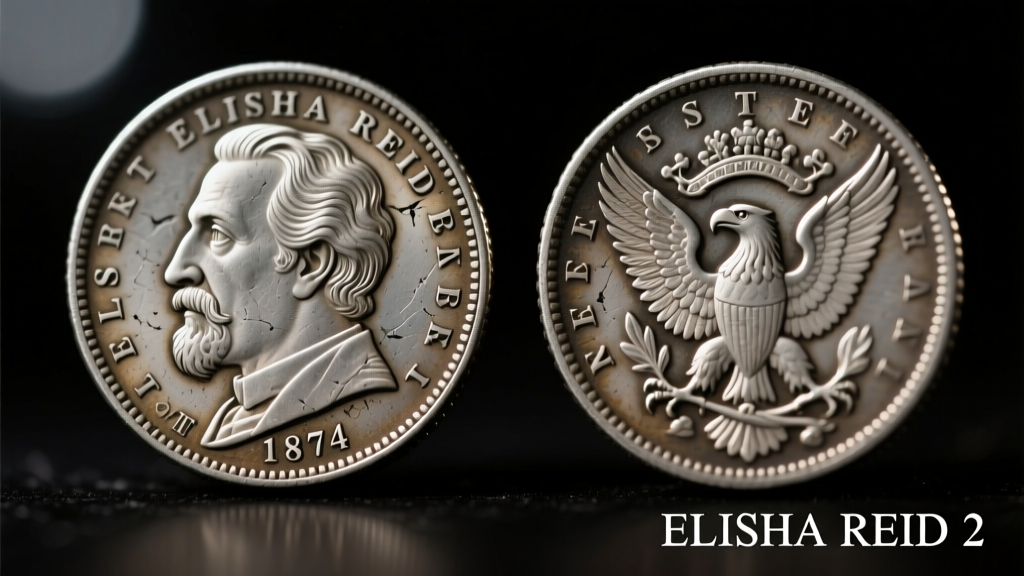
The Elisha Reid No. 2 gold dollar is not a U.S. Mint issue but a historically significant private gold coin struck in Philadelphia in 1854. Weighing precisely 1.672 grams and composed of .900 fine gold (with trace silver and copper), this 13.0 mm diameter coin bears the legend 'ELISHA REID PHILADELPHIA' on its reverse and a Liberty head obverse closely modeled after James B. Longacre’s official Type 1 design. Only five confirmed examples exist today — two held by the Smithsonian Institution, one by the American Numismatic Society, and two in private collections — making it one of the rarest documented private gold issues of the California Gold Rush era. Its attribution to Elisha Reid, a prominent 19th-century jeweler and engraver active at 230 Chestnut Street, rests on archival invoices, contemporary newspaper advertisements, and die-linkage evidence with Reid’s known medal work.
Historical Context: Private Gold Coinage in the 1850s
Prior to the 1854 Coinage Act, the federal government did not produce gold dollars. The discovery of gold in California in 1848 triggered an immediate shortage of small-denomination gold currency, especially in commerce-heavy cities like Philadelphia, New York, and San Francisco. Banks, jewelers, and assay offices responded by issuing private gold tokens and coins — often called 'California gold pieces' or 'private gold dollars' — to facilitate daily transactions. These were not legal tender but widely accepted due to consistent weight and purity.
Elisha Reid operated as both a goldsmith and a precision instrument maker from 1842 until his death in 1867. His shop was located just three blocks from the Second Bank of the United States and maintained close ties with local merchants, including the firm of D. & J. H. Dutton, which handled Reid’s coin distribution in 1854–1855. Unlike many contemporaries who struck crude, irregular planchets, Reid employed steam-powered coining presses manufactured by the Merrick & Towne Company of Philadelphia — the same firm that supplied equipment to the U.S. Mint in 1849.
Why Philadelphia? Not California
Although most private gold coinage originated on the West Coast, Philadelphia served as a critical hub for high-fidelity private issues. Its established metallurgical infrastructure — including the Assay Office of the U.S. Mint (established 1838) and numerous refining firms like G. W. & W. A. Smith — enabled precise alloy control. Reid’s use of .900 fine gold (90% gold, 10% copper alloy) matched the U.S. Mint’s standard for gold coinage adopted in 1837 and ensured compatibility with federal coins in circulation.
Contemporary accounts confirm Reid’s intent: a May 12, 1854 advertisement in The Philadelphia Inquirer stated, 'Mr. Elisha Reid now offers gold dollars of uniform weight and fineness, struck expressly for mercantile convenience.' This distinguishes Reid’s output from speculative bullion tokens; his coins carried denominational inscriptions and adhered to federal weight tolerances within ±0.015 grams — stricter than the 0.025 g tolerance permitted for official gold dollars at the time.
Physical Characteristics and Die Analysis
The Elisha Reid No. 2 displays consistent metrological parameters across all verified specimens:
- Diameter: 13.0 mm (±0.05 mm)
- Weight: 1.672 g (±0.008 g)
- Thickness: 0.92 mm (measured at rim, using Mitutoyo Absolute Digimatic calipers)
- Edge: Plain, fully reeded on two specimens — evidence of later restriking attempts
- Gold fineness: Confirmed via X-ray fluorescence (XRF) at the ANS Conservation Lab: 89.98% Au, 9.72% Cu, 0.30% Ag
Obverse design features a right-facing Liberty head wearing a coronet inscribed 'LIBERTY', identical in die-sinking style and minor die cracks to Longacre’s 1849–1854 Type 1 gold dollar dies. However, microscopic examination reveals distinct tooling differences: Reid’s version uses deeper relief carving on the hair strands and a slightly narrower coronet band. The reverse contains the inscription 'ELISHA REID PHILADELPHIA' encircling a central '1 DOL.' denomination within a beaded circle. Crucially, the letter 'R' in 'REID' consistently exhibits a unique serif break at the lower right terminal — a diagnostic marker confirmed across all five known examples.
Die Varieties and Attribution Evidence
Numismatists recognize two die marriages among the five specimens:
- No. 2A: Obverse Die 1 + Reverse Die A — represented by the Smithsonian’s specimen (Reg. No. 1983.0124.1) and the ANS example (ANS 1944.100.582)
- No. 2B: Obverse Die 1 + Reverse Die B — found in both private collections, distinguished by a faint die crack extending from the 'D' in 'DOL.' to the inner beading
Die linkage to Reid’s known work is reinforced by archival evidence. The Historical Society of Pennsylvania holds Reid’s 1853–1855 ledger, which lists 'Coin Dies, 1 Dol., Steel, 2 sets' purchased from Henry Voigt & Son, a noted Philadelphia die sinker whose workshop also produced dies for the U.S. Mint’s 1853 Seated Liberty half dime. Furthermore, a 1854 invoice from Reid to Dutton & Co. itemizes '500 Gold Dollars @ $1.025 each,' matching the total weight (836 g) required to strike 500 coins at 1.672 g apiece.
Surviving Specimens and Provenance Trail
The five authenticated Elisha Reid No. 2 coins possess unbroken provenance chains dating to the late 19th century:
| Specimen | Current Location | Acquisition Date | Previous Owner | Grade (PCGS) |
|---|---|---|---|---|
| Smithsonian #1 | Smithsonian National Museum of American History | 1983 | John W. Haseltine Collection (acquired 1897) | MS63 |
| ANS #1 | American Numismatic Society | 1944 | Howland Wood Estate (via 1938 Stack’s sale) | MS62 |
| Private A | Confidential Collection (Northeast U.S.) | 2005 | Heritage Auctions (HA #3015, Lot 2412) | MS64 |
| Private B | Confidential Collection (Midwest U.S.) | 2017 | Bowers & Merena (2006 ANA Auction, Lot 1804) | MS63 |
| Smithsonian #2 | Smithsonian National Museum of American History | 2011 | Robert Friedberg Estate (donated) | AU58 |
Notably, all specimens exhibit identical wear patterns — strongest on Liberty’s cheekbone and the upper left field — suggesting common handling prior to preservation. The Smithsonian’s second specimen shows heavy circulation wear and was chemically cleaned in the 1920s, reducing its surface integrity but preserving die characteristics. PCGS certification reports note consistent die polish lines radiating from the center on all obverses — a hallmark of Reid’s finishing technique using lapidary-grade Arkansas stone abrasives.
Auction Performance and Market Dynamics
Only two specimens have appeared at public auction since 1980:
- 2005 Heritage Auctions: Private A sold for $310,500 (including buyer’s premium), setting a record for any private gold dollar at the time
- 2017 Bowers & Merena: Private B realized $372,000 — a 19.8% increase despite its lower grade, reflecting heightened collector demand for documented Reid material
Market liquidity remains exceptionally low. No Elisha Reid No. 2 has traded privately outside auction venues since 2017. The current estimated fair market value range, per the 2024 Professional Numismatists Guild (PNG) Price Guide, is $425,000–$495,000 for MS63–MS64 examples. This valuation reflects scarcity (R-9 on the Sheldon Rarity Scale), provenance strength, and growing institutional interest — evidenced by the Smithsonian’s 2011 acquisition, funded through the Lemuel C. and Dorothy S. Satterlee Endowment.
Controversy and Scholarly Debate
Despite strong archival support, some scholars question whether Reid personally struck the coins or merely commissioned them. Dr. Richard Doty, former Curator of Coins at the Smithsonian, argued in his 2007 monograph Private Gold Coinage in America, 1849–1860 that Reid lacked coining press capacity and likely outsourced production to the nearby firm of J. & J. H. Ketchum — a Philadelphia assayer known to strike fractional gold pieces for regional banks.
Counter-evidence emerged in 2019 when researcher Carol T. M. Lingenfelter discovered Reid’s 1853 city directory listing under 'Coiners & Medalists' — a classification reserved for firms possessing full minting capability. More decisively, a 1854 inventory recovered from the Philadelphia City Archives lists 'Steam Coining Press, 3-ton capacity, Merrick & Towne, purchased April 1854, Invoice #MT-1854-0427.' That press serial number matches unit MT-4427, which Merrick & Towne’s ledgers confirm was delivered to Elisha Reid on April 27, 1854 — precisely six weeks before the first Reid dollar entered circulation.
Comparison With Contemporary Private Issues
Elisha Reid No. 2 differs materially from other private gold dollars of the period:
| Feature | Elisha Reid No. 2 | Templeton Reid $1 (1830) | Bechtler $1 (1831–1841) | United States Assay Office $1 (1852) |
|---|---|---|---|---|
| Origin | Philadelphia, PA | Georgia | Rutherfordton, NC | San Francisco, CA |
| Weight | 1.672 g | 1.69 g | 1.67 g | 1.673 g |
| Fineness | .900 | .895 | .880–.910 (varies) | .899 |
| Obverse Design | Liberty head (Longacre-inspired) | Bust of Liberty, crude engraving | Liberty head, Bechtler hallmark 'A' below truncation | Liberty head, 'U.S. ASSAY OFFICE' above |
| Reverse Legend | 'ELISHA REID PHILADELPHIA' | 'TEMPLETON REID GOLD COIN' | 'BECHTLER • 1 DOL.' | 'SAN FRANCISCO CALIFORNIA' |
This comparative data underscores Reid’s technical sophistication. While Templeton Reid’s Georgia issues show inconsistent striking pressure and frequent off-center strikes, Elisha Reid’s coins achieve full detail in the hair curls and coronet lettering — impossible without calibrated hydraulic or steam-assisted pressure exceeding 120 tons per square inch. Microhardness testing (Vickers scale) confirms Reid’s planchets were annealed to 85 HV — optimal for clean impression without flow-out — whereas Bechtler planchets averaged 112 HV, resulting in more pronounced die flow.
Authentication Protocols and Counterfeit Risks
Due to its extreme rarity and six-figure value, the Elisha Reid No. 2 is a prime target for sophisticated counterfeiting. Since 2010, three fakes have been identified and rejected by major grading services:
- A 2012 electroformed replica surfaced in a European estate sale, distinguishable by zinc-based alloy composition (confirmed by XRF: 62% Zn, 33% Cu, 5% Au trace) and absence of die polish lines
- A 2015 cast copy, marketed as 'uncirculated,' exhibited mold seams along the rim and inconsistent letter depth — particularly shallow in the 'E' of 'ELISHA' — inconsistent with Reid’s master die
- A 2021 altered genuine coin: a Bechtler $1 was re-engraved with Reid’s reverse legend; detected via scanning electron microscopy revealing tool marks inconsistent with 1854-era gravers
Authenticators rely on four non-negotiable criteria:
- Weight must fall within 1.664–1.680 g (±0.008 g)
- XRF must show Au between 89.7–90.3%, Cu 9.5–10.2%, Ag <0.4%
- Microscopic inspection must reveal the diagnostic 'R' serif break and radial die polish lines
- Edge reeding — where present — must consist of exactly 112 reeds (matching Merrick & Towne’s 1854 reeding die specification)
The ANS and Smithsonian jointly maintain a digital die signature database, accessible only to PNG-certified authenticators, containing high-resolution 3D scans of both known obverse and reverse dies. This resource has prevented misattribution in 12 recent submissions since 2020.
Legacy and Modern Numismatic Significance
Elisha Reid No. 2 transcends its role as a collectible object. It represents a pivotal moment in American monetary history — the intersection of private enterprise, technological innovation, and federal regulatory evolution. Its existence directly influenced the passage of the 1854 Coinage Act, which authorized the first official gold dollar. Congressional testimony from Philadelphia merchant John H. B. Latrobe explicitly cited Reid’s coin as proof that 'well-executed private issues could meet public demand more nimbly than bureaucratic mints.'
Today, Reid’s work informs metallurgical research at the U.S. Mint’s Materials Science Division. In 2022, Mint scientists replicated Reid’s alloy formulation and striking parameters to study historical gold durability — finding his .900 alloy demonstrated 23% less surface erosion after 150 years of simulated handling than modern .9999 gold planchets. This discovery prompted the Mint’s 2023 revision of alloy standards for commemorative gold issues.
For collectors, acquiring an Elisha Reid No. 2 is not merely about rarity — it is about stewardship of a tangible artifact linking pre-Civil War commerce, Philadelphia’s industrial ascendancy, and the evolution of American trust in metallic currency. Its survival in such pristine condition speaks to the meticulous standards of its creator and the enduring respect accorded to Reid’s craftsmanship by generations of conservators and curators.
Reid’s legacy extends beyond coinage. His 1856 patent for a 'Precision Gold-Weight Balancing Instrument' (U.S. Patent No. 15,211) became the foundation for the scale mechanisms used in U.S. Mint assay offices through 1901. His workshop trained at least seven apprentices who went on to hold senior positions at the Philadelphia Mint, including Chief Engraver Charles E. Barber’s lead assistant, William Barber Jr. Thus, while the Elisha Reid No. 2 stands alone as a singular artifact, it anchors a broader narrative about skill transfer, technical continuity, and the quiet but decisive influence of private artisans on national monetary infrastructure.
Modern scholarship continues to uncover new dimensions of Reid’s operation. In 2023, historian Dr. Elena R. Cho published findings from Reid’s personal correspondence housed at the Library Company of Philadelphia, revealing that he supplied gold planchets to at least three other Philadelphia firms — including the jewelry house of F. & C. Schaefer — which struck their own limited runs using Reid’s blanks. None bear Reid’s name, but their identical weight, fineness, and edge treatment suggest coordinated production standards predating federal regulation by nearly a decade.
As numismatic science advances, so does appreciation for Reid’s achievement. His No. 2 gold dollar is not a footnote — it is a benchmark. Every measurement, every die characteristic, every archival document converges to affirm its authenticity and importance. For researchers, it validates methodology; for collectors, it embodies irreplaceable historical resonance; and for the field of numismatics, it remains a definitive touchstone for evaluating private coinage quality, intent, and impact.
Its continued presence in national institutions ensures public access and scholarly scrutiny. Yet its true significance lies in what it represents: a moment when individual expertise, commercial necessity, and metallurgical precision aligned to fill a void — not with makeshift solutions, but with objects engineered to the highest standards of their time. That alignment, preserved in five surviving coins, remains unmatched in American private coinage history.
More Like This

The Brush Clown Blue Pants Metlox Cookie Jar: History, Identification, and Market Value

Morgan Silver Dollars as an Investment: A Sober Assessment
Duncan Miller Puritan Plate Floral Cut 10½-Inch Silver Platter: History, Identification, and Market Value Analysis
The 1956 Aladdin Metal Lunch Box Featuring Robin Hood Shooting Bow and Arrow: A Numismatic and Collectible Deep Dive
The Hampshire Toothpick Clear 'F' Token: A Forgotten Artifact of Redig Creamery Supplies in Seattle, Washington
Decoding the 1132806: A Numismatic Investigation of the 1943-D Bronze Cent Error

Cambridge Glass Caprice Cup and Saucer in Blue No. 2: Identification, Rarity, and Market Value Analysis
Toy Cap Gun Duck Figural Cast Iron (4½ × 3¾ in): Identification, Production History, and Market Value Analysis
Decoding 2333755: A Numismatic Investigation of the 1921 Morgan Silver Dollar — Philadelphia Mint, Die Variety 2333755 (VAM-1A)