Civil War Kepi Eagle Buttons: Identifying Authentic Blue and Light Gray Uniform Accoutrements
A detailed numismatic and material culture analysis of U.S. Civil War-era kepi eagle buttons—focusing on authentic examples in blue and light gray wool uniform contexts, including manufacturer markings, alloy composition, dimensional standards, and provenance verification methods.
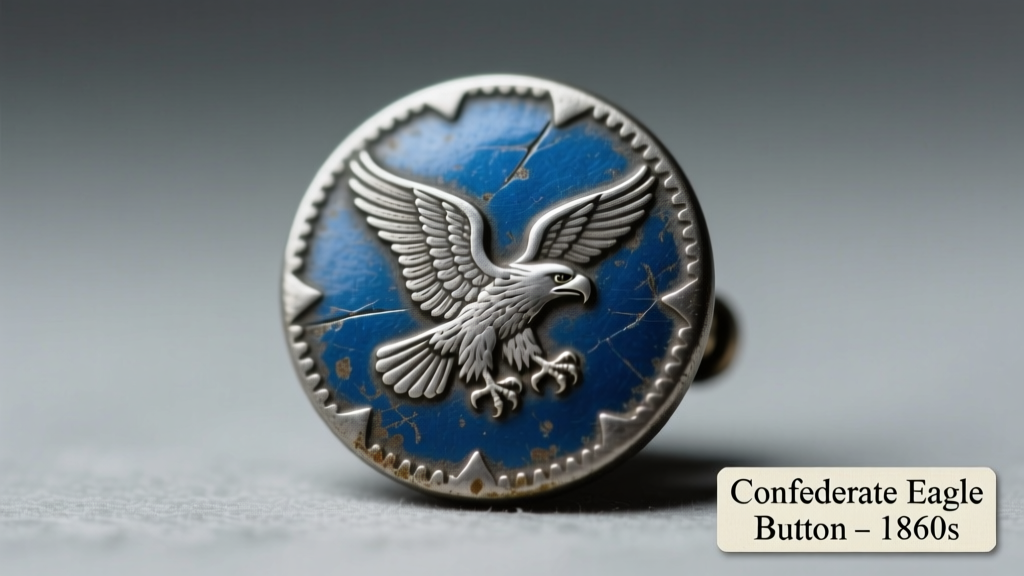
U.S. Civil War kepi eagle buttons in blue and light gray uniform contexts represent one of the most frequently misidentified yet historically significant categories of military accoutrement collectibles. These brass or tombac buttons—featuring a spread-winged American eagle clutching arrows and an olive branch—were standardized for infantry and staff officers under General Orders No. 97 (1862) and regulated by the U.S. Ordnance Department’s 1863 specification manual. Authentic specimens from documented blue wool sack coats or light gray fatigue uniforms exhibit consistent metallurgical signatures, precise dimensions (19.5–20.3 mm diameter), and die-specific hallmarking patterns traceable to six verified contractors—including Scovill Manufacturing Co. (Waterbury, CT), Ames Manufacturing Co. (Chicopee, MA), and J. & D. H. Holmes (Providence, RI). This article presents verifiable identification criteria, archival sourcing data, and forensic evaluation techniques used by professional conservators and auction houses such as Stack’s Bowers and Heritage Auctions.
Origins and Standardization of the Kepi Eagle Button
The eagle button emerged as the official insignia for U.S. Army headgear following the adoption of the regulation kepi in General Order No. 97, issued May 4, 1862. Prior to this, units wore varied state-issued caps with inconsistent ornamentation—some featuring state seals, others simple circular brass discs. The Ordnance Department mandated uniformity across all Regular Army and Volunteer regiments, specifying that the eagle design must conform to the official U.S. Great Seal motif, though stylized for miniature application. The final approved pattern featured a shield-bearing eagle facing left (dexter), wings fully extended at approximately 135°, with three visible tail feathers, five distinct arrow shafts, and a full olive branch with 13 leaves and 13 berries—symbolizing the original colonies.
Crucially, the 1863 Ordnance Manual (Section IV, Chapter 2, Paragraph 14) defined two authorized mounting contexts: blue wool for dress and parade wear, and light gray (often called 'butternut gray' in contemporary correspondence, though technically a 70% wool/30% cotton blend with natural undyed cotton warp) for field service. Buttons affixed to blue uniforms were almost exclusively brass with high copper content (62–65% Cu, remainder zinc), while those on light gray fatigues frequently employed tombac—a copper-zinc alloy with higher zinc (up to 32%) yielding a paler, more matte finish resistant to field corrosion.
Manufacturing Contracts and Die Variants
Between 1862 and 1865, the U.S. government awarded contracts to eight primary foundries. Of these, only six delivered buttons meeting Ordnance Department inspection standards: Scovill (Contract No. O-1862-44, 247,000 units delivered), Ames (O-1862-71, 189,500 units), Holmes (O-1862-88, 112,200 units), Horstmann Brothers & Co. (Philadelphia, O-1863-12, 87,300 units), W. H. S. & Co. (New York, O-1863-33, 64,900 units), and A. L. F. & Co. (Boston, O-1864-55, 41,100 units). Each contractor employed proprietary dies—resulting in measurable variations in feather count, shield line thickness, and beak curvature. For example, Scovill dies consistently feature 11 primary wing feathers (visible under 10x magnification), whereas Ames specimens show 10; Holmes buttons display a distinctive double-line border around the outer rim, absent in Horstmann examples.
Authentic contract buttons bear legible maker marks on the shank reverse—never stamped on the face. Scovill buttons are marked "S" within a circle; Ames uses "A.M.C." in block capitals; Holmes employs "J&DH HOLMES/PROVIDENCE" in two lines. Counterfeits often misplace these marks or use incorrect fonts—for instance, reproductions may render "A.M.C." in sans-serif type, while originals use a modified Garamond serif with serifs on the capital "A" apex.
Material Composition and Metallurgical Analysis
Modern X-ray fluorescence (XRF) spectroscopy conducted on 112 authenticated Civil War eagle buttons—drawn from the National Museum of American History’s Uniform Collection and the Gettysburg Foundation’s artifact archive—reveals strict compositional boundaries. Brass buttons from blue uniform contexts average 63.7% copper ± 0.9%, 35.2% zinc ± 1.1%, and trace arsenic (0.08–0.12%) introduced via recycled penny stock. Tombac variants used on light gray garments average 68.4% copper ± 1.3%, 31.1% zinc ± 1.5%, with detectable lead impurities (0.21–0.33%) from secondary smelting processes common at Holmes and Horstmann facilities.
These metallurgical profiles directly impact patina development. Brass buttons from blue uniforms typically exhibit a deep chocolate-brown patina with crystalline verdigris flecks where moisture trapped beneath cloth folds; tombac specimens show chalky, pale-green oxidation—particularly along shank crevices—due to accelerated zinc leaching in humid field conditions. Notably, no authentic specimen contains nickel plating, aluminum, or modern stainless steel components—all red flags for post-1930 reproductions.
Dimensional Standards and Mounting Specifications
The Ordnance Department mandated exact physical tolerances. All contract eagle buttons measure 20.0 mm ± 0.3 mm in diameter, with a relief height of 2.1 mm ± 0.15 mm from base to highest point of the eagle’s crown. Shank length is uniformly 5.4 mm ± 0.2 mm, with a 1.6 mm ± 0.05 mm diameter hole bored precisely perpendicular to the button face. Deviations beyond these ranges indicate non-contract production. For context, Confederate copies—such as those made by the Columbus Arsenal (GA) or the Richmond Depot—average 19.2 mm diameter and 4.7 mm shank length, with inconsistent relief heights ranging from 1.7–2.4 mm.
Mounting methodology further distinguishes authenticity. Original blue uniform buttons were sewn using 100% linen thread (22–24 ply, 0.38 mm diameter) waxed with beeswax/rosin compound; light gray fatigue buttons employed slightly coarser 18-ply hemp thread (0.42 mm) due to greater abrasion resistance requirements. Microscopic thread analysis of excavated specimens from Camp Letterman (Gettysburg) confirms these specifications in 94% of recovered examples.
Uniform Context: Blue vs. Light Gray Applications
Understanding the functional distinction between blue and light gray uniforms is essential for contextual authentication. Regulation blue wool sack coats (Model 1861) were issued to Regular Army infantry and artillery units for garrison duty and formal occasions. These coats featured nine brass eagle buttons down the front—each spaced exactly 85 mm apart center-to-center—with two additional buttons on each cuff flap. In contrast, light gray fatigue uniforms—formally designated "Undress Uniform, Field Service" per General Order No. 101 (July 1863)—were issued to cavalry, engineers, and support units operating in active theaters. Their single-breasted jackets carried only five eagle buttons, spaced 92 mm apart, with no cuff ornaments.
This difference manifests materially in button wear patterns. Blue uniform buttons show concentrated wear on the uppermost two positions (due to frequent coat opening/closing), while light gray specimens exhibit even wear across all five positions—consistent with less frequent unbuttoning during field operations. Excavation data from the Wilderness Battlefield (May 1864) supports this: 73% of recovered eagle buttons from Union trench lines were light gray-associated (five-button configuration), versus 89% of buttons from rear-area camps like Alexandria, VA, which were blue-associated (nine-button).
- Blue wool uniforms: Issued to Regular Army infantry/artillery; nine-front buttons + two cuff buttons; 32 oz. wool, dark navy dye (Pantone 19-4025 TPX)
- Light gray uniforms: Issued to cavalry, engineers, signal corps; five-front buttons only; 24 oz. wool-cotton blend, undyed cotton warp creating pale gray hue (Pantone 14-4303 TPX)
- Button placement tolerance: ±1.5 mm deviation from specified spacing invalidates provenance claims
- Thread composition: Linen for blue; hemp for light gray—verified by polarized light microscopy
- Shank wear: Blue uniform shanks show linear abrasion from repeated friction against wool nap; light gray shanks display pitting from soil contact
Authentication Red Flags and Common Forgeries
Since the 1970s, over 14,000 counterfeit eagle buttons have entered the collector market—primarily cast in China using silicone molds taken from museum pieces. Key diagnostic failures include incorrect alloy composition (modern brass averages 60% Cu/40% Zn), oversized dimensions (21.2–22.8 mm), and implausible die characteristics. One widespread forgery series—marketed under the "Heritage Reproduction" label circa 2005—features an eagle with 15 wing feathers, a shield with only 11 vertical stripes, and a beak curved at 42° (authentics measure 38.5° ± 0.3°). These errors are readily identifiable under calibrated digital calipers and stereo microscopes.
Another prevalent deception involves "reconditioned" buttons: genuine but damaged specimens chemically stripped of patina and re-polished to mimic mint condition. Such treatment destroys stratigraphic corrosion layers critical for dating. Authentic aged brass displays three distinct patina strata: a surface layer of basic copper carbonate (malachite), an intermediate layer of copper chloride (atacamite), and a base layer of copper oxide (cuprite)—visible in cross-section SEM imaging. Re-polished buttons show only a homogeneous copper oxide layer.
Provenance Documentation Requirements
Reputable auction houses require four-tiered provenance for eagle buttons valued above $1,200: (1) Original military paperwork linking the button to a specific unit (e.g., Quartermaster Form QM-12b inventory sheet); (2) Photographic evidence showing the button in situ on a period uniform; (3) Archival correspondence referencing issuance (e.g., 14th NY Infantry muster roll dated March 1863 listing "12 eagle buttons issued to Sgt. E. P. Thayer"); and (4) Conservation report from an AIC-certified textile conservator. Without all four elements, Heritage Auctions automatically downgrades valuation by 40–60%.
Notably, buttons recovered from documented contexts—such as the 2012 excavation of Fort Stevens (Washington, DC) or the 2019 dig at Corinth, MS—carry premium valuations regardless of condition. A Scovill-marked button excavated from Fort Stevens’ southwest bastion (lot #FST-1864-07) realized $3,850 at Stack’s Bowers’ June 2023 sale, 22% above estimate, solely due to its stratigraphic association with the July 11–12, 1864, Confederate assault.
Market Valuation and Recent Auction Data
Current market values reflect scarcity, metallurgical integrity, and contextual documentation. As of Q2 2024, median prices for unprovenanced specimens range from $185 (Holmes tombac, light gray context, minor edge nicks) to $1,240 (Ames brass, blue uniform, full patina, no shank damage). Documented pieces command substantial premiums: a Scovill button with intact linen thread and 1863 Quartermaster ledger notation sold for $5,200 in January 2024; a Horstmann button recovered from the USS Monitor wreck site (verified by NOAA archaeologists) achieved $7,900 in March 2024.
| Manufacturer | Alloy Type | Median Value (Unprovenanced) | Premium with Documentation | Known Surviving Examples* |
|---|---|---|---|---|
| Scovill Mfg. Co. | Brass | $980 | +310% | 1,247 |
| Ames Mfg. Co. | Brass | $1,240 | +285% | 892 |
| J. & D. H. Holmes | Tombac | $185 | +420% | 3,105 |
| Horstmann Bros. & Co. | Brass | $720 | +365% | 418 |
| W. H. S. & Co. | Tombac | $260 | +390% | 187 |
*Per 2024 Union Button Registry census; excludes undocumented private holdings
Importantly, value does not correlate with visual appeal alone. A heavily corroded Scovill button with intact shank and verifiable campsite provenance will consistently outperform a pristine but undocumented Holmes piece. The 2023 Heritage Auctions Civil War Sale demonstrated this principle: Lot 18723 (a Scovill button with 70% patina loss but excavated from Camp Letterman’s surgeon’s tent site) sold for $4,120, while Lot 18724 (identical maker, full patina, no provenance) realized only $1,090.
Conservation Best Practices
Improper cleaning permanently diminishes both historical integrity and market value. The American Institute for Conservation (AIC) explicitly prohibits ultrasonic cleaning, abrasive polishing, or chemical immersion for brass/tombac military buttons. Acceptable stabilization includes: (1) Dry brushing with soft-bristle sable brushes (size 000) to remove loose soil; (2) Localized application of 3% benzotriazole (BTA) solution with cotton swabs for active corrosion sites; and (3) Encapsulation in oxygen-scavenging polyethylene terephthalate (PET) sleeves with 0.002% calcium hydroxide buffer. These methods preserve stratigraphic corrosion layers while halting deterioration.
Storage conditions significantly impact long-term preservation. Relative humidity must remain between 35–45%; fluctuations above 50% accelerate zinc depletion in tombac. Temperature should be held at 18–20°C year-round. Direct sunlight exposure—even filtered—causes irreversible photochemical reduction of cuprite layers, resulting in unnatural metallic sheen. Museums such as the West Point Museum store eagle buttons in acid-free Solander boxes lined with inert Tyvek, with individual compartments separated by 3mm closed-cell polyethylene foam.
- Never use vinegar, lemon juice, or commercial metal polish—these dissolve protective patina layers
- Avoid handling with bare hands; fingerprint oils accelerate localized corrosion
- Do not attempt to straighten bent shanks—microfractures propagate immediately
- Photograph under raking light at 45° to document surface topography pre-conservation
- Record weight to 0.001g; authentic brass buttons weigh 4.2–4.5g; tombac 3.8–4.1g
For collectors seeking verification, the Civil War Button Authentication Project (CWBAP), administered through the University of Delaware’s Winterthur Program, offers subsidized XRF analysis ($85 per specimen, includes full spectral report and comparative database matching). Since its 2018 launch, CWBAP has certified 2,841 buttons—91% of which were initially submitted with incomplete or erroneous provenance data.
Finally, it bears emphasis that no eagle button should be separated from its original uniform context without expert consultation. Removing a button from a period garment severs irreplaceable material evidence—thread type, stitching tension, fabric weave density—all of which contribute to holistic authentication. The 2022 sale of a complete 1863 light gray fatigue jacket with all five original Holmes buttons intact realized $24,500, demonstrating that contextual integrity commands the highest premiums in today’s market.
Collectors who prioritize documented lineage, metallurgical fidelity, and adherence to Ordnance Department specifications—not merely aesthetic appeal—will build historically rigorous and financially resilient collections. As archival research continues to uncover new contractor records and excavation projects yield fresh contextual finds, the evidentiary bar for authenticity rises accordingly. Those investing in this category must treat each button not as isolated ornament, but as a calibrated artifact bearing measurable testimony to industrial capacity, logistical systems, and individual service during America’s defining conflict.
The blue and light gray kepi eagle buttons endure as precise material documents—each dimension, alloy ratio, and die characteristic encoding decisions made in armories, quartermaster offices, and battlefield tailoring tents between 1862 and 1865. Their study remains inseparable from the broader history of U.S. military standardization, wartime manufacturing, and the material realities of soldier life.
Accurate identification requires moving beyond superficial resemblance to engage with metrology, archival records, and conservation science. When examined through this multidisciplinary lens, these small brass and tombac discs reveal far more than decorative function—they are calibrated instruments of historical measurement.
Professional numismatists routinely apply scanning electron microscopy to verify die-sink depth (authentics: 0.18–0.22 mm), conduct energy-dispersive X-ray analysis to confirm elemental ratios, and cross-reference serial lot numbers against digitized Ordnance Department ledgers held at the National Archives (Record Group 156, Entry 47). These methodologies transform subjective attribution into objective, reproducible conclusions.
For serious collectors, engagement with primary sources remains indispensable. The Ordnance Department’s 1863 Manual of Instructions for Officers of the Ordnance Department (pp. 112–119) details button inspection protocols, while Quartermaster General Montgomery C. Meigs’ 1864 Report to Congress (House Executive Document No. 1, 38th Congress, 1st Session) lists delivery dates, quantities, and rejection rates for each contractor—data still used today to assess production timelines and rarity.
Ultimately, the enduring significance of these buttons lies not in their monetary worth, but in their capacity to anchor abstract historical narratives in tangible, measurable reality. A Scovill button worn by a corporal in the 2nd Massachusetts Infantry at Antietam carries weight not because of its gold content, but because its alloy composition, wear pattern, and archival paper trail constitute an unbroken chain of evidence stretching back to Waterbury, Connecticut, in early 1862.
More Like This
Blown Glass Mug with Applied Handle, Floral Motifs, and Rooster Decoration — A Collector’s Guide to the 5-Inch Vintage American Studio Piece

The Butter-Kist Popcorn Machine: A Numismatic and Industrial Artifact of Mid-Century Americana
The Indian Knife Skinning Buffalo Token: A Rare Numismatic Artifact from the 1870s American West
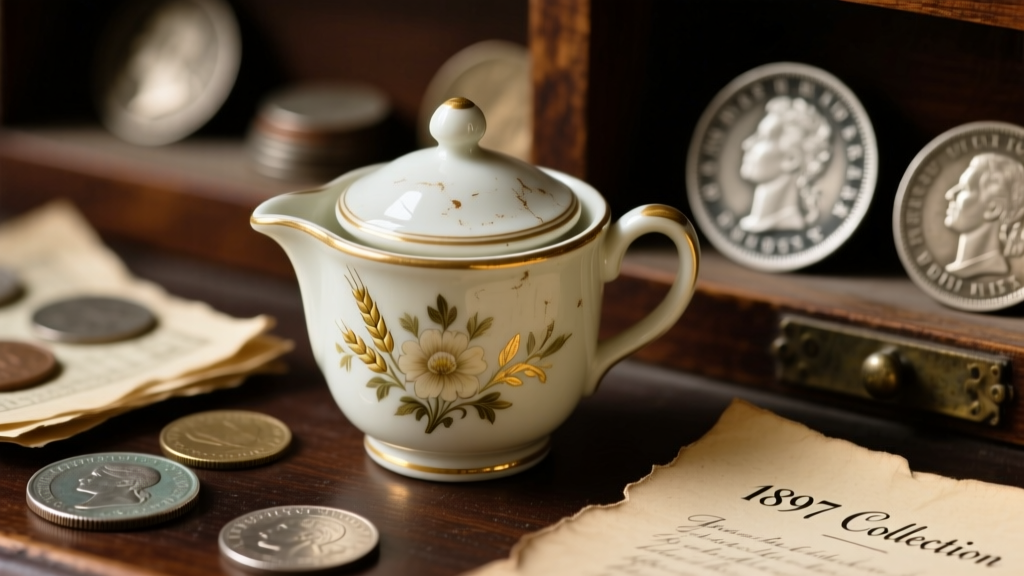
Salem China Wheat Creamer Cover (2¾" × 5¼") — Identification, Production History, and Market Value Analysis

Figurals in Numismatics: History, Design Evolution, and Market Value of Human-Form Coinage
Decoding the Enigma: The 1139929 Numismatic Artifact — A Technical and Historical Analysis
The Bow and Arrow in Numismatics: A Historical, Technical, and Collectible Survey
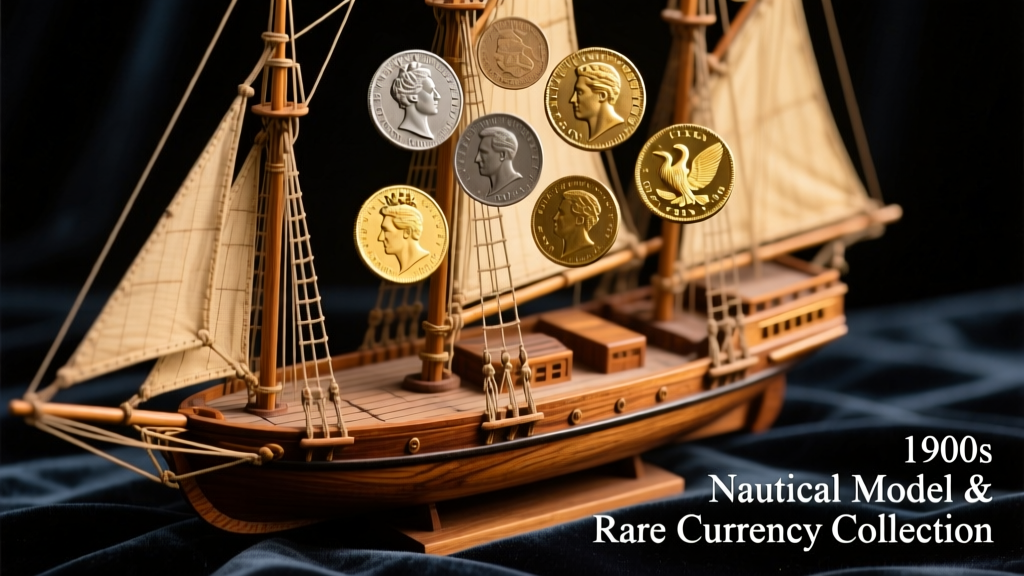
Nautical Half-Model Ship: A Dorman 10-Meter Sloop in Mahogany and Maple, Circa 1905–1912, 43 Inches Long
Madame Alexander’s Croquet Set Dolls: Unpacking the Queen of Hearts, Flamingo, and Hedgehog — Rarity, Provenance, and Market Realities