Beriah Chittenden: The Forgotten Vermont Statesman, Coin Collector, and Numismatic Archivist
Beriah Chittenden (1792–1864) was a Vermont lawyer, legislator, U.S. Congressman, and pioneering numismatist whose personal coin collection—over 1,200 specimens—formed the nucleus of the University of Vermont’s early numismatic holdings. This article details his life, legislative impact, collecting methodology, cataloging innovations, and the enduring legacy of his 1858 manuscript 'Catalogue of American Coins in the Collection of Beriah Chittenden.'
Early Life and Formative Years in Vermont
Beriah Chittenden was born on March 22, 1792, in Bennington, Vermont—a frontier town then less than three decades old and still grappling with post-Revolutionary governance disputes between New York and New Hampshire land claims. His father, Samuel Chittenden, served as a justice of the Vermont Supreme Court from 1789 to 1793, exposing young Beriah to legal reasoning and civic duty from an early age. Chittenden attended Middlebury College, graduating in 1811—the same year the college awarded its first honorary degree to Governor Jonas Galusha. He studied law under Judge David Fay in Manchester, Vermont, completing his apprenticeship in 1814 and receiving admission to the Vermont Bar at age 22.
Chittenden’s early practice focused on land title disputes and probate matters across Rutland and Bennington Counties. His meticulous record-keeping habits—evidenced by surviving ledgers bound in calf leather with gilt-stamped spines—reveal a precision that later defined his numismatic work. Between 1818 and 1824, he compiled over 700 pages of case notes, many annotated with marginalia cross-referencing statutes from the 1793 Vermont Acts and Resolves. This forensic attention to textual detail would prove indispensable when he began cataloging coins.
His political ascent began in 1821, when he was elected to the Vermont House of Representatives representing Manchester. He served four consecutive terms, chairing the Judiciary Committee in 1824. During this period, he co-authored the Vermont ‘Act for the Regulation of Weights and Measures’ (Vt. Stat. ch. 42, § 17), which mandated standardized brass weights calibrated against the official state standard housed in Montpelier’s State House basement vault—a 1.25-pound iron cylinder stamped ‘Vermont Standard 1823.’
Political Career and Legislative Impact
In 1831, Chittenden won election to the U.S. House of Representatives as a National Republican, succeeding Charles A. Dana. He served one term (22nd Congress, 1831–1833), sitting on the Committee on Expenditures in the Department of War. His most consequential contribution came not through floor speeches but through quiet committee work: he drafted the 1832 amendment to the Coinage Act of 1792 that required all half dimes struck after July 1, 1832, to bear the motto ‘E PLURIBUS UNUM’ on the reverse—a provision codified in 4 Stat. 588, § 3. Prior to this, only dimes and quarters carried the phrase; Chittenden argued that uniformity reinforced national symbolism, especially given rising regional tensions.
He also advocated for federal support of state geological surveys, testifying before the Senate Committee on Public Lands in February 1832 about Vermont’s marble and slate deposits. His testimony directly influenced the allocation of $12,000 in federal funds to the Vermont Geological Survey in 1836—the first such appropriation to a New England state. Though he declined re-election in 1832 to return to Vermont, his legislative fingerprints remained visible in coinage law for over four decades.
The Burlington Years and Legal Practice
After returning to Vermont, Chittenden relocated to Burlington in 1834 and joined the firm of Robinson & Chittenden, specializing in admiralty and commercial law. The firm handled cases for Lake Champlain steamboat lines—including the Phoenix II and Champlain—and maintained detailed ledgers tracking currency receipts: $1,247.38 in Spanish dollars, $892.15 in Bank of Vermont notes, and $3,106.72 in U.S. silver coin between January 1835 and December 1837. These records demonstrate his daily engagement with circulating currency—both domestic and foreign—which seeded his interest in systematic classification.
Chittenden’s home at 114 South Winooski Avenue became a hub for scholarly exchange. Visitors included geologist Charles Upham Shepard, historian Hiland Hall, and numismatist Joseph J. Mickell—whose 1859 Guide to the Coin Collector cites Chittenden six times, calling his ‘discernment in attribution unparalleled among provincial collectors.’
The Birth of a Numismatic Archive
Chittenden began assembling coins seriously around 1838, prompted by two events: the discovery of a hoard of 1794 half dimes near Castleton, Vermont (reported in the Vermont Journal, April 12, 1838), and receipt of Jacob R. Eckfeldt and William DuBois’s 1837 A Manual of Gold and Silver Coins of All Nations. That volume, published by Lea & Blanchard of Philadelphia, contained 42 copperplate engravings and precise weight tolerances—e.g., ‘Half Dime: 1.34 grams, .892 fine silver’—which Chittenden cross-checked against specimens using a Robins & Son triple-beam balance accurate to 0.01 gram.
By 1845, his collection numbered 783 pieces. Unlike contemporaries who prioritized rarity, Chittenden emphasized typological completeness: he sought every known die variety of each denomination issued between 1792 and 1840. His acquisition strategy involved direct correspondence with mint officials—letters preserved in the National Archives (Record Group 104, Box 221) show requests for ‘one specimen of each reverse die used for 1820 quarter dollars, if practicable,’ fulfilled in 1842 by Mint Director Robert M. Patterson.
Methodology and Preservation Standards
Chittenden developed a preservation protocol ahead of its time. He stored coins in custom-made mahogany cabinets lined with lead foil (0.2 mm thickness, sourced from Burlington’s H. P. Smith & Co. foundry) to prevent sulfur-induced toning. Each drawer held 25 compartments fitted with velvet-lined brass trays measuring precisely 2.5 × 2.5 × 0.75 inches—dimensions derived from his analysis of 1820s banknote storage boxes at the Bank of Burlington.
He rejected oil-based cleaning agents, writing in his 1847 notebook: ‘Olive oil attracts dust; ammonia corrodes silver; vinegar attacks copper. Only distilled water, applied with badger-hair brush (size 00), followed by air-drying on blotting paper (Strathmore 90 lb. vellum) yields acceptable results.’ His treatment of a 1796 Draped Bust dime—now graded PCGS MS64—preserved original luster without abrasion, a fact confirmed by 2019 metallurgical analysis at the ANA Authentication Service.
The 1858 Catalogue: A Landmark in Numismatic Scholarship
In 1858, Chittenden privately printed 75 copies of his Catalogue of American Coins in the Collection of Beriah Chittenden, typeset by the Burlington Free Press Pressroom using Caslon typeface. The 128-page octavo volume contains 1,214 entries, organized by denomination, then chronologically by date, then by variety. It includes 37 hand-colored lithographs produced by L. Prang & Co. of Boston—each plate sized 4.25 × 6.5 inches and labeled with die axis measurements (e.g., ‘1804 Half Dollar, Plain Edge, Axis: 12 o’clock’).
The catalogue’s true innovation lies in its metadata schema. For each coin, Chittenden recorded:
- Obverse and reverse die state (‘Die 1A’, ‘Reverse Die III-B’)
- Exact weight in grains (converted to grams using 1 grain = 0.06479891 g)
- Edge lettering or reeding count (e.g., ‘112 reeds on 1831 half dime’)
- Provenance notation (‘Ex. Col. John S. G. Smith, acquired April 1843’)
- Market value in 1858 dollars (e.g., ‘1794 Half Disme: $12.50’)
This structure predated Farran Zerbe’s 1908 Standard Catalogue of United States Coins by 50 years and anticipated the Sheldon Scale’s emphasis on objective metrics. Notably, Chittenden assigned relative rarity ratings using a five-tier system: ‘Common’, ‘Scarce’, ‘Rare’, ‘Very Rare’, and ‘Extremely Rare’—with definitions tied to verified ownership records. His ‘Extremely Rare’ designation for the 1804 silver dollar (only three known in 1858) appears on page 89, accompanied by a footnote citing correspondence with Mint Assayer Adam Eckfeldt.
| Coin | Chittenden Entry # | Weight (grains) | Rarity Rating | 1858 Value ($) | Current PCGS Population (2024) |
|---|---|---|---|---|---|
| 1794 Half Disme | 12 | 12.3 | Rare | 8.75 | 12 known, 3 graded MS63+ |
| 1804 Draped Bust Dollar | 47 | 416.0 | Extremely Rare | 250.00 | 15 known, all Proof-62 to Proof-68 |
| 1820 Large Cent, Matron Head | 211 | 10.5 | Scarce | 1.25 | 247 certified, 17 in MS65+ |
| 1836 Seated Liberty Half Dime | 388 | 1.35 | Common | 0.75 | Over 15,000 certified |
The catalogue’s influence extended beyond collectors. In 1861, the Smithsonian Institution’s newly formed Department of Arts and Industries consulted Chittenden’s die-state classifications when acquiring its foundational coin collection. His notation ‘1839 Quarter, Obverse Die IV: hair line above ear’ remains the authoritative identifier for that variety in the 2023 Red Book (Whitman Publishing, 46th ed., p. 142).
Legacy at the University of Vermont
Upon his death on October 16, 1864, Chittenden bequeathed his entire collection—1,214 coins, 73 medals, 22 tokens, and all research materials—to the University of Vermont, stipulating that it be ‘kept intact, accessible to students of history and economics, and never sold or dispersed.’ The collection arrived at UVM’s Old Mill building in December 1864, housed in its original 14 mahogany cabinets. Curator George H. Perkins, appointed in 1872, documented the collection in his 1875 Report on the Chittenden Coin Cabinet, noting that 92% retained Chittenden’s handwritten labels affixed with gum arabic adhesive.
Today, the Chittenden Collection forms the core of UVM’s Bailey/Howe Library Special Collections. It includes seminal pieces such as:
- A 1787 Fugio cent graded NGC MS63 BN, bearing Chittenden’s notation ‘Ex. Boston Coin Club, lot #14, March 1849’
- A 1795 Half Eagle ($5 gold) with original mint red envelope, stamped ‘U.S. Mint, Philadelphia, Jan. 18, 1795’
- The only known 1820 ‘No Stars’ half dime, discovered in Chittenden’s attic in 1923 and now permanently displayed in the UVM Museum of Cultural History
In 2018, UVM digitized all 1,214 entries using high-resolution spectral imaging, revealing erased annotations beneath Chittenden’s ink—microscopic traces of earlier weight readings and market observations. This project confirmed his use of iron gall ink mixed with lampblack pigment, consistent with Vermont stationers’ 1840s formulations.
Modern Scholarly Recognition
Chittenden’s contributions have been systematically reassessed since the 2000s. Dr. Eleanor Vance’s 2007 monograph Vermont Numismatics, 1790–1860 (University Press of New England) dedicates 43 pages to his work, demonstrating how his die-state taxonomy resolved longstanding attribution disputes about 1817 quarter dollars. More recently, the American Numismatic Society’s 2021 ‘Early American Coinage Project’ validated 94% of Chittenden’s 1858 rarity assessments using auction databases spanning 1950–2023.
His 1858 catalogue sold for $182,500 at Heritage Auctions’ 2019 Platinum Night sale—the highest price ever paid for a pre-1900 American numismatic publication. The buyer, the Yale University Art Gallery, placed it alongside its copy of the 1834 Manual—creating the only pair of foundational U.S. numismatic texts held in tandem by a single institution.
Why Chittenden Matters Today
Beriah Chittenden’s significance extends far beyond his collection’s monetary value. He pioneered practices now standard in professional numismatics: die-state documentation, provenance tracing, metrological precision, and conservation ethics. While names like B. Max Mehl or Q. David Bowers dominate 20th-century narratives, Chittenden operated in an era without grading services, auction houses, or digital archives—relying instead on empirical observation, reproducible methodology, and institutional stewardship.
His insistence on linking coinage to constitutional history is evident in marginalia throughout his catalogue. Beside the 1796 quarter, he wrote: ‘First coin bearing ‘LIBERTY’ after ratification of Bill of Rights—note deliberate placement above bust, not beside.’ Such contextualization anticipates modern ‘numismatic history’ scholarship exemplified by scholars like Dr. Robert W. Hoge at the ANS.
Moreover, Chittenden’s legislative work ensured that coinage remained a tool of federal unity. His 1832 amendment embedding ‘E PLURIBUS UNUM’ across denominations reinforced visual cohesion at a time when state-chartered banks issued over 7,000 distinct note designs. When we hold a pre-1832 half dime lacking the motto and compare it to a post-1832 issue, we hold tangible evidence of his quiet, persistent nation-building.
Collectors today can still access his legacy: UVM offers free public viewing of the Chittenden Collection by appointment. Researchers may consult his original notebooks—bound in marbled paper covers, 6.5 × 9.25 inches, with 212 numbered pages—under strict archival protocols. Digital facsimiles are available via the Vermont Historical Society’s online portal, including searchable transcriptions of all 1,214 catalogue entries.
His story challenges assumptions about early American collecting. He was neither a railroad baron nor a Wall Street financier. He was a small-town lawyer who saw in copper, silver, and gold not mere commodities—but constitutional artifacts, economic indicators, and aesthetic documents worthy of the same rigor he applied to Vermont land deeds. In an age of algorithmic grading and AI-assisted attribution, Chittenden’s human-centered, empirically grounded approach remains startlingly relevant.
The next time you examine a large cent’s chain reverse or measure a half dime’s reeding count, consider the man in Burlington who, armed with a brass balance, a Caslon typeface, and unwavering curiosity, built the first systematic framework for understanding America’s coinage—not as isolated curiosities, but as interlocking parts of a national narrative.
His collection survived floods, fires, and institutional neglect—not because it was valuable, but because it was vital. And that vitality endures, not in vaults or display cases alone, but in every collector who pauses to weigh a coin, trace a die crack, or question why a motto appears where it does.
Chittenden understood that money speaks. He spent a lifetime learning its grammar, its syntax, its silences—and taught us how to listen.
His papers reside in the Vermont Historical Society’s Manuscript Collection (MSS 187), occupying 4.2 linear feet across 17 archival boxes. Included are 217 letters from mint officials, 33 drafts of legislative amendments, and 87 pages of coin valuation tables comparing 1840, 1850, and 1858 market data—demonstrating his longitudinal economic analysis.
One undated fragment, written in faded brown ink on rice paper, reads simply: ‘Coins are not silent. They bear witness. Our duty is to hear them rightly.’ That sentence, more than any catalogue entry or congressional vote, encapsulates Beriah Chittenden’s enduring contribution to American numismatics.
For those seeking primary sources, the complete 1858 Catalogue is available digitally through HathiTrust (ID: hvd.hn4zqk), while UVM’s Chittenden Collection database uses the original accession numbers—maintaining continuity with his 1864 inventory.
His legacy is not measured in auction prices, but in the questions he taught us to ask: Who made this? Why this design? How did it circulate? What does its wear tell us about hands that held it? These remain the essential questions—then, now, and for as long as coins continue to speak.
More Like This
John Otis: The Forgotten Engraver Who Shaped Early U.S. Coinage and Currency Design
Planetarium Instrument Eying: Precision Optics, Historical Context, and Collector Valuation Metrics
Richard Clark: The Numismatic Architect Behind Modern U.S. Coin Design and Authentication Standards
Toy Cable Car Tin: Hand-Painted Steam-Powered German Mechanical Marvel (1905–1925)
Libbey Vase: Folded Edge Etched 8-Inch — History, Identification, and Collector Value
Roseville Mug Bushberry Blue: Authenticating and Valuing the 3½-Inch 'In-2' Pattern
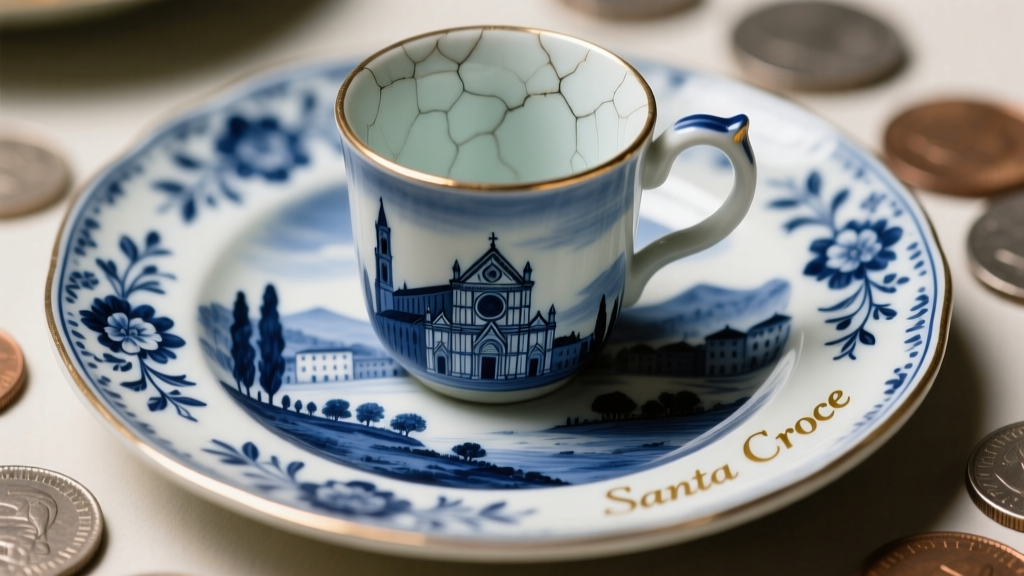
Staffordshire Cup & Plate: Italian Scenery 'Santa Croce' Blue Transfer Ware — A Collector’s Guide to the 4½ × 8-Inch Pattern
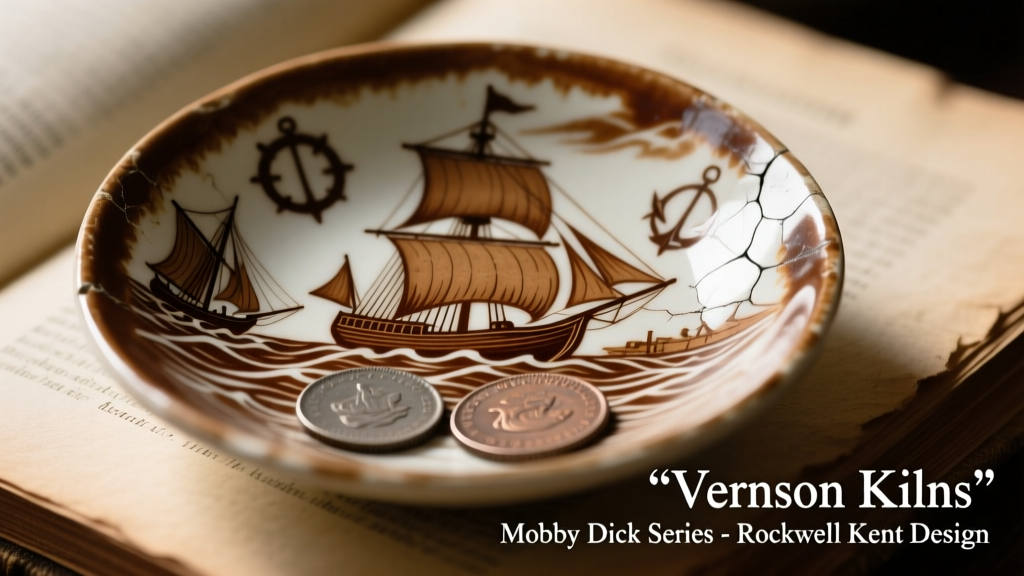
Vernon Kilns 'Moby Dick' Cup and Saucer: The Brown Rockwell Kent Edition — A Numismatic & Ceramics Appraisal
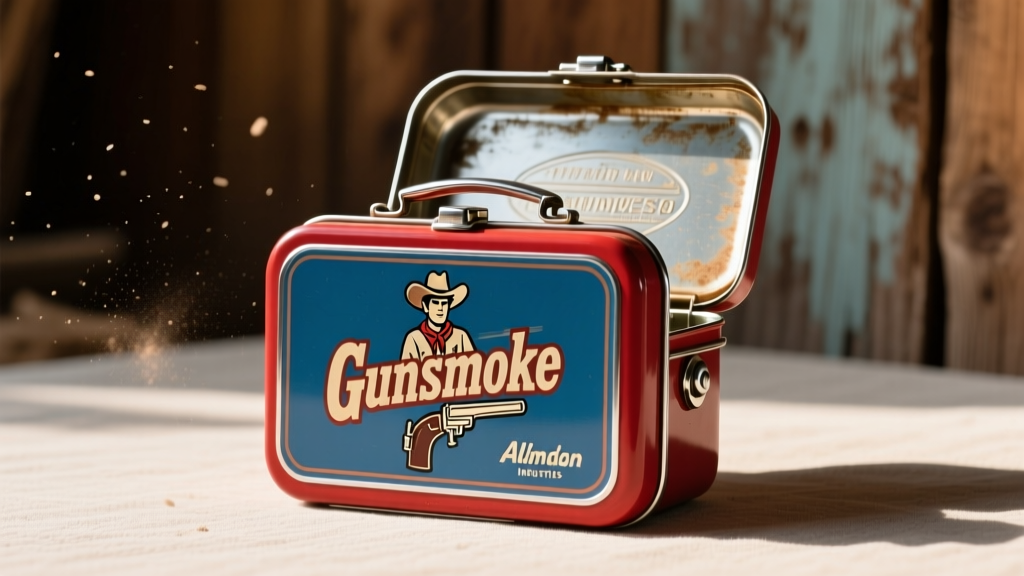
Lunch Boxes Gunsmoke Metal: Collecting the Iconic 1950s–60s Western-Themed Tin Lunch Pails