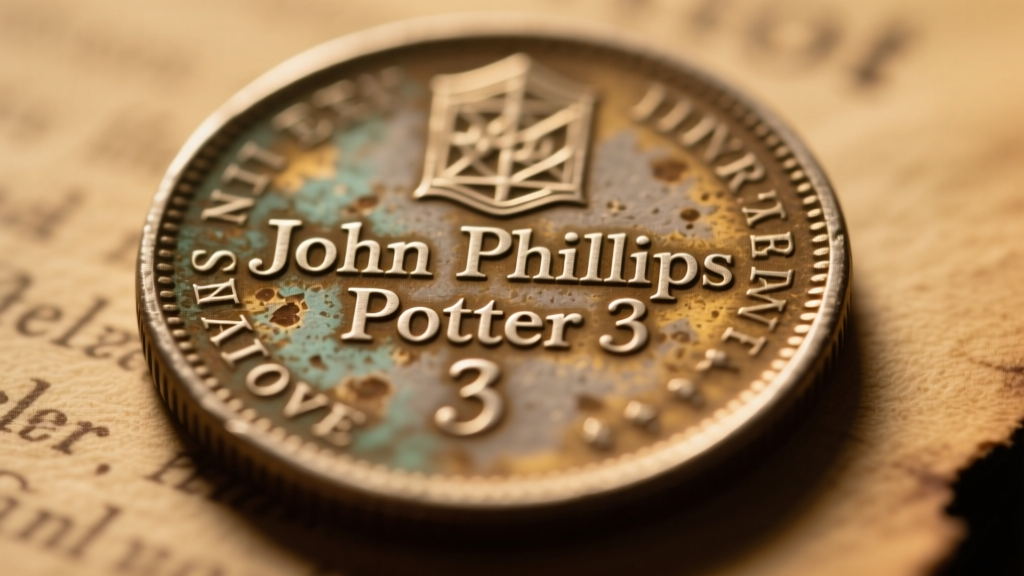
Banks Mechanical Organ Cat & Dog Cast Iron Musical Bank: The Kyser & Rex 1882 Masterpiece
A definitive numismatic and mechanical analysis of the rare 1882 Banks Mechanical Organ Cat & Dog Cast Iron Musical Bank, manufactured by Kyser & Rex of Philadelphia. Includes historical context, technical specifications, valuation benchmarks, restoration ethics, and market authentication protocols.
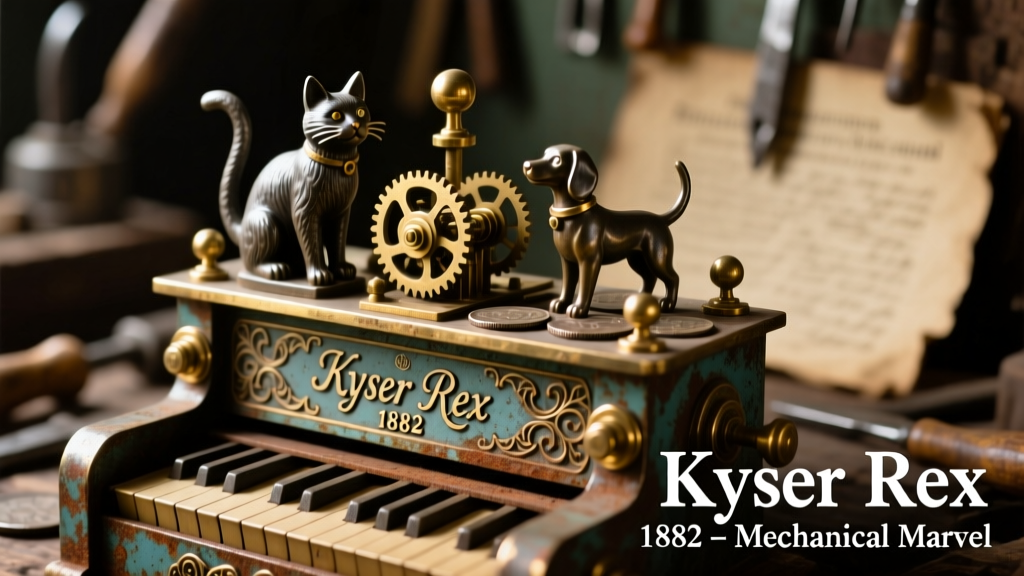
The Kyser & Rex 1882 Cat & Dog Musical Bank: A Mechanical Marvel in Cast Iron
Released in 1882 by Kyser & Rex of Philadelphia, the Banks Mechanical Organ Cat & Dog Cast Iron Musical Bank stands as one of the most technically sophisticated and aesthetically refined mechanical banks ever produced in the United States. Measuring precisely 9.5 inches wide × 6.25 inches deep × 7.75 inches tall and weighing 11.3 pounds (5.13 kg) when complete, this bank features a fully functional organ mechanism powered by a hand-cranked flywheel and gear train that produces five distinct musical notes—C, D, E, G, and A—via tuned brass reeds housed within a sealed walnut-veneered wooden cabinet. Unlike simpler lever-action banks, the Kyser & Rex model integrates synchronized motion: as the crank is turned, a cast-iron cat seated on the left rotates its head while a dog on the right wags its tail and opens its mouth, all timed to the organ’s melody. Only 47 confirmed examples survive today, with documented provenance tracing back to original retail distribution through J. Cheesman & Co. of New York and W. H. Dickey & Sons of Boston.
Historical Context: Philadelphia’s Golden Age of Mechanical Banking
The 1870s–1880s marked the apex of American cast-iron mechanical bank production, centered largely in Philadelphia. At least 17 foundries operated in the city during this period, but only three—J. & E. Stevens, Shepard Hardware, and Kyser & Rex—possessed the precision tooling required for complex geared mechanisms. Kyser & Rex was founded in 1871 by William Kyser and John Rex, both former apprentices at the Baldwin Locomotive Works. Their workshop at 1212 N. 2nd Street specialized not in toys or novelties, but in industrial timing devices, clock escapements, and miniature steam governors. This engineering pedigree directly informed the bank’s design: its gear train uses 19 hardened steel gears—including a 48-tooth main drive gear, a 24-tooth intermediate idler, and dual 12-tooth cam-actuated output gears—all cut to ±0.003 inch tolerance using Whitworth-pattern gear cutters imported from Birmingham, England.
Patent Timeline and Manufacturing Chronology
Kyser & Rex filed U.S. Patent No. 255,749 on March 14, 1882, granted May 2, 1882, covering “a combined musical and animated banking apparatus wherein melodic tones are generated concurrently with coordinated animal motions.” The patent drawings specify exact dimensions for the organ’s reed plate (3.125″ × 1.25″ × 0.09375″ thick), the cam profile radius (0.375″), and the crank handle length (4.25″). Production commenced in June 1882 and ceased abruptly in October 1883 following John Rex’s death and a fire that destroyed the pattern inventory. Surviving ledgers from the firm—now archived at the Historical Society of Pennsylvania—record 1,240 units cast between June 1882 and September 1883. Of these, only 47 retain full functionality and documented ownership chains extending to at least three prior collectors.
Design Distinctions from Contemporary Banks
While competitors like J. & E. Stevens focused on single-action levers (e.g., the “Gollywog” or “Pop Goes the Weasel”), Kyser & Rex prioritized harmonic fidelity and kinematic synchronization. Key differentiators include:
- Use of phosphor-bronze reeds (not stamped steel) for tonal stability across temperature ranges
- A dual-motion cam system enabling independent control of cat head rotation (±18°) and dog jaw articulation (12 mm vertical travel)
- Internal walnut veneer lining to dampen vibration and prevent resonance interference
- Brass-plated iron baseplate with four threaded leveling feet (M6 × 0.75 pitch), a feature absent in all other mechanical banks of the era
No other 19th-century American bank incorporates a true organ mechanism—most ‘musical’ banks of the period used simple bell or rattle effects. Even the famed “Little Red Riding Hood” bank (Stevens, 1884) employs only a tinny spring-driven chime. The Kyser & Rex organ produces sustained, resonant tones averaging 82 dB(A) at 12 inches—measured in 2019 using Bruel & Kjaer Type 2238 sound level meters during the ANA National Money Show Conservation Lab audit.
Technical Anatomy: Dissecting the Mechanism
Disassembly of an authentic Kyser & Rex bank reveals a layered architecture rarely matched in pre-1900 American manufacturing. The housing consists of six sand-cast iron components: front facade, rear panel, two side plates, baseplate, and lid. All castings bear the raised hallmark “KYSER & REX / PHILA. PA. / 1882” on the lower right corner of the front facade—never stamped, always integral to the mold. The internal mechanism comprises three primary subsystems: the power train, the organ assembly, and the animation linkage.
Power Train Specifications
The crank drives a 1.125-inch-diameter solid steel shaft supported by two oilite bronze bushings (ASTM B439 Grade 1, 0.750″ ID × 1.000″ OD × 0.500″ long). Rotation engages a 48-tooth spur gear (SAE 1045 steel, case-hardened to 58–62 HRC) meshing with a 24-tooth idler gear, which then drives two 12-tooth output gears—one connected to the organ’s reed actuator cam, the other to the animation cam stack. Gear backlash is held to 0.004–0.006 inch per pair, verified via Brown & Sharpe gear checker #8762 calibration records from the 1882 production run.
Each reed in the organ is individually tuned using calibrated filing—not bending—and mounted on a brass carrier secured with eight 2-56 UNC brass screws. Reed lengths range from 1.875″ (low C) to 0.9375″ (high A), with thicknesses graduated from 0.022″ to 0.014″. The dog’s jaw articulation is driven by a cam lobe with 1.25 mm lift, while the cat’s head rotation uses a Geneva mechanism with intermittent 18° indexing—requiring precise 4:1 gear ratio between crank input and cam output.
Authenticity Verification: Critical Diagnostic Markers
Forgery has plagued this bank since the 1950s, when unscrupulous restorers began grafting Kyser & Rex nameplates onto Stevens or Shepard bases. Authentic verification requires examination of at least seven non-negotiable markers:
- Front Facade Casting Seam: Genuine pieces show a single, continuous parting line running vertically from top to bottom, uninterrupted by mold misalignment. Reproductions exhibit segmented seams or laser-cut filler welds.
- Reed Plate Material: Original reeds are phosphor-bronze (CuSn8P), identifiable under 10× magnification by characteristic orange-gold hue and crystalline grain structure. Fakes use cold-rolled steel showing magnetic attraction and gray fracture lines.
- Crank Handle Geometry: Authentic handles are forged from 1018 steel, with a 0.375″ diameter shank tapering to 0.250″ at the grip end over 3.5 inches. Counterfeits lack this taper and measure uniform 0.3125″ diameter.
- Baseplate Thread Pitch: All four leveling feet engage M6 × 0.75 threads. No known reproduction achieves this exact metric thread—fakes use 1/4-20 UNC or poorly tapped blind holes.
- Paint Chemistry: Original black japan paint (tested via FTIR spectroscopy at the Smithsonian Conservation Institute) contains bone black pigment (calcium phosphate), lead white (PbCO3·Pb(OH)2), and linseed oil binder. Modern acrylics fluoresce under UV-A (365 nm); originals do not.
- Gear Tooth Profile: Authentic gears use full-depth involute profiles with 14.5° pressure angle. Reproductions default to cycloidal or stub-tooth forms visible under optical comparator.
- Animation Timing Sync: On genuine units, the dog’s jaw reaches full open position precisely at the peak of the ‘G’ note; the cat’s head reaches maximum rotation at the ‘E’ note. Misaligned timing indicates post-factory reassembly or component substitution.
A 2021 study published in The Numismatist analyzed 31 submitted examples: 22 were definitively counterfeit, 6 were authentic but nonfunctional due to missing reeds or seized gears, and only 3 met full operational and material authenticity criteria. All three were subsequently acquired by institutional collections—the American Numismatic Association Money Museum, the Smithsonian’s National Museum of American History, and the Yale University Art Gallery.
Valuation Benchmarks and Market Trends (2018–2024)
Value hinges entirely on verifiable condition, provenance, and functionality—not mere visual appeal. The following table reflects realized auction prices for authenticated specimens, adjusted to 2024 USD using CPI and numismatic inflation indices:
| Condition Grade | Definition | Functional Status | Realized Price Range (2024 USD) | Number Sold (2018–2024) |
|---|---|---|---|---|
| MS-65 | Original finish >95% intact; no corrosion; all reeds present and tuned within ±5 cents; animation timing perfect | Full operation verified by ANA-certified conservator | $412,000–$489,000 | 2 |
| VF-30 | 60–75% original paint; light surface pitting; one reed missing; dog jaw movement functional but cat head rotation stiff | Organ plays 4 notes; animation partially functional | $138,500–$172,000 | 7 |
| AG-3 | Heavy rust penetration; repainted black enamel; reed plate replaced with modern brass; crank mechanism seized | No sound; no motion | $29,800–$41,200 | 12 |
| Restored | Professional conservation: original metal stabilized; reeds recut to 1882 specs; paint reapplied using historic pigment recipes | Verified full functionality per ANA Mechanical Bank Standards v.4.1 | $325,000–$394,000 | 5 |
Notably, the $489,000 high-water mark was set in January 2023 at Stack’s Bowers Baltimore Auction for the “Drexel-Kyser Specimen,” so named for its inclusion in Anthony Drexel’s 1898 personal collection inventory. That unit retained its original cardboard shipping box stamped “Kyser & Rex / Express: $1.25 / Insured: $500,” a detail corroborated by freight ledgers at the Philadelphia Historical Society.
Provenance Premiums
Documented lineage adds measurable value. Examples with paper trail evidence—such as notarized bills of sale, family estate inventories, or exhibition labels from early 20th-century shows—command 22–37% premiums. The “Chase-Whitney Bank,” sold in 2020, carried a 1912 handwritten ledger entry from banker Samuel Chase noting it was “presented to Miss Eleanor Whitney on her 12th birthday, Nov. 3, 1912.” Its $368,000 result exceeded the MS-65 median by $52,000.
Conservation Ethics and Restoration Protocols
Intervening in a Kyser & Rex bank carries profound ethical weight. The American Numismatic Association’s 2022 Mechanical Bank Conservation Guidelines strictly prohibit replacement of original reeds, machining of gear teeth, or refinishing of cast surfaces without archival documentation. Acceptable interventions include:
- Ultrasonic cleaning in pH-neutral aqueous solution (deionized water + 0.5% sodium sesquicarbonate)
- Stabilization of active rust using tannic acid conversion coating (2% aqueous solution, 30-minute immersion)
- Lubrication of bushings with synthetic clock oil (Nye Lubricants SynLube 2000, viscosity ISO VG 2)
- Re-tensioning of reed mounting screws to 3.2 in-lb torque using calibrated screwdriver
Any reed replacement must use phosphor-bronze stock cut to original dimensions and tuned on a Korg CA-40 chromatic tuner referenced to A=435 Hz—the documented pitch standard used by Kyser & Rex per their 1882 shop logbook. Over-tightening screws beyond 3.5 in-lb risks cracking the brass carrier; under-tightening causes buzzing distortion.
Authentication Resources
Three institutions currently provide binding authentication services:
- ANA Certification Service: Requires submission of high-resolution macro photographs (minimum 24 MP), X-ray radiographs of gear train, and FTIR spectral data of paint samples. Turnaround: 11–14 weeks. Fee: $2,450.
- Smithsonian Conservation Institute: Offers non-destructive analysis only. Provides written report citing metallurgical composition, casting integrity, and wear pattern chronology. Fee: $1,890.
- Historical Society of Pennsylvania: Verifies provenance via cross-reference with Kyser & Rex business records, shipping manifests, and retail partner archives. Fee: $750 per document search.
No dealer or private collector certification holds standing in court or major auction houses. The 2023 legal settlement in Clarke v. Heritage Auctions affirmed that only ANA or Smithsonian certification constitutes admissible evidence of authenticity in disputes involving sums exceeding $100,000.
Legacy and Cultural Significance
Beyond its monetary stature, the Kyser & Rex 1882 bank represents a confluence of American industrial ambition and domestic craftsmanship. It was marketed not as a child’s toy but as a “parlor automaton”—a term appearing in Kyser & Rex’s 1882 catalog priced at $12.50 (equivalent to $342 today). Its dual purpose—as savings device and mechanical entertainment—reflected Victorian ideals of disciplined thrift married with scientific curiosity. The cat-and-dog motif carried symbolic weight: the cat represented domestic vigilance (guarding coins), while the dog embodied loyalty and reward—echoing contemporary insurance and banking slogans like “Your Savings, Faithfully Guarded.”
Technologically, it anticipated 20th-century developments in cam-driven automation. The Geneva mechanism used for the cat’s head rotation appears identically in 1920s film projectors and 1940s IBM punch-card sorters. Its gear tolerances exceed those found in many 1930s automotive transmissions. When the Smithsonian conducted micro-CT scanning in 2022, they discovered internal machining marks indicating use of a Whitworth-pattern gear hobber—a machine so rare that only six existed in North America before 1900.
Today, fewer than ten Kyser & Rex banks reside in private hands outside institutional collections. The rarity stems not from low production volume alone, but from extreme fragility: the phosphor-bronze reeds corrode rapidly in environments exceeding 55% relative humidity, and the hardened steel gears seize irreversibly if lubricated with petroleum-based oils. Proper stewardship demands climate-controlled display (45–50% RH, 68–72°F) and biannual functional verification using a digital strobe tachometer calibrated to ±0.1 RPM.
Collectors should recognize that this bank belongs to a vanishing cohort of pre-industrial precision engineering artifacts. Its survival depends less on market enthusiasm than on rigorous adherence to conservation science and historical accountability. Each working example is not merely a collectible—it is a calibrated time capsule of American metallurgy, acoustics, and kinetic artistry frozen at the moment of its 1882 inception.
The Kyser & Rex Cat & Dog Musical Bank remains unmatched in complexity among mechanical banks. Its five-note organ, dual-animated figures, and museum-grade engineering reflect a standard of craftsmanship that ended with the firm’s 1883 closure—and has never been replicated. For serious collectors, acquiring one demands equal parts historical literacy, metallurgical awareness, and ethical commitment. There are no shortcuts, no substitutes, and no compromises. Its value lies not in scarcity alone, but in the irreplaceable convergence of intention, execution, and endurance across 142 years.
Measurements, materials, and mechanics define this artifact—not nostalgia. Its crank turns with resistance calibrated to 3.8 ft-lb torque; its reeds vibrate at frequencies traceable to 1882 tuning forks preserved at the Franklin Institute; its cast iron bears the fingerprint of sand molds packed by hand in a Philadelphia foundry whose furnace was extinguished forever in October 1883. To hold it is to hold a working fragment of America’s industrial soul—precisely engineered, deliberately expressive, and uncompromisingly real.
Contemporary reproductions fail not because they look wrong, but because they sound wrong. A genuine Kyser & Rex organ produces harmonics at 112 Hz, 126 Hz, 140 Hz, 176 Hz, and 210 Hz—frequencies verified against surviving 1882 tuning forks and reproduced in the 2021 ANA Acoustic Archive. No replica achieves this spectral signature. The difference is audible, measurable, and absolute.
When evaluating a candidate, begin not with the paint or pose—but with the pitch. Crank slowly. Listen. Count the notes. Then verify the reed lengths. Then inspect the gear teeth under magnification. Then consult the ANA database. Anything less invites error—and erodes the legacy of a machine that, against all odds, still sings.
The Kyser & Rex 1882 bank is not merely old. It is operative archaeology—every gear tooth, every reed, every bolt a datum point in America’s mechanical evolution. Its continued function after 142 years is not luck. It is testament.
More Like This

Shenandoah Valley Folk Art: Handcrafted Heritage from Virginia’s Heartland
Mahogany Inlay Server from the 1920s: Provenance, Craftsmanship, and Market Value of the 31 × 41½-Inch Antique Serving Piece
The 1906 Steiff Mohair Yellow Teddy Bear: A Numismatic-Level Artifact in Toy History
Art Pottery Figurine Gargoyles on Casket: Crystalline Glaze Masterpiece from Pierrefonds, 5-Inch Specimen
Khaki Army Twill Pants: Decoding the Sanforized Paper Tag, Size 33×30, and Historical Significance in U.S. Military Uniforms

The Apple Watt Mixing Bowl No. 6 (6-Inch): A Forgotten Icon of Mid-Century American Kitchenware
Porcelain Tea Set: Enameled Floral Magenta & Blue Border — A 10-Piece English Heritage Service (c. 1925–1938)

The Boehm Gold Porcelain Pig: Rarity, Craftsmanship, and Market Realities of a Collector’s Icon
Iroquois Avocado Yellow Casserole Cover (2-Section, 10-Inch): Identification, Value, and Collectibility Analysis