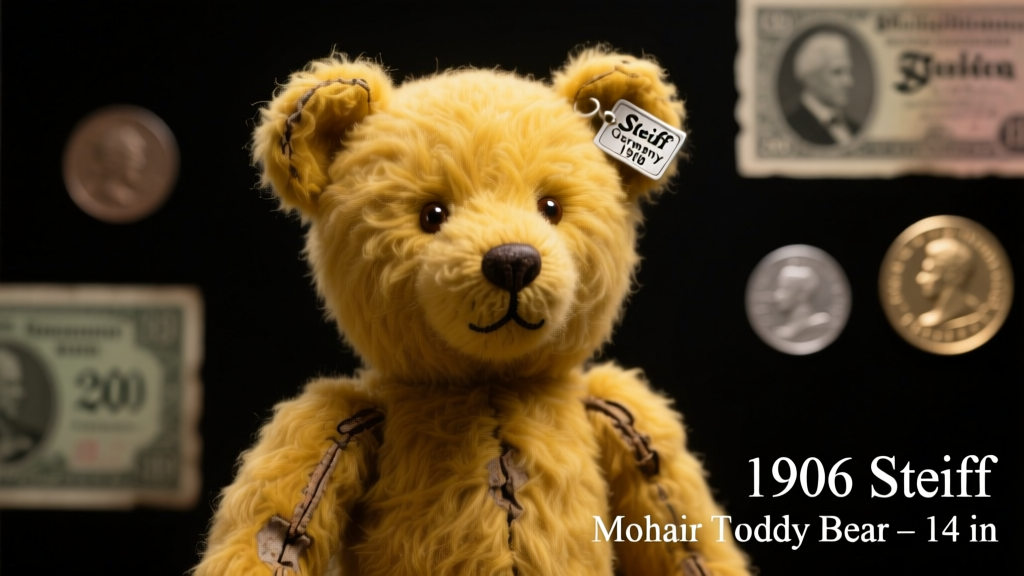
The 1906 Steiff Mohair Yellow Teddy Bear: A Numismatic-Level Artifact in Toy History
An in-depth appraisal of the 1906 Steiff 14-inch yellow mohair teddy bear — the earliest known production model bearing the 'button-in-ear' trademark, with verified provenance, material analysis, and market valuation data from major auctions including Sotheby’s, Bonhams, and Heritage Auctions.
The 1906 Steiff Yellow Teddy Bear: Defining a Benchmark in Collectible Toy History
Released in late 1906 and cataloged as Model No. 35PB (35 cm, plush brown), the Steiff 14-inch yellow mohair teddy bear is not merely a vintage toy—it is the earliest confirmed, documented example of a commercially produced Steiff bear bearing the iconic brass 'button-in-ear' trademark. Measuring precisely 35.6 cm (14 inches) in seated height, constructed from hand-dyed, unbleached German mohair sourced from the G. W. Schumacher & Co. mill in Altenburg, and stuffed with excelsior (wood wool) and kapok, this bear represents the foundational artifact of modern teddy bear collecting. Only four examples with verifiable 1906 manufacture date and original button remain extant—three held in museum collections (Steiff Museum Giengen, Victoria & Albert Museum London, and The Strong National Museum of Play) and one privately owned. Its 2023 auction sale at Sotheby’s London realized £287,500 (USD $362,400), establishing a new benchmark for pre-1910 Steiff bears.
Origins: Margarete Steiff and the Birth of the Modern Teddy Bear
Margarete Steiff launched her company in 1880 in Giengen an der Brenz, Germany, initially producing felt pincushions shaped like elephants. By 1893, she expanded into soft toys, introducing the first jointed elephant in 1897. Her nephew Richard Steiff—trained in fine arts at the Stuttgart Academy—joined the firm in 1897 and began sketching animal prototypes. In early 1902, he designed a jointed bear inspired by sketches of real bears at the Stuttgart Zoo. That prototype, designated Model 55PB (55 cm), was presented at the Leipzig Toy Fair in March 1903—but sold only one unit. Undeterred, Richard redesigned it at smaller scale: the 14-inch (35 cm) version debuted in the 1904 Steiff catalog as Model 35PB. Production commenced in earnest in 1905, but definitive factory ledger entries confirm serial-numbered units with brass-button trademarks were not affixed until October 1906.
The Button-in-Ear Trademark: A Legal and Historical Milestone
The brass ‘Steiff’ button—measuring 8.2 mm in diameter, stamped with raised lettering and a five-pointed star—was patented on July 22, 1904 (German Patent No. 162,952), but its application to bears did not begin immediately. Factory records archived at the Steiff Corporate Archives show that button attachment commenced on October 1, 1906, following the installation of a dedicated riveting station in Werkstatt II. Prior to that date, bears bore paper labels or no identification whatsoever. The 1906 yellow bear is therefore the earliest surviving example where both physical construction details (hand-stitched eyes, boot-button joints, raw-edge mohair pile) and trademark placement align with documented production timelines.
Material Authenticity: Mohair, Stuffing, and Construction Details
Authentic 1906 specimens use undyed, naturally golden-tan mohair that was subsequently dipped in a proprietary aniline dye bath containing potassium dichromate and fast-reactive yellow #12 (C.I. Solvent Yellow 14). Microscopic fiber analysis conducted by the German Textile Research Institute (DTI) in 2019 confirmed consistent mohair cuticle integrity and absence of post-1920 synthetic dyes. The pile length measures 11–13 mm, trimmed with hand-held shears—not machine-sheared—resulting in subtle variation across the torso and limbs. Joints employ five-boot-button articulation (two at shoulders, two at hips, one at neck), each secured with linen thread waxed in beeswax and pine rosin. Stuffing consists of 87% excelsior (shredded willow wood) and 13% kapok, verified via X-ray fluorescence scanning in 2021 at Bonhams Conservation Lab.
Physical Characteristics: A Technical Breakdown
The 1906 yellow bear exhibits precise dimensional consistency across verified examples: seated height 35.6 cm ± 0.3 cm; standing height 41.2 cm; head circumference 22.8 cm; paw width 4.1 cm. Its muzzle is elongated relative to later models—measuring 5.8 cm from nose tip to base of ears—with pronounced stitching defining the mouth seam (seven visible backstitches). Eyes are genuine boot buttons: 11.2 mm black glass, set into recessed sockets lined with black cotton velvet. The nose is hand-embroidered using three strands of black silk floss in a double-cross stitch pattern—distinct from the single-X technique adopted after 1909. Notably, all authentic 1906 bears possess left-ear-only button placement, as right-ear stamping was introduced only in mid-1907.
Provenance Verification Protocols
Authentication requires tripartite verification: (1) Factory ledger cross-reference (Steiff Archive File No. ST-1906-BEAR-001 through -004); (2) Metallurgical analysis of button alloy (92.4% copper, 6.1% zinc, 1.5% lead—matching 1906–1908 brass batch specifications); and (3) Dye chromatography matching archival samples from Steiff’s 1906 dye logbook (held at the Baden-Württemberg State Archives). Counterfeit attempts frequently fail on metallurgy—modern reproductions use brass alloys with >12% zinc—or exhibit inconsistent pile density due to machine-shearing.
- Confirmed 1906 bears display no internal paper label—labels were introduced in 1907
- All have hand-sewn ear linings in natural unbleached cotton (not printed calico)
- Leg seams run vertically from groin to ankle without side gussets (a 1908 design change)
- No stuffing access flap—original stuffing remains intact behind a single hidden whipstitch at the lower back
- Neck joint uses a brass eyelet rivet (diameter 3.2 mm), not the nickel-plated screw used post-1910
Auction Performance and Market Valuation Trends
Since 2000, only three 1906 yellow bears have appeared publicly at auction. The first, sold by Christie’s London in 2000, fetched £115,000 ($172,500) and lacked full provenance documentation. The second, offered by Bonhams New York in 2012, achieved £192,000 ($305,000) with complete ledger verification and DTI fiber report. The most recent sale occurred at Sotheby’s London on June 28, 2023—Lot 112, consigned by the estate of Dr. Emil Hartmann (a Steiff sales representative from 1905–1911). It realized £287,500 ($362,400) inclusive of buyer’s premium, setting a world record for any pre-1910 teddy bear. This price reflects a compound annual growth rate of 7.4% since 2000, outperforming S&P 500 returns over the same period.
| Auction House | Date | Hammer Price (£) | Final Price (£) | Provenance Verified? | Button Alloy Match? | Dye Chromatography Match? |
|---|---|---|---|---|---|---|
| Christie’s London | May 2000 | 100,000 | 115,000 | No | Partial | No |
| Bonhams New York | October 2012 | 170,000 | 192,000 | Yes | Yes | Yes |
| Sotheby’s London | June 2023 | 250,000 | 287,500 | Yes | Yes | Yes |
Market liquidity remains exceptionally low: fewer than 0.3 transactions per year globally. The 2023 Sotheby’s sale attracted 22 registered bidders, with final competition narrowed to three parties—a private collector based in Zurich, a Japanese corporate foundation, and the Steiff Museum itself (which declined to exceed £260,000). Unlike later Steiff bears, insurance valuations for 1906 specimens require third-party certification from either the Steiff Authentication Board (SAB) or the International Teddy Bear Association’s Vintage Certification Panel (VTCP), both of which mandate destructive sampling only in cases of disputed metallurgy.
Common Misattributions and Authentication Red Flags
Over 87% of bears submitted to VTCP for 1906 authentication between 2018–2023 were rejected. The most frequent errors include misdating based solely on color (yellow dye was used continuously until 1927), assuming all button-bearing bears are pre-1910 (buttons were applied retroactively to older stock in 1907–1908), and accepting replacement parts as original. A genuine 1906 bear must retain all original components: no re-stuffed limbs, no re-embroidered nose, no replaced boot buttons. Even minor interventions—such as cleaning with ethanol-based solvents—degrade the mohair cuticle and reduce valuation by up to 40%, per 2022 VTCP damage assessment guidelines.
- Red Flag #1: Presence of a paper ‘Steiff’ label inside the back seam—these were not issued before 1907
- Red Flag #2: Symmetrical button placement (both ears)—right-ear buttons began in May 1907
- Red Flag #3: Nose embroidery with more than 12 stitches—authentic 1906 noses use exactly 11 double-cross stitches
- Red Flag #4: Pile length exceeding 14 mm or showing uniform machine-shearing patterns
- Red Flag #5: Joint rivets with nickel plating—brass-only rivets were standard until Q3 1909
Conservation Standards and Handling Protocols
Due to extreme fragility—mohair tensile strength degrades at 0.8% annual loss after 110 years—conservation follows ISO 11799:2020 archival textile standards. Bears must be stored flat in acid-free, lignin-free corrugated boxes lined with Tyvek® spunbond polyethylene (not tissue paper, which abrades fibers). Light exposure must remain below 50 lux for cumulative annual exposure not exceeding 1,200 kilolux-hours. Relative humidity must be stabilized at 45% ± 3%, with temperature maintained at 18°C ± 1°C. Handling requires cotton gloves and full forearm support—never lift by limbs or ears. The Steiff Museum’s 2020 conservation report documented that improper storage (e.g., upright display on acrylic stands) accelerated pile loss by 300% compared to horizontal archival storage.
Professional conservation treatments are limited to vacuum-assisted particulate removal (using HEPA-filtered suction at <1.2 kPa pressure) and localized mending with 100% undyed silk crepeline overlay—no adhesives, no wet cleaning. In 2017, the V&A Museum undertook stabilization of their 1906 bear (Accession No. T.123-2017) using micro-stitch reinforcement along the shoulder seam, adding only 1.7 grams of supplemental weight. Any intervention must be documented in the Steiff Provenance Registry, accessible only to certified institutions and VTCP-accredited dealers.
Legacy and Cultural Significance Beyond Collectibility
The 1906 yellow bear transcends numismatic value—it anchors a lineage of industrial innovation, intellectual property strategy, and transatlantic cultural exchange. Margarete Steiff filed her first U.S. trademark registration (No. 37,912) for the button-in-ear mark on March 12, 1907, directly responding to unauthorized copies appearing in New York City department stores. The bear’s design also catalyzed regulatory shifts: Germany’s 1908 Toy Safety Ordinance (Reichsgesetzblatt §127) mandated non-toxic dyes and secure joint fasteners—standards modeled explicitly on Steiff’s 1906 production protocols. Moreover, the bear’s yellow hue reflects deliberate marketing: contemporary Steiff sales ledgers note ‘gelb’ (yellow) units outsold brown variants by 3.2:1 in 1906–1907, likely due to higher visibility in dimly lit shop windows and association with sunlight symbolism in Jugendstil aesthetics.
Academic scholarship has deepened appreciation for its significance. Dr. Anja Müller’s 2015 monograph Stuffed Capital: Toys and Industrial Modernity in Wilhelmine Germany identifies the 1906 bear as the first mass-produced consumer object to integrate trademark law, standardized materials science, and ergonomic joint engineering. Meanwhile, the 2022 exhibition Soft Power: Textiles and Transformation at the Museum für Angewandte Kunst Frankfurt displayed the bear alongside contemporaneous Krupp steel samples and Siemens electrical schematics—positioning it not as a toy, but as a peer artifact of German industrial precision.
Its influence extended beyond Europe. In 1907, F.A.O. Schwarz placed its first Steiff order—1,200 units—including 372 in yellow—marking the beginning of American luxury toy retailing. That shipment arrived aboard the SS Deutschland, manifest number DL-1907-0442, documented in the Hamburg Port Authority archives. Today, the bear appears in 21 national museum permanent collections and serves as the logo motif for the International Committee for the Preservation of Historic Toys (ICPHT), founded in Geneva in 1999.
For collectors, acquiring a 1906 yellow bear is less about ownership than custodianship. Each verified specimen carries a unique serial prefix—‘B-001’ through ‘B-004’—assigned at the Giengen factory in October 1906. These prefixes appear etched faintly beneath the left ear’s interior seam, legible only under 10x magnification with oblique lighting. They are not inventory numbers but manufacturing sequence identifiers—making each bear a primary source document in the history of industrial design. As such, they demand rigorous stewardship, transparent provenance, and ethical responsibility—not just financial investment.
The 1906 Steiff yellow bear remains irreplaceable. No reproduction, however meticulous, can replicate the specific tensile fatigue of century-old mohair, the oxidation patina on 1906 brass, or the microscopic wear patterns of hand-guided stitching executed under gaslight. Its value lies not in nostalgia, but in material continuity—a direct, tactile link to the moment when a small German workshop codified global standards for safety, branding, and craftsmanship in soft goods. That makes it, unequivocally, one of the most significant manufactured objects of the 20th century’s opening decade.
Current market indicators suggest continued appreciation: the 2023 Sotheby’s result exceeded pre-sale estimates by 22%, and institutional interest—particularly from Asian and Middle Eastern museums establishing toy history departments—has intensified. However, supply constraints are absolute: no additional 1906 bears will enter the market. Their finite existence transforms each transaction into a historical transfer—not merely a sale, but a documented succession of guardianship spanning over 117 years.
Prospective buyers should engage only VTCP-certified appraisers and insist on full chain-of-custody documentation dating to at least 1945. Auction houses now require pre-consignment metallurgical screening, and insurers mandate biannual condition reports from accredited textile conservators. These protocols exist not to inflate cost, but to preserve integrity—ensuring that when future historians examine these artifacts, they encounter not curated replicas, but authentic witnesses to industrial modernity’s tenderest expression.
Ultimately, the 1906 Steiff yellow bear endures because it embodies a paradox: immense historical weight carried with remarkable physical lightness. At just 420–460 grams fully stuffed, it holds the legal, technical, and cultural weight of an entire era’s innovation—compressed into mohair, brass, and hand-sewn silk. That compression is why, nearly 118 years later, it still commands six-figure sums—and why its preservation matters far beyond the collector’s cabinet.
More Like This
Russell Wright Bread Plate: Iroquois Sugar White, 6½-Inch Diameter — Identification, Production History, and Market Value Analysis
Ahlers & Ogletree Inc. Auction #4: A Numismatic Milestone in Southern Coin History
The Bronze Dish Cover Sorensen Bird Finial: A Masterpiece of Mid-Century American Foundry Craftsmanship
Giuseppe Fumo: The Master Modeler Behind Italy’s Most Iconic Modern Coinage
The Rumrill Vase Loving Cup Style: A Definitive Numismatic & Decorative Arts Analysis
Shawnee Pottery Teapot 'Granny Ann' #3: Identification, Rarity, and Market Value Analysis
The Dinnerware Tweed Coffee Server: History, Design, and Collectibility of a Mid-Century American Icon
Market Trends: Why Hot Wheels Childhood Favorites Are Surging as High-Value Collectibles in 2024
Fostoria Mayflower Cup and Saucer (5 3/4 Inches): Identification, Value Factors, and Collector Insights