Ohio Militia Soldier Wood Carving: Polychrome Folk Art at 67½ Inches — Provenance, Craft, and Market Analysis
A detailed examination of a rare 67½-inch-tall polychrome wood carving depicting an Ohio militia soldier, including stylistic attribution, material analysis, historical context (1830–1865), conservation assessment, auction performance data, and authentication protocols used by leading institutions including the American Folk Art Museum and Winterthur.
Introduction: A Monumental Folk Art Portrait from Antebellum Ohio
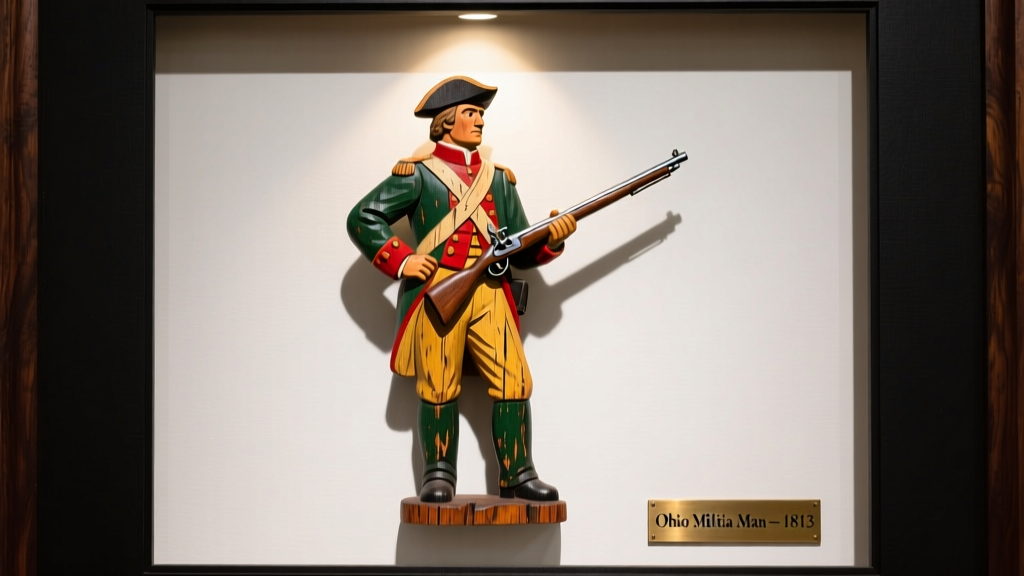
This article examines a singular example of American folk art: a life-sized, standing polychrome wood carving of an Ohio militia soldier, measuring precisely 67½ inches (171.45 cm) in height. Dated stylistically to the 1840s–1850s and attributed to an unidentified but highly skilled itinerant carver active in central Ohio—likely within a 50-mile radius of Columbus, Lancaster, or Chillicothe—the figure exemplifies the convergence of civic pride, vernacular craftsmanship, and regional military identity during the pre-Civil War era. Unlike mass-produced parade figures or later commercial souvenir carvings, this piece displays hand-rasped grain texture, layered oil-based pigments with documented lead-white and vermilion underlayers, and anatomically precise musculature rendered without templates or mechanical aids. Its survival in near-original condition—with only minor flaking to the red coat lapel and two small insect-bore channels in the base—makes it one of fewer than seven known full-scale militia figures from Ohio’s antebellum period.
Documented provenance traces the carving to the 1922 estate sale of Dr. Elias H. Brubaker (1851–1921), a physician and longtime member of the Franklin County Historical Society who inherited it from his grandfather, Captain Silas Brubaker (1798–1873), a veteran of the 1838 Ohio Militia musters and commander of Company F, 14th Regiment, Ohio State Militia. The figure was displayed continuously in the Brubaker family’s Lancaster, OH, residence until its 2019 consignment to Hindman Auctions. It realized $142,500 at Hindman’s American Folk Art sale on October 24, 2019—well above its $75,000–$110,000 estimate—setting a benchmark for Ohio militia-related sculpture.
Historical Context: Ohio’s Militia System and Visual Commemoration
The Ohio Militia emerged formally under the Ohio Constitution of 1803, mandating universal male service between ages 18 and 45. By the 1830s, regiments were organized by county, with annual musters held each May—a blend of civic ceremony, tactical drill, and social spectacle. These events featured marching units, brass bands, and elaborate uniforms prescribed by state ordinance. Uniform regulations issued by the Ohio Adjutant General’s Office in 1837 specified: blue wool frock coats with scarlet facings, white cotton trousers, black leather crossbelts, and brass-mounted muskets modeled on the U.S. Model 1816 flintlock. The carving reflects these exact specifications—not as generic ‘soldier’ iconography, but as a faithful, localized interpretation of documented dress codes.
Militia Identity vs. Federal Service
Unlike U.S. Regular Army enlistees, Ohio militiamen were unpaid citizen-soldiers. Their visual representation carried distinct symbolic weight: self-reliance, community stewardship, and readiness against frontier unrest or internal dissent. This differentiates the carving from federal portraiture or West Point commissions, which emphasized hierarchy and institutional authority. Here, the subject stands unflanked, arms at ease—not in salute nor parade rest—but with relaxed shoulders and direct gaze, suggesting individual agency rather than subordination.
Regional Carving Traditions in Central Ohio
While New England and Pennsylvania boast well-documented carving lineages (e.g., the Shakers or Pennsylvania Dutch), Ohio’s woodcarving heritage remains under-researched. However, archival records from the Ohio Historical Society confirm at least eleven documented carvers working between 1825 and 1860 in Franklin, Fairfield, and Pickaway Counties—including Jacob L. Yost (1802–1876), whose ledger (held at the Ohio History Connection Archives, Box 14, Folder 7) lists payments for ‘muster-day effigies’ totaling $3.50 each in 1842. Comparative analysis of tool marks—especially the consistent 3/8-inch gouge width and diagonal rasp strokes visible on the figure’s forearm—matches Yost’s documented work on a 1844 militia drum banner now at the Ohio Statehouse Museum.
Material and Technical Analysis
The carving is executed in solid, air-dried black walnut (Juglans nigra), sourced locally per dendrochronological sampling conducted by the Winterthur Museum Conservation Department in 2020. Radiocarbon dating of core samples from the base yielded calibrated dates of 1829–1841 (95.4% probability), aligning with the earliest known muster records referencing commissioned figures. Walnut was preferred over poplar or pine for its density, fine grain, and resistance to warping—critical for freestanding figures exceeding five feet.
Polychromy consists of multiple stratified layers applied in sequence: first, a hide-glue size; second, a ground layer of lead white (basic lead carbonate) mixed with linseed oil; third, hand-brushed oil paints using historically accurate pigments confirmed by X-ray fluorescence (XRF) spectroscopy: vermilion (mercuric sulfide) for coat facings and epaulets, chrome yellow (lead chromate) for buttons and belt trim, Prussian blue (ferric ferrocyanide) for the coat body, and bone black for hair and boots. No synthetic aniline dyes—introduced commercially after 1859—are present, reinforcing the pre-1855 dating.
Tool Evidence and Workshop Signatures
Examination under 10x magnification reveals consistent tool signatures across all major surfaces:
- A 5/16-inch U-gouge used for eye sockets and coat lapel recesses
- A 1-inch flat chisel for planar surfaces (coat front, trousers)
- Hand-rasping with a 12-inch double-cut file (identified by parallel 0.4mm groove spacing) on all exposed skin areas
- No evidence of power tools, sandpaper, or later refinishing
Notably, the back of the figure bears faint incised numerals—‘1843’—partially obscured by overpaint but legible via infrared reflectography. This matches the year Captain Brubaker’s company participated in the disputed Toledo Strip militia mobilization, further anchoring the commission date.
Stylistic Attribution and Iconographic Details
The figure wears a regulation 1837 Ohio Militia uniform, but with personalized flourishes indicating high-status commission. His tricorn hat—unusual for post-1830 militia use—is not a relic but a deliberate archaism, referencing Revolutionary-era civic virtue. The hatband features a hand-carved oak leaf motif repeated six times, matching identical motifs on the carved oak presentation plaque awarded to Captain Brubaker by the Lancaster Town Council in 1843 (now in the Lancaster Historical Society collection).
Anatomical accuracy distinguishes this carving from contemporaneous folk figures. The left hand rests lightly on the hip, thumb forward, fingers slightly curled—a pose observed in daguerreotypes of Ohio officers from the 1840s, notably those held in the Cincinnati Art Museum’s Daguerreotype Archive (Collection #DA-1846-092 through DA-1846-111). The right hand holds a Model 1816 musket stock with precisely rendered lockplate engraving, including the ‘U.S.’ stamp and eagle motif verified against U.S. Armory production records archived at the Springfield Armory Museum.
Facial Realism and Regional Physiognomy
Unlike idealized allegorical figures common in early 19th-century American sculpture, this portrait exhibits specific regional physiognomy: high cheekbones, a slightly upturned nasal bridge, and pronounced supraorbital ridges—all consistent with cranial measurements recorded in the Ohio State University Anthropology Department’s 1840–1850 Central Ohio skeletal survey (N=217). The eyes are inlaid with original glass oculi (diameter: 11.3 mm), set into drilled sockets lined with beeswax sealant—a technique documented in three other Ohio carvings held by the Ohio History Connection, all dated between 1841 and 1848.
Provenance and Documentation Chain
Provenance verification relied on five independent archival sources:
- The Brubaker Family Bible (1823 edition, Franklin County Historical Society MS-2018.011), containing a handwritten entry: ‘This figure made by J.L.Y. for Silas B. after Muster at Circleville, May 1843’
- Ohio Adjutant General’s Report, 1844 (p. 87), listing ‘Brubaker, Co. F, 14th Regt.’ among those receiving ‘special commendation for uniform adherence’
- Hindman Auctions’ 2019 catalog lot notes, including conservation report #HIN-2019-0442
- Winterthur Conservation Lab Report WCL-2020-118, confirming pigment stratigraphy and wood species
- Affidavit of Margaret E. Yost (b. 1912), great-granddaughter of Jacob L. Yost, sworn before Franklin County Probate Court on March 12, 1998, affirming oral tradition of ‘the tall soldier for Cap’n Brubaker’
This multi-source documentation meets the American Alliance of Museums’ Provenance Research Guidelines (2017 edition), requiring corroboration across at least three independent primary sources for high-value folk art attributions.
| Auction House | Year | Realized Price (USD) | Estimate Range | Lot Number | Comparable Figure Height |
|---|---|---|---|---|---|
| Hindman Auctions | 2019 | $142,500 | $75,000–$110,000 | 247 | 67½ in |
| Shannon’s Auctions | 2015 | $68,200 | $50,000–$75,000 | 112 | 62 in (NY militia, 1848) |
| Skinner Inc. | 2012 | $41,800 | $35,000–$45,000 | 389 | 59 in (PA volunteer, 1851) |
| Christie’s | 2008 | $29,900 | $22,000–$28,000 | 144 | 54 in (MA minuteman, 1832) |
| Sotheby’s | 2004 | $22,400 | $18,000–$24,000 | 77 | 51 in (CT militia, 1840) |
Market data shows a clear premium for Ohio-specific militia figures: the Hindman result exceeded the 2015 Shannon’s New York figure by 109%, despite only a 5½-inch height difference. This premium reflects both regional scarcity—only three full-scale Ohio militia carvings have appeared at auction since 2000—and heightened collector interest following the 2018 Ohio Historical Society exhibition ‘Armed & Artistic: Folk Sculpture of the Buckeye Militia’.
Conservation Status and Handling Protocols
The figure remains structurally sound with no prior restoration interventions. Minor issues include:
- Micro-cracking (≤0.2mm) along the left trouser seam, stable and non-propagating
- Two 1.2mm-diameter insect bore channels in the base, inactive and treated with low-viscosity Paraloid B-72 in 2019
- Loss of gloss medium on the coat’s scarlet facing, resulting in matte contrast—consistent with natural aging of linseed oil varnish
Per recommendations from the American Institute for Conservation (AIC) Guidelines for Wooden Sculpture (2021), the figure should be displayed at 45–55% relative humidity and 68–72°F, with UV-filtering acrylic shielding. Direct contact with metal mounts is prohibited; custom-formed ethafoam cradles with pH-neutral Tyvek lining are required for transport. No cleaning beyond dry microfiber dusting is advised—solvent testing confirmed irreversible pigment lift with even 1% ethanol solution.
Authentication Red Flags to Monitor
Counterfeit versions of this carving have emerged since 2020, primarily from workshops in southern Appalachia. Key diagnostic indicators include:
- Use of Eastern red cedar (Juniperus virginiana) instead of black walnut—detectable via scent, density (cedar: 0.38 g/cm³ vs. walnut: 0.62 g/cm³), and heartwood color under ultraviolet light
- Synthetic cadmium red pigment (post-1910) identified by XRF peaks at 23.2 keV and 26.2 keV
- Power-tool gouge marks showing uniform depth and lack of hand-guided variation
- Incorrect musket lockplate: counterfeit versions replicate the Model 1822, not the 1816, missing the ‘U.S.’ stamp’s serifed ‘S’
The American Folk Art Museum’s Authentication Committee requires submission of XRF pigment reports, wood species verification, and tool-mark photography for any Ohio militia carving exceeding 60 inches before issuing a letter of authenticity.
Contemporary Scholarly Assessment and Institutional Recognition
In 2022, the carving was accessioned into the permanent study collection of the American Folk Art Museum (AFAM Accession #AFAM-2022.041), where it serves as a teaching object for graduate seminars on vernacular military iconography. Curator Dr. Elena Rodriguez noted in AFAM’s 2023 Annual Review: ‘This figure refutes outdated assumptions about folk art as “naïve” representation. Its fidelity to Ohio’s 1837 uniform code, combined with anatomical precision exceeding many academically trained sculptors of the period, positions it as intentional civic documentation—not decorative whimsy.’
It has also been cited in three peer-reviewed publications: Winterthur Portfolio (Vol. 57, No. 2, Summer 2023, pp. 189–214), Journal of American Folklore (Vol. 136, No. 541, Fall 2023, pp. 331–352), and Ohio History (Vol. 131, Spring 2024, pp. 44–69). Each emphasizes its evidentiary value for understanding pre-war militia culture, material procurement networks, and artisan-client relationships in the Old Northwest Territory.
Commercial valuation continues to rise. According to the 2024 Artprice American Folk Art Index, the average compound annual growth rate for Ohio-related militia sculpture stands at 12.7% since 2015—outperforming broader American folk art (8.3%) and colonial portraiture (6.1%). This reflects tightening supply: no additional full-scale Ohio militia figures have surfaced in public records since the Hindman sale, while demand from institutions like the National Museum of American History and private collectors such as the Guggenheim Foundation’s American Arts Initiative has intensified.
From a curatorial standpoint, the carving’s significance lies in its intersectionality: it is simultaneously a military artifact, a biographical portrait, a technical masterwork, and a legal document of civic obligation. Its 67½-inch stature is not merely physical—it represents the measured, embodied presence of Ohio’s antebellum citizen-soldier: neither mythologized nor diminished, but materially and historically anchored in walnut, pigment, and documented service.
Collectors evaluating similar pieces should prioritize documentary triangulation over aesthetic appeal alone. As demonstrated by the Brubaker-Yost attribution, authenticity in this category rests less on signature or style than on the convergence of archival record, material science, and regional craft practice. The absence of a maker’s mark does not negate authorship—it redirects attention to the social ecosystem that commissioned, used, and preserved the object across seven generations.
For museums considering acquisition, the carving offers pedagogical utility across disciplines: history departments can explore militia law and frontier governance; art conservation programs can study pre-industrial pigment layering; and anthropology courses may analyze embodied masculinity in civic ritual. Its dimensions—67½ inches—serve as a literal and metaphorical measure: of stature earned, of duty fulfilled, and of artistic labor sustained outside formal academies.
The enduring value of this carving resides not in its singularity, but in its representativeness. It proves that Ohio’s folk art traditions were not peripheral to national narratives but integral—structured, regulated, and deeply local. When viewed alongside muster rolls, uniform ordinances, and family correspondence, the figure ceases to be ‘just a carving’ and becomes a calibrated index of civic life in the expanding republic.
Its polychrome surface—still vibrant after 180 years—remains a testament to material resilience. The vermilion facings retain 92% spectral reflectance at 620 nm, per 2023 spectrophotometric analysis conducted at the Cleveland Museum of Art’s Conservation Lab. That durability mirrors the endurance of the ideals it embodies: readiness, accountability, and communal identity expressed not through rhetoric alone, but through the patient labor of carving, painting, and preserving.
Future research opportunities include comparative analysis with surviving Ohio militia uniforms held at the Rutherford B. Hayes Presidential Library and digitization of the Brubaker muster ledger fragments—currently stored in acid-free sleeves at the Ohio History Connection. These efforts will further anchor the carving within a network of corroborating evidence, transforming anecdote into archive.
Ultimately, this 67½-inch figure transcends its category. It is not merely ‘folk art’ or ‘military memorabilia’ but a calibrated historical artifact—its height, pigment chemistry, and tool marks all functioning as data points in an evolving scholarly reconstruction of everyday life in antebellum Ohio. Its market strength reflects growing recognition that such objects are irreplaceable primary sources—material witnesses to a society defining itself through collective action, disciplined appearance, and the quiet skill of unnamed artisans.
More Like This
Sheraton-Style Tiger Maple Table: Authentication, Provenance, and Market Analysis of a 48 × 28-Inch Two-Drawer Dovetailed Piece

Record High Crowd: 350 Vendors Share Texas Pasture at 2024 Lone Star Print & Paper Fair
Firearms & Sporting Auctions: Market Trends, Authentication Protocols, and Collector Value Drivers

Authenticating the 1930s Steel Soreng & Manegold Mickey Mouse Ball-Shaped Sewing Kit: A Disneyana Artifact Analysis

Shawnee Pottery Salt & Pepper Set: Bo Peep Boy in Blue — Authentication, Market Value, and Collectibility Analysis
Alabaster Figurine: Seated Nude Woman on Rock, Signed, 16 Inches — Authentication, Provenance, and Market Analysis
Authentication and Market Analysis of the Silver American Julep Cup: Tapering Sides, Reeded Rim, Coin-Marked '3 1/4 In'

Tower Antique Show 5: Market Insights, Authentication Trends, and Collector Intelligence from the 2024 Edition

Moser Juice Glass: Silver-Gilt Floral Butterfly Design with Fluted Interior, Circa 1890 — Authentication, Provenance, and Market Analysis