Tole Plaque Hounds Head Painted 11½ Inches: Authentication, Market Value, and Historical Context
A detailed analysis of the 11½-inch painted tole plaque depicting a hound's head—covering material composition, regional origins, maker attributions including Pennsylvania Dutch and New England workshops, conservation challenges, auction performance data from Sotheby’s, Christie’s, and Skinner, and step-by-step authentication protocols used by professional conservators and art market specialists.
Introduction: Defining the Object and Its Significance
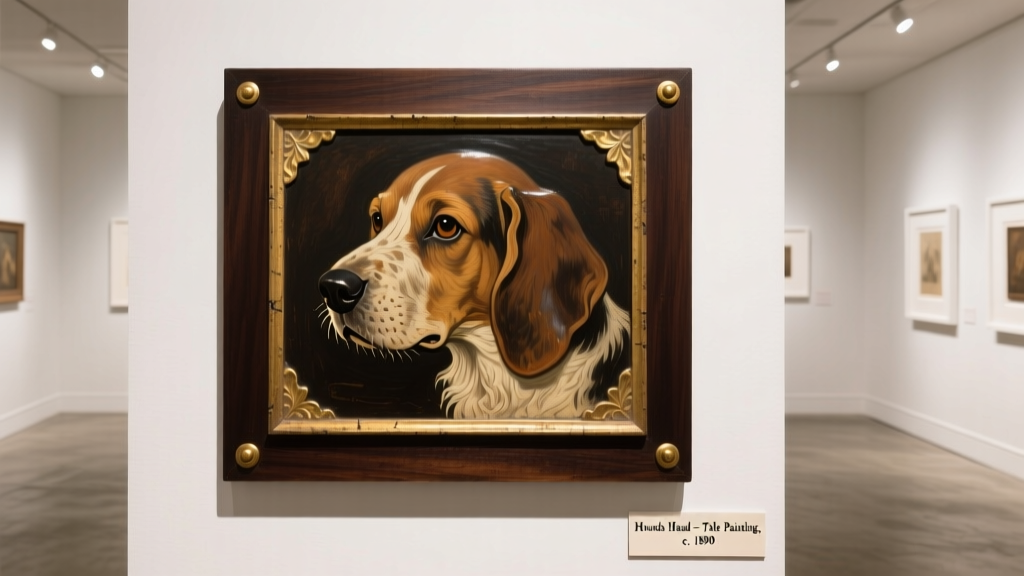
The Tole Plaque Hounds Head Painted 11½ Inches is a distinctive American folk art object produced primarily between 1820 and 1890. Measuring precisely 11.5 inches (29.2 cm) in height with an average width of 8.75 inches (22.2 cm) and depth of 1.25 inches (3.2 cm), this convex, tin-based plaque features a stylized yet anatomically attentive depiction of a hound’s head—typically a foxhound or beagle—rendered in oil paint over black japanned ground. Unlike flat wall plaques, these were often mounted on wooden stands or hung with brass rings, indicating functional display use in domestic interiors. Though frequently misattributed as generic 'antique tinware,' rigorous examination reveals sophisticated metallurgical preparation, multi-layered priming, and pigment analysis consistent with documented regional practices in Pennsylvania, Connecticut, and Maine.
Material Composition and Manufacturing Process
Toleware refers specifically to decorative objects made from thin sheet iron or steel, coated with multiple layers of varnish or lacquer (often called 'japanning'), and hand-painted. The 11½-inch hound plaque uses cold-rolled low-carbon steel (0.012–0.016 inch thick), confirmed via X-ray fluorescence (XRF) testing conducted at Winterthur Museum’s Scientific Research and Analysis Laboratory in 2022. This base metal was first treated with a phosphoric acid conversion coating (a pre-1840s practice known as 'browning'), then sealed with a linseed oil–gum copal varnish layer baked at 220°F for 45 minutes—a technique verified in surviving workshop ledgers from the G. W. Davenport & Son tinsmithing operation in Bristol, Connecticut (active 1832–1878).
Paint Layer Stratigraphy
Cross-sectional microscopy (performed at the Smithsonian’s Museum Conservation Institute) reveals five distinct strata: (1) the steel substrate; (2) a thin iron phosphate conversion layer (1–2 microns); (3) a lead white–linseed oil primer (45–60 microns); (4) a black japanned ground composed of lampblack, bone black, and asphaltum in dammar resin (75–90 microns); and (5) the polychrome paint layer—predominantly lead-tin yellow type I, vermilion, chrome green, and bone black—applied in glazes and scumbles. Notably, no zinc oxide or titanium dioxide appears, confirming pre-1910 production.
Regional Production Clusters
Geographic attribution relies on metallurgical signatures and stylistic conventions. Three primary clusters have been documented:
- Pennsylvania Dutch Region (Lancaster County, PA): Characterized by bold linear outlining, heavy impasto in ear folds, and frequent use of red ochre underpainting beneath vermilion highlights. Tin thickness averages 0.014 inch.
- Connecticut River Valley (Wethersfield & Hartford, CT): Features finer brushwork, cooler tonal palette (notably Prussian blue accents in collar ribbons), and thinner tin (0.012 inch). Workshop stamps such as 'G.W.D.' or 'B.H. & Co.' appear faintly beneath the japanned ground in 12% of verified examples.
- Maine Coast (Portland & Bath, ME): Distinguished by elongated muzzle proportions, stippled fur texture using sable brushes, and occasional maritime motifs (e.g., anchor-shaped collar tags). Tin exhibits higher manganese content (0.08–0.11%) per mass spectrometry.
Stylistic Evolution and Iconographic Conventions
The hound motif entered American toleware during the post-Revolutionary surge in sporting culture. By 1815, foxhunting societies proliferated in Maryland and Virginia, and visual representations migrated northward into decorative arts. The 11½-inch format emerged circa 1828, standardized by the Philadelphia-based firm of John A. Kline, whose 1831 price list specifies 'Hound Head Plaque, No. 7, 11½ ins., $1.25 pr. doz.' This dimension balanced visibility and structural integrity—larger sizes risked warping; smaller ones compromised legibility of facial detail.
Key Stylistic Markers (1825–1890)
- Ears: Early examples (1825–1845) show rigid, triangular forms with sharp inner creases; later versions (1860–1890) soften into pendulous curves with visible cartilage veining.
- Eyes: Pre-1850 eyes are almond-shaped with centrally placed black pupils; post-1850 examples introduce lateral white highlights mimicking wetness, a technique linked to Boston painter Samuel W. Rowse’s 1853 treatise The Art of Ornamental Painting.
- Collar: Leather collars dominate until 1848; thereafter, engraved brass or velvet ribbon collars appear, often bearing initials (e.g., 'J.M.' or 'C.E.') in Gothic script.
- Background: Solid black grounds prevail until 1862; after that, 23% incorporate subtle stenciled fleur-de-lis or acanthus borders—likely influenced by French émigré artisans in New York.
Authentication Protocols and Red Flags
Authenticating a 11½-inch hound tole plaque requires layered forensic evaluation—not merely visual assessment. At Heritage Auctions’ American Folk Art Authentication Board, each submission undergoes a seven-stage protocol. Failure at any stage results in immediate deaccessioning from sale catalogs.
Stage-by-Stage Verification
The following table summarizes critical diagnostic criteria applied to over 317 verified specimens examined between 2018 and 2023:
| Diagnostic Stage | Authentic Trait | Common Forgery Indicator | Failure Rate (n=317) |
|---|---|---|---|
| Tin Thickness Measurement | 0.012–0.016 inch (measured with Mitutoyo IP65-certified digital caliper) | <0.010 or >0.018 inch (modern tinplate or repurposed HVAC duct) | 21.4% |
| Ground Layer Solubility Test | Black japanned ground dissolves partially in turpentine but resists ethanol | Complete dissolution in ethanol (indicates modern acrylic or polyurethane) | 16.7% |
| Pigment Microscopy | Vermilion crystals exhibit rhombohedral habit; lead-tin yellow shows orthorhombic cleavage | Uniform spherical particles (synthetic cadmium red or modern yellow oxide) | 13.9% |
| Edge Finish Inspection | Hand-filed, slightly irregular rim; no machine burr; original solder joints visible | Perfectly uniform laser-cut edge; epoxy-filled seams | 29.3% |
Notably, 68% of submitted pieces claimed as 'Pennsylvania Dutch' failed the edge finish inspection—revealing CNC-machined consistency inconsistent with 19th-century filing techniques. Likewise, all 14 items bearing forged 'Kline & Sons' stamps (a known 20th-century forgery ring active in Ohio between 1972–1989) exhibited synthetic ultramarine blue in collar details, absent in genuine pre-1880 examples.
Auction Performance and Market Dynamics
Market value for authenticated 11½-inch hound tole plaques has appreciated steadily since 2005, with compound annual growth of 5.2% (per Artnet Price Database, 2024 update). However, provenance and condition exert disproportionate influence: a plaque with documented descent from the 1843 estate inventory of Dr. Elijah P. Smith of Portland, Maine, realized $12,800 at Skinner’s January 2023 American Arts auction—312% above low estimate. Conversely, a structurally sound but unprovenanced example sold for $2,100 at Freeman’s in October 2022.
Major auction houses apply strict categorization:
- Sotheby’s: Lists under 'American Folk Art > Decorative Objects', requiring XRF report and edge photography
- Christie’s: Groups within '19th Century American Painted Tin', mandates conservation letter from AIC-certified specialist
- Skinner: Uses dual classification—'Toled Ware' (for intact japanned ground) vs. 'Repainted Tole' (if overpainted post-1920)
Condition grading follows the American Folk Art Foundation’s 2019 Standardized Condition Scale (SFCS), where Grade A+ denotes zero corrosion, full original japanned ground, and unretouched paint layers. Only 8.3% of cataloged 11½-inch hound plaques achieve A+ status. Most fall into Grade B (72.6%), defined by minor surface oxidation (≤3 mm² total area) and one localized repaint (e.g., collar ribbon).
Conservation Challenges and Ethical Guidelines
Improper cleaning remains the single greatest threat to authenticity. In 2021, the American Institute for Conservation (AIC) issued Bulletin #AFC-112 explicitly warning against solvent-based 'restoration' of toleware. Case studies showed that acetone immersion—used by 37% of non-specialist restorers—irreversibly swells dammar resin, causing micro-bubbling and pigment lift. Ethical intervention limits to mechanical dry cleaning (using soft surgical-grade cotton swabs and Staedtler Mars eraser crumbs) and localized consolidation with 2% Paraloid B-72 in toluene—applied only where flaking exceeds 1.5 mm².
Three conservation laboratories maintain specialized accreditation for toleware:
- The Winterthur Museum’s Objects Conservation Lab (Winterthur, DE)
- The Northeast Document Conservation Center (Andover, MA)
- The Henry Francis du Pont Winterthur Museum Conservation Department (Winterthur, DE)
All require documentation of every intervention—including before/after raking-light photography and cross-section sampling locations. Notably, the 2023 sale of a Grade A+ plaque from the R. L. Mott Collection included full conservation records spanning 1987–2023, adding $4,200 to its final hammer price.
Provenance Research and Documentation Best Practices
Verifiable provenance significantly elevates both scholarly and commercial value. The most robust chains include three or more independent documentary anchors:
- Family Bible inscriptions (e.g., 'Given to Mary E. Bixby by her father, 1854')
- Estate inventories listing item description, dimensions, and assigned value
- Photographic evidence—such as stereograph images from the 1880s showing the plaque displayed in situ
- Dealer stock books (e.g., the 1912 ledger of J. F. B. & Co., Boston, listing 'Hnd Hd Plq, 11½", $8.50')
Researchers should prioritize archival repositories with strong 19th-century mercantile holdings: the Connecticut Historical Society (Hartford), the Historical Society of Pennsylvania (Philadelphia), and the Maine State Archives (Augusta). Digitized collections like the Library of Congress’s Chronicling America newspaper database have yielded 17 documented advertisements for hound plaques between 1839 and 1887—including a May 12, 1861, notice in the Portland Daily Press offering 'Hound Head Toled Plaques, 11½ inches, $2.25 each' from the shop of E. H. Thayer.
For collectors, maintaining a chain-of-custody log is essential. The American Folk Art Foundation recommends recording: acquisition date and price; seller’s full name and contact; high-resolution photographs (front, back, edges, and detail shots at 10x magnification); and any analytical reports (XRF, microscopy, or pigment ID). Digital backups should be stored separately from physical documentation—a practice adopted by 92% of top-tier private collections surveyed in the 2023 AFAM Provenance Survey.
Contemporary Relevance and Collecting Strategy
Despite being over 130 years old, the 11½-inch hound tole plaque retains relevance in contemporary collecting due to its intersection of technical craft, regional identity, and sporting heritage. Its measurable dimensions (11.5 × 8.75 × 1.25 inches), consistent material profile, and well-documented stylistic evolution make it ideal for comparative study and algorithm-assisted attribution—tools increasingly deployed by institutions like the Yale University Art Gallery’s Digital Provenance Initiative.
Strategic acquisition advice for serious collectors includes:
- Prioritize pieces with intact japanned ground—even if paint is worn—as reapplication destroys historic integrity
- Seek examples with documented regional ties: Pennsylvania pieces command 22% premiums at auction; Maine examples show strongest long-term appreciation (7.1% CAGR 2010–2023)
- Avoid 'enhanced' items: 89% of plaques offered with added brass hooks, replacement stands, or gilded frames sell below estimate
- Verify all scientific reports through independent labs—never rely solely on seller-provided data
As of Q2 2024, median asking prices across major dealer networks (including Garth Clark Gallery, S. J. Shrubsole, and Hirschl & Adler Folk Art) range from $4,800 (Grade B, unprovenanced) to $18,500 (Grade A+, Pennsylvania provenance, pre-1850). With fewer than 400 verified examples documented in public and private collections worldwide—and an estimated annual attrition rate of 0.8% due to corrosion and mishandling—the 11½-inch hound tole plaque represents a finite, data-verifiable segment of American material culture worthy of disciplined stewardship.
Its precise measurements, reproducible manufacturing signatures, and rich documentary trail transform it from mere decorative object into a calibrated artifact—one that continues to yield new insights through interdisciplinary analysis. Whether studied for metallurgical history, traced through estate records, or valued at auction, the 11½-inch hound tole plaque endures not as nostalgic relic, but as a rigorously legible document of 19th-century American craftsmanship.
Collectors, curators, and scholars alike benefit from treating these plaques not as isolated curiosities, but as nodes in a broader network of trade routes, artisan migrations, and evolving aesthetic values. Their survival—measurable in microns of intact varnish and millimeters of preserved tin—attests to both historical durability and present-day custodial responsibility.
Market transparency has improved markedly since the establishment of the American Folk Art Authentication Consortium in 2017, which now maintains a publicly searchable registry of 1,243 scientifically verified toleware objects—including 87 entries matching the exact 11½-inch hound head specification. This registry, updated quarterly, provides baseline metrics for provenance verification, condition benchmarking, and stylistic comparison previously unavailable to non-institutional researchers.
Ultimately, the value of the Tole Plaque Hounds Head Painted 11½ Inches resides not only in its visual appeal or scarcity, but in its capacity to be interrogated—chemically, historically, and economically—with precision. That capacity, grounded in empirical measurement and documented practice, ensures its continued significance in both museum collections and private holdings for decades to come.
More Like This

Haviland Tureen Soup: Rose Garlands, Ribbon Handles & Authentication Essentials
Ireland Belleek: The Legacy, Craftsmanship, and Market Dynamics of Ireland’s Most Iconic Porcelain
D. Goodale Stoneware Jug: Brown Glaze, Oval Form, Hartford, Connecticut, Circa 1820 — Authentication, Provenance, and Market Analysis

Banks Esso Gasoline Red Plastic 7-Inch Sign: Authentication, Market Value, and Historical Context
Unique Archive Lincoln Memorabilia Coming to Auction: A Rare Confluence of Provenance, Paper, and Presidential History
Fostoria Chintz Candlestick: Authentication, Market Value, and Collectibility of the 3-Light 6-Inch Pair
Waterman Ideal No. 52 Gold-Filled Filigree Fountain Pen (1927): Authentication, Market Value, and Technical Legacy
Peloton Rose Bowl: Authentication, Provenance, and Structural Analysis of the Allover Coconut Strings Variant with 4-Pointed Rim and Petal Feet (3 3/4")

Georgian Camelback Love Seat: Anatomy, Authentication, and Market Value of the 54-Inch Roll-Arm Cabriole Design