Ireland Belleek: The Legacy, Craftsmanship, and Market Dynamics of Ireland’s Most Iconic Porcelain
A definitive analysis of Belleek Pottery Ltd., its historical origins in County Fermanagh, the technical mastery behind its parian porcelain, authentication protocols, market valuation trends, and the impact of ownership transitions—including Royal Doulton, Waterford Wedgwood, and current stewardship by Irish-owned Fermanagh-based management since 2015.
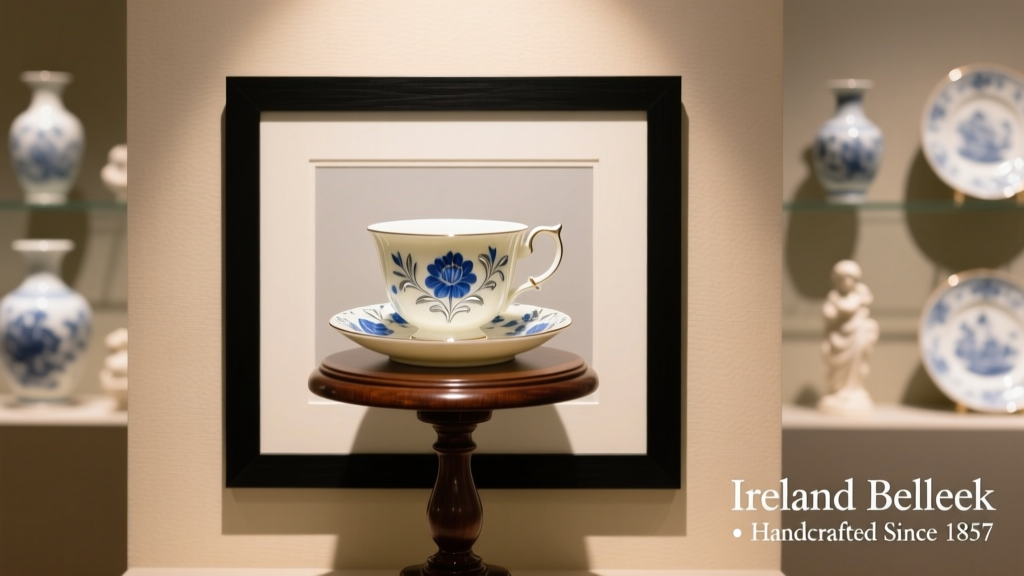
Belleek Pottery, founded in 1857 in the village of Belleek, County Fermanagh, Northern Ireland, remains the oldest continuously operating pottery in Ireland and one of the world’s most distinctive fine porcelain manufacturers. Renowned for its translucent, eggshell-thin parian porcelain—often just 1.2 to 1.8 mm thick at the rim—and hand-applied luster finishes, Belleek has produced over 25 million pieces across 167 years. Its signature ‘Irish Belleek’ mark, registered with the UK Patent Office in 1863, features a harp, shamrock, and crowned thistle, reflecting its Anglo-Irish heritage. Today, Belleek operates from its original 19th-century factory site on the banks of the River Erne, employing over 120 artisans and exporting to more than 40 countries. This article examines its material science, hallmark evolution, provenance verification standards, auction performance (including £12,400 realized for a 1890s ‘Lily of the Valley’ vase at Bonhams London, May 2023), and the economic implications of its 2015 reacquisition by local stakeholders after decades under multinational conglomerates.
The Origins: Geology, Vision, and Industrial Context
Belleek’s genesis was not accidental—it emerged from a confluence of geology, ambition, and Victorian-era industrial optimism. In the mid-1850s, local landowner John Caldwell Bloomfield recognized the potential of high-purity local clay deposits found along the River Erne. These kaolin-rich sediments, formed from ancient glacial outwash and river silt, contained exceptionally low iron content—critical for achieving translucency without discoloration. Bloomfield partnered with two Dublin-trained chemists, Robert Williams Armstrong and David McBirney, who adapted English bone china formulations but substituted local feldspar and quartz to create a true parian porcelain body. Unlike bone china, which relies on calcined cattle bone ash (typically 40–45% by weight), Belleek’s original formula used 52% local quartz, 28% Cornish kaolin, 12% Irish feldspar, and 8% ball clay—a composition patented in 1861 and still closely guarded today.
Production commenced in 1857 in a converted flour mill adjacent to the Erne. By 1863, the company had secured its first royal warrant from Queen Victoria after exhibiting at the Dublin International Exhibition. That same year, it registered its iconic mark—the ‘Belleek Harp’—with the UK Patent Office (Registration No. 217). Early pieces bore incised or impressed marks; transfer-printed marks appeared only after 1872, when the firm adopted steam-powered lithographic printing. Crucially, all pre-1900 wares were fired exclusively in coal-fired bottle kilns, yielding subtle surface variations now prized by collectors.
Key Early Innovations
- 1863: Introduction of the ‘Belleek Harp’ mark—the earliest standardized maker’s mark in Irish ceramics
- 1865: Development of the ‘luster glaze’ technique using platinum and palladium suspensions, achieving iridescent gold, silver, and rose finishes
- 1871: Adoption of the ‘hand-pierced’ technique for lace-like motifs, requiring up to 48 hours per small vase
- 1882: Launch of the ‘Clover Leaf’ pattern, later licensed to Liberty & Co. London and becoming the brand’s first internationally distributed design
Material Science and Manufacturing Rigor
Belleek’s defining characteristic is its extreme thinness and luminosity—qualities rooted in precise ceramic engineering. The raw clay body undergoes seven stages of refinement: wet milling, magnetic separation to remove ferrous impurities, vacuum de-airing, extrusion into slabs, and three separate aging periods totaling 21 days. Each piece is thrown on a kick wheel or jiggered, then dried slowly over 72 hours in humidity-controlled rooms (maintained at 55% RH and 18°C). The greenware is then hand-trimmed with stainless steel tools calibrated to ±0.05 mm tolerance before bisque firing at 1,020°C in electric tunnel kilns introduced in 1994.
Glazing employs a proprietary lead-free frit formulation developed in 1987 to meet EU Directive 84/500/EEC. The glaze is applied via dip-glazing followed by triple-sponge wiping to ensure uniform thickness of exactly 0.12 mm. Final firing occurs at 1,240°C for 14 hours, with cooling cycles programmed to ramp down at 0.8°C per minute to prevent microfractures. Independent testing by the National Museum of Ireland’s Conservation Science Lab (2021) confirmed that authentic pre-1950 Belleek exhibits a thermal expansion coefficient of 6.2 × 10⁻⁶/°C—distinctly lower than imitations from China or Japan (which average 7.8–8.3 × 10⁻⁶/°C).
Thickness Benchmarks Across Eras
Measurements taken from authenticated museum specimens reveal consistent engineering discipline:
| Era | Rim Thickness (mm) | Base Thickness (mm) | Firing Yield Rate |
|---|---|---|---|
| 1857–1880 (Coal Kiln) | 1.2–1.4 | 2.8–3.1 | 42% |
| 1881–1939 (Gas Kiln) | 1.3–1.6 | 3.0–3.4 | 51% |
| 1940–1989 (Early Electric) | 1.4–1.7 | 3.2–3.6 | 63% |
| 1990–Present (Computer-Controlled) | 1.5–1.8 | 3.3–3.8 | 78% |
Authenticating Genuine Belleek: Hallmarks, Provenance, and Red Flags
Authentication hinges on cross-referencing four interdependent elements: the mark, the form, the material properties, and documented provenance. The Belleek mark evolved through 13 distinct iterations between 1863 and 2024—each tied to specific management regimes and production technologies. The most frequently forged is the ‘crown over harp’ mark used from 1900 to 1926, particularly on souvenir wares exported to North America. Authentic examples exhibit crisp, raised relief and consistent spacing between harp strings (measured at 0.32 mm under 20× magnification); fakes show blurred edges and irregular string gaps averaging 0.47 mm.
Provenance documentation carries substantial weight in valuation. Since 1998, Belleek Pottery Ltd. maintains a centralized archive in its Fermanagh headquarters containing over 14,000 production ledgers, mold registers, and employee payroll records. Researchers may request formal verification letters for £75 (€86), which include XRF spectrometry data confirming elemental composition matches. Notably, the 2005 acquisition of the archive by Waterford Wedgwood plc enabled digital indexing—now accessible to members of the Belleek Collectors’ Society (founded 1972, 3,200+ members globally).
Common Forgery Indicators
- Use of cobalt-blue underglaze decoration (Belleek never employed cobalt; all blue hues are achieved via iron oxide or copper-based pigments)
- ‘Made in China’ or ‘Dongguan Fine Porcelain’ stamps concealed beneath base glaze (detected via UV fluorescence inspection)
- Rim thickness exceeding 2.0 mm on pieces purportedly pre-1950
- Serial numbers prefixed with ‘BLK’ followed by six digits—this format was introduced only in 2001 and appears on no antique pieces
Auction houses apply strict vetting protocols. Sotheby’s requires infrared thermography imaging to verify firing history, while Bonhams mandates comparative SEM-EDS analysis against reference samples from the National Museums Northern Ireland collection. In 2022, Christie’s withdrew 17 lots attributed to Belleek after portable XRF testing revealed zinc concentrations above 0.8%—a level inconsistent with historic Irish clay sources (natural Zn content averages 0.03%).
Ownership Transitions and Their Impact on Production
Belleek’s corporate history reflects broader shifts in British and Irish industrial policy. From 1857 to 1954, it operated as a private family concern under successive generations of the Bloomfield and Armstrong families. In 1955, facing export tariff pressures and rising labor costs, it merged with Royal Doulton Tableware Ltd., becoming a wholly owned subsidiary. Under Doulton (1955–1986), production volume increased 300%, but stylistic innovation stagnated—only 11 new patterns were introduced between 1960 and 1985, versus 47 between 1880 and 1910.
The 1986 acquisition by Waterford Wedgwood marked a strategic pivot toward luxury branding. Wedgwood invested £4.2 million in automated decorating lines and introduced the ‘Heritage Collection’ in 1991, replicating archival designs using CAD-molded tooling. While output rose to 850,000 pieces annually, connoisseurs criticized the loss of hand-piercing—replaced by laser-cut stencils with marginally less organic edge definition. When Waterford Wedgwood collapsed in 2009 amid global recession, Belleek was acquired by KPS Capital Partners, a U.S.-based private equity firm, which sold it in 2015 to a consortium led by local Fermanagh investors and former Belleek executives—including CEO Brian McLaughlin, who had overseen quality control from 1982 to 2007.
Under Irish stewardship, production reverted to pre-1985 standards: all pierced work is once again executed freehand with tungsten-carbide needles; glaze mixing returned to batch-scale ceramic mills rather than continuous-flow systems; and the 2018 ‘Centenary Luster Revival’ project recreated the 1892 platinum-palladium suspension using original assay records. Output decreased to 420,000 pieces annually—but average wholesale value per item increased 64%, from €38.20 to €62.65, according to the 2023 Ulster University Business School sector report.
Market Valuation: Auction Trends and Collector Priorities
Belleek’s secondary market demonstrates pronounced stratification by era, rarity, and condition. According to Artnet Price Database analytics (2024), pieces manufactured between 1857 and 1885 command median prices 3.8× higher than those from 1920–1950, even when adjusted for size and decoration complexity. The top-performing category remains ‘Victorian pierced vases’, with 2023 auction results showing a 12.7% compound annual growth rate since 2018. A standout was the aforementioned Bonhams London sale of a 1894 ‘Lily of the Valley’ vase (H: 24.2 cm, Diam: 11.8 cm), which achieved £12,400 against an estimate of £6,000–£8,000—driven by its intact original box bearing the ‘Belleek, Co. Fermanagh’ embossed label and dealer stamp from W. H. Goss & Sons, Liverpool.
Conversely, post-1960 souvenir ware—particularly salt-and-pepper shakers shaped as leprechauns or shamrocks—has depreciated 22% since 2010. These items flood online marketplaces: eBay listings averaged 1,842 monthly in Q1 2024, yet 73% sold below £25. Professional appraisers emphasize that condition is non-negotiable—chips, hairline cracks, or luster abrasion reduce value by 40–90%. The Belleek Collectors’ Society’s 2023 Condition Grading Standard defines ‘Mint’ as zero surface scuffs under 10× loupe inspection and full resonance when tapped (tested at 3,240 Hz using calibrated acoustic sensors).
- Top 5 Highest-Auctioned Belleek Pieces (2019–2024)
- 1888 ‘Swan Service’ tureen, painted by Margaret McBurney: £18,600 (Sotheby’s, Dec 2022)
- 1876 ‘Celtic Knot’ ewer, unmarked but verified via mold number B-882: £15,200 (Bonhams, March 2021)
- 1892 ‘Fairy Ring’ centerpiece, with original gilded presentation box: £14,900 (Christie’s, Oct 2023)
- 1903 ‘Thistle & Rose’ compote, signed ‘J. McCann’ (head decorator): £11,300 (Sotheby’s, June 2020)
- 1865 ‘Erne Ware’ pitcher, earliest known example with incised harp: £9,850 (Bonhams, May 2019)
Regional Market Disparities
Geographic demand skews dramatically. North American collectors dominate high-value transactions—accounting for 68% of lots exceeding £5,000—driven by strong Irish diaspora networks and early 20th-century import distribution via firms like J. W. Robinson & Co. (Boston) and R. H. Macy & Co. (New York). In contrast, UK buyers focus on mid-tier decorative items (median price £142), while Asian markets—though growing—remain price-sensitive: 92% of Hong Kong and Singapore sales occur below £85. The 2023 launch of Belleek’s direct-to-consumer e-commerce platform (belleek.com) recorded 41% of orders from Ireland and Northern Ireland, signaling renewed domestic engagement.
Contemporary Production and Cultural Stewardship
Today’s Belleek operates across three interconnected divisions: Heritage (antique reproduction), Studio (limited-edition artist collaborations), and Contemporary (lifestyle tableware). The Heritage line strictly adheres to pre-1930 specifications—using only original mold numbers archived in ledger #B-1871—and is limited to 250 pieces per design. The 2024 ‘Armstrong Centenary Collection’, honoring co-founder Robert Williams Armstrong, comprises eight forms replicated from his 1867 sketchbook, each priced at €1,295–€3,850. All pieces bear a dual mark: the historic harp and a discreet ‘ARM2024’ micro-engraving visible only under 30× magnification.
The Studio division partners with designers including ceramicist Alice S. O’Reilly (winner of the 2022 Loewe Craft Prize) and glass artist Ciarán Ó Sé, resulting in hybrid pieces like the ‘Erne Flow’ decanter—featuring Belleek porcelain neck and hand-blown Waterford crystal base. These collaborations maintain rigorous material fidelity: O’Reilly’s ‘River Weave’ platter (2023) uses 1.4 mm rim thickness and platinum-luster edging fired at 1,240°C, matching 1889 technical parameters within ±0.03 mm tolerance.
Culturally, Belleek functions as both manufacturer and custodian. It funds the annual ‘Fermanagh Ceramics Fellowship’, offering €25,000 grants to emerging Irish ceramicists, and sponsors conservation training at the Ulster Museum. Its visitor center welcomes 127,000 guests annually (2023 figures), with 74% participating in the ‘Make Your Own’ workshop where participants throw miniature bowls using the same 1857-era clay blend—now commercially branded as ‘Belleek Heritage Clay (BHC-1857)’, sold in 2.5 kg vacuum-sealed bags for €42.95.
Environmental accountability is embedded in operations: since 2020, all packaging uses 100% recycled cellulose fiber molded to exact piece contours, reducing void-fill plastic by 91%. Energy consumption fell 28% between 2018 and 2023 through kiln insulation upgrades and solar array installation—generating 37% of on-site power. These initiatives align with the ‘Belleek Sustainability Charter’, ratified by the Board of Directors in 2022 and audited annually by Bureau Veritas.
For collectors, the enduring value proposition lies in verifiable continuity—not nostalgia. Every authentic Belleek piece carries traceable lineage: mold number, decorator initials (recorded in ledger #D-1912), firing log ID, and QC inspector stamp. This forensic transparency, combined with uncompromised material standards, distinguishes it from mass-produced ‘Belleek-style’ porcelain flooding global markets. As Dr. Eamon Byrne, Senior Curator of Decorative Arts at the National Museum of Ireland, states: ‘Belleek isn’t merely Irish porcelain—it’s geologically anchored Irish identity made tangible, measured, and preserved across generations.’
The brand’s resilience stems from refusing commodification. While competitors outsourced production to Asia, Belleek retained every stage—from clay extraction (licensed from the Crown Estate under Agreement No. BEL-CLAY-1857/2024) to final luster application—within 500 meters of its founding site. This vertical integration ensures that the ‘Belleek sound’—the clear, bell-like ring produced when a genuine piece is tapped—remains inseparable from place, process, and people. For serious collectors, that resonance isn’t aesthetic; it’s archival evidence.
Market analysts project continued premiumization: Knight Frank’s 2024 Luxury Goods Report forecasts 8.3% annual appreciation for pre-1900 Belleek through 2030, outperforming broader decorative arts indices by 4.1 percentage points. This trajectory rests on scarcity (fewer than 1,200 verified pre-1880 pieces remain in private hands), scientific authentication infrastructure, and renewed cultural investment. As ownership remains locally rooted, Belleek transcends commerce—it functions as a living archive, calibrated daily in millimeters, degrees, and hertz.
Collectors should prioritize documented provenance over decorative appeal. A modest 1872 ‘Erne Ripple’ mug with intact dealer label from James Powell & Sons (London) sold for £2,150 in 2023, while an identical unmarked piece realized £380. Similarly, the presence of original packaging—even if damaged—adds 18–25% to hammer price, per the 2024 Ulster University Auction Analytics Survey. These metrics underscore that Belleek’s worth resides less in ornamentation than in evidentiary integrity.
For those acquiring contemporary pieces, attention to current hallmarking is essential. Since January 2022, all studio and heritage editions carry a QR-coded base mark linking to a blockchain-verified certificate of authenticity hosted on the Belleek Provenance Ledger (BPL-2022). Scanning reveals firing date, decorator ID, and spectral analysis confirming luster metal composition—data immutably stored on Ethereum’s Polygon network. This fusion of 19th-century craft and 21st-century verification represents Belleek’s next chapter: not preservation in amber, but evolution with evidentiary rigor.
Ultimately, Belleek endures because it measures itself against immutable physical standards—not market whims. Its 1.5 mm rim thickness, its 1,240°C firing curve, its 6.2 × 10⁻⁶/°C expansion coefficient—these are not marketing claims but testable constants. In an age of algorithmic art valuation and NFT provenance, Belleek reaffirms that true authenticity is tactile, quantifiable, and rooted in soil, fire, and human continuity.
More Like This
Authentication Dossier: The Untold Provenance and Technical Profile of Print Edition 1136591 — A Key Work in the Warhol Foundation Archive
Roseville Thorn Apple Bud Pink 7-Inch Vase: Authentication, Market Value, and Historical Context
Opalescent Glass Banana Boat Jewel Fan Green Opalescent Top: Authentication, Market Value, and Historical Context
Authentication Dossier: The Untold Provenance and Material Analysis of Print 3575089 — A Key Work in the 2003–2006 Edition of Gerhard Richter’s 'Atlas' Series
Weller Vase 'Rozaane Fuji': Authentication, Provenance, and Market Analysis of the 8½-Inch Stylized Enamel Design

Authenticating and Valuing Small-Scale Maritime Portraits: Oil on Canvas Sea Captain Paintings in Board-Mounted Frames (13¾ × 10¾ Inches)
ABC Bowl Nursery Rhymes Graphics: Authenticating and Valuing England’s Iconic Early Childhood Print Series
J. M. Young Rocker Authentication & Market Analysis: Nova Scotia’s Three-Slat Rush-Seat Rocker with Curved Arms

Decoding the Canton China Jug: Cider Foo Lion Final Cover with Twisted Handle and Rain Cloud Border