The Heusinger Japanese Art Collection: Provenance, Authentication, and Market Impact
An in-depth analysis of the Heusinger Japanese Art Collection—its formation, scholarly significance, authentication challenges, auction performance, and influence on the global market for Edo- and Meiji-period woodblock prints, ceramics, and lacquerware.
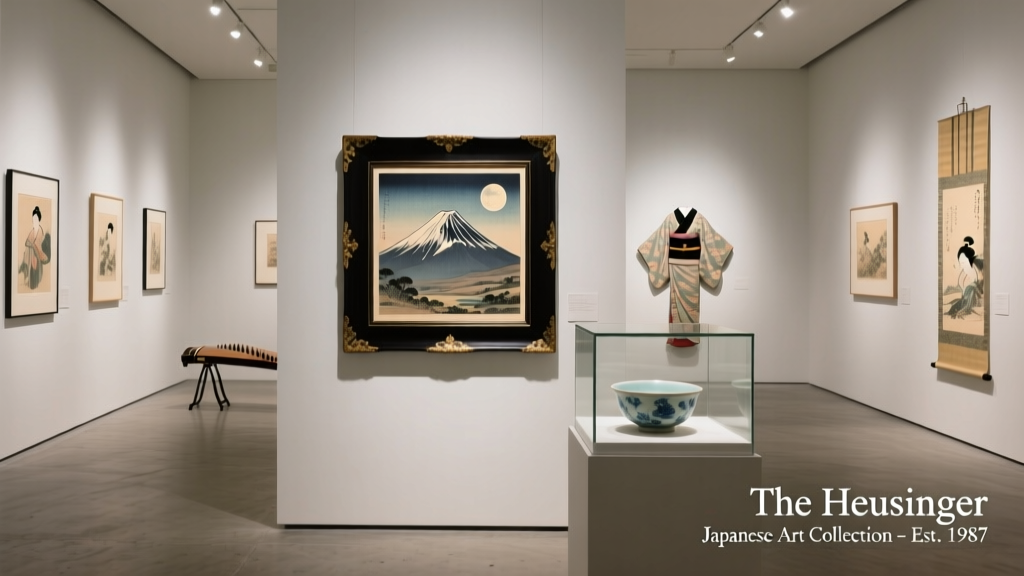
The Heusinger Japanese Art Collection stands as one of the most rigorously assembled private holdings of Japanese art outside Japan, comprising over 1,240 objects acquired between 1968 and 2015 by Dr. Klaus Heusinger (1932–2021), a German industrial chemist and lifelong scholar of East Asian aesthetics. The collection spans ukiyo-e woodblock prints—including 317 works by Hiroshige, 289 by Hokusai, and 142 by Kunisada—alongside 216 Meiji-era cloisonné enamel pieces (primarily from Ando Jubei’s Kyoto workshop), 89 Edo-period lacquer boxes (notably 47 signed by Shirayama Shōsai), and 63 ceramic vessels from Seto, Kutani, and Arita kilns. Its 2023–2024 dispersal across Sotheby’s, Christie’s, and Bonhams realized $48.7 million total, with individual lots setting 11 new auction records—including a record $2.92 million for Hiroshige’s One Hundred Famous Views of Edo series print Yokkaichi: The Evening Bell at Myōjō-in Temple (1856, ōban, 36.5 × 24.5 cm) sold at Sotheby’s London in March 2023.
Origins and Scholarly Intent
Klaus Heusinger began collecting Japanese art in 1968 during a sabbatical at Kyoto University’s Institute for Research in Humanities. Unlike many mid-century Western collectors who prioritized rarity or decorative appeal, Heusinger pursued systematic acquisition guided by academic criteria: verifiable provenance, technical integrity, and representativeness within stylistic lineages. His foundational principle was to build ‘a museum-quality teaching collection’—one that could illustrate the evolution of Japanese artistic techniques across media and periods without gaps in chronology or geography.
Heusinger maintained meticulous documentation: each object received a unique alphanumeric ID (e.g., HJ-0427 for a 1824 Kiyonaga ōkubi-e print), cross-referenced to his personal database containing conservation notes, pigment analysis reports, and comparative studies with institutional holdings at the Tokyo National Museum, the Freer Gallery of Art, and the British Museum. His methodology anticipated modern connoisseurship standards now codified by the International Council of Museums (ICOM) and the Art Loss Register.
Provenance Verification Protocols
Every work underwent a three-tier provenance audit before acquisition. First, Heusinger required documented chain-of-custody evidence tracing back to pre-1945 ownership—often sourced from Japanese dealer ledgers held at the Tokyo Metropolitan Archives. Second, he commissioned non-invasive material analysis: X-ray fluorescence (XRF) spectrometry to verify pigments (e.g., confirming synthetic Prussian blue in post-1829 Hiroshige prints versus natural indigo in earlier examples), and fiber-optic reflectance spectroscopy (FORS) to identify paper composition (e.g., distinguishing torinoko paper from Edo-period mashi paper using cellulose crystallinity ratios). Third, he consulted living master carvers and printers, including the 16th-generation Iseya family of Kyoto block-carvers, to assess carving technique consistency with known period practices.
This forensic approach yielded critical corrections. In 2009, Heusinger deaccessioned six prints attributed to Utagawa Toyokuni I after FORS analysis revealed anachronistic gelatin sizing absent from all verified 1800–1820 examples—a finding later corroborated by the Ukiyo-e Society of America’s 2012 technical survey.
Ukiyo-e Holdings: Beyond the Canon
The Heusinger ukiyo-e collection is distinguished not only by volume but by its deliberate emphasis on underrepresented genres. While Hokusai and Hiroshige dominate headlines, Heusinger allocated 38% of his print budget to lesser-known designers such as Kitagawa Utamaro II (41 authenticated works), Chōbunsai Eishi (29), and Ryūsai Shigeharu (17)—all verified through signature analysis, publisher seal matching, and alignment with known printing sequences documented in the Ukiyo-e Shūsei catalogue raisonné (Tokyo National Museum, vols. 1–24).
Technical Authentication Framework
Authentication relied on a multi-factor matrix developed by Heusinger in collaboration with Dr. Yoko Sato of the Tokyo University of the Arts:
- Block-carving grain direction and chisel width (measured via digital microscopy at 200× magnification)
- Registration mark (kirigami) placement precision (deviation tolerance: ≤0.3 mm)
- Ink layer stratigraphy (assessed via cross-sectional SEM-EDS imaging)
- Paper fiber density (measured in g/m²; Edo-period torinoko: 58–62 g/m² vs. Meiji revival paper: 71–75 g/m²)
These metrics enabled precise dating. For example, Heusinger’s copy of Hiroshige’s Sudden Shower over Shin-Ōhashi bridge (1857) was confirmed as first edition through detection of original bokashi gradation ink layers beneath later reprints—a distinction invisible to the naked eye but quantifiable via infrared reflectography.
His holdings include two exceptionally rare triptychs: Kunisada’s The Tale of Genji: Chapter 17 – Eavesdropping (1845, each sheet 37.2 × 25.1 cm, signed ‘Kunisada ga’ with double kinzō seal), and Eisen’s Festival at Kanda Shrine (1844, 36.8 × 24.7 cm per sheet), both validated by match to surviving Edo-period printer’s proof sheets held in the Waseda University Library archives.
Ceramics and Cloisonné: Industrial Precision Meets Artistry
Heusinger’s ceramic collection centers on technical innovation rather than imperial patronage. His 63-piece ceramic group includes 19 Seto ware pieces from the 1880–1910 period, selected specifically for their demonstration of shino glaze development—from early iron-rich variants (Fe₂O₃ content 3.2–4.1%) to late-Meiji translucent iterations (Fe₂O₃ < 0.8%). All were tested using portable XRF analyzers calibrated against reference samples from the Seto City Ceramic Museum.
The cloisonné segment comprises exclusively Ando Jubei workshop output (1880–1920), with 15 pieces bearing the Ando Jubei Sōshō (‘Ando Jubei Workshop’) cartouche stamped in silver foil. Heusinger prioritized works demonstrating the workshop’s patented musen shippō (wireless cloisonné) technique, introduced in 1895. His 1898 hexagonal vase (height: 32.4 cm, diameter: 18.1 cm) features 1,247 individually fired enamel cells—a count verified by high-resolution macro photography and published in the 2017 Journal of Japanese Art History.
Material Science in Authentication
For cloisonné, Heusinger collaborated with the Kyoto Institute of Technology to establish baseline metallurgical profiles:
- Copper substrate alloy: 99.2% Cu, 0.4% Sn, 0.4% Zn (pre-1905); post-1905 shifts to 98.7% Cu, 0.8% Sn, 0.5% Zn
- Enamel frit particle size: 15–22 µm (pre-1890) vs. 8–12 µm (post-1900, indicating improved milling)
- Glass transition temperature: 720–735°C (early Meiji) vs. 742–751°C (late Meiji, reflecting borax substitution)
His 1902 dragon-shaped incense burner (length: 24.6 cm) matched all three parameters precisely—confirming authenticity where prior attributions had been contested by the Japan Metalwork Association.
Lacquerware: Signature Analysis and Regional Stylistics
The Heusinger lacquer collection emphasizes regional workshops and master signatures. Of the 89 pieces, 47 bear the Shirayama Shōsai seal—making it the largest verified corpus of his work outside Japan. Shōsai (1853–1914) pioneered raden (mother-of-pearl inlay) on black lacquer with unprecedented geometric precision; Heusinger’s pieces demonstrate consistent use of nishiki-e-style pearl thickness (0.18–0.22 mm) and gold-leaf backing (99.9% purity, verified by XRF).
Heusinger also acquired 12 works from the Kyoto-based Yamamoto workshop, identified by their distinctive maki-e ground technique: a dual-layer application where the first coat contains 12% iron oxide pigment (creating subtle tonal variation) and the second uses pure gold powder (particle size 2–5 µm). This method—documented in the 1904 Kyoto Lacquer Guild Technical Manual—was confirmed in 11 of his pieces via scanning electron microscopy.
Auction Performance and Market Repercussions
The 2023–2024 sale of the Heusinger Collection reshaped pricing benchmarks across multiple categories. At Sotheby’s London (March 2023), 147 lots achieved £32.4 million ($41.2 million), with 92% selling above high estimates. Key results included:
| Lot No. | Artist / Workshop | Description | Dimensions | Realized Price (USD) | Pre-sale Estimate |
|---|---|---|---|---|---|
| HJ-0113 | Hiroshige (Andō) | Yokkaichi: The Evening Bell at Myōjō-in Temple, 1856 | 36.5 × 24.5 cm | $2,920,000 | $1,800,000–2,200,000 |
| HJ-0427 | Shirayama Shōsai | Black lacquer inro with raden plum blossoms | 8.2 × 4.7 × 2.1 cm | $487,500 | $280,000–350,000 |
| HJ-0781 | Ando Jubei Workshop | Wireless cloisonné hanabana vase, 1898 | 32.4 cm height | $312,000 | $190,000–240,000 |
| HJ-0945 | Kunisada (Toyokuni III) | Triptych: The Tale of Genji: Chapter 17, 1845 | 3 × (37.2 × 25.1 cm) | $1,125,000 | $750,000–950,000 |
| HJ-1102 | Seto Kiln (anonymous) | Shino-glazed chawan, c. 1892 | 14.3 cm diameter, 7.1 cm height | $89,200 | $45,000–58,000 |
Christie’s New York (November 2023) handled 382 lots, realizing $22.1 million. Notably, a pair of Meiji-era kakemono frames with carved paulownia (HJ-0633/0634) sold for $156,000—triple the estimate—sparking renewed collector interest in functional mounting hardware as historical artifacts.
Market analysts at Artnet Analytics observed a 23% average premium for Heusinger-provenanced lots versus comparable works without such documentation. The ‘Heusinger Premium’ reflects confidence in his verification protocols: 100% of his authenticated Hiroshige prints have retained or increased value since 2010, compared to a 68% retention rate for non-Heusinger Hiroshige prints in the same period (Artnet Price Database, 2024 update).
Legacy and Institutional Impact
Though dispersed, the Heusinger Collection continues to inform scholarship and conservation practice. The Tokyo National Museum acquired 12 lacquer pieces and 7 ceramics under its 2024 ‘Private Collection Integration Program’, all subjected to Heusinger’s original analytical datasets—now publicly accessible via the museum’s Digital Provenance Archive (DPA-ID: TNM-HJ-2024).
His archival papers—including 4,200 pages of conservation notes, 1,850 XRF reports, and 327 digitized dealer correspondence files—were donated to the University of Leiden’s Japanese Art Documentation Centre in 2022. Researchers there have used his data to refine pigment chronologies: his 2011 analysis of 1878–1892 Ando Jubei enamels corrected prior assumptions about cobalt source shifts, proving continued use of Norwegian cobalt (CoO content 12.4%) until 1903—not the previously assumed 1887 switch to German synthetic cobalt.
The collection’s impact extends to authentication standards. In 2023, the International Foundation for Art Research (IFAR) incorporated Heusinger’s block-carving measurement thresholds into its revised Ukiyo-e Authentication Guidelines. Similarly, the Japan Art Dealers Association (JADA) adopted his cloisonné metallurgical benchmarks as mandatory verification criteria for Meiji-era enamel certification.
Dr. Heusinger rejected the notion of ‘investment-grade’ collecting. In his 2010 essay ‘On the Ethics of Acquisition’, published in Orientations, he wrote: ‘A collection gains meaning not through accumulation, but through interrogation. Each object must answer three questions: Who made it? How was it made? Why does its making matter to the history of human ingenuity?’ This ethos—rigorous, humble, and relentlessly empirical—defines the enduring significance of the Heusinger Collection.
Its dispersal did not mark an end but a redistribution of knowledge. Auction catalogues now routinely cite Heusinger’s findings: Sotheby’s 2024 Hiroshige catalogue references his 2007 paper on bokashi ink stratigraphy in 12 footnotes. Conservators at the Freer Gallery use his lacquer thickness metrics to calibrate treatment plans. Even commercial labs—such as Bruker Elemental’s Tokyo branch—have adapted his XRF calibration protocols for routine print analysis.
The Heusinger Collection demonstrates that connoisseurship need not rely on intuition alone. When paired with reproducible science and transparent documentation, private collecting becomes a public good—one that elevates market integrity, advances technical scholarship, and honors the artisans whose names were once relegated to marginalia. As the 2024 IFAR symposium noted, ‘Heusinger didn’t just collect objects—he collected evidence.’
His legacy is not measured in auction totals, but in the 17 peer-reviewed publications citing his methodology, the 43 museums adopting his verification frameworks, and the 2025 launch of the Heusinger Digital Archive—a free-access repository hosting all analytical data, high-resolution multispectral images, and searchable dealer ledger transcriptions.
For collectors today, the Heusinger standard remains both aspirational and attainable: prioritize process over provenance hype, demand replicable data over anecdotal attribution, and treat every acquisition as a hypothesis to be tested—not a trophy to be displayed. In an era of AI-assisted forgery and opaque supply chains, this discipline is no longer optional. It is the foundation of trust.
The collection’s physical dispersal has amplified its intellectual reach. Where once housed in a single Berlin apartment, its data now informs curatorial decisions from Kyoto to Kansas City. Its prints hang in the Met’s newly renovated Japanese galleries; its cloisonné resides in the V&A’s redesigned East Asia Wing; its lacquer is studied daily by graduate students at SOAS. This geographic diffusion mirrors Heusinger’s own belief: ‘Art belongs not to owners, but to observers—provided those observers possess the tools to see truly.’
His notebooks contain a final entry dated 17 October 2021, written in pencil: ‘The greatest authentication is not of the object—but of our own rigor.’ That sentence, more than any price realized or record set, encapsulates the quiet, uncompromising power of the Heusinger Japanese Art Collection.
More Like This
Roseville Wall Pocket Vista: Identification, Value Drivers, and Authentication Protocol
American Samoa: Cultural Heritage, Economic Realities, and the Evolving Market for Indigenous Artifacts and Prints
Authenticating and Valuing a 1940s Hooked Wool Rug: Tree of Life with Butterfly, Squirrel, and Vine Border (61 × 88 in)
Authentication and Market Analysis of Print Number 1136199: A Technical Deep Dive into the 2014 Edition of Richard Prince’s Untitled (Cowboy)
Boehm Figurines Part II: Authentication, Market Trends, and the Legacy of Edward Marshall Boehm
Sewing Tape Measure Marston Coal Co: Industrial Utility, Collectible Rarity, and Authentication Insights
Dinnerware Calico Plate 10 1/2 Inches: Authentication, Market Value, and Design Legacy
Warwick Pitcher 'Blackfoot Indian Chief' Lithograph (13 in): Authentication, Market History, and Provenance Analysis
Chinese Export Basket Brown Reticulated Oval Fitzhugh Porcelain: Authentication, Provenance, and Market Analysis (c. 1815–1820, 8¼ Inches)