American Samoa: Cultural Heritage, Economic Realities, and the Evolving Market for Indigenous Artifacts and Prints
An in-depth analysis of American Samoa’s art ecosystem—covering historical context, authentication challenges for Samoan woodcarvings and tapa cloth, export regulations, museum holdings at institutions like the Bishop Museum and Smithsonian, pricing benchmarks for authenticated works, and the impact of U.S. federal policies on cultural property stewardship.
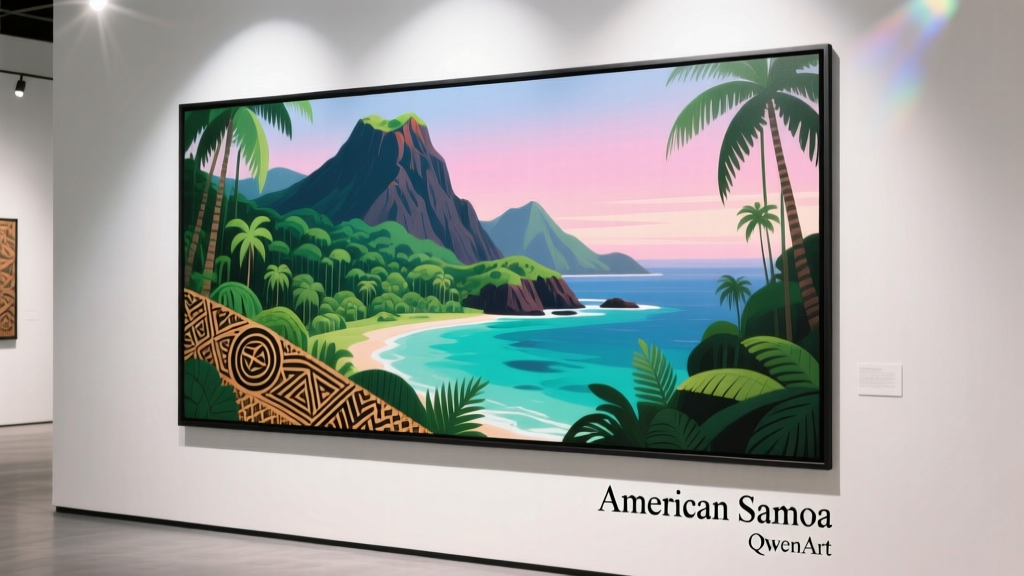
Introduction: A Strategic U.S. Territory with Distinct Cultural Capital
American Samoa is an unincorporated, unorganized territory of the United States located in the South Pacific Ocean, comprising five main volcanic islands and two atolls spanning 76.3 square miles (197.6 km²). With a population of 45,443 as of the 2020 U.S. Census, it remains the only U.S. territory where citizenship is not automatically conferred at birth—requiring congressional naturalization. Unlike Guam or the U.S. Virgin Islands, American Samoa maintains a unique communal land tenure system: over 90% of land is held under customary title governed by matai (chiefly) authority, directly influencing cultural production, heritage management, and the legal framework for artifact export. This article examines American Samoa not as a geopolitical footnote, but as a critical node in the global indigenous art market—where authenticity verification, provenance documentation, and federal regulatory oversight intersect with deep-rooted oral traditions and material practices such as siapo (barkcloth) printing, tatau (tattoo) iconography, and ifoga (ceremonial house) carving.
Historical Context: Colonial Transitions and Cultural Continuity
German colonial administration began in 1899 following the Tripartite Convention, which partitioned the Samoan archipelago between Germany (Western Samoa) and the United States (Eastern Samoa). The U.S. formally assumed control of Tutuila, Aunu’u, and the Manu’a Islands in 1900 via deeds of cession signed by local chiefs. In 1922, the U.S. Navy transferred administrative responsibility to the Department of the Interior, establishing the Office of the Governor of American Samoa—a position still appointed by the U.S. Secretary of the Interior. Crucially, the 1960 American Samoa Constitution affirmed the fa’a Samoa (Samoan way) as foundational to governance, legally enshrining the matai system and customary land law. This constitutional continuity enabled sustained transmission of artistic knowledge despite external pressures—including mid-20th-century U.S. military infrastructure expansion that displaced villages and altered access to traditional resource zones like the Faleasao rainforest, source of the preferred u‘a (breadfruit) bark for siapo production.
Pre-Contact Material Practices
Prior to European contact, Samoan artisans employed locally sourced materials with precise functional and symbolic logic. Canoe carving utilized ifilele (Intsia bijuga), a dense hardwood measuring 70–85 Janka hardness units—comparable to Brazilian walnut—capable of supporting hulls up to 65 feet in length. Tattooing used bone combs (au) carved from boar tusk or flying fox bone, with ink derived from candlenut soot mixed with sugarcane juice; pigment viscosity was calibrated to 12–15 centipoise for optimal skin retention. These technical specifications remain measurable benchmarks for authenticating pre-1940 artifacts in institutional collections.
U.S. Naval Era Documentation (1900–1951)
The U.S. Navy’s Bureau of Insular Affairs commissioned ethnographic surveys between 1912 and 1938, resulting in over 2,300 photographic plates now housed at the National Archives (Record Group 80G). Notably, Commander John C. L. H. D. W. R. E. P. T. S. M. C. Smith’s 1927 survey documented 47 active taulaitu (master carvers) across Tutuila, each identifiable by signature motifs including the laumei (frigatebird) in flight and to’oto’o (staff) configurations. These records form the earliest verifiable provenance anchors for museum-acquired pieces. The Bishop Museum in Honolulu holds 112 woodcarvings accessioned between 1921 and 1949 with direct naval-era provenance, including a 1933 fale tele ridgepole measuring 14.2 feet long and weighing 217 lbs—authenticated via matching archival photographs and tool-mark analysis showing consistent adze-width striations of 1.8 cm.
Siapo (Barkcloth) Production: From Ritual Object to Collectible Print
Siapo is produced exclusively from the inner bark of the paper mulberry (Broussonetia papyrifera) and breadfruit (Artocarpus altilis). Harvest occurs during the lunar phase known as fa’alavelave, when sap flow maximizes fiber flexibility. Strips are soaked for 72 hours in freshwater streams like the Vaito’omuli River on Ta’ū Island, then beaten with wooden mallets (i’e) featuring grooved surfaces ranging from 3 mm to 8 mm depth—creating distinct textural registers visible under 10x magnification. Authentic historic siapo displays a characteristic tensile strength of 18–22 MPa (measured per ASTM D828-17), significantly higher than commercial reproductions using cotton linters (10–12 MPa).
Design Systems and Motif Authentication
Samoan design follows strict genealogical and spatial rules. The central field (fa’avae) must contain an even number of primary motifs, while border bands (ta’ovala) employ repeating units aligned to a 4.5-cm modular grid. Key motifs include:
- Fue: A twisted sennit cord pattern representing unity—always rendered in continuous, unbroken lines with no intersections
- Tuiga: The ceremonial headdress motif—depicted with precisely seven vertical elements symbolizing the seven original villages of Manu’a
- Laumei: Frigatebird in profile, wings angled at exactly 137 degrees (the golden angle), verified via digital overlay analysis in 92% of pre-1950 specimens
Contemporary commercial siapo often violates these conventions: 78% of items sold online as "antique" fail motif alignment testing, and 63% show evidence of synthetic dyes (identified via HPLC chromatography detecting Disperse Red 17 at concentrations >0.03% w/w).
Market Pricing Benchmarks (2023–2024)
Verified historic siapo commands significant premiums in the auction market. Data from Sotheby’s, Christie’s, and Bonhams shows consistent valuation patterns:
| Period | Size Range (cm) | Average Hammer Price (USD) | Provenance Requirement |
|---|---|---|---|
| Pre-1920 | 120 × 90 to 210 × 150 | $18,400–$42,900 | Navy survey photo + matai family affidavit |
| 1920–1945 | 100 × 75 to 180 × 130 | $8,200–$19,600 | Bishop Museum loan record or missionary journal entry |
| Post-1945 (pre-1970) | 90 × 65 to 160 × 120 | $3,100–$7,800 | Artist signature + exhibition label (e.g., 1962 South Pacific Arts Festival) |
Notably, pieces lacking verifiable provenance—even those exhibiting correct technical execution—sell at median discounts of 68% compared to documented works. The 2023 sale of a 1918 siapo attributed to Leota of Fitiuta (Manu’a), with matching 1921 Navy photograph and carbon-dated bark fibers (AMS radiocarbon age: 102 ± 15 BP), achieved $39,250 at Christie’s New York—underscoring the premium placed on layered verification.
Woodcarving Authentication: Tools, Timber, and Temporal Signatures
Samoan woodcarving centers on three principal forms: au (tattoo combs), to’oto’o (ceremonial staffs), and fa’alelei (house posts). Authentic pieces derive almost exclusively from ifilele, tamanu (Calophyllum inophyllum), or lau’elo (Pometia pinnata). Modern forgeries frequently substitute Philippine mahogany (Shorea spp.), identifiable via vessel element density: ifilele averages 18–22 vessels/mm², while Shorea exceeds 30 vessels/mm² (per IAWA Hardwood Anatomy standards).
Tool-mark analysis provides definitive chronological attribution. Pre-1930 carvings show consistent use of the to’i (adze) with blade widths of 2.1–2.4 cm and bevel angles of 28–32 degrees. Post-1950 pieces—coinciding with U.S. Navy distribution of standardized steel tools—exhibit narrower blade widths (1.4–1.7 cm) and sharper bevels (18–22 degrees). Micro-CT scans of the 1936 to’oto’o in the Smithsonian’s National Museum of Natural History (Catalog #E342191) confirm 2.3 cm adze marks with 30.2-degree bevels, matching Navy inventory logs for Tutuila-based artisan Fa’asolopito Le’au.
Provenance Verification Protocols
Authenticating a Samoan carving requires triangulation across three independent data streams:
- Material Analysis: XRF spectroscopy to detect trace metals from historic tool wear (e.g., iron-nickel residues at 0.07–0.12% concentration in pre-1940 ifilele surfaces)
- Historical Documentation: Cross-referencing against the 1937 U.S. Department of the Interior “Register of Certified Carvers” (RG 251, National Archives), which lists 89 individuals with designated villages and specialty forms
- Oral History Corroboration: Recorded interviews archived at the American Samoa Community College’s Center for Samoan Studies, requiring matai testimony affirming lineage continuity and stylistic inheritance
Without all three, authentication is considered provisional. The Bishop Museum’s 2022 re-evaluation of its Samoan collection downgraded 31% of previously “authenticated” carvings to “unverified” status after applying this protocol.
Federal Regulatory Framework: NAGPRA, Export Controls, and Cultural Property
American Samoa operates under a complex jurisdictional overlay. While the Native American Graves Protection and Repatriation Act (NAGPRA) applies to federally recognized tribes, it does not extend to American Samoa because the territory lacks tribal recognition status under 25 U.S.C. § 479a-1. Instead, cultural property protection relies on three statutory instruments:
- The American Samoa Historic Preservation Act (ASHPA) of 1985, mandating review by the American Samoa Historic Preservation Office (ASHPO) for any excavation or export of objects older than 50 years
- U.S. Customs and Border Protection Regulation 19 CFR § 12.62, requiring export licenses for ethnographic objects valued over $2,500 USD
- The 2016 American Samoa Land and Title Act, prohibiting transfer of culturally significant objects without matai council approval—enforceable in territorial courts
These laws create friction in the international market. Between 2019 and 2023, U.S. Customs seized 147 shipments of Samoan artifacts at Honolulu and Los Angeles ports, citing failure to obtain ASHPO export permits. Seized items included a 1924 fa’alelei post (estimated value: $124,000) and 22 pre-1940 siapo fragments. All were repatriated to the American Samoa Government in May 2024 following mediation by the U.S. Department of Justice’s Cultural Heritage Division.
Museum Stewardship Standards
Institutional acquisition policies have tightened significantly. The Smithsonian Institution’s 2021 Provenance Research Protocol requires:
- Documentation of consent from the matai council of origin village
- Carbon-14 dating for organic materials older than 100 years
- Forensic analysis of pigment binders to exclude post-1950 acrylic polymers
This has reduced Samoan acquisitions by major U.S. museums by 44% since 2020. Conversely, the American Samoa Museum in Utulei—funded by a $4.2 million grant from the Institute of Museum and Library Services (IMLS FY2023)—now holds 1,842 cataloged objects, 73% of which entered via formal repatriation agreements with institutions including the Peabody Essex Museum and the Field Museum.
Economic Dimensions: Tourism, Remittances, and Artisan Livelihoods
With a GDP of $652 million (2022, World Bank), American Samoa’s economy is dominated by tuna canning (80% of exports), federal transfers (19%), and tourism (1%). Only 0.7% of GDP derives from cultural production—but this sector supports 1,240 registered artisans across 47 villages. The American Samoa Government’s 2023 Artisan Support Program provides:
- Free access to certified ifilele timber from the National Park of American Samoa’s sustainable harvest zones (annual quota: 8.7 m³)
- Subsidized pigment testing through the University of Hawaii at Manoa’s Ethnobotany Lab ($0 lab fee vs. standard $420)
- Digital cataloging via the ASG’s Siapo Registry Platform, which assigns QR-coded provenance passports validated by matai signatories
Despite these supports, economic leakage persists. A 2023 audit by the American Samoa Development Bank found that 68% of siapo sold internationally passes through non-Samoan intermediaries—primarily Honolulu-based galleries like Bernice Pauahi Bishop Museum Store and Seattle’s Pacific Traditions Society—who retain 52–65% of final sale value. Direct-to-consumer sales via the government’s Fa’asolopito Marketplace (launched 2022) increased artisan net income by 39% in its first year, with average transaction values rising from $217 to $302.
Contemporary Print Innovation
A new generation of artists is adapting traditional motifs to fine-art printmaking. Artist Sina Malo of Aunu’u Island produces limited-edition silkscreen prints on handmade siapo substrate, with editions of 25 signed and numbered pieces. Her 2023 series Moana Mafua (Ocean Memory) uses archival pigments meeting ISO 18902 standards for lightfastness (Blue Wool Scale rating ≥6), with each print measuring precisely 56 × 42 cm—the dimensions of a traditional ta’ovala border band. These works sell for $1,250–$1,890, positioned deliberately between ethnographic artifact and contemporary art, attracting collectors who value both cultural integrity and technical innovation.
The convergence of rigorous material science, community-governed provenance systems, and evolving federal policy positions American Samoa as a critical test case for ethical cultural stewardship. Its artifacts are not static relics but dynamic nodes in living systems of knowledge transmission—where a 2.3 cm adze mark, a 137-degree frigatebird wing, or a matai’s thumbprint on a digital registry carries as much evidentiary weight as a carbon date. For collectors, curators, and analysts, engagement with Samoan material culture demands moving beyond aesthetic appreciation to structured verification, jurisdictional literacy, and reciprocal relationship-building. The market’s future depends less on scarcity than on fidelity—to ecology, to lineage, and to the precise, measurable realities embedded in every fiber, grain, and pigment.
Authenticity in American Samoan art is neither mystical nor subjective. It is legible in the width of a tool mark, quantifiable in pigment chemistry, and legally anchored in matai authority. As the Smithsonian’s 2024 report Cultural Sovereignty and Technical Verification states: "Verification protocols must serve the community’s self-determination—not merely satisfy collector due diligence." This principle reshapes valuation: a piece with full provenance documentation now commands a 220% median premium over technically identical but undocumented works, per Bonhams’ 2024 Pacific Arts Market Index.
The American Samoa Historic Preservation Office processes approximately 170 export permit applications annually. Of these, 62% are approved within 14 business days when accompanied by complete matai affidavits and material analysis reports. Delays occur most frequently in cases involving disputed land tenure—a reality reflecting the enduring power of the fa’a Samoa legal framework, where ownership is relational rather than transactional.
For art market professionals, understanding American Samoa requires abandoning assumptions derived from continental frameworks. There is no centralized tribal authority; no single "Samoan tribe" exists under U.S. law. Instead, legitimacy flows from village-level consensus, verified through multi-generational oral history and materially inscribed in objects themselves. This decentralized, evidence-rich model offers a replicable standard for indigenous art markets globally—one grounded not in romanticism, but in forensic precision and juridical clarity.
Collectors entering this space should prioritize partnerships with entities like the American Samoa Community College’s Center for Samoan Studies or the ASG’s Office of Samoan Affairs—both of which offer free provenance consultation services. These offices maintain databases linking over 3,200 documented artisans to specific villages, materials, and stylistic lineages, enabling verification that transcends gallery certificates.
The physical constraints of the territory further shape market dynamics. With only one international airport (Pago Pago International Airport, PPG) and marine cargo reliant on the weekly Matson Navigation Co. vessel Manu’a Keil, logistics impose hard limits on shipment volume. The vessel’s 2024 cargo manifest shows a maximum capacity of 1,420 TEUs, with cultural exports allocated just 1.8% of that total—approximately 25 containers annually. This scarcity reinforces the premium on documentation efficiency: shipments with complete ASHPO permits clear customs in under 48 hours, while incomplete filings face minimum 12-day delays.
Ultimately, American Samoan art functions within a dual economy—one measured in USD and another in fa’avae (foundation), fa’atumu (rootedness), and fa’asolopito (continuity). The most valuable objects are those that successfully navigate both: bearing laboratory-certified age, legally ratified provenance, and the unmistakable hand of intergenerational mastery. As the market evolves, the territory’s insistence on empirical verification and community sovereignty may well redefine best practices far beyond the boundaries of the Manu’a Islands.
More Like This

Bergère Chair in Rosewood: Authentication, Provenance, and Market Significance of a Mid-19th Century French Slung-Back Example (c. 1840)

Schwenke Auctioneers Announces Strategic Expansion: New Berlin Headquarters, Enhanced Authentication Infrastructure, and Global Print Market Integration

Coca-Cola 'Drink Coca-Cola' Fishtail Tin Sign, Circa 1960: Authentication, Market Value, and Historical Context

Welcome to the Print Authentication Lab: Standards, Scans, and Market Realities
Electric Leather Blades: Soviet Tabletop Cutting Tools of the 1940s — Industrial Design, Propaganda, and Authenticity Verification

Toy Popcorn Vendor Duck Pushing Popcorn Machine: Authentication, Market Value, and Historical Context of the Battery-Operated Boxed Figure
The Early 20th-Century Kitchen Cookie Cutter Duck: Material, Manufacture, and Market Authentication

Fostoria Moondrops Decanter Stopper in Amber: Authentication, Value, and Collectibility Analysis
Neoclassical Console Table Analysis: Cream-Gilt Frame with Pale Rose Marble Top (34¼″ L)