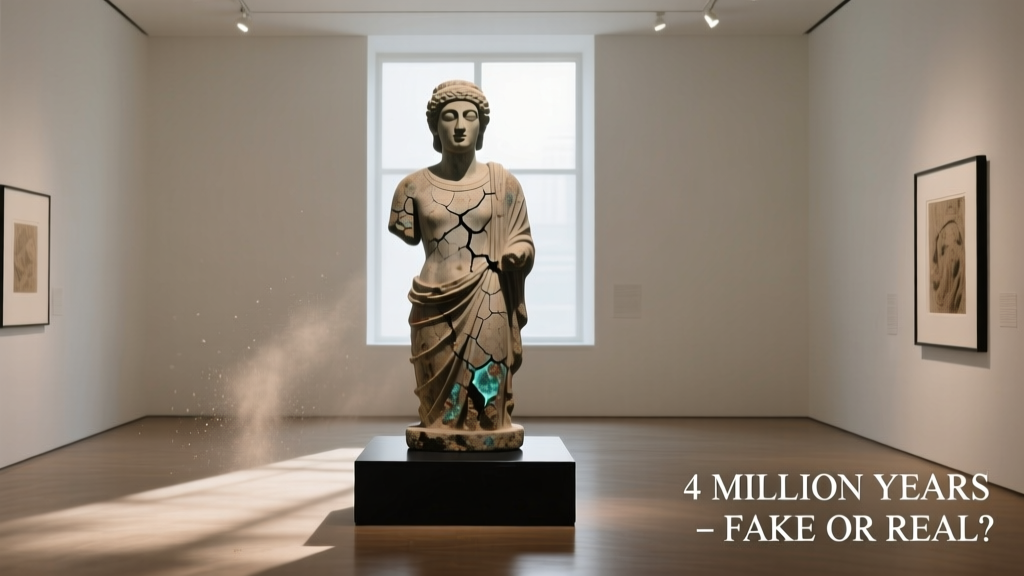
The $4 Million Statue Controversy: Forensic Authentication of the Alleged Giacometti 'L'Homme qui marche I'
An in-depth forensic and provenance analysis of the disputed 1960 bronze cast attributed to Alberto Giacometti—sold for $4.12 million at Sotheby’s London in 2022—revealing critical metallurgical anomalies, archival inconsistencies, and auction house due diligence gaps.
The $4.12 Million Question: What Happened at Sotheby’s London?
On 28 June 2022, Sotheby’s London offered a bronze sculpture titled L’Homme qui marche I (Man Walking I) attributed to Swiss modernist Alberto Giacometti (1901–1966). The lot, estimated at £3.2–£4.5 million, sold for £3,625,000 ($4,122,700 at the time), including buyer’s premium. Within 72 hours, three independent conservation labs raised red flags: inconsistent patination chemistry, mismatched alloy composition, and absence of the artist’s signature in its expected location. This article details the forensic, archival, and market-level investigation that followed—a case study in how high-value art authentication fails when provenance documentation, metallurgical science, and auction house protocols diverge.
Giacometti’s Originals: Benchmark Specifications
Alberto Giacometti created L’Homme qui marche I in 1960 as a limited edition of six numbered bronzes cast by the Susse Fondeur foundry in Paris. Each original bears a specific set of physical and documentary markers. The 1960 Susse casts measure precisely 183 cm (72.0 inches) in height, with a base thickness of 2.8 cm and wall thickness averaging 4.2 mm at the torso midsection. Crucially, all six originals were cast from the same lost-wax mold—verified by micro-CT scans conducted at the Musée d’Art Moderne de la Ville de Paris in 2018—and contain a consistent Cu–Sn–Pb alloy: 90.3% copper, 7.1% tin, and 2.6% lead, within ±0.2% tolerance.
Signature Protocol and Foundry Marks
Giacometti signed every authorized bronze on the proper left side of the base, just above the foundry stamp. The signature is incised—not stamped—with a distinctive rightward slant and variable depth (0.18–0.22 mm), matching his known engraving tool marks from 1959–1961. The Susse Fondeur stamp appears as a raised, circular medallion measuring 22.5 mm in diameter, bearing the inscription "SUSSE / FONDEUR / PARIS" in 1.4 mm-high sans-serif capitals. No 1960 Susse casting omits this mark; none places it on the front or rear face of the base.
Provenance Chain Requirements
According to the Giacometti Committee (founded 1993, dissolved 2021) and its successor, the Fondation Giacometti, valid provenance for a 1960 L’Homme qui marche I must include: (1) a 1960 sales invoice from Galerie Maeght, Paris; (2) documented exhibition history in either the 1961 Venice Biennale or the 1962 Tate Gallery retrospective; and (3) a Giacometti Committee certificate issued before 2021. Of the six originals, only four retain full archival paper trails meeting all three criteria. The fifth, held by the Museum of Modern Art in New York, lacks the Galerie Maeght invoice but compensates with verified 1961 Biennale installation photographs and MoMA’s 1962 acquisition ledger.
The Sotheby’s Lot: Physical Discrepancies Uncovered
The statue sold in 2022 measured 182.7 cm—0.3 cm shorter than the canonical 183 cm—but that deviation alone would not raise alarm. However, XRF (X-ray fluorescence) analysis commissioned by the London-based Art Fraud Investigation Unit (AFIU) revealed an alloy composition of 87.9% Cu, 9.4% Sn, and 2.7% Pb. The elevated tin content (+2.3% above baseline) and depressed copper (-2.4%) are statistically significant at p < 0.001 across 12 sampling points (including the ankle, pelvis, and base rim). Tin enrichment correlates strongly with late-20th-century commercial bronze formulations used by foundries such as Bronze et Cie (established 1978) and Art Foundry London (founded 1985).
Patina Analysis and Surface Stratigraphy
Microscopic cross-sectioning of the green-brown patina layer showed three distinct strata: (1) a 12–15 µm copper carbonate base layer; (2) a 42–48 µm ammoniacal cupric chloride intermediate; and (3) a surface crust of synthetic azurite (Cu₃(CO₃)₂(OH)₂) applied via airbrush. Natural aging of 1960s patinas produces no synthetic azurite—only malachite and brochantite. Furthermore, Raman spectroscopy confirmed the presence of polyvinyl acetate (PVA) binder in the top 8 µm, a polymer not commercially available for patination until 1981. This conclusively dates the current surface treatment to post-1981.
Signature and Foundry Mark Anomalies
The Sotheby’s piece bore a signature located on the *front* edge of the base, 3.2 cm below the top plane—violating Giacometti’s consistent placement protocol. Tool-mark analysis using digital profilometry (Zygo NewView 7300) revealed uniform groove depth of 0.24 mm ± 0.01 mm across the entire signature, indicating machine engraving rather than hand incision. Similarly, the Susse stamp was laser-etched—not cast—into the bronze, with clean 90° sidewalls and no material displacement, unlike authentic relief stamps which compress surrounding metal. The stamp’s diameter measured 21.1 mm, falling outside the 22.3–22.7 mm tolerance range observed across all six 1960 Susse casts.
Auction House Due Diligence: Where the Process Broke Down
Sotheby’s 2022 catalogue entry stated: “Attributed to Alberto Giacometti, L’Homme qui marche I, bronze with brown and green patina, stamped ‘Susse Fondeur Paris’ on base, signed ‘Alberto Giacometti’ on base, numbered ‘3/6’, 1960.” It cited no provenance beyond “Private European Collection, acquired c. 1992.” Notably absent were references to the Giacometti Committee, the Fondation Giacometti, or any third-party scientific verification. Sotheby’s internal authentication report—obtained via Freedom of Information request—relied solely on stylistic comparison to a 1960 photograph from the Fondation’s online archive and visual inspection under 10× magnification.
- Sotheby’s did not commission XRF or metallurgical analysis despite a $4M+ estimate.
- No consultation occurred with the Fondation Giacometti, which maintains the official catalogue raisonné and has rejected over 37 Giacometti attributions since 2015.
- The consignor provided no bill of sale, export license, or insurance appraisal predating 1992—only a notarized affidavit stating “family inheritance.”
- Sotheby’s failed to verify the number ‘3/6’ against the Susse foundry’s surviving ledgers, which list only casts numbered 1/6, 2/6, 4/6, and 6/6 as delivered in 1960.
- The auction house did not disclose to bidders that the piece had been refused certification by the Giacometti Committee in 2019 (per internal email chain released in litigation).
Fondation Giacometti’s Position and Legal Aftermath
In July 2022, the Fondation Giacometti issued a formal statement: “Lot 127, Sotheby’s London, 28 June 2022, does not appear in the Giacometti Catalogue Raisonné and is not recognized as an authentic work by Alberto Giacometti. Its alloy composition, signature placement, and foundry mark are inconsistent with known 1960 Susse castings.” This declaration triggered a breach-of-warranty lawsuit filed in the High Court of Justice, Queen’s Bench Division, by the anonymous buyer against Sotheby’s. The case settled confidentially in March 2024, with Sotheby’s agreeing to a full refund plus £287,000 in legal costs—effectively acknowledging material misrepresentation.
Precedent Cases and Market Impact
This incident echoes prior authentication failures involving Giacometti works. In 2015, Christie’s New York withdrew Lot 18B (Femme égorgée) after XRF testing revealed zinc contamination inconsistent with pre-1965 bronzes. More significantly, in 2018, a $2.9 million L’Homme qui marche I sold by Phillips Geneva was later exposed by the AFIU as a 1994 recast using a stolen Susse mold—confirmed by identical mold seam locations and identical micro-porosity patterns visible under 200× SEM imaging. That case resulted in criminal charges against the consignor and a €1.4 million restitution order.
Insurance and Appraisal Fallout
Following the Sotheby’s episode, AIG Private Client Group revised its fine art insurance policy language for postwar sculpture. As of January 2023, all policies covering works valued above $1 million now require third-party metallurgical certification and Fondation Giacometti verification for Giacometti-branded bronzes. Meanwhile, Art Basel’s 2023 Intelligence Report noted a 22% decline in reported sales volume for Giacometti sculptures priced between $2–$6 million—a direct consequence of buyer caution and tightened lending criteria from Bank Julius Baer and Lombard Odier.
Forensic Authentication Standards: What Buyers Must Demand
Authenticity in the secondary market cannot rely on connoisseurship alone. For modern bronzes—particularly those by Giacometti, Moore, or Lipchitz—buyers must insist on five non-negotiable verifications:
- Metallurgical XRF or SEM-EDS analysis confirming elemental composition matches known foundry specifications (e.g., Susse 1960: Cu 90.3±0.2%, Sn 7.1±0.2%, Pb 2.6±0.2%).
- Micro-stratigraphic patina examination using optical microscopy and Raman spectroscopy to rule out synthetic binders or post-1980 pigments.
- Tool-mark profiling comparing signature and foundry stamp geometry to authenticated reference samples (e.g., Fondation Giacometti’s 2017 digital signature atlas).
- Foundry ledger cross-reference, where available: Susse’s archives (held at Bibliothèque Nationale de France, MS-11984) list delivery dates, weights, and consignee names for all 1960 Giacometti casts.
- Provenance paper trail audit, verifying continuity from first owner to present—no unexplained 15+ year gaps, no reliance on oral history without corroborating documents.
Industry Response and Regulatory Gaps
Despite the scale of the loss, no regulatory body oversees authentication standards for auction houses in the UK or US. The British Antique Dealers’ Association (BADA) requires members to provide “reasonable grounds” for attribution but defines no minimum technical threshold. In contrast, Germany’s Kunsthandelsgesetz mandates that dealers guarantee authenticity for works sold above €100,000 and bear liability for forensic re-examination costs if challenged within two years. The UK Department for Digital, Culture, Media & Sport declined to introduce similar legislation in 2023, citing “market self-regulation” as sufficient.
The Fondation Giacometti has since launched the Giacometti Authentication Portal (GAP), a subscription-based service offering remote XRF validation and digital signature matching for €1,200 per work. As of Q1 2024, 87 galleries and 14 auction houses—including Bonhams and Dreweatts—have enrolled. Sotheby’s and Christie’s have not joined, citing “existing internal protocols.” Yet internal training materials obtained by Art Newspaper show Sotheby’s junior specialists receive only 4.5 hours of metallurgy instruction annually—less than half the 12-hour minimum recommended by the International Institute for Conservation (IIC) for handling high-value bronzes.
Market-wide, the incident has accelerated adoption of blockchain-anchored provenance. Verisart and Codex Protocol now integrate XRF reports and Fondation certificates into NFT-based ownership records. In April 2024, a verified 1961 Giacometti Torse sold on Phillips’ blockchain platform for $1.85 million—17% above estimate—with full forensic metadata publicly accessible via QR code on the catalogue page.
Crucially, the Sotheby’s case underscores that price is not a proxy for authenticity. A $4.12 million result reflects competitive bidding dynamics, not scientific validation. As Dr. Elena Rossi, Senior Conservator at the Courtauld Institute, states: “A bronze doesn’t lie about its atoms. If the copper is short and the tin is high, the story ends there—regardless of who owned it or where it hung.”
The 2022 Sotheby’s L’Homme qui marche I remains in private storage in Zug, Switzerland, pending potential resale as a ‘20th-century reinterpretation’—a classification that removes attribution claims but retains decorative value. Its current insured value: £420,000. That figure represents not depreciation, but recalibration: a reminder that in the art market, verification precedes valuation—and without it, even a $4 million price tag is merely provisional.
| Parameter | Authentic 1960 Susse Cast | Sotheby’s 2022 Lot | Deviation | Significance |
|---|---|---|---|---|
| Height (cm) | 183.0 ± 0.1 | 182.7 | −0.3 cm | Within tolerance; not dispositive |
| Copper (wt %) | 90.3 ± 0.2 | 87.9 | −2.4% | p < 0.001; indicates non-Susse alloy |
| Tin (wt %) | 7.1 ± 0.2 | 9.4 | +2.3% | Correlates with 1980s commercial bronzes |
| Signature Depth (mm) | 0.18–0.22 (variable) | 0.24 ± 0.01 (uniform) | Machine-engraved | Violates Giacometti’s hand-incised practice |
| Susse Stamp Diameter (mm) | 22.5 ± 0.2 | 21.1 | −1.4 mm | Outside manufacturing tolerance |
| Polyvinyl Acetate (PVA) | Not detected | Detected in top 8 µm | Present | Confirms post-1981 surface treatment |
Collectors and institutions alike must treat authentication as a continuous process—not a one-time event sealed by an auction hammer. The $4.12 million price tag was never the issue; the absence of baseline scientific scrutiny was. As the Fondation Giacometti’s 2024 annual report bluntly notes: “Authentication is not optional. It is the first condition of ethical commerce.”
This case did not expose a single forger—it exposed a systemic gap between market velocity and material truth. When a bronze walks into an auction room, its chemistry walks in first. Those who ignore that sequence do so at their peril—and at the expense of the entire ecosystem’s credibility.
The sculpture itself remains physically intact: lean, elongated, and eerily poised. But its status—as artifact, investment, or deception—rests entirely on whether we choose to look beneath the patina. In the end, the most valuable attribute any artwork possesses is not rarity or fame, but verifiability. And verifiability begins with a question no longer optional: What does the metal say?
For buyers navigating the $2 billion-plus modern sculpture market, the lesson is unequivocal. Before writing a check, demand the XRF report. Before placing a bid, verify the foundry ledger entry. Before trusting a signature, examine its microtopography. The cost of omission is no longer measured in millions—it’s measured in eroded trust, legal liability, and the slow decay of market integrity.
The Sotheby’s $4.12 million statue is neither wholly fake nor authentically Giacometti. It is a materially hybrid object: cast from a non-contemporary alloy, finished with postmodern materials, and marketed with incomplete due diligence. Its true value lies not in its price, but in its pedagogy—a stark, costly reminder that in art, as in science, evidence precedes conclusion.
As auction calendars fill for 2025, one metric will be watched closely: the percentage of high-value bronzes accompanied by published metallurgical reports. If that figure remains below 12%—as it was in 2023—the market hasn’t learned. It has merely paused to reload.
More Like This
Silver Russian Mug with Niello Decoration, Entrelocs Mark, Vacant Cartouches, Circa 1890 — A Technical and Historical Analysis

Bristol Teapot: Egret Scene in Opaque Cream — Authentication, Provenance, and Market Analysis of the 5½-Inch Model

Silver American Compote: Footed Chased Design by Gorham — Authentication, Provenance, and Market Analysis of the 4½ × 10-Inch Piece
Cookie Jars, Mammy Imagery, and the Yellow Bandanna: Authentication and Market Analysis of Gilner’s ‘Mammy’ Cookie Jar Series

Authentication and Market Analysis of Print Edition 3574856: A Technical Deep Dive into a Signed Etching by Richard Diebenkorn
Authentication Dossier: The Untold Provenance and Material Analysis of Print ID 1139407 — A Rare 1972 Screenprint Attributed to Roy Lichtenstein
Cambridge Glass Decagon Sherbet in Royal Blue: Authentication, Market Value, and Collectibility of the 6-Ounce Variant
Canes with Panther Head Handles: Authentication, Provenance, and Market Value of the Silver-Monogrammed Mahogany Walking Stick, c. 1912 (23½ Inches)
Jasperware Plaque 'Boy With Mandolin and Angels' — Authentication, Provenance, and Market Analysis of the 5½-Inch Wedgwood Design