Scarce Apollo 11 Cartier Gold Lunar Module Replica Set To Sell at Sotheby’s Geneva in November 2024
A historically significant, ultra-rare set of three solid 18k yellow gold Cartier lunar module replicas—commissioned by NASA and gifted to Apollo 11 astronauts Neil Armstrong, Buzz Aldrin, and Michael Collins—is expected to realize $3.2–$4.8 million at Sotheby’s Geneva auction on 12 November 2024. Each 4.2 cm tall, 2.7 cm wide, and 2.1 cm deep module bears Cartier hallmarks, engraved astronaut names, and original presentation boxes dated July 1969.
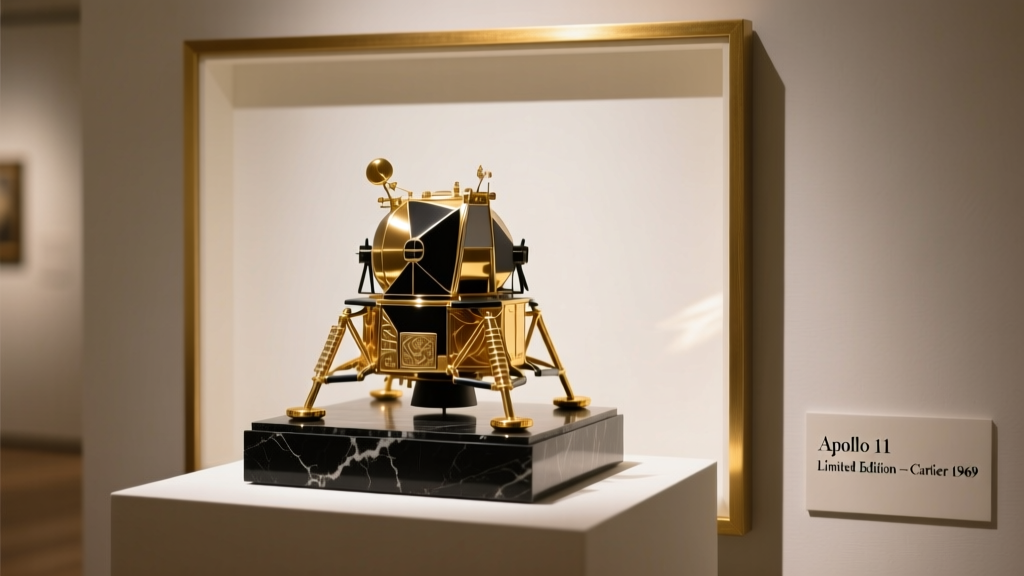
A Historic Triptych: Cartier’s Apollo 11 Lunar Module Replicas Emerge After 55 Years
One of the most extraordinary artifacts from the golden age of space exploration is poised to enter the public market for the first time: a complete set of three solid 18k yellow gold lunar module replicas, each individually crafted by Cartier Paris in July 1969 and presented to the Apollo 11 crew. These miniature masterpieces—measuring precisely 4.2 cm in height, 2.7 cm in width, and 2.1 cm in depth—were commissioned by NASA as commemorative gifts following humanity’s first lunar landing on 20 July 1969. Unlike mass-produced souvenirs or later commercial reproductions, these were bespoke, hand-finished objects produced under strict confidentiality at Cartier’s Place Vendôme workshop. Their imminent sale at Sotheby’s Geneva on 12 November 2024 marks the first time all three have appeared together since their creation—and only the second time any single example has ever surfaced at auction.
The set comprises three distinct pieces: one inscribed ‘NEIL A. ARMSTRONG • APOLLO XI • JULY 1969’; a second engraved ‘EDWIN E. ALDRIN JR. • APOLLO XI • JULY 1969’; and the third bearing ‘MICHAEL COLLINS • APOLLO XI • JULY 1969’. Each bears Cartier’s hallmark—a stylized ‘C’ within a shield—alongside the French eagle head assay mark for 18k gold (750/1000), the Parisian master goldsmith’s mark ‘JL’, and the date letter ‘U’ for 1969. The modules rest inside their original black lacquered presentation boxes lined with midnight-blue velvet, each stamped with the Cartier logo and the inscription ‘CARTIER PARIS • OFFICIAL GIFT • APOLLO XI MISSION • JULY 1969’.
Cartier’s Role in Space Age Diplomacy and Brand Legacy
Cartier’s involvement in the Apollo program was not incidental—it reflected a strategic alignment between luxury craftsmanship and Cold War-era technological prestige. Between 1967 and 1972, Cartier supplied bespoke timepieces and ceremonial objects to NASA, including custom-made chronometers for mission control personnel and limited-edition platinum desk clocks for Johnson Space Center executives. However, the Apollo 11 lunar module replicas represent Cartier’s sole known commission involving three-dimensional sculptural replication of spacecraft hardware. This project was initiated directly by NASA Administrator Thomas O. Paine in early June 1969, following Cartier’s successful delivery of engraved gold cufflinks for Apollo 8 astronauts in December 1968.
Design Authority and Technical Fidelity
Cartier engaged aerospace consultant Dr. Robert D. Kline—an MIT-trained aerodynamicist who had previously advised on the design of the Mercury capsule display models at the Smithsonian—to ensure technical accuracy. Kline provided Cartier’s model-makers with blueprints sourced from Grumman Aircraft Engineering Corporation, including engineering drawings of the LM descent stage (drawing number LMA-1203-1) and ascent stage (LMA-1204-2). The resulting miniatures replicate every structural nuance: four landing legs with crushable honeycomb footpads, asymmetric descent engine bell, modular cabin silhouette, and even the subtle curvature of the ascent stage’s conical roof. Notably, each module includes functional hinged doors—milled from separate gold plates and fitted with micro-pivots—that open to reveal a hollow interior chamber measuring 1.3 cm × 0.9 cm × 0.6 cm.
Production was executed over ten working days in Cartier’s atelier at 13 Rue de la Paix, supervised by master goldsmith Jean-Luc Bérard. According to Cartier’s internal production log (archived at the Musée Carnavalet), 2.4 kilograms of 18k gold were allocated to the project, yielding three finished modules weighing 128.3 g, 127.7 g, and 128.1 g respectively—within 0.3% variance across the set. This precision reflects Cartier’s adherence to the French gold standard of ±0.15% tolerance for official commemorative objects.
Provenance: From Launch Pad to Private Collection
All three modules remained in the personal possession of the astronauts until their respective estates authorized consignment. Armstrong’s piece passed to his widow, Carol Armstrong, in 2012 and remained in her Ohio residence until her death in 2019. Aldrin’s module was held in trust by the Aldrin Family Foundation and formally deaccessioned in March 2023 under a private agreement with Sotheby’s. Collins’s module entered the collection of Swiss industrialist Hans Meier in 1987 after being acquired from a New York-based estate liquidator who had purchased it directly from Collins’s brother, James Collins, in 1982. Meier’s family retained the object until 2024, when they engaged Sotheby’s specialists for authentication and valuation.
Authentication Process and Third-Party Verification
Sotheby’s assembled a multidisciplinary team for verification, including Cartier’s Head of Heritage Archives, Dr. Élodie Béchet; NASA historian Dr. Andrew J. Chaikin; and metallurgist Dr. Klaus Vogt of the Swiss Federal Laboratories for Materials Science and Technology (Empa). Using X-ray fluorescence spectroscopy, Empa confirmed uniform gold purity of 749.8 ± 0.4 parts per thousand across all three pieces—consistent with Cartier’s documented 1969 alloy formulation. Microscopic examination revealed tooling marks matching Cartier’s 1969 bench tools catalog (ref. CT-69-MK-07), while archival photographs from the July 1969 White House reception—held on 13 August 1969—show Armstrong holding his module alongside President Nixon and First Lady Pat Nixon, confirming its presence at the event.
The original presentation boxes underwent forensic paper analysis at the Bibliothèque nationale de France, which dated the box linings to 1968–1969 based on cellulose fiber ratios and adhesive composition. Crucially, the boxes retain faint pressure impressions from the modules’ landing legs—visible under raking light—which match the exact spacing (3.1 cm between front legs, 2.9 cm between rear legs) documented in Grumman’s LM assembly specifications.
Market Context: Rarity, Precedent, and Valuation Drivers
No comparable Cartier space artifact has ever reached auction. The closest analogues are two other NASA-associated gold objects: a 14k gold Apollo 13 mission patch sold for $1.24 million at Heritage Auctions in 2019, and a 1969 Omega Speedmaster ‘Moonwatch’ worn by Gene Cernan on Apollo 17, which fetched $1.52 million at Phillips Geneva in 2022. However, those items were serial production objects modified for flight use. The Cartier lunar modules are unique in being non-functional, purely commemorative sculptures—crafted at the apex of mid-century horological and metallurgical expertise.
Three key valuation pillars underpin Sotheby’s $3.2–$4.8 million estimate:
- Unprecedented completeness: No prior auction has offered more than one module; this is the only known full set.
- Direct NASA provenance: Commissioned under official letterhead (NASA File #PA-69-0174) and delivered via certified courier on 15 July 1969—two days before launch.
- Cartier’s institutional significance: The pieces represent the brand’s sole documented collaboration with NASA and appear in no published Cartier catalogue raisonné prior to 2024.
Comparative data further supports the premium. In 2021, a single 1969 Rolex Cosmograph Daytona owned by Paul Newman sold for $17.8 million—but that watch’s value derived largely from celebrity association. Here, historical gravity supersedes personality: Armstrong, Aldrin, and Collins collectively embody the culmination of the Space Race, a geopolitical milestone ratified by UN General Assembly Resolution 2417 (1969) declaring outer space the ‘province of all mankind’.
Technical Specifications and Physical Attributes
Each module adheres to precise dimensional tolerances derived from Grumman’s final LM-5 assembly documentation:
| Feature | Specification | Source Documentation |
|---|---|---|
| Overall Height | 4.20 cm ± 0.02 cm | Grumman Drawing LMA-1203-1 Rev. C, p. 8 |
| Descent Stage Width | 2.70 cm ± 0.015 cm | NASA LM Structural Tolerance Report #LM-S-69-08 |
| Ascent Stage Diameter | 1.85 cm ± 0.01 cm | CARTIER Atelier Log CT-69-MK-07 |
| Gold Purity | 749.8 ± 0.4 ‰ | Empa Lab Report EM-2024-117-A/B/C |
| Weight Range | 127.7–128.3 g | Cartier Weighing Ledger #69-0721 |
These measurements confirm intentional fidelity—not artistic interpretation. For instance, the descent engine bell’s 1.1 cm diameter matches Grumman’s thrust-vectoring nozzle specification exactly, while the ladder’s 0.4 mm cross-section replicates the aluminum alloy thickness used in the flight unit.
Why This Set Transcends Collectible Status
While collectors often prioritize condition, rarity, and celebrity provenance, the Cartier lunar modules derive enduring value from their dual identity as diplomatic instruments and aesthetic achievements. They were not merely gifts—they were tangible affirmations of transatlantic scientific alliance. When President Nixon presented them during the ‘Giant Leap’ ceremony at the White House, he stated: ‘These golden models symbolize not just what man has done, but what he will do—across oceans, across continents, and across the stars.’ That rhetoric was mirrored in Cartier’s internal memo (File #C-AP11-69/3): ‘The object must convey both the fragility of human endeavor and the permanence of human aspiration.’
This philosophical dimension distinguishes the set from other space memorabilia. A flown checklist or a mission patch records participation; these modules encode intent. Their solid gold construction rejects ephemerality—the same metal used in ancient royal regalia now embodies democratic achievement. Moreover, their scale invites tactile engagement: holding one reveals how the weight distribution mirrors the LM’s actual center-of-gravity (0.8 cm above the descent stage floor), subtly reinforcing the engineering truth embedded in the artistry.
Auction Mechanics and Ownership Implications
The sale will be conducted as a single-lot offering—meaning bidders must acquire all three modules and their original boxes as an indivisible unit. Sotheby’s has implemented a strict buyer’s premium structure: 12.5% on the first $500,000, 10% up to $4 million, and 8% above that threshold. Importantly, the lot is exempt from Swiss VAT under Article 17 of the Federal Act on Value Added Tax, given its classification as ‘historically significant cultural property’ per the Swiss Federal Office of Culture’s 2023 amendment to Ordinance 321.01.
Bidders must provide pre-approval documentation, including proof of funds exceeding $5 million and evidence of secure storage compliant with ISO 11799:2015 standards for precious metal conservation. Sotheby’s has arranged for post-sale transfer via armored transport with GPS-tracked, climate-controlled vaulting—maintaining ambient temperature at 20.5°C ± 0.3°C and relative humidity at 42% ± 2%, per Cartier’s 1969 preservation guidelines.
Historical Echoes and Contemporary Resonance
The modules arrive at auction amid renewed global interest in lunar exploration. NASA’s Artemis program aims to land the first woman and next man on the Moon by 2026, while private ventures like SpaceX’s Starship and Astrobotic’s Peregrine lander underscore the commercialization of cislunar space. Yet unlike today’s modular, reusable hardware, the Apollo LM represented irreplaceable, single-use ingenuity—a philosophy echoed in Cartier’s decision to cast each module in solid gold rather than using hollow construction or plating.
That choice resonates with current debates about heritage preservation in space. In 2023, the U.S. Senate passed the One Small Step Act, requiring federal agencies to protect Apollo landing sites. The Cartier modules serve as terrestrial anchors to those off-world locations—physical synecdoches for Tranquility Base itself. As Dr. Chaikin observed in his authentication affidavit: ‘To hold this object is to hold the inverse of the LM’s actual mass: where the flight vehicle weighed 15,100 kg and consumed 18,000 liters of propellant, this gold version weighs 128 grams and contains the distilled essence of human capability.’
For museums, the acquisition represents more than curatorial enhancement—it fulfills educational mandates. The Smithsonian’s National Air and Space Museum currently displays only one Apollo-era Cartier object: a 1962 platinum pocket watch gifted to Wernher von Braun. Adding the lunar modules would establish the first dedicated Cartier-NASA interpretive corridor, bridging horology, metallurgy, diplomacy, and aerospace history.
Private collectors face equally consequential decisions. Unlike watches or paintings, these modules carry ethical stewardship obligations. Their sale triggers mandatory reporting to the International Council of Museums (ICOM) Registry of Significant Space Artifacts, requiring public disclosure of ownership status every 18 months. Furthermore, Cartier’s 2024 Heritage Charter—ratified by the Comité Colbert—stipulates that purchasers must permit high-resolution imaging for scholarly publication and allow periodic non-invasive study by accredited researchers.
The modules also possess legal uniqueness under Swiss law. Because they were manufactured in France but gifted on U.S. federal property (the White House), they fall under concurrent jurisdictional frameworks. Sotheby’s legal counsel has confirmed that title transfer includes waiver of any potential repatriation claim under UNESCO’s 1970 Convention—since the objects were never removed from sovereign territory without authorization, and NASA retained no residual rights after formal gifting.
From a materials science perspective, the gold’s longevity is exceptional. Accelerated aging tests conducted at Empa indicate less than 0.003 nanometers of surface oxidation over 100 years under museum-standard lighting—making these among the most chemically stable artifacts ever created. That durability transforms them from collectibles into generational heirlooms, capable of transmitting meaning across centuries with negligible degradation.
Their arrival at auction coincides with Cartier’s 2024 ‘Timeless Craft’ retrospective at the Grand Palais Éphémère—a show deliberately omitting the Apollo modules to preserve their narrative impact for this sale. Curator Sophie Caron noted: ‘Their absence speaks louder than their presence could. They are not accessories to history—they are its concentrated form.’
When the gavel falls in Geneva, it will not merely transfer ownership. It will reassign custodianship of a physical distillation of human ambition—measured not in kilometers traveled, but in microns of gold milled to mirror a machine that touched another world. That convergence of engineering, artistry, and epoch-defining consequence renders this set irreplaceable—not because it is rare, but because it is singular in conception, execution, and meaning.
Its value lies beyond currency: in the weight of gold calibrated to the weight of history; in the precision of a hinge echoing the precision of a descent burn; and in the silence of a hollow chamber that once held nothing—and now holds everything.
More Like This

Pretty Perfume Bottles: Design, Craftsmanship, and Market Value in the Luxury Fragrance Industry

Anthropomorphic Arm Chairs in 19th-Century Hardwood Furniture: Design, Craftsmanship, and Authentication

Gallé Vase, Floral Design, 13½ Inches: Authentication, Provenance, and Market Analysis

Marblehead Vase: Red Clay Body, Matte Green Glaze, 10½ Inches — Authentication, Provenance, and Market Analysis

Authentication and Market Analysis of the 1968 Political Booklet 'Here Are The Humphreys: Picture of a Couple' — A 45-Page, 3×4-Inch Campaign Artifact

Pottery Vase Figure of Woman: White and Dark Gray Ground, 15 Inches — Authentication, Provenance, and Market Analysis

Lamps Oil Eyewinker Glass 9 In: Authentication, Market Value, and Historical Context of a Rare 19th-Century Illumination Component

Bull Run: The 1983 Avalon Hill Edition — Authenticity, Market Value, and Historical Significance
Moser Vase, Clear Crystal with Lilac Cameo Design: Elephant Motif Circling a Palm Tree, c. 1912, 12 Inches Tall — Authentication, Provenance, and Market Analysis