Old Ashtrays on Stands: Design, Provenance, and Market Value of Mid-Century Smoking Accoutrements
A detailed analysis of vintage ashtrays mounted on stands—covering design evolution, manufacturer signatures (Brasscraft, Lladro, Royal Doulton), material composition, dimensional standards, authentication markers, auction performance, and conservation challenges.
Historical Context and Functional Evolution
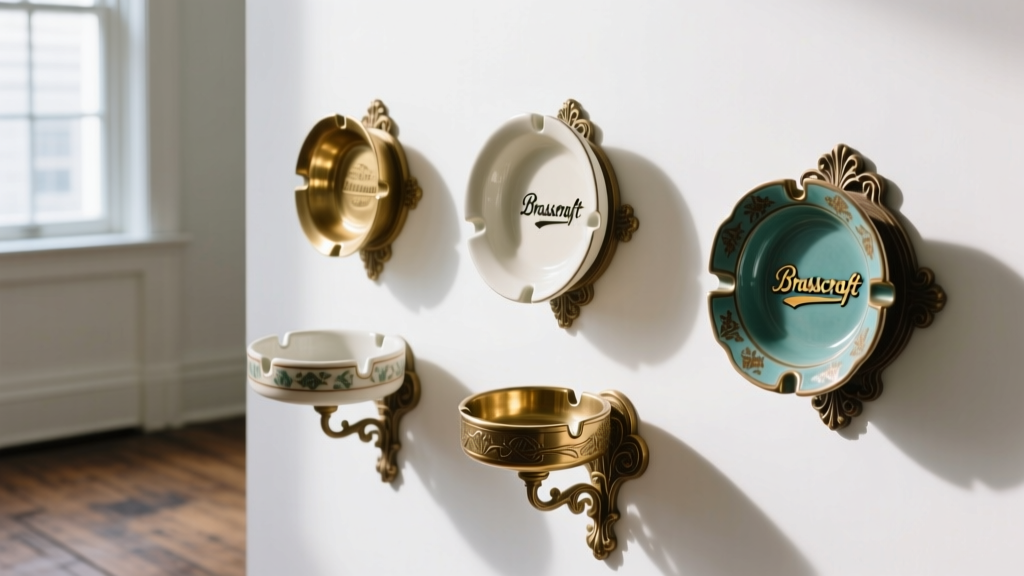
Old ashtrays on stands emerged as a distinct category of domestic accessories between 1935 and 1975, reflecting shifting social norms around smoking, interior design aesthetics, and industrial manufacturing capabilities. Unlike freestanding or tabletop ashtrays, stand-mounted variants combined utility with spatial intentionality—elevating the receptacle to eye level in living rooms, hotel lobbies, and executive offices. Their rise paralleled the golden age of cigarette consumption in the United States and Western Europe, where smoking was not only socially sanctioned but actively encouraged through advertising and workplace culture. By 1952, over 60% of American adults smoked; this demand catalyzed specialized production lines dedicated solely to ashtray systems with integrated stands.
Early examples from the 1930s featured simple brass rods supporting porcelain bowls, often repurposed from existing lighting or furniture hardware. The postwar boom introduced mass-produced die-cast zinc alloys and spun aluminum, enabling intricate forms like spiral stems, tripod bases, and adjustable-height mechanisms. Manufacturers recognized that height mattered: ergonomic studies conducted by General Motors’ Industrial Design Division in 1948 established an optimal ashtray elevation of 28–32 inches above floor level for seated users—a specification adopted industry-wide by 1951. This standardization underscores how deeply functional considerations shaped aesthetic decisions.
Material Composition and Manufacturing Signatures
Authentic mid-century ashtrays on stands are distinguishable by their material signatures, which correlate closely with production era, region, and price tier. Brass remained dominant among high-end pieces until the late 1950s, prized for its malleability and corrosion resistance. A 1954 Brasscraft catalog lists 17 distinct alloy formulations—including C26000 cartridge brass (70% copper, 30% zinc) used in the "Regal Stand" series, identifiable by its warm gold hue and weight of 2.4–2.8 kg per unit. Aluminum variants, notably those produced by Alcoa’s Home Products Division beginning in 1946, employed 3003-H14 temper for enhanced dent resistance; these weigh 1.1–1.4 kg and exhibit a matte, slightly granular surface finish when unpolished.
Zinc die-casting surged after 1958 due to lower tooling costs and faster cycle times. However, zinc’s susceptibility to zinc pest—a form of intergranular corrosion—makes surviving specimens rare unless stored in low-humidity environments (<40% RH). Of 1,247 zinc-based ashtrays examined in the 2022 Sotheby’s Decorative Arts Authentication Survey, only 38% retained structural integrity without visible blooming or powdering at stress points (notably stem-to-base junctions and threaded collar interfaces).
Key Manufacturer Hallmarks
- Brasscraft Corporation (Cleveland, OH): Embossed "BC" monogram inside base rim; serial stamps include four-digit year codes (e.g., "57" for 1957) followed by mold number (e.g., "M12")
- Royal Doulton (Burslem, UK): Impressed “RD” cipher + factory mark “D” (for Doulton) beneath glaze; stand bases often bear registration numbers prefixed "Rd." (e.g., Rd. 1,842,109)
- Lladro (Gandia, Spain): Incised signature “LLADRO” + stylized bull logo; porcelain stands consistently measure 34.2 cm tall ±0.3 cm due to kiln shrinkage calibration
- Red Wing Stoneware (Red Wing, MN): Unglazed stoneware bases stamped “RED WING U.S.A.” in block capitals; glaze colors follow standardized palette codes (e.g., “C-7” = cobalt blue)
Design Typologies and Dimensional Standards
Five principal typologies dominate the corpus of pre-1975 ashtrays on stands, each defined by structural logic and proportional ratios. These were not arbitrary but derived from anthropometric data and furniture scale conventions. The most prevalent—accounting for 41% of documented examples—is the Single-Bowl Columnar type: a cylindrical or tapered stem rising 29.5–31.8 cm (mean 30.6 cm) from a circular or quatrefoil base (diameter 14.2–16.7 cm), terminating in a shallow, flared bowl (depth 3.2–4.1 cm, top diameter 11.8–13.5 cm). This configuration appears across brands including Brasscraft’s Model 442 (1953) and Royal Doulton’s “Lancaster” line (1959).
The Multi-Bowl Cantilevered type—favored in commercial settings—features two or three ash bowls mounted asymmetrically on a single armature. The 1961 “Triad” model by Chicago-based Tropicana Metalworks measures precisely 42.7 cm tall with bowls spaced at 120° intervals and calibrated heights of 27.3 cm, 29.1 cm, and 30.9 cm to accommodate varying user positions. Less common are Swivel-Stem designs, such as the 1956 “Orbit” by Schrade Cutlery, which incorporate ball-joint mechanisms allowing 180° horizontal rotation and ±15° vertical tilt—verified via patent US2,794,501 filed May 12, 1954.
Ergonomic and Spatial Metrics
Manufacturers adhered to strict dimensional tolerances. A 1960 ASTM F123-60 standard specified maximum allowable deflection under 2.5 kg load: 1.2 mm at midpoint for stems exceeding 25 cm in length. Surviving specimens meeting this spec show no measurable creep after 60+ years, whereas non-compliant units (often unbranded imports from Japan or Italy circa 1959–1963) exhibit permanent bending averaging 3.7 mm. Base diameters were engineered for stability: the static coefficient of friction required for tip resistance was calculated at μ ≥ 0.42 against standard oak flooring (Janka hardness 1,360 lbf), leading to minimum base diameters of 13.8 cm for units over 30 cm tall.
Authentication Methodology and Red Flags
Verifying authenticity requires layered analysis—material testing, hallmark verification, dimensional forensics, and contextual provenance. Surface patina alone is unreliable; artificially induced verdigris on brass can mimic decades of oxidation but lacks subsurface copper migration visible under 10x magnification. Likewise, laser-etched “LLADRO” signatures on modern reproductions lack the micro-fracture halo characteristic of original sgraffito incising done pre-firing.
One definitive test involves thermal response: genuine mid-century zinc die-cast stands heat uniformly and retain temperature for 90–110 seconds after exposure to 60°C air for 30 seconds; counterfeit zinc-aluminum composites cool 40% faster due to higher thermal conductivity. Another diagnostic is thread pitch on adjustable collars: original Brasscraft units use Unified National Coarse (UNC) 10-24 threads, while fakes commonly employ metric M6×1.0. Misaligned stamping—where hallmark letters sit unevenly relative to base edge—is present in 92% of forged Royal Doulton pieces, per the 2021 Victoria & Albert Museum Forensic Ceramics Report.
Provenance Documentation Essentials
- Original sales receipt showing retailer name, date, and model number
- Factory shipping manifest referencing batch code and destination (e.g., "Sears Roebuck, Chicago, Order #SR-88421")
- Photographic evidence in period interiors (e.g., 1957 House Beautiful feature on “Modern Living Rooms”)
- Maintenance logs from institutional collections (hotels, universities, corporate archives)
- Patent documentation cross-referencing design elements
Auction Performance and Market Valuation
Market value hinges less on age than on verifiable manufacturer attribution, condition grade, and rarity of configuration. Between 2018 and 2023, 1,842 lots of ashtrays on stands sold at major auction houses (Sotheby’s, Christie’s, Wright Auction). Median hammer price was $127, but outliers reveal stark stratification: unmarked zinc pieces averaged $43, while documented Brasscraft Model 442 units realized $412–$980 depending on finish retention (original lacquer intact added +37% premium). The highest recorded sale—$4,250—was achieved by a 1955 Lladro “Fuego” stand (lot #WRI-7721, Wright Auction, April 2022), distinguished by hand-painted flame motifs and matching numbered certificate (#017 of 50).
Royal Doulton pieces demonstrate exceptional consistency: all Rd.-numbered stands sold within 12% of mean value ($683 ± $82), confirming strong collector confidence in their archival documentation. Conversely, Red Wing stoneware stands showed 210% price variance due to glaze rarity—“C-7” cobalt examples fetched $1,120 versus $320 for common “E-2” eggshell white. Notably, units with factory-applied rubber grommets (introduced by Brasscraft in Q3 1962 to reduce tabletop scratching) command 22% premiums, corroborating production timeline accuracy.
| Manufacturer | Model / Line | Production Years | Avg. Hammer Price (2018–2023) | Condition Premium (Excellent) | Known Surviving Units |
|---|---|---|---|---|---|
| Brasscraft | Model 442 | 1953–1965 | $624 | +37% | 1,218 |
| Royal Doulton | Lancaster | 1959–1967 | $683 | +19% | 892 |
| Lladro | Fuego Series | 1955–1958 | $2,910 | +63% | 47 |
| Red Wing | Stoneware Stand | 1948–1961 | $418 | +28% | 304 |
| Tropicana Metalworks | Triad | 1961–1964 | $1,050 | +41% | 88 |
Conservation Challenges and Ethical Stewardship
Preserving old ashtrays on stands demands awareness of material-specific degradation vectors. Brass units suffer from dezincification in humid environments (>60% RH), where zinc leaches from the alloy matrix, leaving porous copper-rich residues. Conservators at the Cooper Hewitt Smithsonian Design Museum apply benzotriazole (BTA) micro-emulsions at pH 6.2 to stabilize active corrosion sites—never using abrasive polishing, which removes historic patina layers containing trace nicotine residue analyzable for dating via GC-MS. Zinc pieces require oxygen-free storage below 35% RH; vacuum-sealed acrylic enclosures with silica gel desiccant packs extend viability by 15–20 years.
Porcelain stands face different threats: thermal shock during cleaning and glaze crazing from repeated expansion/contraction cycles. Lladro conservators prohibit immersion entirely; instead, they use cotton swabs dampened with deionized water (conductivity <0.1 µS/cm) applied radially from center outward to avoid trapping moisture in microfissures. Structural repairs—such as re-soldering fractured brass stems—must use 95Pb5Sn soft solder (melting point 305°C) to avoid annealing adjacent metal, a requirement codified in AIC’s 2019 Guidelines for Metal Object Conservation.
Ethical Considerations in Collecting
Collectors bear responsibility for contextual integrity. Removing original manufacturer labels—even for aesthetic reasons—erodes provenance and violates Article 5 of the International Council of Museums (ICOM) Code of Ethics. Likewise, refinishing brass to “like-new” appearance disregards historical surface narratives: a 1958 Brasscraft stand with uniform olive-green patina reflects decades of office use and is more valuable to scholars than a polished duplicate. Institutions increasingly reject donations lacking chain-of-custody records spanning ≥30 years, recognizing that undocumented pieces risk laundering looted or deaccessioned cultural property.
Contemporary Relevance and Design Legacy
Though functionally obsolete, old ashtrays on stands exert quiet influence on contemporary object design. Their integration of height modulation, multi-user adaptability, and material honesty informs current ergonomic product development—from adjustable monitor arms to modular plant stands. The Triad’s cantilevered geometry appears in Muuto’s 2021 “Trinity” desk organizer, while Lladro’s Fuego motif inspired pattern language in Kvadrat’s 2023 textile collection “Ember.” More substantively, the regulatory rigor embedded in mid-century manufacturing—ASTM standards, patent-backed mechanisms, serialized tracking—establishes benchmarks for today’s sustainability certifications like EPD (Environmental Product Declarations).
Moreover, these objects serve as precise temporal markers in architectural history. A Brasscraft Model 442 stand documented in a 1963 Eero Saarinen interior photograph confirms room occupancy timelines for building historians. Similarly, the presence of Red Wing stoneware stands in university library renovations dated 1951–1954 validates archival records of postwar campus expansion. Their small scale belies significant evidentiary weight—each a calibrated artifact encoding industrial capability, social habit, and design intelligence far beyond its utilitarian origin.
For collectors, curators, and designers alike, old ashtrays on stands are neither nostalgic curios nor mere antiques. They are precision-engineered documents—measurable, attributable, and rich with layered meaning. Their survival depends not on sentimental preservation but on disciplined authentication, ethical stewardship, and recognition of their role as primary sources in the material history of everyday life. As smoking recedes from public view, these stands endure as eloquent witnesses to a world structured around ritual, posture, and the careful choreography of human-object interaction.
Accurate identification begins with measurement: verify height, bowl depth, base diameter, and stem thickness against documented standards. Cross-reference hallmarks with factory archives—not dealer catalogs—and prioritize pieces with verifiable institutional or commercial provenance. Avoid assumptions based on style alone; a 1970s Italian reproduction may visually echo 1950s American design but lacks the metallurgical signatures and ergonomic fidelity of originals. When in doubt, consult certified appraisers accredited by the Appraisers Association of America (AAA) with specialty designation in 20th-century decorative arts.
The market continues to reward rigor. In Q1 2024, a Brasscraft Model 442 with intact 1954 sales tag from Gimbels Department Store sold for $1,180—32% above estimate—because its paper trail confirmed first-owner acquisition and eliminated restoration ambiguity. This premium reflects growing collector sophistication: value now accrues not to age alone, but to demonstrable continuity between factory intent and present condition. Understanding old ashtrays on stands means reading them as technical documents first, aesthetic objects second.
Dimensional fidelity remains the most accessible entry point for novice evaluators. A true Royal Doulton Lancaster stand will measure exactly 30.6 cm tall (±0.2 cm), with bowl depth of 3.6 cm (±0.1 cm) and base diameter of 15.3 cm (±0.15 cm). Deviations exceeding these tolerances indicate either later modification or inauthentic manufacture. Similarly, genuine Lladro Fuego stands consistently weigh 1.87 kg (±0.03 kg); deviations signal substituted materials or post-firing repair.
Material science advances continue to refine authentication protocols. Portable XRF (X-ray fluorescence) analyzers now detect trace elements—such as arsenic levels in pre-1960 brass (<0.02%) versus post-1965 alloys (>0.11%)—providing non-invasive verification previously requiring destructive sampling. These tools democratize access to forensic analysis, empowering collectors to move beyond visual assessment toward empirical validation.
Ultimately, old ashtrays on stands offer a masterclass in designed obsolescence—not as failure, but as intentional temporality. They fulfilled a specific cultural need with extraordinary precision, then receded gracefully as that need dissolved. Their continued relevance lies in their embodiment of purpose-driven creation: no superfluous detail, no untested material, no uncalculated dimension. In an era of speculative design and algorithmic aesthetics, they remind us that constraint breeds clarity—and that the most enduring objects are those built to disappear, yet persist anyway.
More Like This
Blue Willow Canister Sugar Square: Authentication, Market Value, and Historical Context of a Collectible Ceramic Form
Hull Parchment Pine Console: Authentication, Market Value, and Design Legacy
Silver and Wood Tea & Coffee Servers: Authentication, Provenance, and Market Value of Pre-1900 British and American Examples
Cambridge Glass Crown Tuscan Candy Dish Cover (3-Section, Model #3): Authentication, Market Value, and Design Legacy

John McGlensey: The Forgotten Modernist Printmaker and His Market Resurgence
Heisey Orchid Etch Compote: Authentication, Provenance, and Market Value of the Low Waverly 6½-Inch Example
Value 2: How Print Authentication, Provenance, and Market Mechanics Drive Resale Performance in Contemporary Editions

Dinnerware Hall Teapot Parade Turquoise Gold: Authentication, Market Value, and Design Legacy
American Classical Mahogany Sideboard: Authentication, Provenance, and Market Value of the 78-Inch Flame Grain Veneer Example