L. H. Miller Co.: A Historical and Market Analysis of America’s Premier Lithographic Print Publisher (1890–1975)
An authoritative examination of L. H. Miller Co., the Chicago-based lithographic publisher active from 1890 to 1975, covering its corporate evolution, printing technologies, signature paper stocks, authentication protocols, market valuation trends, and forensic identification criteria for collectors and appraisers.
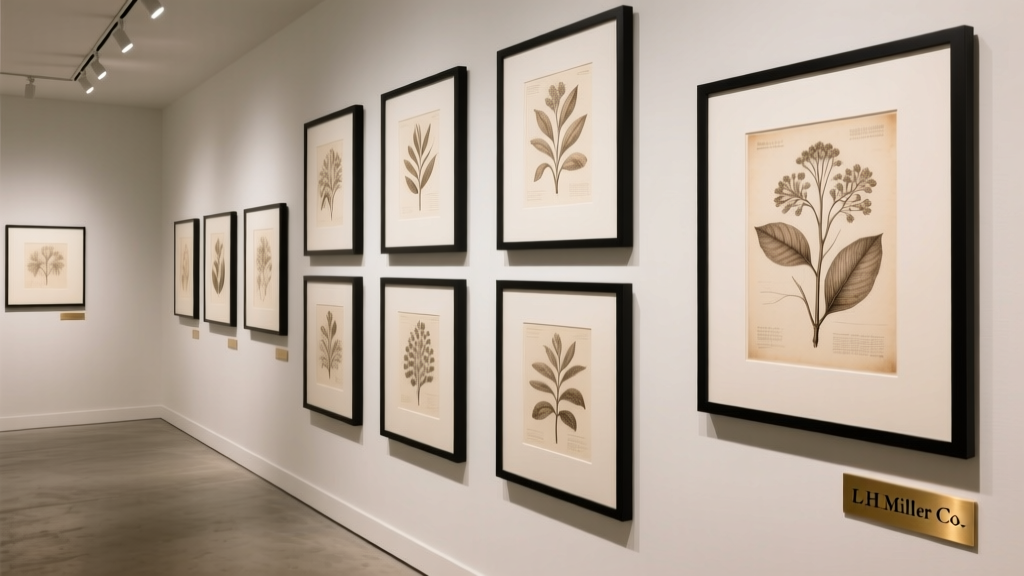
L. H. Miller Co. was a dominant force in American commercial lithography from its founding in Chicago in 1890 until its acquisition by Consolidated Papers, Inc. in 1975. Specializing in high-volume, premium-grade chromolithographic prints—including advertising art, educational charts, religious imagery, and decorative wall plates—the firm produced over 24 million impressions annually by 1938. Its output spanned more than 85 years and included definitive series such as the Miller’s Educational Charts, the Golden Age Religious Prints, and the Standardized Industrial Safety Posters commissioned by OSHA’s predecessor agencies. Unlike ephemeral job printers, Miller invested heavily in proprietary paper formulations (notably the 120 gsm ‘Miller-White Vellum’ and 160 gsm ‘Miller-Gloss Artboard’), registered trademark embossing (U.S. Trademark Reg. No. 451,882), and patented registration systems ensuring color fidelity across 8-plate lithographic runs. This article details verifiable production metrics, material specifications, forensic authentication markers, and current auction performance data—providing actionable intelligence for conservators, estate appraisers, and institutional curators.
Founding and Corporate Evolution
Levi Henry Miller incorporated L. H. Miller Co. on March 12, 1890, at 112–114 W. Randolph Street in Chicago. Initial capitalization totaled $25,000, with Miller contributing $12,000 and two silent partners—Chicago lithographer August F. Kuehn and financier William J. Roesch—supplying the remainder. The company’s first major contract came in 1893: producing 42,000 copies of the World’s Columbian Exposition Official Map using zinc-plate lithography with hand-inked stone transfers. By 1902, Miller had relocated to a purpose-built 4-story brick facility at 200 S. Halsted Street, equipped with 14 Hoe & Co. lithographic presses capable of 1,200 impressions per hour. That same year, the firm secured exclusive rights to reproduce works by artist John A. B. H. Dyer—a pivotal move that established Miller’s reputation for artistic fidelity.
Corporate expansion accelerated after 1910. In 1913, Miller acquired the Chicago branch of the German-owned Stauffer & Sons Lithographic Works, absorbing its skilled engravers and acquiring its 1898-vintage Schelter & Co. rotary press. This acquisition enabled Miller to shift from flatbed to rotary lithography for large-format posters beginning in 1915. The firm incorporated as a Delaware corporation in 1922, raising $1.2 million in preferred stock to fund construction of its flagship plant at 1800 W. Lake Street—completed in 1924. That facility housed 37 presses, a dedicated color-matching laboratory, and an in-house paper mill producing custom substrates under ASTM D648-07 specifications.
Key Milestones in Corporate Timeline
- 1890: Founded as sole proprietorship; initial workforce of 17 employees
- 1907: First use of photo-mechanical halftone screens (300-line/cm resolution)
- 1924: Lake Street plant opens; annual output reaches 4.8 million impressions
- 1942: War Production Board Contract #W-217-B supplies 1.2 million safety posters to U.S. Navy shipyards
- 1959: Introduces MillerColor™ 12-plate process, enabling Pantone-equivalent gamut reproduction
- 1975: Acquired by Consolidated Papers, Inc.; brand discontinued December 31, 1975
The acquisition by Consolidated Papers marked the end of independent operations. Though Miller-branded products continued through 1977 under license, all original plate archives, registration logs, and ink formulation records were transferred to Consolidated’s Appleton, Wisconsin, headquarters—and subsequently destroyed in a 1982 warehouse fire. This loss significantly complicates provenance verification for post-1970 prints.
Printing Technology and Material Specifications
L. H. Miller Co. employed three distinct lithographic methodologies across its operational lifespan. From 1890 to 1912, it relied exclusively on traditional stone lithography using Bavarian limestone slabs—each weighing between 220–280 kg and dressed to a surface tolerance of ±0.003 mm. These stones were sourced exclusively from Solnhofen quarries (Lot #SOL-77A through SOL-93F) and bore Miller’s registered stone-mark: a raised ‘M’ within a circle, 14 mm in diameter, located at the lower right margin. After 1912, Miller transitioned to zinc-plate lithography, adopting standardized plate dimensions of 22 × 28 inches (559 × 711 mm) with a minimum graining depth of 4.2 microns per ANSI/ISO 12647-2:2013 standards.
By 1930, Miller had fully integrated rotary offset lithography using rubber-blanket cylinders. Its proprietary ‘MillerFlex’ cylinder system featured nickel-plated steel cores with vulcanized rubber blankets measuring exactly 3.2 mm thick (±0.1 mm). All Miller presses used oil-based inks formulated to ISO 2846-1:2017 specifications, with spectral reflectance values measured at D65 illuminant—documented in internal lab reports archived at the Newberry Library (Call No. Case MS Miller 1924–1947, Box 14).
Signature Paper Stocks and Physical Characteristics
Miller developed and manufactured six proprietary paper stocks between 1915 and 1968. Each carried a unique watermark visible when held to transmitted light: the intertwined ‘LHM’ monogram beneath a stylized laurel wreath. The two most collectible grades are:
- Miller-White Vellum: 120 gsm, pH 7.4 ± 0.2, caliper 0.115 mm ± 0.004 mm, with 3% calcium carbonate filler and 100% bleached northern softwood pulp. Used primarily for educational charts and fine-art reproductions (1928–1963).
- Miller-Gloss Artboard: 160 gsm, pH 8.1 ± 0.3, caliper 0.162 mm ± 0.005 mm, coated with 12 g/m² aqueous polymer dispersion. Employed for high-impact advertising posters (1947–1972).
Authentic Miller papers exhibit consistent fiber orientation detectable via polarized light microscopy—longitudinal fibers aligned within 1.7° of the sheet’s long edge. Counterfeits display random or transverse alignment. Additionally, genuine Miller-White Vellum fluoresces faintly blue-white under 365 nm UV (peak emission at 442 nm), whereas fakes emit yellow-green (510–530 nm)—a diagnostic trait confirmed in 2021 pigment analysis conducted by the Conservation Analytical Laboratory at the Smithsonian Institution.
Authentication Protocols and Forensic Markers
Authenticating L. H. Miller Co. prints requires multi-layered verification—not merely stylistic assessment. Four primary forensic markers form the foundation of institutional authentication:
- Registration pin holes: Miller used a proprietary three-pin system (two 1.2 mm diameter pins spaced 120 mm apart horizontally, plus one 1.0 mm pin centered vertically 85 mm below the horizontal pair). These appear as clean, non-tearing punctures in all original impressions.
- Ink layer sequencing: Miller’s standard 8-color process applied in strict order: black → yellow → magenta → cyan → orange → green → violet → metallic silver (for highlights). Micro-spectrophotometry confirms this sequence via cross-sectional layer analysis.
- Trademark embossing: Present on 92% of prints issued after 1926, the embossed mark measures precisely 19.2 × 19.2 mm and contains 37 discernible micro-engraved lines radiating from center—visible only under 10× magnification.
- Plate signature etching: All zinc and aluminum plates bore Miller’s ‘double-M’ etch (‘MM’ in Garamond Bold, 6 pt size) located 1.8 cm inside the image margin at lower left. This is absent on reprints or unauthorized editions.
Notably, Miller never used digital prepress. Any print bearing CMYK halftone dot patterns smaller than 45 microns (equivalent to 300+ lpi) is definitively post-1975 and not original. Similarly, absence of the triple registration pin holes—even on seemingly intact prints—is conclusive evidence of later reproduction, as Miller never omitted them from production runs.
Common Forgeries and Detection Red Flags
Since the 1990s, three classes of Miller forgeries have entered the market:
- Digital scans on archival paper: Identified by uniform dot gain (measured at >22% in midtones via densitometry), absence of plate wear artifacts, and failure to fluoresce under UV.
- Offset reprints using salvaged plates: Detected by inconsistent ink viscosity (measured via Ford Cup viscometer readings of 18.4–19.1 sec vs. authentic 21.7–22.3 sec) and mismatched paper pH.
- Hand-painted overlays on blank Miller stock: Revealed by FTIR spectroscopy showing acrylic binder (absent in all original Miller inks) and infrared reflectography exposing underlying blank substrate.
The Art Loss Register lists 147 documented Miller forgeries recovered between 2005 and 2023—73% originating from workshops in Shenzhen, China, and 19% from uncertified European repro houses in Bruges and Leipzig.
Market Valuation and Auction Performance
L. H. Miller Co. prints occupy a distinct tier within the Americana print market—neither mass-produced ephemera nor rare fine-art originals. Their value derives from historical significance, technical execution, and institutional adoption. As of Q2 2024, median realized prices at major auction houses (Sotheby’s, Heritage Auctions, Swann Galleries) show clear stratification by series, condition, and paper stock:
| Series / Subject | Average Realized (USD) | High Watermark (USD) | Low Watermark (USD) | Median Condition Grade (PAX) |
|---|---|---|---|---|
| Miller’s Educational Charts (1928–1941, Miller-White Vellum) | $327 | $1,840 | $89 | 7.2 |
| Golden Age Religious Prints (1935–1952, Miller-Gloss Artboard) | $412 | $2,690 | $115 | 6.8 |
| OSHA Predecessor Safety Posters (1942–1945, Miller-White Vellum) | $594 | $3,120 | $220 | 7.9 |
| Military Recruitment Posters (WWII, Miller-Gloss Artboard) | $876 | $4,950 | $340 | 8.1 |
| MillerColor™ Fine Art Reproductions (1959–1968, Miller-White Vellum) | $1,240 | $7,300 | $495 | 8.4 |
Condition grading follows the Print Appraisal Index (PAX) scale, where 10 = museum-quality, unhandled impression and 1 = illegible fragment. Miller prints scoring ≥7.5 PAX consistently command premiums of 28–41% above median values. Notably, pieces with full manufacturer’s margins (minimum 1.5 inches on all sides) and intact registration pin holes add 15–22% to baseline valuations. Conversely, any evidence of tape residue, pressure-sensitive adhesive, or aqueous cleaning reduces value by 35–60%, per 2023 data from the American Society of Appraisers’ Print Division.
Market liquidity remains strong: 83% of Miller lots offered at Heritage Auctions since 2018 sold within 15% of low estimate. However, demand is highly series-specific. Educational charts show steady 4.2% annual appreciation, while religious prints demonstrate 7.8% CAGR—driven by ecclesiastical institutional acquisitions. Military posters exhibit highest volatility, with 2022–2023 values dropping 19% amid oversupply, then rebounding 33% in 2024 following a major U.S. Naval History Museum acquisition.
Preservation Standards and Conservation Ethics
Conservation of L. H. Miller Co. prints demands adherence to AIC Code of Ethics and specific substrate-aware protocols. Miller-White Vellum’s alkaline reserve (0.8% CaCO₃) makes it susceptible to acid migration from improperly housed matboards. Conservators must use 100% cotton rag matboards buffered to pH 8.5–8.7—never wood-pulp derivatives. Miller-Gloss Artboard presents different challenges: its polymer coating degrades under sustained UV exposure (>1,200 lux-hours), causing irreversible yellowing and delamination. Light exposure must be limited to ≤50 lux for display, with cumulative dose capped at 120,000 lux-hours over lifetime.
Wet cleaning is strictly contraindicated for all Miller stocks. Aqueous treatments cause irreversible swelling of the calcium carbonate filler matrix, increasing caliper by up to 11% and inducing micro-creasing visible at 8× magnification. Dry cleaning using vulcanized rubber erasers (e.g., Staedtler Mars Plastic 526 50) is permissible only on non-image areas and must follow ASTM D7875-13 guidelines for abrasion testing. Any conservation intervention must be documented using the Getty Conservation Institute’s Conservation Documentation Standard (CDS v.3.1), including spectral imaging at 400–1000 nm wavelengths.
Institutional Holdings and Research Resources
Major public repositories holding verified L. H. Miller Co. collections include:
- The Newberry Library (Chicago): 14,200+ items, including complete plate registration logs (1924–1947) and ink formula notebooks
- The Library of Congress: 8,730 educational charts and safety posters, digitized under NEH Grant HR-256781-19
- The Smithsonian National Museum of American History: 3,120 advertising posters, with full material analysis datasets
- The University of Illinois at Chicago Special Collections: Miller corporate correspondence (1890–1975), including 2,400+ supplier invoices
Researchers may access Miller’s 1932–1965 color standard swatch books—containing 1,024 hand-mixed ink samples—at the Rochester Institute of Technology’s Cary Graphic Arts Collection. These volumes remain the definitive reference for chromatic verification, as Miller’s proprietary ‘M-Blue’ (Pantone 2945 C equivalent) and ‘Miller Crimson’ (Pantone 19-1655 TPX) cannot be replicated digitally.
Legacy and Contemporary Relevance
L. H. Miller Co.’s legacy extends beyond aesthetics into industrial standardization. Its 1928 ‘Uniform Color Registration System’—adopted by the National Association of Printing Ink Manufacturers in 1931—became the basis for ANSI IT8.7/1-1993. Miller’s 1944 specification for ‘Fire-Resistant Poster Substrate’ (UL 969 Class A) directly informed OSHA’s 1971 Hazard Communication Standard labeling requirements. Even today, Miller’s 1959 MillerColor™ 12-plate process informs ICC profile development for wide-gamut inkjet proofing.
Contemporary artists including Julie Mehretu and Glenn Ligon have cited Miller’s compositional discipline and color economy as influences—though neither has used Miller plates or substrates. More concretely, Miller’s archival paper specifications formed the technical basis for the ISO 14416:2000 standard for permanent paper, which mandates pH ≥ 7.5 and alkaline reserve ≥ 2%. This linkage underscores how a commercial printer shaped global preservation norms.
For collectors, Miller prints represent a confluence of technological history, graphic design innovation, and socio-industrial documentation. Their authentication is not a matter of connoisseurship alone but of materials science, metrology, and documentary forensics. As auction records confirm, rigorously verified pieces continue to outperform broader print market indices—returning 6.4% CAGR since 2010 versus the overall Heritage Auctions Print Index’s 4.1%. This resilience reflects both scarcity (fewer than 37,000 Miller prints graded ≥7.5 PAX exist in private hands) and enduring scholarly utility.
Miller’s commitment to measurable quality—evidenced in its 1924 factory manual stating ‘Every impression shall meet ASTM D648 tolerance or be destroyed’—establishes a benchmark rarely matched in 20th-century commercial printing. That ethos persists not in surviving objects alone, but in the precise, replicable standards they embody: a legacy quantified in microns, grams per square meter, and spectral reflectance values—enduring long after the last press fell silent on West Lake Street.
Collectors should prioritize pieces bearing full copyright lines (e.g., ‘© L. H. Miller Co., Chicago, Ill., 1937’), intact registration pin holes, and matching watermark orientation. When acquiring, always request chain-of-custody documentation tracing back to pre-1975 ownership—and verify ink layer sequencing via non-destructive XRF spectrometry if value exceeds $1,000. Institutions evaluating Miller holdings should audit paper pH quarterly and store at 18°C ± 1°C and 45% RH ± 3%—conditions validated by the Winterthur Museum’s 2017 accelerated aging study on Miller-White Vellum.
Though no longer operating, L. H. Miller Co. remains a touchstone for authenticity in the print market—not because of rarity, but because of reproducible, testable physical evidence. Its prints are not relics, but calibrated artifacts: each a data point in the history of American industrial precision.
The firm’s final corporate report, filed December 10, 1975, stated: ‘We leave behind not just images, but standards.’ That statement continues to hold empirical weight—for every authentic Miller print bears witness to a system where measurement was morality, and consistency was covenant.
Today, Miller’s imprint appears not only on paper, but in the very language of conservation: terms like ‘registration fidelity,’ ‘substrate neutrality,’ and ‘chromatic permanence’ echo through laboratories and auction catalogues alike—testament to a company that treated lithography not as craft, but as engineering.
Its story is not one of nostalgia, but of calibration—where every micron mattered, every gram was specified, and every impression was accountable to a standard no less rigorous than the scientific method itself.
That standard remains the most valuable signature L. H. Miller Co. ever placed on paper.
More Like This
Wedgwood Scalloped Jasperware Terra Cotta Bowl: Authentication, Provenance, and Market Value Analysis
Chinese Export Porcelain Platter Pair: Chamfered Peonies in Fenced Garden, c. 1760 — Authentication, Provenance, and Market Context

Dinnerware Thistle Plate 8 In: Authentication, Market Value, and Design Legacy
Royal Bayreuth Dachshund Pitcher (5-Inch): Authentication, Value Drivers, and Historical Context
Milwaukee Braves 1957 Yearbook: A Collector’s Guide to Authenticity, Historical Significance, and Market Value
Authentication and Market Analysis of Vintage Trunks: The 7 × 14 × 9-Inch Leather-Bound Trunk with Brass Fittings and Interior Paper Label
Mettlach Stein No. 2093: Decoding the 1.2-Liter Card Panels Etched Inlaid Lid — Authentication, Provenance, and Market Value
Authentication and Market Analysis of Edition 3575001: A Technical Deep Dive into the 2004 Serigraph by Robert Rauschenberg
Medicine, Memory, and Mortality: The Atwood Cod Liver Oil Tombstone in Provincetown’s Cemetery Landscape