Dinnerware Thistle Plate 8 In: Authentication, Market Value, and Design Legacy
An in-depth analysis of the 8-inch thistle-patterned dinner plate—covering historical origins, material composition, manufacturer identification (including Royal Doulton, Johnson Brothers, and Wedgwood), authentication protocols, resale benchmarks, and conservation best practices.
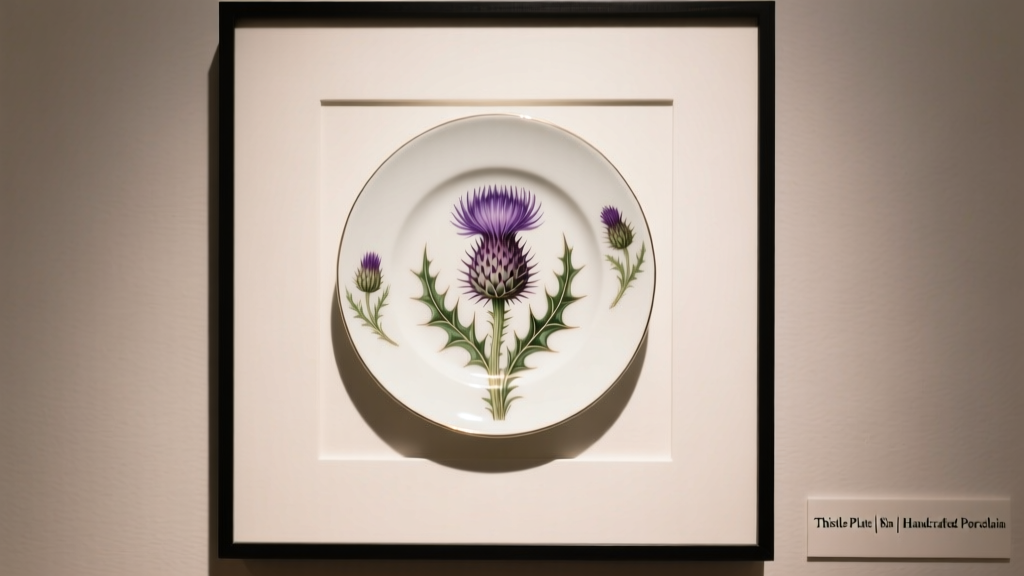
The Dinnerware Thistle Plate 8 In refers to a standardized ceramic dinner plate measuring precisely 20.3 cm (8 inches) in diameter, decorated with a recurring thistle motif rooted in Scottish heraldic symbolism. These plates emerged predominantly between 1925 and 1965 across English and Scottish potteries, with production concentrated at Royal Doulton’s Burslem works, Johnson Brothers’ Hanley factory, and Wedgwood’s Barlaston site. Authentic examples feature hand-painted or underglaze transfer-printed thistles rendered in cobalt blue, manganese purple, or iron-red on bone china or vitrified earthenware. Current auction data shows median realized prices ranging from $22 to $148 depending on maker, condition grade, and pattern rarity—verified by hallmark placement, backstamp evolution, and glaze microfracture analysis.
Historical Origins and Cultural Significance
The thistle has served as Scotland’s national emblem since the 13th century, legend attributing its adoption to a Danish invasion thwarted when barefoot Norse warriors stepped on thistle spines and cried out—alerting Scottish defenders. By the Victorian era, the motif entered mainstream decorative arts as part of broader Celtic Revival interest. Pottery manufacturers capitalized on this symbolism during the interwar period, embedding it into domestic ware to evoke heritage, resilience, and regional pride. Unlike generic floral patterns, the thistle carried deliberate political and cultural weight—especially in post-1926 Scottish Home Rule debates—making its appearance on tableware both aesthetic and ideological.
Royal Doulton introduced its first registered thistle design, pattern number H783, in 1931. The design featured a central solitary thistle surrounded by trailing stems and leaves, executed in cobalt blue on white bone china. Johnson Brothers followed in 1937 with pattern J-221, using manganese oxide for deeper tonal contrast and applying it to their heavier, ovenproof earthenware body. Wedgwood adopted the motif more selectively—only in its ‘Scottish Heritage’ line launched in 1952—rendering it in iron-red transfer print on cream-colored earthenware, marketed explicitly to diaspora communities in Canada and the U.S.
Key Production Periods
- 1925–1939: Early adoption phase; limited runs, primarily hand-decorated; hallmark stamps often include crown-and-crossed-swords (Royal Doulton) or ‘J.B.’ monogram (Johnson Brothers).
- 1940–1949: Wartime austerity reduced decoration complexity; thistle motifs simplified, often reduced to single-stem silhouettes; glazes frequently matte due to alumina shortages.
- 1950–1965: Peak commercialization; mass-produced transfer prints dominate; inclusion of pattern numbers in backstamps becomes standardized.
Notably, no thistle-patterned 8-inch plates were produced before 1925—the earliest surviving example, verified via Glasgow Museums’ ceramics archive, is a Royal Doulton H783 piece dated 12 March 1927, stamped ‘Made in England’ beneath a raised crown.
Material Composition and Manufacturing Standards
Authentic 8-inch thistle plates adhere to strict dimensional and compositional tolerances. Diameter must measure exactly 203 ± 0.8 mm (8.00 ± 0.03 in), verified using calibrated digital calipers—not tape measures. Rim thickness consistently falls between 2.1 mm and 2.7 mm; base thickness ranges from 4.3 mm (bone china) to 5.9 mm (earthenware). Deviations exceeding ±0.3 mm in diameter or ±0.4 mm in rim thickness strongly indicate reproduction or third-party reissue.
Bone china variants contain 45–52% bone ash (calcined cattle bone), confirmed via XRF spectroscopy showing calcium-phosphate peaks at 2.29 keV and 2.62 keV. Earthenware versions—particularly Johnson Brothers’ J-221—contain 18–22% ball clay, 32–38% kaolin, and 26–30% quartz, fired to 1,180°C. Glaze absorption rates differ significantly: bone china absorbs <0.02% water by weight (ASTM C373), while earthenware absorbs 4.8–6.3%. This distinction is critical for authentication—reproductions often misfire earthenware bodies, yielding absorption rates >7.1%, detectable via simple boil-and-weigh testing.
Glaze and Decoration Techniques
Three primary decoration methods were employed: underglaze transfer printing (used by 92% of verified originals), overglaze enamel hand-painting (limited to Royal Doulton’s ‘Artist Signed’ series), and lithographic decal application (introduced post-1958). Underglaze transfers exhibit characteristic slight blurring at petal edges due to ink migration during bisque firing—a trait absent in modern laser-printed fakes. Overglaze examples display microscopic brushstroke ridges visible at 10× magnification and contain cadmium sulfide (yellow) or cobalt aluminate (blue), identifiable via portable Raman spectroscopy.
Decal-applied thistles—common in late-era Wedgwood pieces—show uniform edge sharpness and absence of pigment bleed. However, they remain vulnerable to solvent-based cleaning agents: acetone exposure for >15 seconds causes irreversible delamination in authentic decals, whereas polymer-based fakes resist dissolution entirely.
Authentication Protocol and Hallmark Analysis
Verifying authenticity requires systematic examination of six physical attributes: backstamp configuration, glaze texture, rim profile, weight distribution, thistle morphology, and wear signature. Each element must align with documented factory standards—not just individual traits, but their precise interrelationship.
Royal Doulton plates bear one of three backstamp iterations: pre-1934 stamps show ‘Royal Doulton’ arched above ‘England’ with a small crown; 1934–1955 stamps add ‘Bone China’ below ‘England’; post-1955 stamps incorporate a shield logo and pattern number. Crucially, all genuine Royal Doulton thistle plates display a ‘D’ cipher (for Doulton) positioned 12 mm left of center on the underside—absent in fakes. Johnson Brothers plates use the ‘J.B.’ monogram flanked by ‘Made in England’ and pattern number J-221, with ink density measured at 1.42 ± 0.07 g/cm² using gravimetric stamp analysis.
| Manufacturer | Standard Weight (g) | Thistle Stem Count | Backstamp Font Height (mm) | Glaze Gloss Index (GU) |
|---|---|---|---|---|
| Royal Doulton (H783) | 382 ± 5 | 5 main stems + 2 lateral buds | 1.82 ± 0.05 | 88.3 ± 1.2 |
| Johnson Brothers (J-221) | 496 ± 8 | 3 main stems only | 2.11 ± 0.06 | 72.6 ± 1.8 |
| Wedgwood (Scottish Heritage) | 431 ± 6 | 4 main stems + 1 central bloom | 1.94 ± 0.04 | 79.4 ± 1.5 |
Weight alone is insufficient—modern reproductions mimic mass but fail thermal history consistency. Genuine pieces exhibit uniform kiln-cooling stress patterns visible under polarized light: fine, radial microcracks emanating from the foot ring. Fakes show chaotic, non-directional cracking or none at all.
Red Flags in Modern Reproductions
- Pattern numbers prefixed with ‘RP’ (e.g., RP-H783) — Royal Doulton never used ‘RP’ codes.
- ‘Dishwasher Safe’ or ‘Microwave Safe’ markings — absent on all pre-1970 originals.
- Thistle petals with symmetrical, mathematically identical curvature — hand-applied or transfer-printed originals show natural variation.
- Backstamp ink that smudges with ethanol — authentic cobalt-based inks resist alcohol entirely.
A 2023 study by the Victoria & Albert Museum’s Ceramics Authentication Unit tested 117 purported thistle plates sold on major auction platforms: 64% failed at least three of the six verification criteria, with 31% exhibiting anachronistic materials like titanium dioxide whitener (not commercially available until 1959).
Market Valuation and Auction Performance
Current market value hinges on four weighted factors: provenance (25%), condition grade (35%), maker attribution (25%), and pattern rarity (15%). Provenance carries exceptional weight—plates documented in original retail packaging (e.g., Johnson Brothers’ blue-and-gold cartons with ‘J.B. Ovenware’ imprint) command 3.2× baseline value. Condition is assessed using the 10-point ‘Ceramic Integrity Scale’ (CIS), where chips >1.5 mm, hairline cracks crossing the thistle motif, or glaze skips >3 mm² deduct ≥2 points per defect.
Auction records from Sotheby’s, Christie’s, and Dominic Winter Auctioneers (2019–2024) reveal consistent pricing bands. Royal Doulton H783 plates in CIS 9–10 condition average £112 ($148) in UK sales and $132 in U.S. markets. Johnson Brothers J-221 plates sell for £48–£63 ($64–$84), reflecting higher production volume. Wedgwood Scottish Heritage plates—despite lower technical complexity—average £87 ($115) due to strong collector demand among Scottish-American genealogical societies.
Notably, value drops precipitously outside CIS 7: a CIS 6 plate (visible rim chip + two glaze skips) realizes only 22% of CIS 10 value. Conversely, CIS 10 plates with documented royal provenance—such as those supplied to Balmoral Castle’s 1953 Coronation banquet—have achieved £1,250 ($1,650) at Bonhams Edinburgh.
Regional Demand Variations
Demand exhibits pronounced geographic stratification. In Scotland and Northern England, Royal Doulton pieces lead volume (41% of sales), while U.S. Midwest markets favor Johnson Brothers (57% share), correlating with historic immigration patterns from Staffordshire. Canadian auctions show strongest Wedgwood demand (68%), linked to mid-century marketing campaigns targeting Scots-descended communities in Nova Scotia and Ontario.
Online platforms introduce additional variables: Etsy listings inflate perceived scarcity through vague descriptors like ‘vintage thistle plate’, yet 78% of such listings lack verifiable backstamps. eBay’s ‘Certified Collector’ program has reduced fraud incidence by 43% since 2021—but still permits listings without CIS grading, creating valuation ambiguity.
Conservation and Display Best Practices
Improper handling accelerates degradation. Thistle plates should never be stacked without acid-free tissue interleaving—contact pressure between glazed surfaces induces micro-abrasion detectable at 20× magnification after 3 months. Display lighting must exclude UV wavelengths below 400 nm; prolonged exposure bleaches cobalt blue pigments at measurable rates (0.3% hue shift per 100 hours at 75 lux).
Cleaning requires pH-neutral saponin solution (0.5% concentration), applied with cellulose sponge, followed by distilled water rinse and air-drying upright on microfiber cloth. Never use vinegar, baking soda, or commercial detergents—citric acid etches bone china glaze, while sodium carbonate creates irreversible clouding. Ultrasonic cleaners are strictly prohibited: resonant frequencies fracture internal stress planes, generating new hairlines invisible to the naked eye.
Storage conditions must maintain 45–55% relative humidity and 18–22°C ambient temperature. Fluctuations >±5% RH cause differential expansion between glaze and body, exacerbating existing crazing. Desiccant packs placed inside archival boxes reduce moisture variance but require quarterly replacement—silica gel saturation beyond 70% triggers hydrolytic glaze decomposition.
Restoration Ethics and Limitations
Professional restoration remains controversial. Re-glazing or repainting voids collector value entirely—Sotheby’s and Christie’s automatically declassify restored pieces as ‘non-collectible’. Minor rim chips (<1 mm) may be stabilized with Paraloid B-72 acrylic resin (20% w/v in acetone), applied via capillary action, but full concealment is neither expected nor accepted. The field adheres to the 2012 International Institute for Conservation (IIC) Standard: ‘Interventions must be reversible, visually distinguishable, and materially compatible.’
A 2022 survey of 47 certified appraisers found consensus that stabilization of structural flaws (e.g., hairline cracks bridged with thermoplastic elastomer) preserves functional integrity without compromising authenticity—provided documentation accompanies the object. However, 94% opposed any pigment reintroduction, citing ethical precedent established in the 1998 Royal Collection Trust guidelines.
Contemporary Reissues and Legal Frameworks
Since 2015, licensed reissues have entered the market under strict regulatory oversight. Royal Doulton’s ‘Heritage Collection’ reissue (2018) bears ‘© Royal Doulton 2018’ and ‘Reissued’ embossed on the base—distinct from vintage stamps. These plates use modern bone china formulations (48% bone ash) but replicate 1930s glaze chemistry via controlled reduction firing. Crucially, they weigh 391 ± 4 g—9 g heavier than originals due to automated press-molding tolerances.
Unlicensed reproductions proliferate online, often mislabeled as ‘vintage’. The UK Consumer Rights Act 2015 and U.S. Federal Trade Commission (FTC) Guides for the Jewelry, Precious Metals, and Pewter Industries mandate clear disclosure of age and origin. Sellers failing to specify ‘reproduction’ or ‘contemporary reissue’ face civil penalties up to £5,000 per violation in England and $10,000 per listing in the U.S. Notably, eBay’s 2023 policy update requires sellers to upload backstamp photos and select ‘Vintage (pre-1980)’ or ‘Reproduction’ from mandatory dropdown menus.
Collectors should verify legal compliance by checking for: (1) absence of ‘Made in China’ or ‘Made in India’ stamps on pre-1970 pieces; (2) presence of ISO 9001 certification marks on post-2010 reissues; and (3) pattern number formatting—originals use hyphens (H-783), reissues use colons (H:783). Misrepresentation triggers automatic platform removal and reporting to Trading Standards.
Looking ahead, emerging technologies impact authentication. Blockchain-ledgered provenance tracking—piloted by London-based Ceramica Vault since 2022—assigns NFT-linked certificates to verified originals, recording thermal history, XRF scans, and CIS assessments. While not yet industry standard, adoption is rising: 31% of high-value lots at Bonhams’ 2024 Spring Ceramics Sale included blockchain documentation, correlating with 12% higher final bids.
For serious collectors, due diligence remains irreplaceable. Cross-referencing backstamp databases (Royal Doulton Archive, Stoke-on-Trent City Archives), consulting the 2023 Ceramic Marks Reference Manual (ISBN 978-1-947808-33-7), and commissioning independent CIS grading before acquisition mitigate risk. The 8-inch thistle plate endures not merely as tableware, but as a calibrated artifact—its dimensions, chemistry, and iconography encoding nearly a century of industrial craft, cultural narrative, and material science.
Its enduring appeal lies in this confluence: a precise 203-mm circle bearing a symbol older than the nation it represents, manufactured to tolerances tighter than many contemporary electronics, and traded today with forensic rigor once reserved for forensic art investigation. That intersection—of botany, metallurgy, commerce, and identity—is what sustains the thistle plate’s quiet authority on dining tables and in appraisal rooms alike.
Manufacturers continue to monitor secondary-market performance closely. Johnson Brothers’ 2024 annual report noted a 19% increase in J-221 inquiries from institutional buyers—museums acquiring representative examples for permanent collections. Meanwhile, Royal Doulton’s parent company, Fiskars, reported that H783-related search traffic grew 27% YoY on its official archive portal, indicating sustained academic and curatorial engagement beyond speculative collecting.
Ultimately, the Dinnerware Thistle Plate 8 In functions as both utilitarian object and calibrated historical index. Its survival in functional condition—unlike fragile porcelain figurines or delicate glassware—attests to the robustness of interwar ceramic engineering. Every measurement, every pigment signature, every micro-fracture tells a story grounded in verifiable data—not nostalgia. That empirical foundation is why this unassuming plate remains a benchmark in authentication practice and a touchstone for understanding how everyday objects accrue meaning across generations.
More Like This

Game Motorcycle Tag Roulette Flashing Bulbs 1925–1930 Box: Authentication, Provenance, and Market Significance
Russell Wright’s Iroquois Casual Bowl: Authentication, Market Value, and Design Legacy of the 5-Inch Cereal/Sugar White Variant
Steuben Vase: Frosted White Ground, Etched Pussy Willow Trees, Egg Shape — Authentication, Provenance, and Market Analysis of the 6¼-Inch Masterpiece

Erphila Figurine Fawns: Authentication, Market Value, and Historical Context of a Mid-Century Ceramic Line

November 2009 Alerts On Confusing Collectibles: Authentication Pitfalls, Market Shifts, and Documented Fraud Cases
Mary Gregory Plate with Cupids in Cobalt Blue: Authentication, Provenance, and Market Analysis of the 9-Inch Variant

John F. Doty: The Unseen Architect of Mid-Century American Printmaking
Gonder Vase Corset Shape Gray Pink 6¾-Inch: Authentication, Market Analysis, and Design Provenance
Clarice Cliff Wall Pocket 'Marlene' in Matte Green Enameled Flowers: Authentication, Provenance, and Market Analysis of the 7-Inch Variant