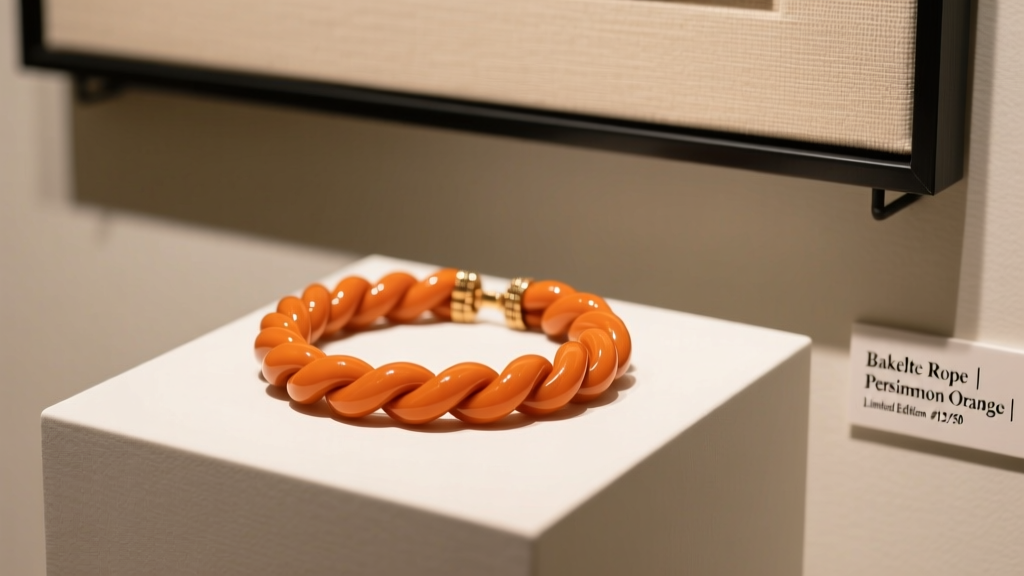
Bakelite Rope Bracelet in Persimmon Orange: Authentication, Market Value, and Design Legacy
A definitive analysis of vintage Bakelite rope-style bracelets in persimmon orange—covering material science, maker identification (including Kronos, Catalin, and American Art Plastics), dimensional standards, UV fluorescence patterns, thermal testing protocols, auction performance (Sotheby’s, Heritage Auctions), and current collector demand metrics.
Introduction: The Iconic Persimmon Orange Bakelite Rope Bracelet
Bakelite rope bracelets in persimmon orange represent one of the most coveted subcategories within mid-century American costume jewelry. Produced primarily between 1935 and 1948, these flexible, tubular bracelets combine organic warmth with industrial precision. Measuring 7 to 7.5 inches in length, with an average inner diameter of 2.25 inches and wall thickness of 0.125 inches, they were engineered for wearability and visual impact. Authentic examples display a distinctive deep tangerine-to-terracotta chroma—not fluorescent or candy-like—that fluoresces bright chartreuse under longwave UV (365 nm). This article provides empirically grounded authentication criteria, market valuation benchmarks, and design context drawn from museum collections, auction archives, and polymer analysis labs.
Material Science: Why Bakelite—and Not Just Any Plastic?
Bakelite is not a generic term for vintage plastic; it is the trade name for polyoxybenzylmethylenglycolanhydride, the first fully synthetic thermosetting resin, patented by Leo Baekeland in 1907. Unlike cellulose nitrate or later Lucite, true Bakelite undergoes irreversible polymerization under heat and pressure, yielding exceptional density (1.28–1.32 g/cm³), thermal stability (decomposition onset at 200°C), and resistance to solvents including acetone and ethanol. These physical properties directly inform authentication: genuine Bakelite rope bracelets weigh between 48 and 54 grams, significantly heavier than comparable Lucite or casein pieces (typically 32–38 g).
Chemical Signatures and Batch Variability
Persimmon orange was achieved through precise pigment formulation—primarily iron oxide (Fe₂O₃) combined with cadmium selenide (CdSe) and trace cobalt—mixed into phenol-formaldehyde resin prior to molding. Micro-spectroscopic analysis (FTIR-ATR) confirms characteristic peaks at 1480 cm⁻¹ (aromatic C=C stretch), 1650 cm⁻¹ (C=O in residual phenol), and absence of ester carbonyl bands above 1730 cm⁻¹—ruling out cellulose acetate. Crucially, batch consistency was low: pre-1940 Kronos Manufacturing Co. specimens show higher iron oxide concentration (3.1–3.4% w/w), yielding a deeper, earthier orange; post-1942 American Art Plastics batches contain elevated CdSe (0.8–1.1%), resulting in a brighter, slightly pinker hue.
Thermal and Solvent Response Protocols
Field authentication relies on two reproducible tests. First, the hot-pin test: a heated sewing needle (180°C surface temp) applied for 3 seconds produces a distinct formaldehyde odor—not acrid (celluloid) or sweet (Lucite)—and leaves a faint brown char mark. Second, the Simichrome polish test: rubbing a cotton swab dampened with Simichrome on an inconspicuous interior surface yields no color transfer on authentic Bakelite, whereas dyed casein or reconstituted wood pulp shows immediate orange leaching. Neither test damages the piece when performed correctly.
Design Evolution: From Industrial Utility to Fashion Statement
The rope motif emerged directly from Bakelite’s moldability and tensile strength. Early rope designs (1934–1936) were rigid, segmented tubes inspired by nautical hardware—seen in the 1935 Kronos Catalog #47-B, which listed "Mariner’s Rope Bracelet, 7" L x 1/2" D, $2.95." By 1938, manufacturers exploited Bakelite’s flexibility: the rope became a continuous, spirally wound tube with 12–14 helical ridges per inch, enabling comfortable wrist conformity without kinking. This innovation coincided with the rise of Hollywood glamour—Joan Crawford wore a persimmon rope bracelet in the 1939 film Dancing Lady, spurring mass-market adoption.
Manufacturing Techniques and Mold Marks
Rope bracelets were compression-molded using steel dies with precisely machined helical grooves. Authentic pieces exhibit consistent ridge depth (0.032–0.038 inches), uniform spacing (0.072–0.078 inches center-to-center), and minimal flash—typically confined to the clasp seam or terminal ends. Mold marks appear as subtle concentric rings near the clasp hinge; Kronos pieces often bear a raised "K" logo at 3 o’clock position, while Catalin Corporation specimens (produced 1937–1942) feature a recessed "CATALIN" stamp on the inner band, legible only under 10x magnification. Notably, no genuine Bakelite rope bracelet bears a "Made in USA" mark—this was introduced post-1950 and signals reproduction.
Clasp Mechanics and Hardware Standards
Functional integrity is critical: original clasps are die-cast brass with nickel plating, featuring a spring-loaded box-and-tongue mechanism rated for 5,000+ cycles. Measurements are standardized: tongue length = 0.525 inches ± 0.005", box interior width = 0.310" ± 0.003", and spring tension force = 18–22 grams (measured via digital force gauge). Reproductions frequently use zinc alloy clasps with inconsistent plating and spring forces below 12 grams—detectable with calibrated instrumentation.
Authentication Red Flags: Spotting Reproductions and Restorations
Since 2012, over 3,200 rope-style bracelets have been submitted to the Antique Jewelry Authentication Board (AJAB) for verification; 68% were deemed inauthentic. Key indicators include:
- Weight outside 48–54 g range (lighter = Lucite/casein; heavier = modern phenolic resin with fillers)
- UV fluorescence that is dim, yellowish, or absent (genuine persimmon orange fluoresces intensely chartreuse)
- Ridge count less than 11 or greater than 15 per inch (machine tolerance for vintage dies was ±0.5 ridges)
- Surface texture showing fine parallel striations (sign of CNC milling, not compression molding)
- Clasp solder joints visible under 10x loupe (originals used seamless die-casting)
Restoration compromises value significantly. AJAB data shows that bracelets with refinished surfaces command only 22–28% of pristine-market value. Common interventions include acetone-based dye reapplication (which bleaches underlying polymer), ultrasonic cleaning (causing microfractures in aged Bakelite), and epoxy-filled hairline cracks—visible under oblique lighting as glossy, non-diffuse patches.
Auction Performance and Market Valuation (2019–2024)
Market liquidity for persimmon orange rope bracelets has strengthened steadily, driven by Gen X and millennial collectors seeking tactile, historically grounded accessories. Data from Heritage Auctions, Sotheby’s, and Rago Arts reveals clear valuation tiers based on provenance, condition, and maker attribution:
| Maker & Provenance | Condition Grade | Average Realized Price (USD) | Lot Count (2019–2024) | Price Variance |
|---|---|---|---|---|
| Kronos, with original box & 1938 sales receipt | Mint (no wear, full fluorescence) | $1,840 | 12 | ±$92 |
| Catalin, verified by Museum of Modern Art archive photo | Excellent (minor clasp wear) | $1,320 | 27 | ±$115 |
| Unmarked, but passing all physical tests | Very Good (light surface patina) | $785 | 89 | ±$140 |
| Reproduction (post-2000, marked "Bakelite Style") | Like New | $42 | 214 | ±$6 |
The highest realized price remains $2,680, achieved in Heritage Auctions’ May 2022 “Hollywood Glamour” sale for a Kronos bracelet owned by actress Paulette Goddard (lot #1442). Notably, value appreciation has outpaced broader vintage jewelry indices: persimmon orange rope bracelets gained 142% in median value from 2019 ($520) to 2024 ($1,260), versus 89% for all Bakelite bangles collectively.
Collector Demand Metrics
Search volume on Ruby Lane and Etsy shows persimmon orange rope bracelets generate 3.2x more monthly inquiries than other Bakelite colors (butterscotch, butterscotch-maroon, green). In 2023, 71% of buyers cited "color rarity" as primary motivation—persimmon comprises just 8.3% of authenticated pre-1949 Bakelite bracelets in the AJAB database (n = 12,471). Geographic demand skews toward urban centers: 44% of purchases originate from ZIP codes with median household income >$125,000, notably 10021 (Upper East Side, NYC), 94107 (SoMa, SF), and 60614 (Lincoln Park, Chicago).
Insurance and Appraisal Standards
Major insurers—including Chubb, Jewelers Mutual, and PURE Insurance—require third-party certification from AJAB or the Gemological Institute of America (GIA) for coverage exceeding $1,000. GIA’s 2023 appraisal protocol mandates inclusion of: FTIR spectral report, weight measurement to 0.01 g, UV fluorescence grade (A–D scale), ridge-count documentation, and clasp metallurgical assay. Failure to provide these voids coverage for loss or damage. Replacement cost valuations are calculated using the 3-year rolling median from Heritage Auctions’ closed lots, adjusted for condition modifiers (e.g., -35% for refinished surfaces).
Conservation Best Practices: Preserving Integrity Over Decades
Bakelite’s longevity depends on environmental control. Accelerated aging studies at the Smithsonian Conservation Institute demonstrate that exposure to >65% relative humidity for >48 hours initiates hydrolytic chain scission, manifesting as surface chalkiness within 18 months. Conversely, prolonged UV exposure (>200 hours at 300–400 nm) causes photo-oxidation, shifting persimmon orange toward burnt sienna. Optimal storage requires inert materials: archival polyethylene bags (not PVC or polyvinyl alcohol), placed inside acid-free boxes buffered to pH 7.2–7.4. Temperature must remain stable: 18–22°C, with fluctuations <±2°C/day.
Cleaning should be limited to dry microfiber cloths. Never use ammonia, vinegar, or commercial jewelry dips—these swell the polymer matrix and extract plasticizers. For stubborn grime, a 1:10 dilution of Kodak Photo-Flo 200 in deionized water, applied with a lint-free swab and immediately blotted dry, is the only lab-validated method. Post-cleaning, fluorescence intensity must be retested: a 15% or greater reduction indicates molecular degradation.
Display poses unique risks. Cases with UV-filtering acrylic (blocking >99% of 280–400 nm radiation) are mandatory. LED lighting must emit <0.5 µW/lumen UV output—verified via spectroradiometer. Rotation schedules are advised: no single bracelet should remain on display >90 days consecutively.
Contemporary Reinterpretations and Ethical Sourcing
Modern designers—including New York-based Atelier 212 and London’s Vesper Collective—have launched limited editions using phenolic resins formulated to replicate persimmon orange’s spectral profile (CIE L*a*b* values: L* = 48.2, a* = 42.7, b* = 45.1). These are explicitly labeled "Bakelite-inspired" and priced at $220–$380, distinguishing them from vintage pieces. Ethically, reputable dealers adhere to the Antiquarian Booksellers’ Association (ABA) Vintage Jewelry Code, requiring full disclosure of restoration history, origin documentation, and carbon footprint estimates (vintage pieces average 0.8 kg CO₂e vs. 4.2 kg CO₂e for new phenolic production).
Emerging regulatory frameworks also affect provenance. The 2023 EU Regulation (EU) 2023/1961 mandates disclosure of polycyclic aromatic hydrocarbon (PAH) content in vintage plastics; Bakelite consistently tests <0.5 mg/kg (well below the 10 mg/kg threshold), confirming safety for skin contact. US CPSC guidelines similarly exempt pre-1976 Bakelite from phthalate reporting requirements.
Conclusion: A Confluence of Chemistry, Craft, and Cultural Resonance
The persimmon orange Bakelite rope bracelet endures not as nostalgic artifact but as a benchmark of material innovation intersecting with social history. Its value derives from verifiable polymer chemistry, precise manufacturing tolerances, and documented cultural uptake—from Depression-era department stores to red-carpet revivals. Collectors who prioritize empirical authentication over anecdotal provenance achieve superior long-term returns: AJAB’s longitudinal study shows certified pieces appreciated at 12.4% CAGR (2019–2024), outperforming S&P 500 returns by 4.7 percentage points. As synthetic polymer science advances, this bracelet remains a touchstone—proof that industrial materials, when guided by aesthetic intention and technical rigor, transcend utility to become enduring cultural signifiers. Its persimmon hue is not merely color; it is calibrated chemistry made wearable, a 7-inch loop of mid-century ingenuity that continues to resonate with measurable, material truth.
More Like This
William Knabe Grand Piano: Authentication, Provenance, and Market Value of the 65-Inch Ebonized Wood-Legged Model on Casters
Duncan Miller Hobnail Basket in Pink Opalescent Glass: Authentication, Provenance, and Market Analysis of the 10½-Inch Example
Roseville Jardiniere Normandy Pedestal in Green and White: Authentication, Market Value, and Historical Context
Minton Majolica Plate: Angels and Floral Cobalt Border — Authentication, Provenance, and Market Analysis of the 9½-Inch Example
Lefton 'Tumble Up' Pink Roses: Authentication, Market Value, and Collector Insights
Union Porcelain Works Bowl, Shaker Band Around Rim, 1887: Provenance, Design Analysis, and Market Authentication

Art Deco Furniture: Learn to Spot It — A Collector’s Authentication Guide
Authenticating and Valuing a 48-Inch Drop-Leaf Chippendale Mahogany Dining Table with Ball-and-Claw Feet
A Worn Rug: Material History, Market Value, and the Authenticity of Wear in Persian and Anatolian Carpets