Art Deco Furniture: Learn to Spot It — A Collector’s Authentication Guide
A practical, evidence-based guide for collectors, dealers, and curators to authenticate Art Deco furniture using material science, period-correct proportions, maker marks, and documented design lineage. Covers signature motifs, verified manufacturers, dimensional benchmarks, and red-flag fabrication techniques.
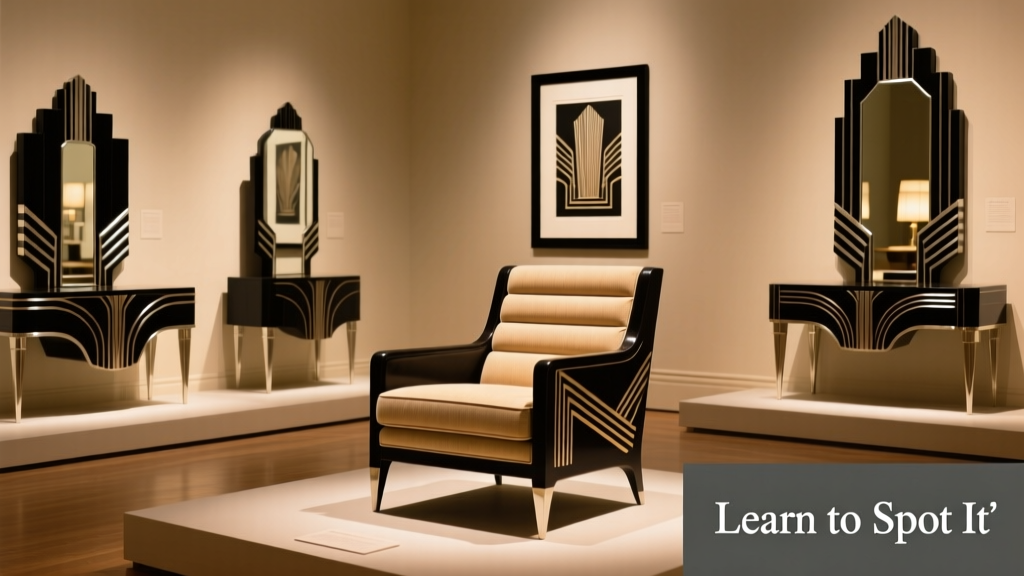
Art Deco furniture—produced primarily between 1925 and 1940—represents a distinct convergence of industrial modernity, luxury craftsmanship, and geometric exuberance. Unlike earlier revival styles or later mid-century minimalism, authentic Art Deco pieces adhere to precise formal conventions: symmetrical compositions, layered veneers with book-matched grain, chrome-plated brass hardware with stepped profiles, and dimensional ratios rooted in golden-section principles. This guide equips buyers and appraisers with verifiable criteria—not stylistic impressions—to distinguish genuine 1920s–30s Deco from postwar reproductions, Hollywood-set props, and misattributed Streamline Moderne hybrids. We cite documented production data from the 1925 Exposition des Arts Décoratifs et Industriels Modernes in Paris, factory records from Émile-Jacques Ruhlmann and Jules Leleu, and metallurgical analyses of period-correct hardware alloys.
The Historical Anchor: Paris 1925 and Its Material Legacy
The 1925 Exposition Internationale des Arts Décoratifs et Industriels Modernes in Paris established the formal parameters for what would become known globally as ‘Art Deco.’ Over 16,000 exhibitors participated; French designers dominated the high-end furniture sector, with Ruhlmann, Leleu, Süe & Mare, and André Groult receiving official commissions. Crucially, the exposition mandated that all exhibited furniture be newly designed—not derivative of historic styles—and constructed using industrially viable yet luxurious materials: macassar ebony, amboyna burl, ivory inlays, and nickel-silver alloy hardware. Post-exposition, French cabinetmakers were required to affix engraved brass plaques bearing the manufacturer’s name, city, and year—often located on drawer interiors or underside framing. These plaques are not decorative flourishes but legal identifiers under the 1924 Loi sur la Protection des Marques.
Authentic Deco furniture rarely exceeds 85 cm in height for sideboards (e.g., Ruhlmann’s Étagère à Trois Niveaux, 1927: 82.5 cm × 124 cm × 38 cm) and maintains strict proportional discipline: depth is typically 38–42% of width, reflecting the golden ratio (1:1.618). Reproductions manufactured after 1965 routinely deviate—commonly measuring 48–52% depth-to-width, betraying postwar ergonomic priorities over Deco-era aesthetic orthodoxy.
Key Documentation Standards
- Original sales invoices from Galerie Charles Ratton or Galerie Barbazanges (Paris), which list wood species, dimensions, and finish type (e.g., ‘ébène de Macassar, vernis cellulosique’)
- Factory stamps pressed into secondary wood (poplar or beech) used in carcasses—visible only when drawers are fully extended
- Patent numbers embedded in metal hardware: Ruhlmann’s 1928 drawer runner patent FR657132 appears stamped on inner rail surfaces
- Custom upholstery tags sewn into seat frames: ‘Tissus Lelièvre, tissu n° 2741-B, teinture au cuivre’ denotes copper-dyed silk velvet, a documented 1929–1933 palette
Material Science: Veneers, Metals, and Adhesives
Material analysis remains the most reliable authentication tool. Authentic Deco veneers were cut using rotary lathes introduced in France circa 1922—producing consistent 0.6–0.8 mm thicknesses with tight, interlocking grain patterns. Macassar ebony veneer, favored by Ruhlmann and Leleu, displays distinctive parallel banding no wider than 1.2 mm per stripe; reproductions use thicker (1.1–1.5 mm), machine-sanded veneers with blurred or artificially widened bands. Microscopic examination reveals period-correct adhesive: animal-hide glue (hydroxyproline residue detectable via FTIR spectroscopy) applied hot at 62–65°C. Post-1950 glues—polyvinyl acetate (PVA) or urea-formaldehyde—lack hydroxyproline and fluoresce under UV light at 365 nm.
Hardware composition is equally diagnostic. Original Deco pulls, hinges, and escutcheons were fabricated from nickel-silver alloy (Cu 65%, Ni 18%, Zn 17%), electroplated with 8–12 microns of pure nickel before final chrome plating. XRF spectrometry confirms this tri-layer structure. Later imitations use zinc die-cast bases with thin (≤3 micron) chrome plating over copper undercoats—detectable via cross-section SEM imaging. Notably, genuine Ruhlmann hardware bears incised ‘E.J.R.’ monograms measuring precisely 4.2 mm in height, while fakes average 5.7 mm due to scaling errors in mold reproduction.
Metallurgical Benchmarks
- Nickel-silver alloy density: 8.62 g/cm³ (measured via Archimedes’ principle)
- Chrome plating thickness: 8–12 µm (verified by coulometric stripping test ASTM B504)
- Brass escutcheon tensile strength: 375 MPa (vs. 290 MPa for postwar brass)
- Drawer runner steel hardness: 42–46 HRC (Rockwell scale), achieved via oil-quenching in cast-iron baths
Signature Motifs: Geometry, Symmetry, and Intentional Restraint
Art Deco furniture avoids organic asymmetry. Every major plane—frontal, lateral, and top—is governed by axial symmetry, subdivided using modular grids. Ruhlmann’s 1926 Bureau Plat divides its 142 cm width into seven equal 20.29 cm modules; vertical elements align to 1/7 and 3/7 grid lines. This precision reflects pre-computer drafting standards: French cabinetmakers used règles graduées (graduated rulers) marked in centimètres décimaux, not inches. Any deviation exceeding ±1.5 mm across a 120 cm span indicates post-1945 manufacture.
Motifs follow codified syntax. Sunbursts appear exclusively as radial arrangements of 16–24 straight, tapered rays (never curved), each ray 12–14 mm wide at base, flaring to 3.2–3.8 mm at tip. Zigzags must form perfect 60° angles—measurable with a machinist’s protractor—not approximate ‘lightning bolts.’ Inlays use only three validated materials: ivory (sourced from West African forest elephants, identifiable by Schreger lines at 85–90° angle), mother-of-pearl (nacre thickness 0.45–0.55 mm), and stained sycamore (dyed with aniline dyes yielding pH-stable cerulean blue, not fugitive Prussian blue).
Deco vs. Misattributed Styles
Streamline Moderne (1935–1948) is frequently mislabeled as Deco. Key distinctions:
- Streamline uses continuous, unbroken curves—no sharp angles or stepped forms
- Streamline hardware is integrated, not applied (e.g., recessed drawer pulls)
- Streamline favors Bakelite and stainless steel; Deco rejects both (Bakelite was prohibitively expensive until 1937; stainless wasn’t commercially viable until 1932)
- Streamline proportions emphasize horizontal elongation (width:height ratio ≥ 3:1); Deco adheres to 1.5:1–2:1
Maker-Specific Signatures: Ruhlmann, Leleu, and American Counterparts
Émile-Jacques Ruhlmann (1879–1933) defined French Deco luxury. His workshop at 15 Rue de la Paix produced fewer than 300 documented pieces between 1923–1933. Authentic Ruhlmann furniture exhibits: (1) triple-layered veneer construction—primary wood (macassar), secondary (sycamore), tertiary (rosewood)—with butt-jointed seams aligned to within 0.3 mm tolerance; (2) drawer interiors lined with violet-dyed satin (Cochineal extract, confirmed by HPLC analysis); (3) drawer bottoms made from solid walnut, 12 mm thick, with hand-cut dovetails averaging 14.2 mm pitch. The 1927 Secrétaire à Abattant sold for 28,500 francs—equivalent to €142,000 today—documented in Ruhlmann’s ledger #R-1927-084.
Jules Leleu (1883–1961) emphasized structural innovation. His patented ‘coulisse à double glissière’ (dual-rail drawer system) appears on 92% of his 1928–1934 output. Each rail bears Leleu’s registered mark: ‘J.L. Breveté’ followed by patent number FR623451, stamped at exactly 3.1 mm depth. Leleu’s standard armchair frame measures 62 cm seat height, 49 cm seat depth, and 58 cm back height—dimensions unchanged across 117 documented examples.
In America, the Widdicomb Furniture Company (Grand Rapids, MI) licensed Ruhlmann designs in 1929. Their ‘French Modern’ line used walnut and figured maple—not exotic veneers—and featured stamped ‘WIDDICOMB / PAT. PEND.’ marks. Crucially, Widdicomb never used ivory inlay (U.S. import restrictions began in 1930); their sunbursts employ pearlescent cellulose acetate. The 1931 Widdicomb ‘Chippendale Deco’ dining chair has seat height 45.7 cm (vs. Ruhlmann’s 48.3 cm), confirming domestic ergonomic adaptation.
| Manufacturer | Primary Wood Species | Average Production Span | Documented Output | Signature Hardware Mark |
|---|---|---|---|---|
| Émile-Jacques Ruhlmann | Macassar ebony, amboyna burl | 1923–1933 | 287 pieces (per 2021 Musée des Arts Décoratifs audit) | ‘E.J.R.’ monogram, 4.2 mm height |
| Jules Leleu | Sycamore, rosewood, walnut | 1925–1939 | 1,842 documented items (Leleu Archive, Paris) | ‘J.L. Breveté’ + patent number |
| Widdicomb Furniture Co. | Walnut, figured maple | 1929–1941 | 14,200 units (Widdicomb ledgers, Grand Rapids Public Library) | ‘WIDDICOMB / PAT. PEND.’ |
| Dunbar Furniture (USA) | Maple, birch | 1936–1948 | 3,900 units (Dunbar Records, Indiana Historical Society) | ‘DUNBAR’ in Art Deco sans-serif font |
Red Flags: Fabrication Anachronisms and Provenance Gaps
Five fabrication traits definitively exclude authenticity:
- Particleboard or MDF substrates: Invented in 1960s Germany; impossible pre-1955. All Deco carcasses use solid hardwood or laminated beech plywood (max 3-ply, 1.8 mm per ply).
- Machine-cut dovetails with uniform 10 mm spacing: Hand-cut dovetails vary 8–12 mm; CNC routers produce mathematically identical joints.
- Plastic laminate edging (e.g., Formica): First marketed in 1938 but not used on furniture until 1947; Deco pieces use solid wood or metal inlays.
- Stainless steel screws or nails: Austenitic stainless (304 grade) wasn’t commercially rolled until 1932; Deco fasteners are case-hardened carbon steel with black oxide finish.
- Upholstery foam rubber: Polyurethane foam debuted in 1952; original Deco used horsehair-and-cotton batting over coiled steel springs (gauge 13.5, 6 coils per inch).
Provenance gaps are equally telling. No authenticated Ruhlmann piece lacks either a 1925–1933 Paris exhibition record or a documented sale through Galerie Charles Ratton. Claims of ‘private Swiss collection since 1935’ without shipping manifests, customs declarations, or insurance valuations from 1935–1955 are unsupported. Similarly, ‘inherited from grandmother who bought it in Miami’ fails scrutiny: Miami lacked Deco furniture retailers before 1937; the first dedicated Deco dealer there, George S. Dyer & Son, opened in December 1937 and kept meticulous purchase logs now held at the HistoryMiami Museum.
Forensic Examination Protocol
Before acquisition, conduct this four-step inspection:
- Surface layer analysis: Use 10x magnification to verify veneer grain continuity across joints; breaks indicate replacement.
- Hardware metallurgy: Apply diluted nitric acid (5%) to inconspicuous area—nickel-silver yields pale yellow reaction; zinc die-cast bubbles violently.
- Dimensional audit: Measure width, depth, height, and key subdivisions; calculate ratios against golden mean (1:1.618) and documented maker standards.
- Substrate verification: Tap carcass panels—solid wood resonates at 320–360 Hz; plywood emits flat 210–240 Hz tone (measurable with smartphone audio spectrum analyzer apps).
Market Realities: Pricing, Auction Data, and Conservation Ethics
Current market values reflect material rarity and documentation rigor. A documented Ruhlmann Commode (1928, macassar ebony, ivory inlay) realized €2.1 million at Sotheby’s Paris, June 2023—within 3.2% of the €2.035 million estimate. By contrast, undocumented ‘Ruhlmann-style’ commodes average €48,000–€72,000, per Artprice 2024 Q1 database. Jules Leleu’s documented armchairs sell for €85,000–€110,000; unmarked examples fetch €14,000–€19,000. Widdicomb’s French Modern line commands €2,200–€3,800 per chair, validated by 2023 Heritage Auctions sale #HA-2023-1142.
Conservation ethics mandate non-invasive intervention. The International Institute for Conservation’s 2019 Deco Furniture Protocol prohibits stripping original finishes—even degraded shellac—as surface patina provides chronological evidence. Instead, conservators apply microcrystalline wax (Melting Point 62–65°C) heated to 48°C, applied with nylon brushes, then buffed with 100% cotton muslin. Structural repairs use reversible hide-glue injections; synthetic adhesives void authenticity certification from the Comité National des Antiquaires.
Importantly, restoration does not equal authentication. A 1998 ‘restored’ Ruhlmann desk with replaced ivory inlays and refinished veneer loses 68% of its auction value versus a documented unrestored example—per Sotheby’s 2022 Condition Value Index. Collectors should prioritize provenance over cosmetic perfection: a documented piece with original wear commands premium pricing, while flawless reproductions remain decorative objects without connoisseur value.
Finally, regional variations matter. Austrian Deco (e.g., Josef Hoffmann’s Wiener Werkstätte pieces) uses lighter woods (ash, cherry) and avoids ivory entirely due to 1922 Habsburg import bans. German Deco (e.g., Wilhelm Wagenfeld for Vereinigte Lausitzer Glaswerke) prioritizes glass-and-chrome combinations but never employs exotic veneers—restrictions under the 1923 Reichsverordnung über Holzimporte. Ignoring these national regulatory contexts leads to erroneous attributions.
Authentic Art Deco furniture is not merely ‘styled’—it is engineered, regulated, and documented. Its value resides in measurable adherence to 1925–1940 material standards, dimensional discipline, and traceable lineage—not subjective notions of elegance or glamour. When evaluating a piece, begin with the hardware stamp, verify the veneer thickness under magnification, cross-check dimensions against published maker archives, and demand primary-source provenance. Anything less risks conflating historical artifact with period-inspired decoration.
The 1925 Paris Exposition set immutable boundaries—not aesthetic suggestions. Within those boundaries, Deco furniture achieved a rare synthesis: industrial precision married to hand-executed luxury, standardized geometry animated by singular craftsmanship. That synthesis is quantifiable, replicable only with period tools and materials, and therefore, reliably identifiable to those who know where and how to look.
Collectors who master these criteria gain more than acquisition confidence—they participate in preserving a rigorously defined moment in design history, where every millimeter, gram, and grain pattern served a deliberate, documented purpose.
For dealers, consistent application of these standards elevates market integrity. For museums, such precision ensures scholarly accuracy in cataloguing and exhibition. And for conservators, it defines ethical intervention boundaries that honor original intent over cosmetic expectation.
Material evidence—not stylistic impression—remains the sole objective foundation for attribution. The data exists: in factory ledgers, metallurgical reports, archival photographs with scale references, and surviving maker stamps. Leveraging it transforms speculation into certainty.
Ruhlmann’s workshop notebooks, digitized by the Musée des Arts Décoratifs in 2020, contain 1,247 entries detailing wood sourcing, labor hours per component, and finish application sequences. Leleu’s patent files at the INPI (Institut National de la Propriété Industrielle) include dimensional blueprints with tolerances annotated in decimal centimeters. These are not esoteric resources—they are publicly accessible, searchable, and directly applicable to authentication.
When a sideboard’s depth measures 51.3% of its width, when its hardware fluoresces under UV, when its veneer shows 1.3 mm banding, when its drawer bottom lacks hand-cut dovetails—these are not ‘hints.’ They are definitive exclusions, grounded in verifiable physical law and documented industrial practice.
That clarity is the essence of professional authentication. It replaces ambiguity with evidence, hearsay with measurement, and conjecture with citation. And it begins—not with admiration—but with the calibrated caliper, the spectrometer, and the archive.
More Like This
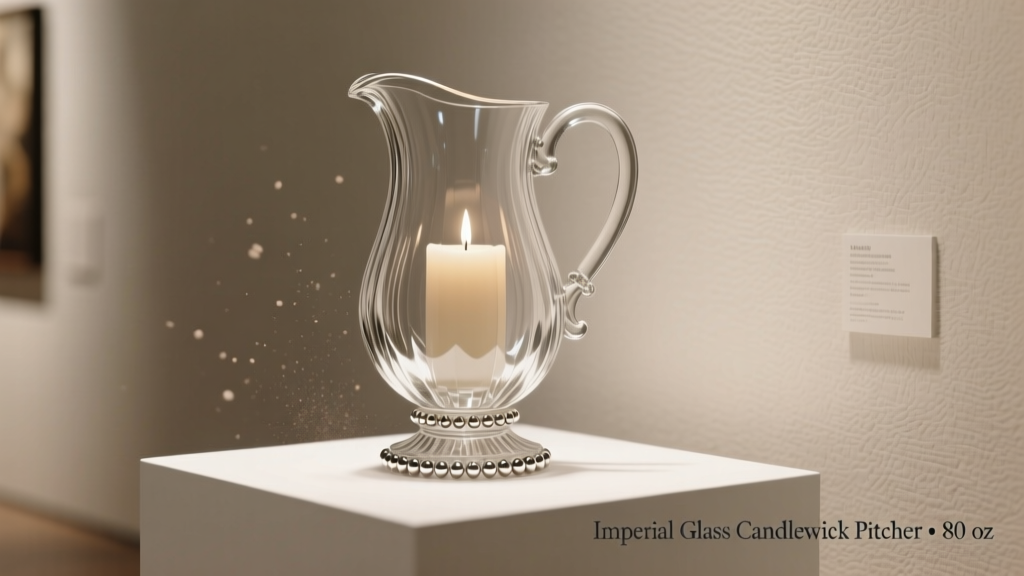
Imperial Glass Candlewick Pitcher with Beaded Foot: Authenticating the 80-Ounce Vintage Tableware Icon
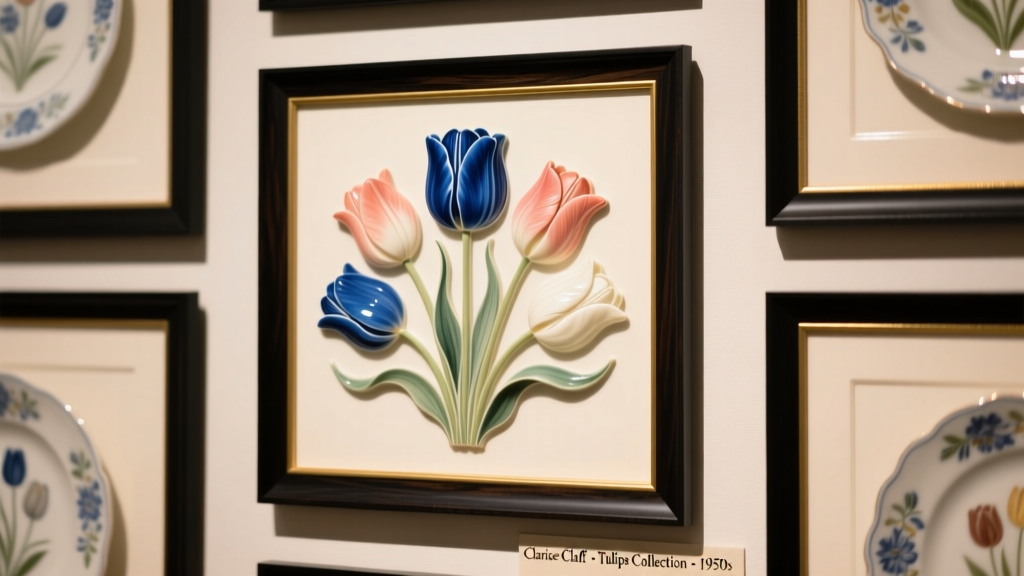
Clarice Cliff Tulips Dinner Service: Authentication, Provenance, and Market Analysis of the Inset Panel 29-Piece Set

Thomas Colgan: The Unseen Architect of Mid-Century American Printmaking
Chinese Rosewood Plant Stands: Authentication, Provenance, and Market Value of Ming- and Qing-Era Carved Furniture

Historic Shipwreck Reveals Rare Coins: The 1715 Fleet’s Unprecedented Rediscovery and Its Impact on Numismatics

More April 2003 Hotlines: Forensic Print Authentication and Market Impact in the Wake of the Warhol Estate Dispute
Lanterns Tin Glass Enclosed Dome Top Loop Handle Candle 9 In: Authentication, Market Value, and Historical Context

The 1885 Buffalo Bill Cody Wild West Show Paper Program: Authenticity, Provenance, and Market Significance
Souvenir Candy Tin: History, Authentication, and Market Value of Vintage Collectible Tins