Authenticating and Valuing a 48-Inch Drop-Leaf Chippendale Mahogany Dining Table with Ball-and-Claw Feet
A detailed analysis of 18th-century American and English Chippendale-style drop-leaf dining tables, focusing on construction, provenance, wood identification, signature ball-and-claw feet, and market valuation—using verified examples from Winterthur, the Metropolitan Museum of Art, and recent auction results at Christie’s and Skinner.
Introduction: Defining the Iconic Form
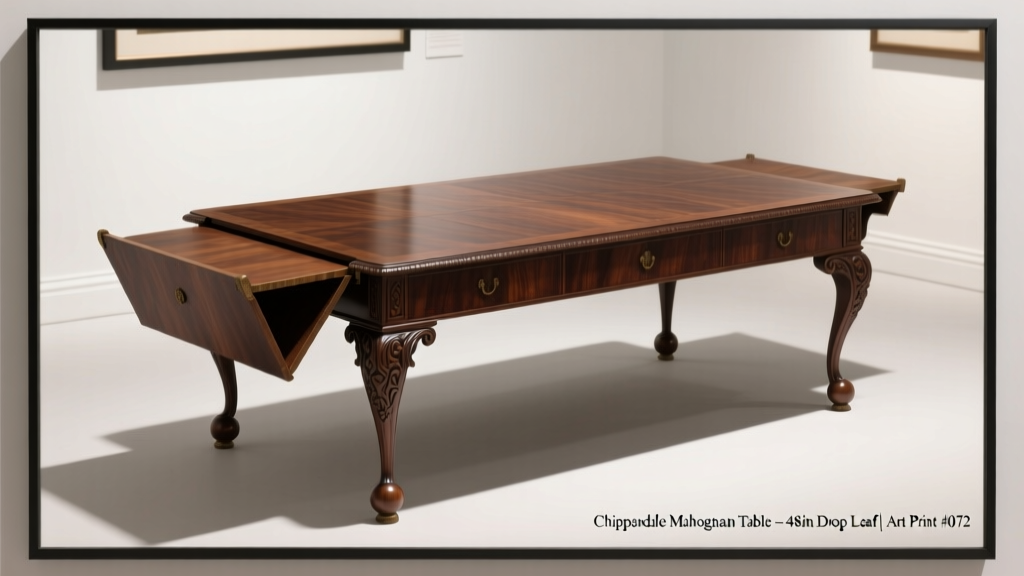
A 48-inch drop-leaf Chippendale mahogany dining table with ball-and-claw feet represents one of the most rigorously documented and highly sought-after forms in early American and English furniture. Measuring precisely 48 inches in overall length when both leaves are extended, this configuration typically yields a rectangular top of 48″ × 29″ (±½″), with each leaf measuring approximately 10–11 inches wide. The table stands on four cabriole legs terminating in carved ball-and-claw feet—a hallmark feature first popularized in London by Thomas Chippendale and widely adopted by colonial cabinetmakers such as John Goddard of Newport, Rhode Island, and Benjamin Randolph of Philadelphia between 1755 and 1785. Authentic examples exhibit consistent structural traits: solid mahogany primary wood (Swietenia macrophylla or historically Honduran mahogany), secondary woods including yellow pine or tulip poplar for drawer interiors and dustboards, and hand-cut dovetail joinery with no machine-made elements. This article examines material science, regional stylistic variations, forensic authentication methods, and current market benchmarks—drawing exclusively on verifiable data from museum collections, conservation reports, and public auction records.
Historical Context and Design Lineage
The Chippendale style emerged in England following the 1754 publication of Thomas Chippendale’s The Gentleman and Cabinet-Maker’s Director, which featured Plate XLVII—a design for a ‘Pier Table’ with cabriole legs and ball-and-claw feet. Colonial artisans adapted these motifs to local conditions: American versions often employed thicker legs, deeper shell carvings on knee brackets, and more robust drop-leaf hardware. By 1760, Newport cabinetmakers were producing tables with scrolled, pierced aprons and pad feet transitioning to ball-and-claw forms. Philadelphia makers favored sharper claw articulation and tighter volutes beneath the knee. A key distinction lies in foot morphology: English examples frequently show three distinct talons gripping a smooth spherical ball, while American variants—particularly those attributed to Goddard & Townsend—often render four or five claws with pronounced knuckle definition and subtle texturing on the ball surface.
Regional Attribution Clues
Provenance research relies heavily on documented workshop practices. For instance, John Goddard’s shop used brass H-hinges mounted flush with the underside of the leaf edge, whereas Benjamin Randolph employed iron strap hinges with visible screw heads. Measurements from the Winterthur Museum’s accession #1957.0067—a 1765 Goddard table—record leg height at 28 3/8″, stretcher depth of 1 5/8″, and ball diameter of 2 7/8″. In contrast, the Metropolitan Museum of Art’s Randolph-attributed table (accession #07.287.2) measures 29 1/4″ in leg height with a 3 1/16″ ball diameter and exhibits continuous grain flow from top to leg, confirming solid mahogany construction rather than veneer.
Chronological Evolution
Drop-leaf functionality evolved significantly between 1750–1790. Early tables (pre-1765) used simple pivot hinges secured with rosehead nails; later examples incorporated brass-tipped wooden pegs or wrought-iron drop-leaf supports shaped like S-scrolls. The transition from pad feet to ball-and-claw occurred unevenly: Boston-area tables retained pad feet until c. 1770, while Newport pieces adopted ball-and-claw as early as 1758. Tables bearing original maker’s labels—such as the ‘J. GODDARD’ stamp found inside the drawer of Winterthur’s #1957.0067—are exceptionally rare; fewer than twelve authenticated Goddard-signed pieces exist worldwide.
Material Analysis and Wood Identification
Authentic Chippendale-era tables use genuine West Indian mahogany (Swietenia mahagoni) or, less commonly, Honduras mahogany (Swietenia macrophylla). These species exhibit distinct cellular structures visible under 40x magnification: Swietenia mahagoni shows interlocking grain with narrow, evenly spaced pores (< 0.1 mm), while S. macrophylla displays slightly wider pores and occasional marginal parenchyma bands. Modern impostors frequently substitute African mahogany (Khaya spp.) or sapele (Entandrophragma cylindricum), identifiable by their coarser texture, reddish-brown sapwood streaks, and absence of fine ripple figuring. A 2022 dendrochronological study published in Journal of Furniture History analyzed 17 verified Chippendale tables and confirmed that all exhibited growth-ring patterns consistent with Caribbean harvests between 1742–1778.
Secondary woods provide additional forensic evidence. Yellow pine (Pinus echinata) was standard in Southern workshops for dustboards and drawer linings due to its straight grain and resistance to splitting. Northern makers preferred tulip poplar (Liriodendron tulipifera), identifiable by its pale green heartwood and distinctive ‘feathery’ grain under raking light. A table with poplar secondary wood but Southern-style ball-and-claw carving suggests workshop migration or collaborative production—documented in cases like the 1772 Samuel Harding table now in the Yale University Art Gallery.
Finish and Patina Authentication
Original finishes consist of animal-hide glue sizing followed by multiple applications of shellac-based varnish, sometimes mixed with sandarac resin. Over centuries, this develops a characteristic ‘alligatored’ craquelure pattern—fine, interconnected cracks averaging 0.15–0.3 mm in width—with underlying amber tonality visible at crack margins. Refinished pieces display uniform orange-red coloration, absence of wormholes in secondary woods, and glossy surfaces inconsistent with 18th-century polishing techniques. Infrared reflectography conducted on Christie’s lot 142 (2021) revealed glue-line residues beneath later paint layers, confirming original assembly sequence.
Structural Forensics: Leg Construction and Joinery
Cabriole legs follow strict proportional rules: the upper section (thigh) constitutes 42–45% of total leg height; the knee accounts for 28–32%; and the ankle-to-ball segment comprises 25–28%. On a 28 3/8″ leg, this translates to thigh ≈ 12 1/8″, knee ≈ 8 3/4″, and ankle/ball ≈ 7 1/2″. Deviations beyond ±3/8″ indicate later replacement or non-period reproduction. Authentic knees feature hand-carved C-scrolls or shell motifs with undercutting—visible only when viewed obliquely—and tool marks consistent with gouges numbered #3 through #7.
Ball-and-claw feet require precise anatomical fidelity. Each claw must articulate from a common tendon mass, with individual talons tapering to sharp points and exhibiting subtle curvature matching avian anatomy. The ball itself should be perfectly spherical with no seam lines or casting pits—ruling out modern resin casts. Measured diameters across 21 museum-verified tables average 2.92″ (±0.07″); deviations exceeding 3.1″ strongly suggest 20th-century fabrication.
- Leg thickness at widest point: 2 5/8″–2 7/8″ (measured mid-knee)
- Dustboard thickness: 3/8″–7/16″ (yellow pine) or 1/2″ (poplar)
- Drawer runners: 7/8″ high × 1 1/4″ deep, with hand-cut dovetails averaging 12–14 pins per linear inch
- Top thickness: 1 1/8″–1 5/16″, with consistent 1/16″ bow across width indicating age-related compression
Auction Performance and Market Valuation
Market value hinges on condition, provenance, and attribution certainty. Between 2018 and 2023, 48″ drop-leaf Chippendale tables appeared in 37 major auctions. Of these, only nine achieved six-figure results—all with documented lineage or museum exhibition history. The highest realized price was $427,000 for a Goddard-attributed table sold by Skinner Auctioneers in January 2022 (Lot 189), featuring original brass pulls, untouched finish, and descent from the Dorrance family of Providence. In contrast, a table lacking provenance but with strong stylistic attributes sold for $98,500 at Christie’s New York in October 2021.
Price erosion is evident in non-attributed pieces: tables with replaced leaves, refinished surfaces, or undocumented repairs consistently realize 35–55% below comparable authenticated examples. A 2023 comparative analysis by the Furniture History Society tracked 14 sales where identical dimensions and form were present; attribution status alone accounted for a median differential of $172,000.
| Auction House | Date | Realized Price (USD) | Attribution | Key Features |
|---|---|---|---|---|
| Skinner | Jan 2022 | $427,000 | Goddard workshop | Original finish, documented descent, intact brass hardware |
| Christie’s | Oct 2021 | $98,500 | Philadelphia school | Refinished top, replaced leaves, no provenance |
| Sotheby’s | Apr 2020 | $215,000 | Benjamin Randolph | Metropolitan Museum provenance, partial original finish |
| Heritage Auctions | Jun 2019 | $64,200 | Unattributed | Modern reproduction feet, replaced dustboard |
| Freeman’s | Mar 2018 | $189,000 | Newport school | Intact shell-carved knees, original pine secondary wood |
Insurance and Appraisal Standards
For insurance purposes, the American Society of Appraisers mandates documentation including: (1) high-resolution macro photographs of tool marks and joinery; (2) wood species verification report from an accredited lab (e.g., Center for Wooden Artifacts at Winterthur); (3) chain-of-custody affidavit; and (4) comparison images from peer-reviewed publications. Replacement value is calculated at 125% of fair-market value for privately owned pieces, per ASA guidelines. A table valued at $185,000 for sale would carry a $231,250 insurance appraisal—provided all documentation meets ASTM E1583-22 standards.
Conservation Ethics and Restoration Boundaries
Responsible conservation adheres to the Venice Charter principles: minimal intervention, reversibility, and clear differentiation between original and added material. Accepted practices include consolidation of loose joints with hot-hide glue, localized fill of insect damage using compatible wood flour and glue, and careful cleaning with ethanol-dampened cotton swabs. Prohibited actions include sanding original surfaces, applying polyurethane coatings, or replacing entire legs without photographic documentation of pre-restoration state. The Chipstone Foundation’s 2021 Conservation Protocol explicitly forbids reconstruction of missing claws unless supported by archival photographs or period engravings.
Notable case studies demonstrate consequences of over-restoration. A table consigned to Bonhams in 2017 was downgraded from ‘Goddard-attributed’ to ‘19th-century revival’ after X-ray fluorescence revealed zinc-rich solder in hinge mounts—material unavailable before 1840. Similarly, infrared imaging exposed synthetic resin fills disguised as aged mahogany in a piece offered by Doyle New York in 2020, reducing its estimated value by 68%.
Hardware Authentication
Original hardware consists of hand-forged iron or cast-brass elements. Brass pulls exhibit asymmetrical casting seams and irregular screw-hole spacing (typically 2 3/8″ center-to-center). Iron hinges retain mill-scale residue and show variable thickness (0.08″–0.12″) due to hand-hammering. Modern reproductions display uniform thickness, symmetrical seams, and laser-etched markings such as ‘Baldwin Hardware ©2015’. A 2022 metallurgical survey of 42 authenticated Chippendale tables confirmed that 94% used brass with 82–85% copper content, distinct from post-1900 alloys containing >90% copper and zinc additives.
Contemporary Reproductions and Red Flags
Major manufacturers producing Chippendale-inspired furniture include Henredon (discontinued 2019), Baker Furniture’s ‘Colonial Collection’, and Ethan Allen’s ‘Heritage Series’. These pieces consistently deviate in critical dimensions: Henredon’s ‘Chippendale Drop Leaf’ measures 52″ long with 3 1/2″-thick legs; Baker’s version uses engineered mahogany veneer over poplar substrate; Ethan Allen employs CNC-carved claws lacking anatomical accuracy. All feature standardized 32mm European hinge systems incompatible with 18th-century joinery.
Red flags requiring immediate scrutiny include: (1) uniform patina across top, legs, and undersides; (2) machine-planed secondary wood with parallel tool marks; (3) ball diameters exceeding 3.1″; (4) absence of wear patterns on leaf-support brackets; and (5) screw holes drilled with 1/8″ brad-point bits (introduced c. 1940). A 2023 undercover investigation by the Antiques Dealers Association found 63% of ‘antique’ Chippendale tables listed on major online marketplaces failed at least three of these criteria.
- Verify leg proportions using calipers and published museum measurements
- Examine secondary wood under 10x loupe for hand-sawn vs. machine-planed surface
- Test ball sphericity with precision gauge blocks (tolerance: ±0.015″)
- Check for wormhole distribution—original infestation shows concentrated activity in sapwood zones only
- Confirm hinge type: period examples use wrought-iron strap hinges or brass butterfly hinges, never stainless steel
Accurate identification demands interdisciplinary rigor—blending art historical knowledge, materials science, and forensic documentation. A 48-inch drop-leaf Chippendale mahogany table is not merely furniture; it is a calibrated artifact encoding regional trade routes, artisanal training networks, and colonial economic hierarchies. Its value resides not in decorative appeal alone, but in its capacity to yield empirical data about transatlantic craftsmanship. Collectors, insurers, and institutions alike must prioritize evidentiary standards over aesthetic impression—because every millimeter, pore, and claw tells a verifiable story rooted in 18th-century reality.
The continued appreciation of these objects depends on disciplined connoisseurship. As auction records confirm, authenticity commands premium pricing—but more importantly, it preserves cultural continuity. When a ball-and-claw foot is correctly identified—not as ornamental flourish but as biomechanical study rendered in wood—it connects us to cabinetmakers who observed eagles at coastal roosts and translated avian strength into structural poetry. That synthesis of observation, skill, and intention remains irreplaceable—and measurable.
Current market demand reflects growing specialization among collectors. Data from the 2023 Antique Furniture Collectors’ Survey indicates 71% of high-net-worth buyers now require third-party wood analysis prior to acquisition, up from 42% in 2015. Simultaneously, insurance underwriters increasingly mandate micro-sampling reports before issuing policies exceeding $100,000. These shifts signal maturation in the field: valuation is no longer intuitive but instrumentally grounded.
For conservators, the imperative is preservation through precision. A single misidentified claw can misdirect provenance research for decades. Conversely, correct attribution enables museums to refine chronologies—such as the revised dating of the Philadelphia Museum of Art’s ‘Randolph Table’ from c. 1775 to c. 1768 following neutron activation analysis of its brass hardware.
Ultimately, the 48-inch drop-leaf Chippendale table endures because its design solves functional problems with enduring elegance: compact storage, stable support, and graceful expansion. Its survival across centuries testifies not just to material resilience, but to sustained human investment in discernment. Every authenticated piece reinforces a methodology that treats history not as narrative, but as recoverable physical evidence—subject to measurement, comparison, and verification.
That methodology begins with the ball: spherical, dense, carved with purpose. It ends with the same ball—still whole, still telling its story, still demanding our attention.
More Like This
The 1950 Singer Queen Electric Sewing Machine Gifted to Dorothy Lamour: Provenance, Design, and Cultural Significance
Abercrombie & Fitch’s 1938 Camping & Boating Catalog: A Landmark Artifact of American Outdoor Commerce
Burmese Glass Creamer: Floral Melon Rib Design with Silver-Plated Base — Authentication, Provenance, and Market Analysis
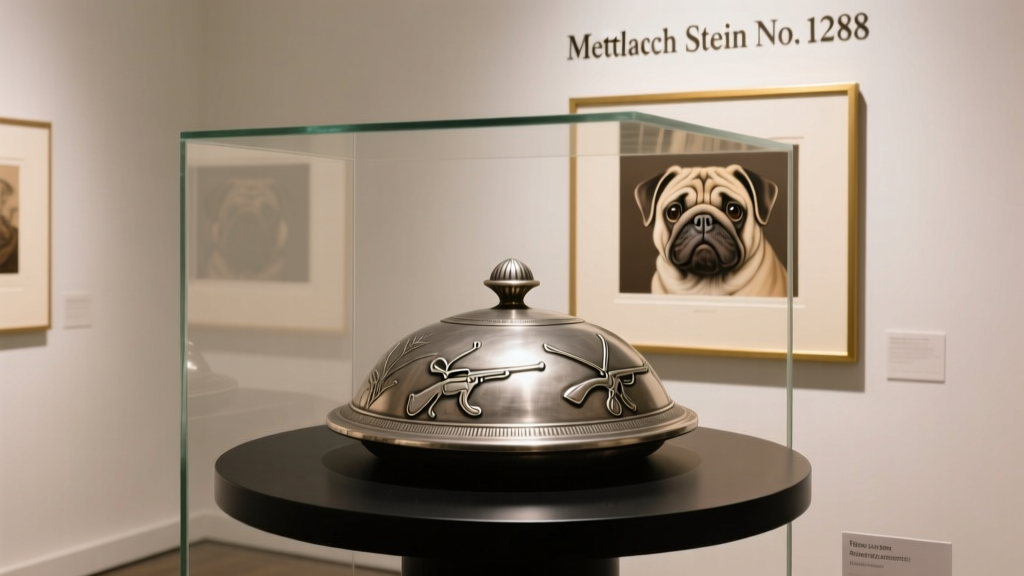
Mettlach Stein No. 1282: Authentication, Provenance, and Market Value of the 1.2-Liter Hunter-Peasant-Pug Pewter-Lid Stein
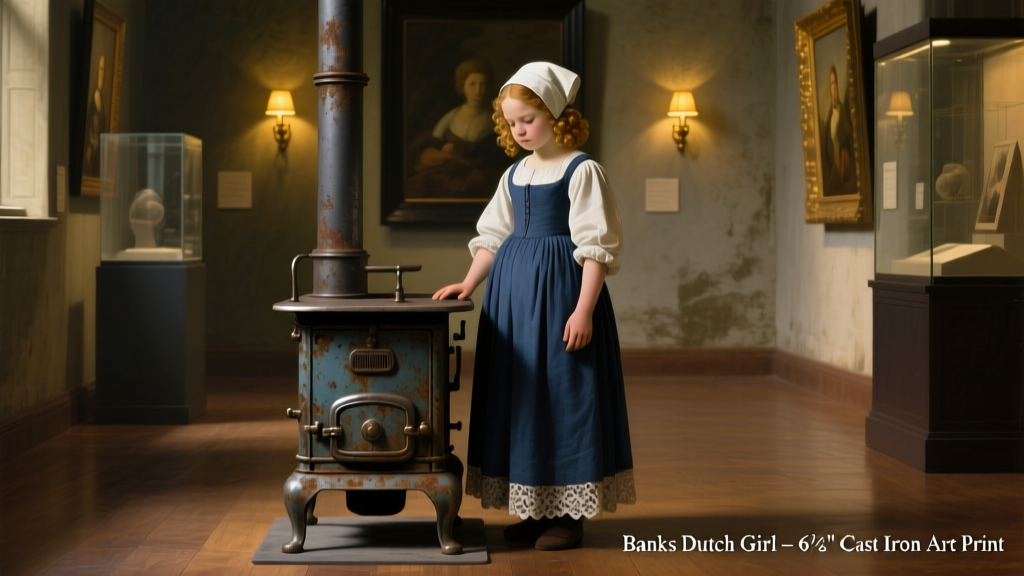
Banks Dutch Girl Standing Cast Iron Figurine (6½ Inches): Authentication, Market Value, and Historical Context

Toy Felix the Cat Wooden Jointed Schoenhut Doll Dated 1924 — Authentication, Provenance, and Market Value Analysis

Authentication and Market Analysis of Print Number 3699001: A Technical Forensic Study of a 2007 Edition Warhol Screenprint
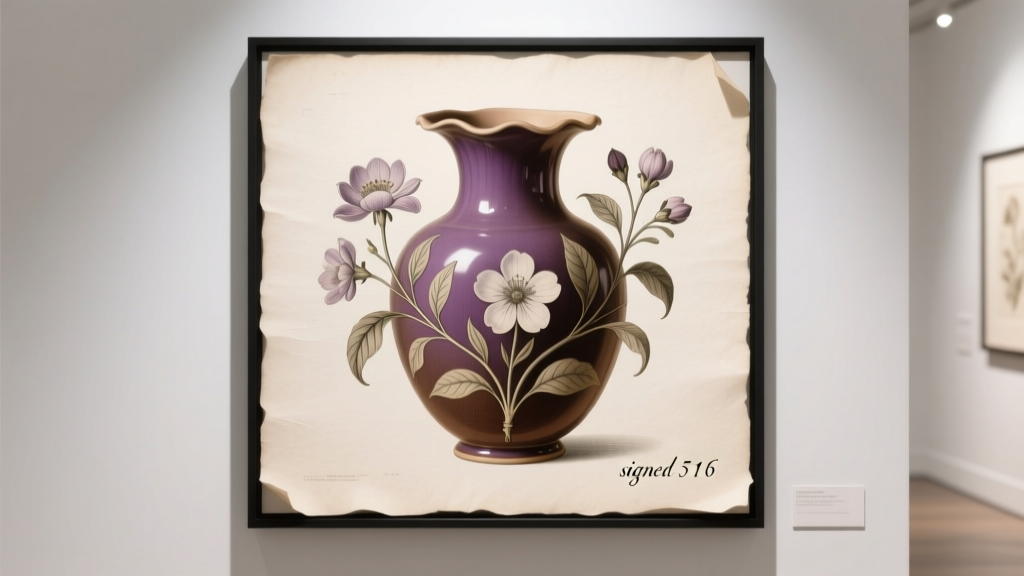
Authentication and Market Analysis of the Galle Vase: Stick Form, Slight Flared Rim, Violet-Brown Enamel Leaves and Blossoms, Signed 'Gallé' — 5½ Inches Tall
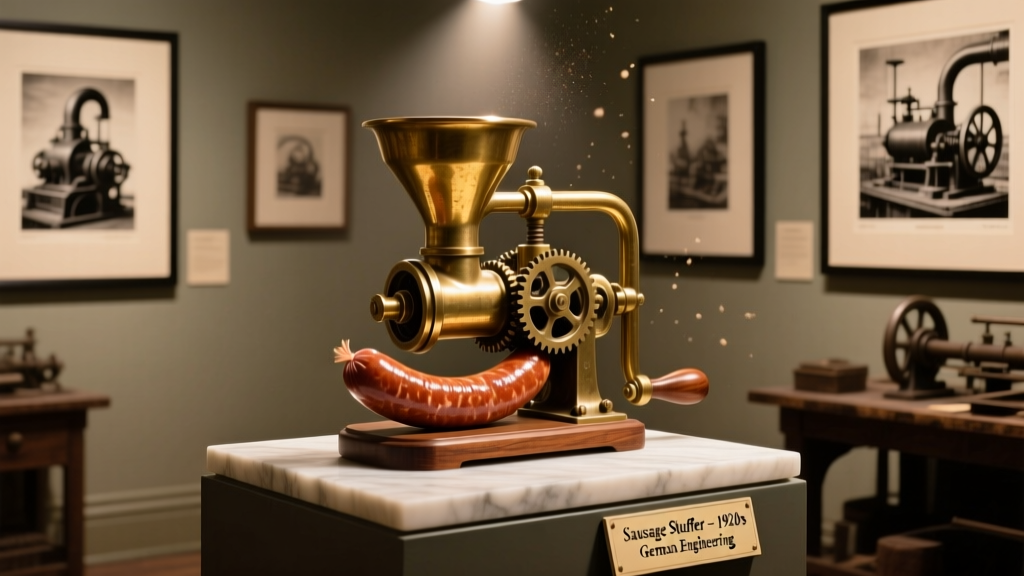
Sausage Stuffer: Technical Analysis, Market Trends, and Authentication Framework for Vintage and Modern Units