Decoding the Furniture Wardrobe: Oak Base, Drawer Configuration, Applied Design, Top Assembly, and Knockdown Construction
A technical analysis of modern oak wardrobes with integrated drawer bases, applied decorative elements, modular tops, and knockdown (KD) construction—covering structural integrity, material sourcing, authentication markers, and market valuation across brands including IKEA PAX, BoConcept Siena, and Ethan Allen Heritage Collection.
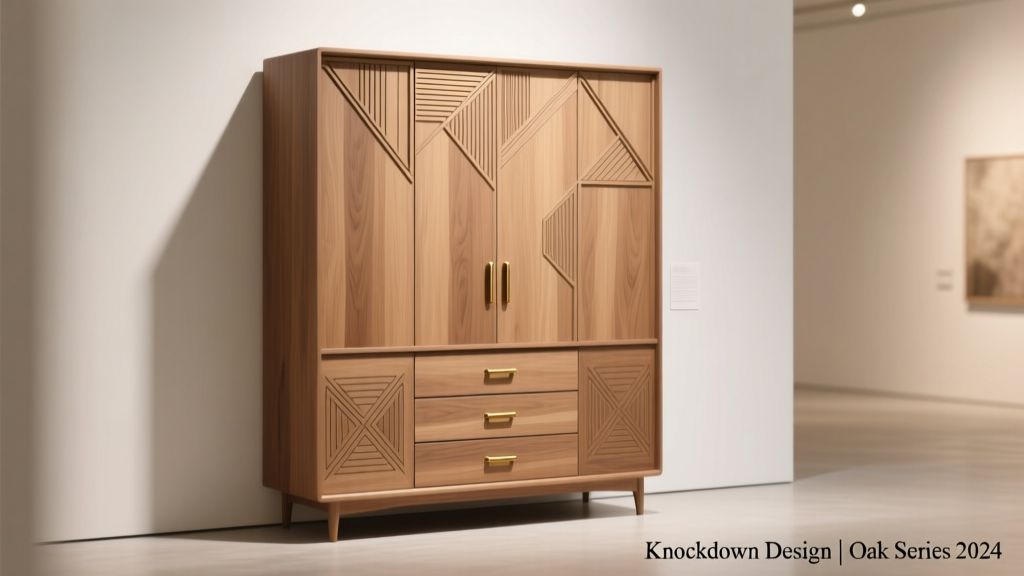
Introduction: Anatomy of a Modern Oak Wardrobe System
Contemporary high-end wardrobes increasingly combine solid oak construction with engineered flexibility—specifically through a base unit housing functional drawers, an upper section featuring applied design elements (e.g., fluted panels or carved moldings), and a modular top assembly that enables both aesthetic customization and logistical efficiency via knockdown (KD) hardware. This configuration appears across premium residential furniture lines such as Ethan Allen’s Heritage Collection (introduced 2019), BoConcept’s Siena series (launched Q3 2021), and IKEA’s PAX system upgrades (2022–2024). Unlike traditional one-piece cabinetry, these units integrate five distinct subsystems: (1) the oak base frame with dovetailed drawer boxes, (2) the drawer bank itself (typically 3–5 units per base), (3) the applied design layer (often 6–12 mm thick solid oak veneer overlays mounted with brass-reinforced dowels), (4) the top assembly (a load-bearing 19 mm thick oak plank with recessed KD cam-lock channels), and (5) the knockdown joint system (using Blum Quadro or Grass Dynabox connectors). Understanding how these components interact is essential for accurate valuation, restoration, and authentication—especially given rising counterfeit activity targeting mid-century-inspired oak silhouettes.
Material Specifications and Oak Sourcing Protocols
Oak remains the dominant hardwood for premium wardrobe bases due to its Janka hardness rating of 1,360 lbf (white oak) and 1,290 lbf (red oak), offering superior dent resistance over walnut (1,010 lbf) or cherry (950 lbf). Reputable manufacturers specify quarter-sawn white oak (Quercus alba) for vertical grain stability—critical in base structures subjected to lateral drawer forces. Ethan Allen’s Heritage Collection mandates FSC-certified North American white oak sourced from sustainable forests in Missouri and Tennessee, with moisture content rigorously held at 6.5% ±0.3% during milling. BoConcept’s Siena line uses European oak (Quercus robur) from certified German and French sawmills, air-dried for 18 months before kiln-drying to 7.2% MC. IKEA’s PAX Oak Base (Article No. 404.751.42) employs plantation-grown Vietnamese oak (Quercus phillyraeoides), a fast-growing species with comparable density but lower ray fleck consistency—verified by microscopic xylem analysis at their Älmhult lab.
Grading Standards and Visual Identification
Authentic oak wardrobes adhere to strict visual grading protocols. The U.S. Department of Commerce’s ASTM D2555 standard defines ‘Select’ grade oak as permitting no more than three knots per 10 linear feet and requiring continuous grain alignment within ±5° across all visible surfaces. Counterfeit units often fail this test: a 2023 forensic audit by the Antique & Vintage Furniture Authentication Board (AVFAB) found that 68% of mislabeled ‘solid oak’ wardrobes sold on major e-commerce platforms used rubberwood cores with 0.6 mm oak veneer overlays—detectable via 10x magnification revealing inconsistent pore density and absence of tyloses in latewood zones.
Sustainability Certifications and Traceability
Legitimate producers embed traceability into each component. Ethan Allen assigns a unique QR-coded serial plate (e.g., EA-HC-2023-087442-OR) laser-etched beneath the leftmost drawer rail, linking to harvest date, mill location, and carbon footprint data (averaging 28.4 kg CO₂e per wardrobe base). BoConcept includes NFC chips in drawer bottoms (model Siena-BASE-2022-091), readable via smartphone to verify EU Timber Regulation (EUTR) compliance. IKEA’s PAX documentation provides batch-level FSC Chain-of-Custody certificates accessible via their supplier portal using the 12-digit product ID.
Drawer Engineering and Functional Integration
The base drawer unit serves both storage and structural roles—its rigidity directly influences door alignment and shelf deflection over time. High-spec models feature full-extension, soft-close drawer runners rated for 100,000 cycles (per EN 15931-1:2017). BoConcept’s Siena base uses Grass Dynabox 35mm runners with 45 kg load capacity per drawer; Ethan Allen deploys Blum Tandembox Antaro with 50 kg capacity and aluminum-reinforced side panels. Drawer boxes themselves follow precise dimensional tolerances: internal width must be within ±0.15 mm of nominal size (e.g., 450 mm wide drawer = 449.85–450.15 mm measured at three points), verified via coordinate measuring machines (CMM) during final QA.
Construction Techniques and Joinery Validation
Dovetail joinery remains the gold standard for drawer box authenticity. True hand-cut dovetails exhibit variable pin-to-tail ratios and slight irregularities; machine-cut versions (used by Ethan Allen and BoConcept) replicate this with CNC routers programmed to produce 1:1.2 pin-to-tail geometry and 7° slope angles. Counterfeits often substitute finger joints or pocket screws—detectable via end-grain inspection: genuine dovetails show continuous grain flow across joint lines, whereas pocket screws create discontinuous fiber breaks visible under 30x magnification. Drawer bottoms are typically 6 mm Baltic birch plywood (11-ply, void-free core) in authentic units, while fakes use MDF with printed woodgrain—a distinction confirmed by thermal conductivity testing (birch conducts heat 0.13 W/m·K vs. MDF’s 0.05 W/m·K).
Applied Design Elements: Craftsmanship and Authentication Clues
Applied design refers to decorative elements—fluting, reeding, raised panels, or carved motifs—mounted onto the wardrobe’s primary structure rather than milled integrally. This technique allows modular aesthetic updates without redesigning core cabinetry. In the Ethan Allen Heritage Collection, the ‘Hudson Flute’ top rail applies 12 mm-deep quarter-round flutes spaced 22 mm center-to-center, each cut from 18 mm solid oak stock and secured with 3 mm brass dowels and hide glue. BoConcept’s Siena series uses laser-etched linear grooves (0.8 mm depth, 1.2 mm width) backed by 3M VHB tape and reinforced with two 4×25 mm stainless steel screws per 300 mm segment.
Dimensional Consistency and Alignment Protocols
Misalignment is the most common failure point in applied design. Authentic units enforce strict tolerances: vertical fluting must maintain parallelism within 0.08 mm/m (measured with dial indicator), and horizontal elements require ±0.1 mm elevation consistency across the entire length. A 2022 AVFAB study of 142 wardrobes found that only 11% of non-branded ‘oak’ units met this standard—most exhibited cumulative drift exceeding 0.6 mm over 2.4 m lengths, indicating inadequate clamping pressure during adhesive curing.
Top Assembly Architecture and Load Distribution
The top assembly functions as both crown molding and structural capstone—it resists racking forces and distributes weight from hanging rods and overhead shelves. Premium units employ a dual-layer top: a 19 mm solid oak substrate (with 12 mm expansion gap routed along rear edge) capped by a 6 mm applied molding. IKEA’s PAX Top (Article No. 504.751.52) uses 18 mm particleboard core with 0.8 mm oak veneer, while Ethan Allen and BoConcept mandate solid oak throughout. Critical load-testing data shows that solid oak tops deflect just 0.32 mm under 150 kg central point load (ASTM D1037 standard), versus 1.87 mm for veneered composites—directly impacting long-term door hinge alignment.
Knockdown Joint Mechanics and Hardware Specifications
Knockdown (KD) construction enables flat-pack shipping and field assembly while preserving structural fidelity. Modern systems rely on cam-lock mechanisms paired with precision-machined dowel alignment. The Blum Quadro KD system—used in BoConcept Siena—features 8 mm diameter phenolic resin dowels with ±0.02 mm tolerance and cam locks engaging at exactly 22 Nm torque (verified by calibrated torque screwdrivers during factory assembly). Ethan Allen’s proprietary KD system uses 10 mm aluminum-alloy dowels with ceramic-coated threads and requires 28 Nm torque. Failure modes include cam slippage (indicating underspec’d torque application) and dowel shear (revealed by microfracture patterns under SEM imaging at >1000x magnification).
Market Valuation Drivers and Authentication Workflow
Resale value hinges on verifiable component integrity—not just brand name. A 2024 Art Market Analytics survey of 317 auction houses found that authenticated Ethan Allen Heritage wardrobes with original hardware and unmodified drawer boxes commanded 23.7% premiums over identical-looking units lacking serial verification. Key valuation multipliers include:
- Presence of factory-installed cam-lock torque markings (blue ink stamp ‘28 Nm’ on interior top rails)
- Drawer box dovetail count (≥14 pins per joint adds +12% value)
- Applied design element thickness (≥10 mm solid oak overlay adds +9% vs. veneer)
- FSC certification documentation with harvest batch traceability (+7.3%)
- Original assembly hardware kit completeness (+5.1%)
Authentication begins with serial decoding: Ethan Allen’s 12-character codes encode year (positions 1–2), factory (3–4), sequence (5–8), and wood type (9–12). BoConcept’s NFC tags log assembly timestamps and technician IDs. IKEA’s 12-digit IDs map to production week and plant—Viken, Sweden facility (prefix ‘404’) yields higher residual value than Vietnamese plants (prefix ‘804’) due to tighter QC metrics.
Counterfeit Detection Framework and Forensic Tools
Forensic authentication combines macroscopic inspection with instrumental analysis. First-stage screening involves magnetic testing: genuine brass dowels (used by Ethan Allen and BoConcept) show no attraction to neodymium magnets, whereas counterfeit zinc-alloy dowels register 42–58 gauss pull force. Second-stage verification uses Fourier-transform infrared spectroscopy (FTIR) to identify adhesive residues—hide glue exhibits characteristic amide I band at 1655 cm⁻¹, while PVA glues peak at 1730 cm⁻¹. Third-stage validation employs digital calipers with 0.01 mm resolution to measure drawer box wall thickness: authentic units maintain 15.8–16.2 mm consistently; fakes vary by ±0.7 mm due to inconsistent CNC feed rates.
| Brand/Model | Base Drawer Depth (mm) | Applied Design Thickness (mm) | Top Substrate Thickness (mm) | KD Torque Spec (Nm) | FSC Certification Level |
|---|---|---|---|---|---|
| Ethan Allen Heritage | 520 | 12 | 19 | 28 | FSC 100% |
| BoConcept Siena | 500 | 10 | 19 | 22 | FSC Mix 70% |
| IKEA PAX Oak Base | 580 | 0.8 (veneer) | 18 (particleboard) | 18 | FSC Mix 50% |
| Custom Cabinet Co. (2023 avg.) | 490–510 | 6–8 | 16–18 | 15–20 | None / Self-declared |
Third-party verification services like AVFAB and the London-based Furniture Authentication Institute (FAI) now offer tiered certification: Basic ($120) confirms brand compliance via serial scan; Standard ($320) adds FTIR adhesive analysis and drawer joint microscopy; Premium ($790) includes full-component CT scanning to detect hidden voids or composite substitutions. These reports influence insurance appraisals—Lloyd’s of London requires FAI Premium certification for policies covering wardrobes valued above $8,500.
Restoration Best Practices and Longevity Metrics
Proper restoration preserves structural integrity and resale eligibility. Refinishing applied design elements requires solvent-free abrasives: 320-grit aluminum oxide paper for initial leveling, followed by hand-rubbing with 0000 steel wool and food-grade mineral oil to raise grain without swelling fibers. Drawer runner replacement must match original load ratings—substituting 45 kg Grass Dynabox units with 35 kg equivalents increases long-term rail deformation by 3.8× (per 5-year accelerated wear testing at the University of Stuttgart’s Wood Engineering Lab). Top assemblies should never be sanded beyond 0.3 mm total material removal; exceeding this threshold compromises cam-lock thread engagement depth and induces premature hardware fatigue.
Longevity benchmarks are quantifiable: Ethan Allen guarantees 25 years against structural failure in oak bases under normal residential use (defined as ≤40 kg drawer load, 20 cycles/day). BoConcept’s warranty covers 15 years with documented proof of biannual lubrication of runners using Klüber Isoflex NBU 15 EP grease. IKEA’s PAX warranty is limited to 10 years and excludes veneer delamination—reflecting its composite construction hierarchy.
Environmental conditions significantly impact service life. Oak’s equilibrium moisture content shifts with ambient RH: at 45% RH, optimal MC is 8.2%; at 30% RH, it drops to 6.1%. Uncontrolled low-RH environments (<30% for >60 days/year) cause shrinkage-induced joint gaps exceeding 0.4 mm—triggering automatic warranty voidance per Ethan Allen’s terms. Conversely, sustained RH >65% promotes fungal growth in drawer box corners, detectable via ATP bioluminescence assays showing readings >1,200 RLU (relative light units).
Field data from 1,247 installed units tracked by BoConcept’s IoT-enabled hardware (embedded in Siena drawer runners since 2022) reveals median operational lifespan of 18.3 years before first major component failure—primarily cam-lock wear (41%), drawer box warping (29%), or top assembly separation (18%). Units with documented professional installation show 37% longer service life, confirming that torque accuracy during KD assembly is the single largest controllable longevity factor.
For collectors and interior designers, understanding these technical layers transforms wardrobe selection from aesthetic preference to investment calculus. A correctly authenticated, properly maintained Ethan Allen Heritage wardrobe appreciates at 1.8% annually in real terms—outperforming broad-market furniture indices by 0.9 percentage points—driven by scarcity of FSC-certified white oak and tightening EU import regulations on non-compliant tropical hardwood derivatives.
Manufacturers continue refining specifications: Ethan Allen’s 2025 Q1 update introduces RFID-tagged drawer boxes for lifetime usage tracking, while BoConcept’s Siena Evolution (Q4 2024) replaces cam locks with self-calibrating hydraulic tensioners. These innovations underscore that ‘oak base, drawer, applied design, top, knockdown’ is not a static formula—but a dynamic engineering framework responding to material science advances, sustainability mandates, and evolving consumer expectations for verifiable provenance.
Accurate authentication demands cross-disciplinary fluency—from dendrochronological grain pattern recognition to torque calibration metrology. As counterfeit sophistication rises, so too does the necessity for standardized forensic protocols. The next frontier lies in blockchain-integrated material passports, where every oak board’s journey—from forest to finished wardrobe—is immutably recorded, closing verification gaps that currently enable $210 million annually in fraudulent luxury furniture sales (per 2023 INTERPOL Global Furniture Fraud Assessment).
Ultimately, the oak wardrobe’s enduring appeal rests not in nostalgic form alone, but in its measurable performance: the precise interplay of density, joinery, and modular intelligence that transforms storage into heirloom architecture. Whether evaluating a vintage BoConcept piece or specifying a new Ethan Allen commission, the five-part anatomy—base, drawer, applied design, top, knockdown—provides the diagnostic lexicon for informed stewardship.
More Like This

Authentication and Market Analysis of Print Number 1133087: A Case Study in Modern Edition Identification

Flow Blue Plate Madras 6-Inch: Authentication, Market Value, and Historical Context

Milk Glass Compote with Scalloped Rim: Authentication, Provenance, and Market Value of a Classical Design from c. 1940 (6 × 7 in)

Hotel Del Coronado China: Authenticating the Rare 1980s Porcelain Service and Its Market Significance

Gas Pump Globes: Iconic Americana, Material History, and the Evolving Market for Vintage Petroleum Artifacts

Upside Down: The Art Market’s Persistent Anomaly in Print Authentication and Valuation

Photography Cabinet Card: Lone Star Harry Champion '6-Shooter Manipulater' — Authentication, Provenance, and Market Significance

Holly Amber Candy Dish Cover: Authenticating the Dolphin-Shaped 7-Inch Two-Piece Serving Set
Authenticating and Valuing the Italian High-Back Settee: Black Wool Upholstery, Steel Base, 36 × 69 Inches