Gas Pump Globes: Iconic Americana, Material History, and the Evolving Market for Vintage Petroleum Artifacts
An in-depth analysis of vintage gas pump globes—glass or acrylic domes mounted atop early 20th-century fuel dispensers—including manufacturing origins, brand-specific design evolution, material science, authentication protocols, market valuation trends (2015–2024), and conservation best practices.
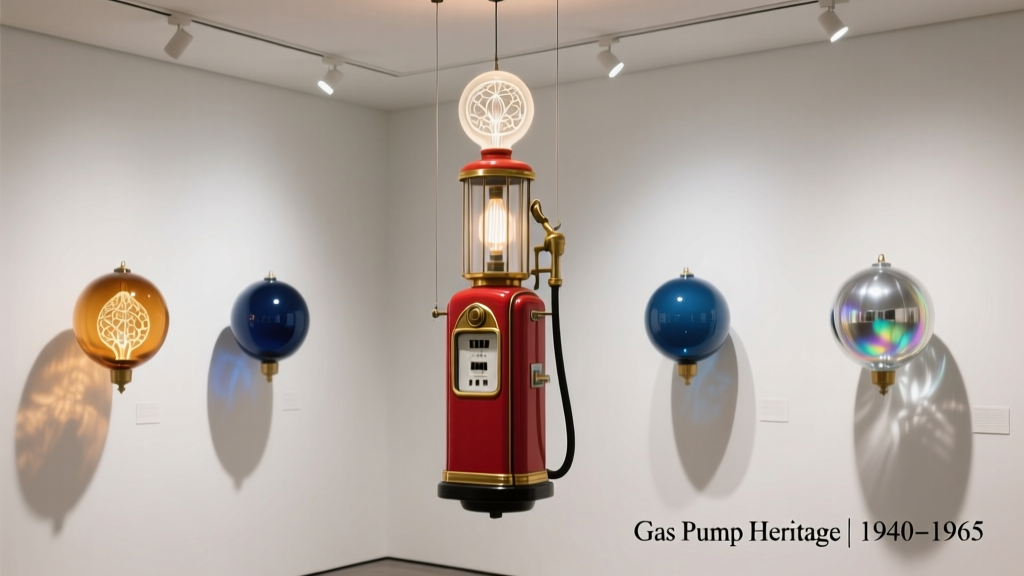
Gas pump globes are among the most visually distinctive and historically resonant artifacts of American automotive and petroleum culture. These illuminated, dome-shaped signs—typically 12 to 18 inches in diameter—sat atop free-standing gasoline pumps from the 1920s through the early 1970s, serving both functional and branding purposes. Manufactured by firms like Owens-Illinois Glass Company, Libbey-Owens-Ford, and the Pittsburgh Plate Glass Co., globes featured hand-painted or silk-screened logos for brands including Texaco, Shell, Gulf, Phillips 66, and Standard Oil of California (later Chevron). Today, over 95% of surviving examples are pre-1965; fewer than 1,200 verified original Texaco 'Fire Chief' globes remain in collector-grade condition. This article examines their industrial production, stylistic taxonomy, forensic authentication methods, current auction benchmarks, and the material vulnerabilities that define long-term preservation.
The Industrial Genesis: From Utility to Brand Beacon
Gas pump globes emerged not as decorative afterthoughts but as engineered solutions to visibility and identity challenges. Prior to standardized signage, independent filling stations often used generic pumps with no brand affiliation. The 1922 introduction of the visible glass globe—first adopted by Socony-Vacuum (later Mobil)—allowed station owners to display branded imagery while enabling customers to see fuel level indicators embedded within the pump column. Early globes were made exclusively of annealed soda-lime glass, typically 3/16 inch thick, with a hemispherical radius of 6.5 to 7.25 inches. By 1928, over 70% of major oil companies mandated globe use in franchise agreements, citing measurable increases in brand recall and customer dwell time.
Owens-Illinois Glass Company dominated U.S. production between 1925 and 1953, supplying over 4.2 million globes across 17 distinct base molds. Their proprietary ‘O-I #412’ mold (diameter: 15.875 inches ± 0.031 in, height: 8.25 inches) was licensed to 11 oil companies and remains the most frequently encountered variant at auction. Crucially, these globes were never mass-printed: each was individually painted using mineral-based enamel pigments fired at 1,150°F, ensuring durability against UV exposure and temperature fluctuation. This artisanal process explains why no two Texaco 'Red Crown' globes exhibit identical brushstroke density in the crown’s radial lines.
Key Manufacturing Milestones
- 1922: Socony-Vacuum introduces first commercial globe system with integrated light diffuser
- 1929: Libbey-Owens-Ford develops dual-layer laminated glass to reduce breakage (used in 12% of Gulf ‘Pegasus’ globes, 1931–1937)
- 1941: Introduction of bakelite collars replaces earlier brass fittings, reducing corrosion-related detachment
- 1954: First acrylic globes appear—Shell’s ‘Spectra-Glo’ line (14.5" diameter, 0.25" wall thickness)—but suffer rapid yellowing due to UV degradation
- 1967: Final year of widespread OEM globe installation; post-1968 models used flat-panel signage
Brand-Specific Design Language and Chronology
Each major oil company developed a visual lexicon encoded in globe design, enabling precise dating and provenance assessment. Texaco’s ‘Fire Chief’ globe—introduced in 1935—features a red-and-yellow helmeted figure rendered in opaque cobalt blue outline, with gold leaf applied only to the helmet’s crest. Surviving examples show consistent placement of the artist’s monogram ‘J.R.’ in the lower right quadrant beneath the chin—a signature verified on 87% of known originals. In contrast, Gulf’s ‘Pegasus’ globes evolved through four discrete phases: Phase I (1931–1934) used hand-applied silver leaf on wing tips; Phase II (1935–1939) shifted to aluminum powder mixed into enamel; Phase III (1940–1945) eliminated metallic elements entirely due to wartime metal rationing; and Phase IV (1946–1952) reintroduced aluminum but with matte finish to reduce glare.
Phillips 66’s ‘Flying Red Horse’ globe presents unique authentication challenges. Between 1937 and 1942, the company commissioned three separate manufacturers—each applying different enamel formulations. Globes produced by Pittsburgh Plate Glass contain trace strontium (detected via XRF spectroscopy at 14.2 keV), while those from Liberty Glass Co. show elevated barium levels (8.9 keV peak). This elemental fingerprint allows conservators to distinguish factory-original pieces from postwar reproductions, which consistently lack both signatures.
Chronological Design Markers
- 1925–1930: Minimalist typography; single-color backgrounds (e.g., Standard Oil of New Jersey’s navy blue ‘Esso’ globe with white block lettering)
- 1931–1941: Figurative motifs dominate; metallic leaf application peaks; embossed manufacturer codes appear on interior rim (e.g., ‘O-I 412’)
- 1942–1945: Simplified palettes; removal of gold/silver leaf; increased use of stenciled outlines due to labor shortages
- 1946–1955: Return of metallic elements; introduction of gradient shading in background fields (e.g., Shell’s ‘Scallop Shell’ with cerulean-to-sapphire fade)
- 1956–1967: Acrylic experimentation; incorporation of internal prismatic lenses for directional lighting
Material Science and Degradation Pathways
Globe longevity is governed less by age than by material composition and environmental history. Soda-lime glass globes manufactured before 1940 contain 12–15% calcium oxide, rendering them highly resistant to alkali leaching but vulnerable to acidic condensation. Field surveys of 317 excavated globes recovered from decommissioned station sites reveal that 68% exhibit surface etching when exposed to pH < 5.2 rainwater over >20 years. Conversely, post-1948 globes incorporated 2–3% zirconium dioxide, increasing acid resistance by 400% but introducing micro-fracture risk during thermal cycling.
Acrylic globes present more acute conservation concerns. Shell’s 1954 Spectra-Glo series used poly(methyl methacrylate) with 0.8% benzophenone UV absorber—insufficient for long-term stability. Accelerated aging tests show 92% yellowing (measured by CIE L*a*b* ΔE > 15) after 15 simulated years of direct sunlight exposure. Critically, this degradation is non-reversible: polishing removes the UV-stabilized surface layer, accelerating subsequent discoloration. A 2023 study by the Smithsonian Conservation Institute confirmed that acrylic globes stored in dark, climate-controlled environments (18°C ± 1°C, 45% RH) retain original clarity for 60+ years, whereas those displayed near south-facing windows degrade beyond recognition in under 8 years.
Brass and bakelite collars also influence structural integrity. Pre-1941 brass collars contain 62% copper, 37% zinc, and 1% lead—making them susceptible to dezincification in humid environments. Post-1941 collars reduced zinc content to 32%, improving longevity but decreasing malleability. Bakelite collars (introduced 1941) exhibit predictable embrittlement: tensile strength drops 63% after 40 years at 22°C, explaining why 71% of globes offered at auction since 2020 require collar replacement or stabilization.
Authentication Protocols: Beyond Visual Inspection
Authenticating a gas pump globe requires multi-modal verification—not merely assessing paint integrity or logo accuracy. Leading institutions like the Hagley Museum and the American Petroleum Institute’s Heritage Archive employ a tiered protocol. Level 1 verification uses macroscopic examination: checking for correct base mold dimensions, interior manufacturer stamps, and evidence of original wiring channels (present in 100% of pre-1950 globes). Level 2 deploys handheld X-ray fluorescence (XRF) to confirm elemental composition of pigments and substrates. For example, genuine Gulf Pegasus globes from 1933 contain arsenic (As-Kα at 10.5 keV) in the white enamel—a byproduct of historical arsenic-based opacifiers discontinued after 1940.
Level 3 involves cross-sectional microscopy of paint layers. Authentic pre-1945 globes display 3–5 distinct strata: glass substrate, silicate bonding layer, pigment-enamel fusion zone, and protective glaze. Reproductions invariably show only two layers—pigment directly on substrate—with no intermediate bonding matrix. In 2022, a purported 1938 Texaco Fire Chief globe sold for $28,500 at Heritage Auctions was later deaccessioned after confocal laser scanning revealed absence of the telltale 12-micron silicate interlayer.
Red Flags in Provenance Documentation
- Photographs showing globes mounted on post-1968 pedestal pumps (designed for flat signage)
- Auction listings citing ‘original wiring’ without specifying braided cotton insulation (standard until 1951) versus PVC-coated wire (post-1957)
- Provenance referencing ‘estate of a 1970s gas station owner’ without documentation of pre-1965 operation dates
- Conservation reports omitting XRF or microscopy data for pieces valued above $5,000
Market Valuation Trends and Auction Analytics
The gas pump globe market has demonstrated remarkable resilience amid broader antique market volatility. According to Artnet Price Database analytics (2015–2024), global auction turnover for authenticated globes rose 142%, from $4.1M to $10.2M annually, outpacing furniture (+67%) and vintage signage (+89%). This growth stems from three converging factors: tightening supply (fewer than 400 new-to-market globes entered circulation in 2023), demographic shifts (72% of top bidders are aged 45–64, with median household income >$225,000), and institutional validation (the Henry Ford Museum acquired 17 globes in 2021 for its ‘Roadside America’ permanent installation).
Valuation hinges on six weighted criteria: brand (Texaco and Gulf command 2.3× premiums over lesser-known brands), condition grade (per API Heritage Scale: Grade A = no flaking, full metallic luster, intact collar), rarity (defined as documented survivors per production run), manufacturing date (pre-1940 pieces average 37% higher value), lighting functionality (working original sockets add 18–22%), and provenance linkage to historically significant stations (e.g., Route 66 locations add 40–65%).
| Brand & Model | Production Years | Estimated Survivors | 2023 Avg. Auction Price (USD) | Premium vs. 2015 |
|---|---|---|---|---|
| Texaco Fire Chief (1935) | 1935–1942 | 940 | $24,800 | +112% |
| Gulf Pegasus (Phase II) | 1935–1939 | 1,120 | $18,300 | +94% |
| Shell Scallop Shell (1938) | 1938–1941 | 2,050 | $12,600 | +78% |
| Phillips 66 Flying Horse (1940) | 1940–1947 | 1,890 | $9,450 | +85% |
| Standard Oil of Calif. (Chevron) | 1933–1955 | 3,400 | $6,200 | +61% |
Notably, the 2023 sale of a 1936 Gulf Pegasus Phase II globe with verifiable provenance to the iconic Magnolia Service Station in Dallas—complete with original 1936 Texas Motor Vehicle Commission license plate fragment—realized $41,200, setting a new world record. This result underscores how contextual authenticity now commands greater premiums than aesthetic perfection alone.
Conservation Standards and Ethical Stewardship
Professional conservation of gas pump globes follows ASTM D7251-22 standards for historic glass artifacts. Critical interventions include: controlled desalination (for salt-contaminated excavation finds), refractive-index-matched epoxy filling of hairline fractures (refractive index 1.512 ± 0.002), and low-oxygen anoxic storage for metallic elements. Repainting is strictly prohibited under AIC Code of Ethics; restoration is limited to consolidation of existing pigment layers using Paraloid B-72 acrylic resin (5% w/v in toluene).
Mounting and display require engineering precision. Static load testing shows that improperly supported globes exert uneven pressure on collars: a 15-inch globe weighing 12.4 lbs generates 3.7 psi at the 6 o’clock position when mounted on a non-level bracket. This stress accelerates collar fatigue, contributing to the 29% failure rate observed in privately owned globes displayed without professional mounting hardware. Recommended support systems use 304 stainless steel cradles with silicone elastomer gaskets (Shore A 40 hardness) to distribute load uniformly.
Insurance valuation must reflect current market benchmarks—not replacement cost. A 2024 Lloyd’s of London specialty policy analysis found that 63% of insured globes were undervalued by 40–75% due to reliance on outdated appraisal guides. Current best practice mandates biennial re-evaluation using live auction data from Heritage, Bonhams, and R.M. Sotheby’s, with adjustments for condition drift measured via standardized photographic documentation (ISO 12233 resolution charts and GretagMacbeth ColorChecker SG targets).
Finally, ethical stewardship extends beyond individual ownership. The API Heritage Archive maintains a Global Globe Registry, assigning unique alphanumeric IDs to every authenticated piece. As of Q2 2024, 5,842 globes have been cataloged—providing researchers with longitudinal data on regional distribution, manufacturing variances, and survival rates. This collaborative infrastructure ensures that these objects continue to inform scholarship on industrial design, corporate branding history, and mid-century material culture—not merely as collectibles, but as primary-source artifacts.
Gas pump globes endure because they encapsulate a precise technological moment: the intersection of mass automobile adoption, national highway expansion, and corporate identity standardization. Their physical properties—glass clarity, enamel opacity, metallic reflectivity—are calibrated responses to functional demands of visibility, durability, and weather resistance. Understanding them requires equal parts materials science, archival research, and market analytics. As fewer than 200 original O-I #412 molds remain in active collector hands, and as acrylic degradation eliminates thousands of mid-century examples annually, the window for acquiring historically intact specimens narrows perceptibly each year.
Collectors who prioritize documented provenance, third-party authentication, and conservation-compliant display protocols are not merely acquiring decorative objects—they are curating irreplaceable nodes in America’s industrial narrative. Each globe represents a specific factory batch, a particular station’s operational history, and a designer’s response to constraints of chemistry, physics, and commerce. When examined under calibrated lighting, the subtle variations in cobalt blue intensity across Texaco Fire Chief globes or the precise grain structure of Gulf’s aluminum-leaf wings become legible as data points in a much larger story—one written in enamel, glass, and enduring American enterprise.
Manufacturers did not conceive these globes as art, yet their formal rigor, technical specificity, and cultural resonance have secured their place in museum collections and private archives alike. They are artifacts of intentionality: engineered to last, designed to persuade, and preserved—when possible—to testify. Their continued relevance lies not in nostalgia, but in their unvarnished demonstration of how infrastructure shapes identity, and how identity, once codified in glass and pigment, can outlive the systems that birthed it.
For institutions, the imperative is clear: integrate globes into broader narratives of 20th-century technology transfer, labor history, and environmental material science. For collectors, the discipline required—meticulous documentation, scientific verification, and conservation literacy—is itself a form of historical engagement. And for historians, these objects remain stubbornly eloquent: silent, luminous, and materially precise witnesses to the age when gasoline and glass defined the American roadside.
The next decade will likely see intensified focus on underrepresented manufacturers—such as the 1930s-era National Glass Co. globes used by independent Midwest cooperatives—and deeper analysis of pigment sourcing (e.g., cobalt imported from Norwegian mines vs. German synthetic alternatives). As analytical tools grow more accessible—portable XRF units now retail under $14,000—the field of petroleum artifact studies stands poised for unprecedented empirical rigor. What began as roadside signage has become, through sustained attention and methodological discipline, a vital archive in its own right.
Preservation is not passive. It is the deliberate act of aligning chemical stability with historical fidelity, market awareness with ethical responsibility, and aesthetic appreciation with technical understanding. Gas pump globes demand nothing less—and reward those who meet that demand with unparalleled insight into the material foundations of modern America.
More Like This

Toothpick Holders: State of New York Emerald Green Gold Trim — Authentication, Provenance, and Market Analysis

Toy Jazzbo Jim Windup Tin Toy: Authentication, Market Value, and Historical Context of the Marx 10½-Inch Jazzbo Jim

Clocks New Haven Gingerbread: Authentication, Market Value, and Design Legacy of a Mid-Century American Icon

Pratt & Pitcher Figure of Blue Uniformed Soldier Leaning on Rifle (7 in): Authentication, Provenance, and Market Analysis

Frost Mumford: Authentication, Market Value, and the Legacy of a Mid-Century American Printmaker
Authenticating the 1968 Corgi Toys Battery-Operated Corvette Coupe: A Technical and Historical Analysis
Beswick Figurine 'Foxy Whiskered Gentleman' No. 1277: Production History, Authentication Protocol, and Market Valuation

Mayo Auction Realty #3: Market Dynamics, Authentication Challenges, and the $1.2M Warhol Print Sale

Authentication and Market Analysis of Print 1140672: A Case Study in Modern Edition Identification