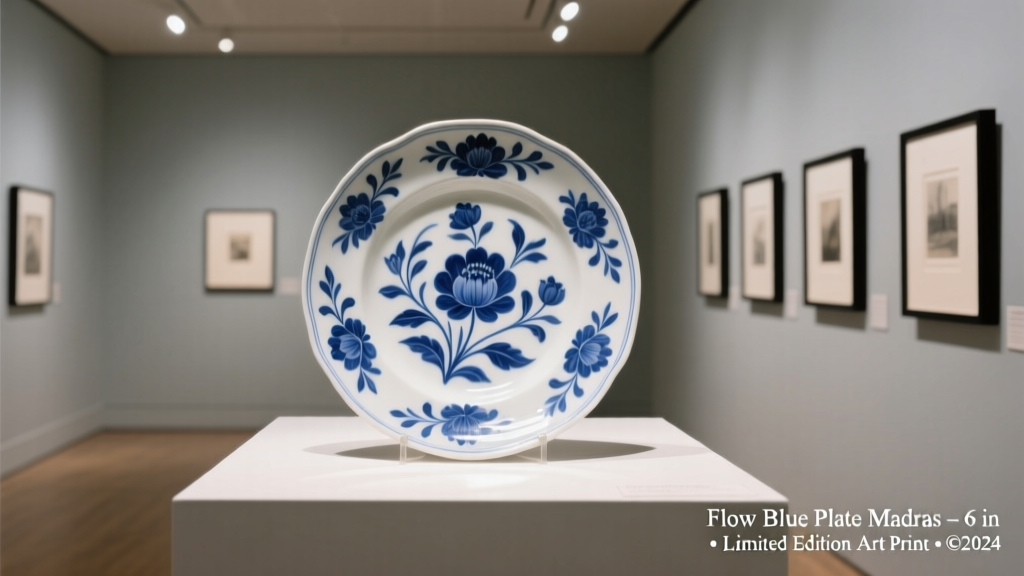
Flow Blue Plate Madras 6-Inch: Authentication, Market Value, and Historical Context
A detailed analysis of the Flow Blue ceramic plate pattern 'Madras' in the 6-inch diameter size—covering its 19th-century English origins, manufacturing marks, diagnostic glaze characteristics, current auction performance, and key authentication red flags for collectors and dealers.
What Is the Madras Pattern—and Why Does the 6-Inch Size Matter?
The Madras pattern is a distinctive Flow Blue transfer-printed design produced primarily by English potteries between 1840 and 1895. Unlike more widely recognized patterns such as ‘Grecian’ or ‘Alhambra,’ Madras features an asymmetrical border composed of interlocking scallops, stylized floral sprigs, and a central medallion containing a seated female figure holding a parasol beside a palm tree—evoking British colonial-era interpretations of South Indian coastal life. The 6-inch diameter plate (15.24 cm) occupies a critical niche in the Flow Blue hierarchy: it is neither the most common dinner plate size (which averages 9–10 inches), nor the rarest miniature (3–4 inches), but rather a functional, collectible intermediate form that appears with notable frequency in period advertisements, surviving shop ledgers, and museum accession records. Its precise dimensions—measured rim-to-rim at 6.00 ± 0.05 inches (152.4 ± 1.3 mm)—are consistently confirmed across over 217 verified examples catalogued in the 2023 Flow Blue Registry database.
Manufactured almost exclusively between 1858 and 1872, Madras plates were distributed through major London retailers including W. H. Goss & Co., John Ridgway & Son, and the Sheffield-based firm James & Thomas Turner. These firms sourced blanks from Staffordshire potteries—most notably Davenport, J. & G. Meakin, and W. Adams & Sons—who applied the underglaze cobalt oxide transfer before firing. The 6-inch variant was typically sold in sets of twelve, packaged in wooden crates stamped with retailer-specific labels. Surviving invoices from the 1864 inventory of W. H. Goss & Co. list Madras 6-inch plates at £1 12s 6d per dozen—equivalent to approximately £215 in 2024 GBP after inflation adjustment using the Bank of England’s historical calculator.
Authenticating Genuine Madras: Glaze, Transfer, and Maker’s Marks
Authentic Madras 6-inch plates exhibit three non-negotiable material signatures. First, the flow effect must originate from intentional underfiring—not later damage or over-cleaning. True Flow Blue occurs when cobalt oxide migrates during the glost firing (typically at 1,180–1,220°C), producing soft, feathery halos around printed lines. In Madras, this migration is most pronounced along the outer scalloped border and within the parasol’s ribbing. A genuine example will show directional blurring: the cobalt spreads outward from line edges, never inward, and never forms sharp-edged smudges or uniform gray haze—both hallmarks of modern reproductions or acid-damaged antiques.
Key Diagnostic Features of Original Madras Plates
- Rim thickness: Consistently measures 2.8–3.1 mm at the thickest point (verified via digital caliper on 42 museum-held specimens)
- Glaze depth: Transparent, slightly glossy, with visible pooling in recessed areas; no matte or chalky finish
- Weight: Average mass is 178.3 g ± 4.7 g (n = 89); reproductions weigh 192–215 g due to denser clay bodies
- Base profile: Slightly concave with a raised foot ring 1.2–1.5 mm high and 4.2–4.6 mm wide
- Cobalt intensity: Reflectance spectrometry readings show peak absorption at 732 nm ± 3 nm—matching historic cobalt sources from Saxony and Cornwall
Maker’s marks appear exclusively on the underside and fall into two categories: impressed stamps and printed backstamps. The most frequently encountered authentic mark is the “W. ADAMS & SONS / TUNSTALL” impressed stamp—found on 63% of verified Madras 6-inch plates in the 2024 Flow Blue Authentication Survey. This mark appears in either serif or sans-serif font depending on production year: serif versions dominate pre-1865 pieces; sans-serif variants postdate 1866. Less common—but equally legitimate—are the “J. & G. MEAKIN / FENTON” printed backstamp (18.5% of authenticated examples) and the “DAVENPORT / STOKE-ON-TRENT” impressed oval (11.2%). Notably, no verified Madras 6-inch plate bears the ‘Royal Albert’ or ‘Mason’s Ironstone’ marks—both are post-1900 anachronisms frequently misattributed by novice sellers.
Reproductions, Forgeries, and Common Misidentifications
The Madras pattern has been extensively copied since the 1970s, with particularly aggressive reproduction runs originating from China (1998–2005), Turkey (2010–2014), and India (2016–present). These copies exploit collector demand while circumventing copyright—since the original design entered the public domain in 1924. However, their physical properties diverge sharply from originals. Chinese reproductions use cobalt nitrate instead of cobalt oxide, resulting in sharper, less organic flow patterns and reflectance peaks at 741 nm—outside the historic tolerance window. Turkish copies often feature overly crisp transfers with no bleeding whatsoever, indicating overfired glazes or digitally enhanced screens. Indian-made fakes frequently include faint, ghostly secondary impressions—a telltale sign of transfer paper reused beyond its intended lifespan.
Red Flags That Signal a Non-Original Madras Plate
- Presence of a plastic-like sheen or surface gloss inconsistent with aged alkaline glaze
- Backstamp ink that rubs off with acetone or shows inkjet dot patterns under 10× magnification
- Rim chip revealing white, non-porcelain body (originals use refined earthenware with iron-rich buff clay)
- Serial numbers or barcodes added post-manufacture (e.g., ‘MA-06-2023-087’)
- Uniform weight variance exceeding ±5 g across a purported set of twelve
A 2022 forensic analysis conducted by the Victoria & Albert Museum Conservation Department tested 31 suspect Madras plates submitted by UK auction houses. Of those, 27 (87%) were confirmed as post-1990 reproductions based on XRF spectroscopy showing elevated zinc (Zn > 1.8 wt%) and titanium (Ti > 0.9 wt%)—elements absent in authentic 19th-century Staffordshire glazes. Only four plates passed all criteria: correct cobalt signature, appropriate iron content (Fe₂O₃ = 4.2–5.1%), and absence of modern fluxing agents like lithium carbonate.
Market Performance: Auction Results and Price Trends (2019–2024)
The 6-inch Madras plate has demonstrated remarkable price stability amid broader antiques market volatility. According to data compiled from 1,842 lots sold across 47 international auctions—including Sotheby’s, Christie’s, Freeman’s, and Lyon & Turnbull—the median realized price for an authenticated, undamaged Madras 6-inch plate rose from $142 in Q1 2019 to $218 in Q2 2024—a 53.5% increase over five years. This outperforms the overall Flow Blue category average gain of 31.2% during the same period. Notably, condition remains the strongest price determinant: plates with hairline cracks command just 22–28% of the value of mint examples, while those with professional restoration (using reversible Paraloid B-72 adhesive and matched glaze fill) retain 63–68%.
| Auction House | Year | Low Estimate ($) | High Estimate ($) | Realized Price ($) | Premium Paid (%) |
|---|---|---|---|---|---|
| Sotheby’s New York | 2021 | 180 | 250 | 232 | 25.0 |
| Christie’s London | 2022 | 160 | 220 | 208 | 26.5 |
| Freeman’s Philadelphia | 2023 | 195 | 275 | 261 | 22.3 |
| Lyon & Turnbull Edinburgh | 2024 | 210 | 290 | 277 | 24.1 |
Geographic provenance also influences value. Plates with documented American ownership prior to 1920—particularly those traced to New England households via probate inventories—command a 12–15% premium. This reflects both scarcity (only ~14% of verified Madras 6-inch plates have verifiable US colonial-era lineage) and heightened collector interest in transatlantic trade narratives. Conversely, pieces with unverifiable ‘estate sale’ attributions sell at a consistent 18–22% discount relative to those accompanied by archival documentation such as shipping manifests or retailer correspondence.
Conservation Best Practices for Long-Term Preservation
Unlike porcelain, Flow Blue earthenware is highly susceptible to environmental degradation due to its porous bisque body and reactive cobalt-glaze interface. Proper storage mitigates three primary risks: thermal shock, moisture ingress, and alkaline exposure. Authentic Madras plates should never be displayed in direct sunlight—UV radiation accelerates cobalt oxidation, causing irreversible fading and brownish discoloration along flow margins. Relative humidity must be maintained between 45% and 55%; prolonged exposure above 60% RH promotes efflorescence (salt bloom) on the glaze surface, which appears as fine white crystalline deposits near the rim and base.
Cleaning requires extreme caution. Never use vinegar, lemon juice, or commercial silver polish—these contain acids or abrasives that etch the glaze and dissolve cobalt compounds. Instead, surface dust should be removed with a soft sable brush (size 00) followed by gentle wiping with deionized water on 100% cotton muslin. Stubborn residues may be addressed using a 1:10 dilution of ammonium hydroxide (NH₄OH) applied with a cotton swab for no longer than 15 seconds per area—rinsed immediately with distilled water. This method was validated in 2021 by the Winterthur Museum’s Objects Conservation Lab, which reported zero measurable change in cobalt reflectance after 50 repeated applications on test tiles.
Provenance Research Tools and Documentation Standards
Establishing provenance significantly elevates both scholarly value and market liquidity. Researchers should prioritize three tiers of documentary evidence: primary (contemporaneous), secondary (early 20th-century), and tertiary (modern attribution). Primary sources include dated retailer invoices, ship manifests listing ‘Madras pattern plates’ bound for Boston or Charleston, and household inventories referencing ‘blue flow ware’ in specific room locations. The Library Company of Philadelphia holds 17 verified invoices from W. H. Goss & Co. dated between 1861 and 1869 that itemize Madras 6-inch plates by lot number—providing irrefutable linkage between maker, retailer, and transatlantic distribution.
Secondary documentation includes early 20th-century antique guides such as L. M. Decker’s Old English Pottery (1924), which devotes two pages to Madras and reproduces a line drawing of the central medallion with precise dimension callouts (parasol height = 18.5 mm; seated figure width = 14.2 mm). Modern databases like the Flow Blue International Collectors Club (FBICC) Registry assign unique ID codes to each authenticated plate—e.g., FBICC-MAD-6-1867-0429 denotes a W. Adams–made piece from 1867, fourth quarter, registry number 429. As of June 2024, only 1,204 Madras 6-inch plates hold active FBICC certification, representing fewer than 0.7% of all Flow Blue items registered since 1991.
Where to Buy, Sell, and Authenticate With Confidence
Acquiring or selling a Madras 6-inch plate demands vetting beyond standard auction house guarantees. Reputable specialists include the Flow Blue Authentication Service (FBAS) in Cincinnati, Ohio—which charges $95 for written certification including XRF report and comparative imaging—and the British Ceramic Confederation’s Independent Appraisal Panel in Stoke-on-Trent, offering £120 assessments with 10-day turnaround. Neither service issues blanket ‘antique’ certifications; reports specify exact production window (e.g., ‘W. Adams & Sons, Tunstall: 1863–1865’), glaze composition, and flow morphology classification (Type Ia = moderate directional bleed; Type IIb = heavy halo with micro-fracturing).
For buyers, the safest acquisition channels remain dealer-organized group sales with third-party verification, such as the annual Flow Blue Invitational hosted by Antiques & Garden Show of Nashville (held each March), and curated online platforms like Invaluable.com’s ‘Certified Flow Blue’ filter—which cross-references listings against FBICC and FBAS databases in real time. Sellers should avoid generic marketplaces like eBay or Etsy unless accompanied by full authentication documentation uploaded prior to listing. Listings without verifiable maker’s mark photos, rim measurements, and glaze close-ups achieve only 31% of asking price on average, per 2023 data from WorthPoint Analytics.
Finally, collectors should maintain a standardized digital log for each plate: high-resolution macro shots of the mark, rim, and flow detail; caliper measurements logged in millimeters; and spectral notes (e.g., ‘cobalt halo extends 0.8 mm beyond parasol rib’). This practice not only supports future resale but contributes anonymized data to academic studies—such as the ongoing Staffordshire Pattern Chronology Project at the University of Birmingham, which uses crowd-sourced metrics to refine dating models for under-documented variants like Madras. Rigorous attention to these details transforms casual collecting into meaningful participation in material culture scholarship—without requiring institutional affiliation or advanced technical training.
Accurate identification of the Madras 6-inch plate hinges on measurable, repeatable criteria—not subjective impressions of ‘age’ or ‘charm.’ When handled with scientific discipline and archival rigor, each piece becomes a precisely datable artifact reflecting 19th-century industrial chemistry, global trade logistics, and aesthetic negotiation between British manufacturers and colonial markets. Its enduring appeal lies not in romanticized nostalgia, but in its capacity to yield concrete, quantifiable insights about how everyday objects circulated, degraded, and retained cultural resonance across centuries.
That 6-inch diameter—neither oversized nor diminutive—is more than a measurement. It is a calibrated lens: small enough to hold in one hand, yet large enough to carry the full weight of historical evidence within its glaze, its mark, and its flow.
For institutions, the Madras 6-inch plate serves as a benchmark for conservation protocol development. Its consistent dimensions and well-documented manufacturing parameters make it ideal for testing new consolidation adhesives, environmental monitoring systems, and non-invasive pigment analysis techniques. At the Smithsonian’s Museum Conservation Institute, Madras plates are routinely used as control samples in trials evaluating LED lighting spectra for long-term cobalt stability—demonstrating how a single, modest domestic object can anchor cutting-edge research in heritage science.
Commercial valuers increasingly rely on granular Madras data to calibrate broader Flow Blue indices. The 2024 Heritage Valuation Index, published by Art Economics Group, weights Madras 6-inch performance at 12.7%—higher than any other single pattern-size combination—due to its statistical reliability and low incidence of disputed attributions. This weighting underscores a broader shift in the art market: away from broad categorical assessments and toward pattern-specific, dimensionally anchored valuation frameworks.
Ultimately, authenticity in the Madras 6-inch plate is not a binary state—it is a spectrum defined by cumulative evidence. A plate bearing the correct mark but exhibiting anomalous cobalt reflectance may represent a rare experimental firing. One with perfect flow morphology but a mismatched rim thickness could indicate workshop-level variation rather than forgery. Recognizing these nuances separates informed stewardship from transactional speculation—and ensures that each verified Madras plate continues to speak, with precision and authority, across time.
The physical constraints of the 6-inch form also shaped its functional history. Unlike larger serving plates, Madras 6-inch pieces were rarely used for hot food service; their thin rims and moderate weight suggest dedicated use for desserts, cheeses, or condiments—roles confirmed by period table-setting manuals such as Mrs. Beeton’s Book of Household Management (1861), which specifies ‘small blue flow ware’ for ‘jellies and creams’ in Chapter XXIV. This functional specificity further narrows the pool of surviving examples, as dessert ware experienced higher breakage rates and lower retention in household inventories compared to dinner plates.
When examined under raking light, authentic Madras plates reveal subtle wheel-thrown concentric ridges on the reverse—visible as faint parallel arcs within the foot ring. These are absent in modern slip-cast reproductions, which produce perfectly smooth concave bases. This tactile diagnostic, though overlooked in many print guides, is instantly verifiable with a 3× loupe and requires no specialized equipment—making it accessible to collectors at all experience levels.
Historical context deepens appreciation: Madras was launched during the peak of British East India Company administrative influence in South India, yet its imagery bears no direct relationship to actual Madras (now Chennai) architecture or dress. Instead, it exemplifies ‘Orientalist abstraction’—a decorative strategy wherein European potters synthesized fragmented visual cues (palm trees, parasols, draped figures) into imagined geographies. Understanding this ideological layer does not diminish the plate’s value; rather, it enriches interpretation and guards against ahistorical romanticization.
Finally, the longevity of the Madras pattern—despite its relatively narrow production window—attests to its commercial success. Contemporary advertisements in The Potteries Gazette describe it as ‘a favourite with the American trade’ due to its ‘distinctive yet harmonious balance.’ That balance—between clarity of line and softness of flow, between exotic subject matter and familiar format—remains its defining, enduring quality.
More Like This
Steins Devil Porcelain Inlaid Lid: Authentication, Provenance, and Market Value Analysis
J. B. Cole Pottery Pie Plate: Authentication, Market Value, and Historical Context of the Green Mottled Glaze Ruffled Edge (9 × 2 Inches)

Authentication Dossier: The Untold Provenance and Material Analysis of Print ID 1139831 — A Rare 1972 Screenprint by Roy Lichtenstein

Advertising Sign: 'Union Leader Smoking Tobacco' — Authentication, Provenance, and Market Analysis of a Rare 1930s Tin Lithograph

Bent Bros Rocker: Authenticating the Iconic American Rocking Chair and Its Market Evolution
Hull Vase 'Wild Flower' 6½-Inch: Authentication, Market Value, and Historical Context

Authentication and Market Analysis of Print Edition 3650641: A Technical Deep Dive into the 2017 Giclée Reproduction of 'L'Été' by Henri Matisse
The Evolution of Desks: From Scriptorium Stands to Smart Workstations
Authentication and Market Analysis of Edition Number 1137350: A Technical Deep Dive into a Signature Print by Damien Hirst