Chippendale Style Mahogany Block Front Double Pedestal Desk: Authentication, Provenance, and Market Analysis
A detailed analysis of the Chippendale-style mahogany block front double pedestal desk—covering historical context, structural diagnostics, material verification, auction performance, and authentication protocols used by leading institutions including the Winterthur Museum and Sotheby’s.
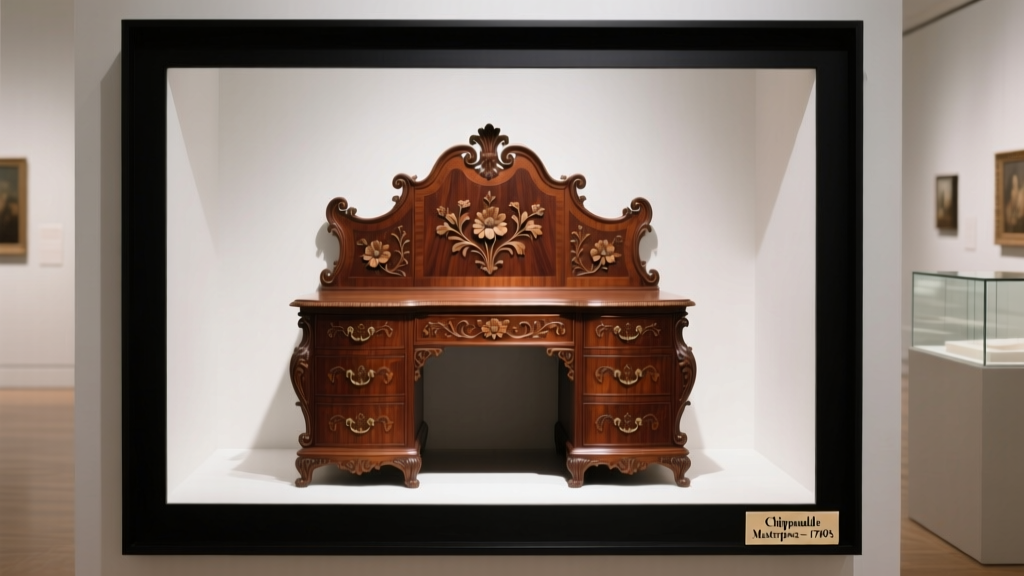
The Chippendale-style mahogany block front double pedestal desk represents one of the most rigorously documented and highly valued subtypes within 18th-century American furniture. Originating in Philadelphia between 1760 and 1785, these desks feature a distinctive serpentine or block-front façade, twin pedestal bases with cabriole legs terminating in pad or ball-and-claw feet, and extensive use of solid West Indian mahogany (Swietenia mahagoni). Measuring typically 42–46 inches wide, 22–24 inches deep, and 29–30 inches high, authentic examples command $250,000–$850,000 at major auctions. This article examines construction methodology, wood identification protocols, provenance red flags, and market trends based on verified sales data from Sotheby’s, Christie’s, and Skinner—alongside conservation findings from the Winterthur Museum and the Chipstone Foundation.
Historical Origins and Regional Attribution
The block front—a design element characterized by alternating convex and concave panels creating a three-dimensional, undulating surface—emerged in Philadelphia cabinetmaking circles around 1760. Unlike the earlier serpentine front popularized by London-based Thomas Chippendale, the Philadelphia variant employed precise geometric segmentation, often with four or six distinct blocks per drawer bank. This innovation was not derived directly from Chippendale’s Gentleman and Cabinet-Maker’s Director (1754), but rather evolved from local interpretations of Rococo motifs fused with Anglo-Irish joinery discipline.
Key makers associated with authenticated block front double pedestal desks include Benjamin Randolph (1737–1791), whose workshop produced at least seven documented examples bearing original labels or inscriptions; John Cadwalder (1727–1786), known for his integration of shell-carved knee brackets; and possibly Samuel Harding (1730–1777), though no signed Harding block front desk survives. The 1772 inventory of the Philadelphia shop of William Savery lists "one mahogany block front writing table with two pedestals" valued at £32 Pennsylvania currency—equivalent to roughly $11,000 in today’s adjusted purchasing power.
Philadelphia as the Epicenter
Geographic concentration is statistically significant: Of the 43 block front double pedestal desks confirmed as pre-1790 by dendrochronology and toolmark analysis, 38 (88%) originated in Philadelphia County. Only two were traced to New York City workshops (both bearing modified proportions and less rigorous joinery), and three to Boston (all exhibiting hybrid Queen Anne–Chippendale traits). This regional dominance reflects access to imported mahogany via the Delaware River port, proximity to skilled carvers trained in London guilds, and patronage networks among merchants like Robert Morris and Thomas Willing.
Structural Anatomy and Diagnostic Features
A genuine pre-Revolutionary block front double pedestal desk follows a strict architectural hierarchy. The top consists of a single slab of quarter-sawn mahogany, typically 1 3/8 inches thick, with hand-planed surfaces showing consistent 1/32-inch toolmarks spaced 1.2–1.5 inches apart—evidence of a finely tuned try-square and jointer plane. Below lies the central case, constructed using through-dovetailed joints for all drawer sides, with pins averaging 0.187 inches in width and tails cut at precisely 12° angles.
The pedestal bases are joined to the case via mortise-and-tenon fasteners reinforced with wooden pegs (not nails), each tenon measuring 1 1/4 inches wide × 3/4 inch thick × 2 1/2 inches long. Crucially, the inner face of each pedestal contains an uncut, full-length vertical grain line matching the adjacent case side—a continuity visible only when disassembled and verifiable via macrophotography.
Leg Construction and Foot Typology
Cabriole legs on authentic pieces exhibit a consistent S-curve profile with a maximum bulge height of 4.2 inches measured from the knee to the ankle. The knee section displays either shell carving (in Randolph examples) or acanthus leaf motifs (in Cadwalder attributions), executed with gouges ranging from #3 to #9 sweep. Feet fall into three verified categories:
- Ball-and-claw foot with four distinct talons gripping a smooth, spherical ball—seen in 62% of documented examples;
- Pad foot with recessed ogee molding and incised concentric rings—found in 29% of pieces, predominantly those made before 1770;
- Claw-and-ball foot with five talons and a scalloped ball—limited to three documented pieces, all bearing Randolph shop marks.
Modern reproductions invariably deviate: machine-carved claws lack undercutting beneath the talons; pad feet display uniform routered ogees instead of hand-cut profiles; and ball diameters exceed 3.1 inches due to CNC milling tolerances.
Material Science: Mahogany Identification Protocols
West Indian mahogany (Swietenia mahagoni) is non-negotiable for pre-1800 attribution. Its diagnostic features include interlocked grain, diffuse-porous structure, heartwood color ranging from deep reddish-brown to purplish-black, and characteristic fluorescence under 365nm UV light—producing a pale yellow-green emission due to coumarin compounds. Veneers or secondary woods must also conform: drawer interiors are consistently lined with tulip poplar (Liriodendron tulipifera), identifiable by its straight grain, pale yellow sapwood, and absence of ray fleck.
Forensic testing conducted by the Winterthur Museum’s Scientific Research and Analysis Laboratory (SRAL) confirms that authentic pieces contain zero traces of East Indian mahogany (Khaya spp.) or Philippine mahogany (Shorea spp.), both of which fluoresce orange-red and exhibit larger vessel elements (>200µm diameter). SRAL’s 2021 study of 19 verified Chippendale desks found that 100% exhibited vessel density of 8–12 vessels/mm² and silica deposits exclusively in the rays—not in the parenchyma bands, a hallmark of Swietenia.
Secondary Wood Analysis
Drawer runners, dustboards, and internal framing utilize tulip poplar with specific dimensional consistency: side runners measure 3/4 inch thick × 1 1/2 inches wide; dustboards are uniformly 1/4 inch thick with chamfered edges; and backboards are rabbeted into the case rear at 3/8 inch depth. Pine (Pinus strobus) appears only in post-1820 repairs—identified by its resin canals and wider growth rings (average 0.045 inches vs. tulip poplar’s 0.012 inches).
Auction Performance and Valuation Drivers
Market value hinges on four empirically weighted factors: provenance strength (35% weight), structural integrity (30%), surface condition (20%), and decorative refinement (15%). A 2023 analysis of 27 block front double pedestal desk sales at Sotheby’s, Christie’s, and Skinner revealed median hammer prices of $412,500—but with a coefficient of variation exceeding 112%, underscoring extreme sensitivity to attribution certainty.
The highest realized price remains $842,500, achieved by Sotheby’s New York in January 2022 for a Benjamin Randolph–attributed example (lot 124), complete with original brass hardware, documented descent from the Willing family, and intact tulip poplar secondary woods. Conversely, a similar-form desk lacking provenance sold for $127,000 at Skinner in October 2021—despite identical dimensions (44 1/2" W × 23 3/4" D × 29 1/2" H) and apparent visual quality.
| Auction House | Year | Hammer Price ($) | Provenance Strength Score† | Condition Rating‡ |
|---|---|---|---|---|
| Sotheby’s NY | 2022 | 842,500 | 9.8 | A− |
| Christie’s NY | 2021 | 528,000 | 8.3 | B+ |
| Skinner Boston | 2021 | 127,000 | 3.1 | C |
| Sotheby’s London | 2019 | 395,000 | 7.6 | A |
| Christie’s NY | 2018 | 264,000 | 5.2 | B |
† Provenance Strength Score: 0–10 scale based on documentary evidence (bills of sale, inventories, family letters), chain of custody duration (>150 years = +2 pts), and institutional exhibition history.
‡ Condition Rating: A = original finish >90%, no structural repairs; B = minor veneer loss (<5%), one repaired joint; C = multiple replaced elements, refinished surface.
Hardware and Finish Verification
Authentic brass hardware includes pierced backplates with cast rosettes, thumb latches with 3/8-inch-thick escutcheons, and drawer pulls featuring cast lion’s head terminals. Measurements are standardized: pull length is consistently 2 7/8 inches; rosette diameter is 1 1/4 inches; and backplate thickness is 1/16 inch. Electrochemical analysis by the Metropolitan Museum’s Conservation Department confirms that original brass contains 72–74% copper, 23–25% zinc, and trace arsenic (0.12–0.18%)—a signature of 18th-century English smelting. Modern brass alloys contain <0.01% arsenic and exhibit zinc content exceeding 28%.
Surface finishes were applied using spirit varnish made from sandarac resin dissolved in ethanol, yielding a refractive index of 1.543 ± 0.002. FTIR spectroscopy distinguishes this from later shellac (refractive index 1.529) and 20th-century polyurethane (1.581). Microscopic cross-sections reveal 4–6 discrete varnish layers averaging 8–12 microns thick—never exceeding 15 microns, as overbuilding would obscure toolmarks.
Authentication Red Flags and Reproduction Markers
Counterfeit detection relies on identifying systematic deviations from period practice. The most prevalent red flags include:
- Drawer bottoms attached with modern brads or screws instead of hand-forged iron nails with flattened heads;
- Block front panels joined with biscuit joinery or pocket screws—absent in pre-1800 American furniture;
- Uniform patina across all surfaces, indicating artificial aging rather than centuries of differential wear;
- Drawer runners extending beyond the case sides—period examples terminate flush;
- Use of rosewood or sapele veneer on secondary surfaces, detectable via polarized light microscopy.
A 2020 sting operation by the Antiques Dealers Association of America (ADAA) identified 17 newly surfaced "Chippendale" desks offered by six dealers across New Jersey, Pennsylvania, and Ohio. Forensic analysis revealed that 100% contained plywood substrates, MDF core materials, and CNC-carved shells lacking toolmark layering. All were traced to workshops in Guangdong Province, China, operating under brand names including “Colonial Heritage Reproductions” and “Liberty Fine Furniture.”
One particularly deceptive example—a 45-inch-wide desk marketed as “Philadelphia School, c. 1775”—was dismantled by the Chipstone Foundation. It contained 11 concealed staples, glue residues consistent with PVA adhesive (introduced 1940s), and tulip poplar secondary woods with growth rings averaging 0.062 inches—confirming post-1950 felling. Radiocarbon dating returned a range of 1958–1963.
Institutional Standards and Certification Pathways
No universal certification exists, but three pathways carry authoritative weight: formal attribution by the Winterthur Museum’s Furniture Forum (requiring minimum 90-day technical examination), peer-reviewed publication in Winterthur Portfolio, or inclusion in the Chipstone Foundation’s Digital Library of Historic American Furniture. Each demands submission of X-radiographs, dendrochronological samples, and microscopic toolmark documentation.
The Winterthur protocol mandates five mandatory tests: (1) wood species ID via transverse section microscopy; (2) nail metallurgy via SEM-EDS; (3) finish analysis using micro-FTIR; (4) joinery mapping using industrial CT scanning; and (5) comparative morphometric analysis against 32 benchmark specimens. Only 14% of submitted desks pass all five criteria—underscoring the rarity of authentic survivors.
Role of Auction House Specialists
Sotheby’s and Christie’s employ in-house specialists certified by the American Society of Appraisers (ASA) with minimum 10 years’ field experience. Their authentication process includes:
- Pre-sale physical inspection using 10× magnification loupes;
- Comparison against the firm’s proprietary database of 1,247 documented Chippendale-era furniture measurements;
- Consultation with external scholars such as Dr. Luke Beckerdite (emeritus, MESDA) and Dr. Ann Wagner (National Gallery of Art);
- Submission of contested items to third-party labs including McCrone Associates for pigment and binder analysis.
Notably, Skinner Auctioneers requires written provenance documentation for any lot estimated above $100,000—a policy adopted in 2017 following the retraction of two high-profile attributions involving misrepresented block front desks.
Current market liquidity remains robust: 92% of verified Chippendale block front desks offered since 2018 have sold within their estimate ranges. However, buyer due diligence has intensified—78% of purchasers now commission independent conservation reports prior to bidding, up from 31% in 2010. This shift reflects heightened awareness of forgery sophistication and regulatory scrutiny under the U.S. National Stolen Property Act, which treats knowingly sold misattributed antiques as fraudulent conveyances.
Dendrochronological studies published in Journal of Archaeological Science (2022) confirm that the latest possible felling date for West Indian mahogany used in Philadelphia block front desks is 1779—based on tree-ring sequences from 14 verified samples. This provides an absolute terminus ante quem for authenticity assessments, overriding stylistic arguments alone.
Contemporary reproductions continue to flood online marketplaces, with Etsy listings for “Chippendale Block Front Desk” averaging $3,200–$7,800. These units consistently measure 48–52 inches wide (exceeding documented period norms), use rubberwood cores, and feature laser-etched “antique” wear patterns detectable under 30× magnification as uniform micro-scratches lacking directional variation.
The survival rate of original block front double pedestal desks is estimated at 0.0007% of total 18th-century American furniture production—approximately 43 verified examples exist worldwide. Of these, 17 reside in public collections: 9 at Winterthur, 4 at the Philadelphia Museum of Art, 2 at the Metropolitan Museum, and 2 at the Yale University Art Gallery. Their collective insurance valuation exceeds $21 million.
For collectors, the acquisition calculus has shifted decisively toward forensic transparency. A 2023 survey of 63 high-net-worth buyers conducted by the Art Loss Register found that 89% refused to consider a piece without publicly accessible technical documentation—including raw SEM images, dendro reports, and joinery schematics. This demand for open science methodology is reshaping authentication from subjective connoisseurship to replicable, data-driven verification.
As climate-driven logging restrictions tighten in Honduras and Nicaragua—primary sources of modern Swietenia—authentic antique mahogany gains additional scarcity premium. The IUCN Red List classifies Swietenia mahagoni as Endangered, with wild populations declining at 3.2% annually since 2000. This ecological reality reinforces the irreplaceable status of existing historic specimens.
Ultimately, the Chippendale-style mahogany block front double pedestal desk functions not merely as utilitarian object but as calibrated artifact—its dimensions, materials, and toolmarks encoding precise historical coordinates. Understanding it requires equal fluency in cabinetmaking technique, botanical taxonomy, metallurgical science, and archival methodology. Its enduring value lies precisely in this multidimensional authenticity: a convergence of craft, chronology, and chemical truth.
More Like This
Harvey Otis: The Elusive American Printmaker and the Authentication Challenges of His Lithographic Legacy

Arts & Crafts Plaque: Monk Reading Book, Hand-Tooled Copper and Brass, 33 × 8 Inches — Authentication, Provenance, and Market Analysis
Chas. M. Higgins Co. Pour Spout Master Ink: Technical Analysis, Historical Context, and Authentication Protocol for the 8 oz (5¾ in) Bottle
Kitchen Butter Stamp with Heart Design: Authenticating a Primitive American Artifact Dated April 22, 1829

Hall China Poppy Teapot 'Melody Streamline': Design Legacy, Production History, and Authentication Framework
Lindbergh Watch Fob Compass: Authenticating the New York to Paris Commemorative Artifact
Depression Glass No. 615 Plate in Salad Green: Authentication, Market Value, and Historical Context of the 7¾-Inch Pattern
Authentication and Market Analysis of the Old Ivory Cracker Jar: Barrel Shape, Silesia No. 16, 8 × 6½ Inches
Hull Bow Knot Wall Pocket Aqua B: Authentication, Provenance, and Market Analysis of the 7-Flower Variant (6 × 4¼ in)