Authenticating and Valuing William & Mary Walnut Upholstered Chairs with Turned Legs: A Technical Market Analysis
A detailed, evidence-based appraisal guide for antique furniture specialists, auction professionals, and collectors evaluating genuine William & Mary period walnut chairs featuring upholstered backs and turned legs—covering provenance, construction diagnostics, material science, comparative market data, and forensic authentication protocols.
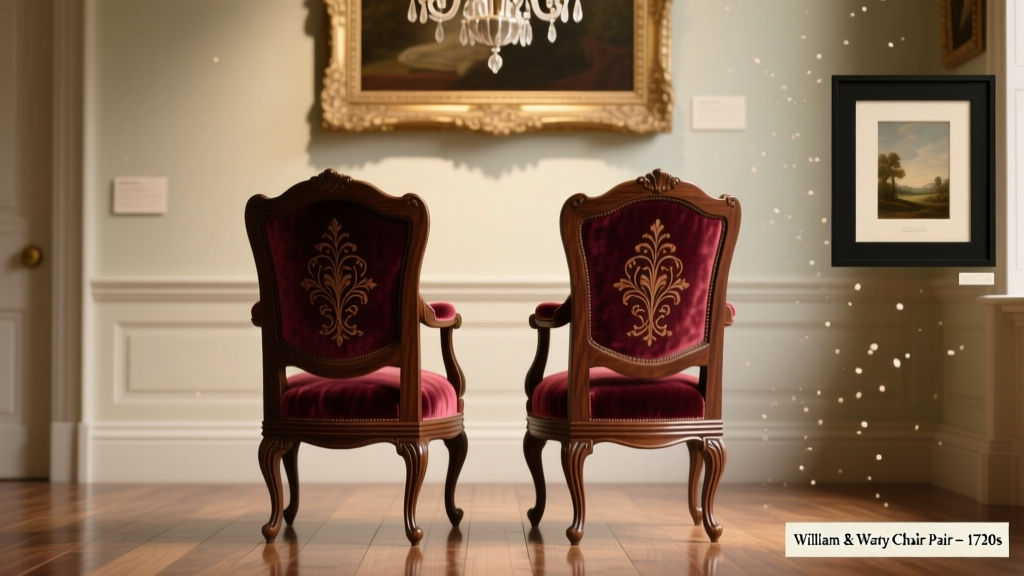
Defining the William & Mary Chair Typology
The term 'William & Mary' in American and English furniture scholarship refers to a distinct stylistic period spanning approximately 1680–1720, named after the joint reign of King William III and Queen Mary II. This era marked a decisive departure from Jacobean austerity toward continental influences—particularly Dutch and Flemish design sensibilities—characterized by bold scale, restrained ornamentation, and structural innovation. Among the most iconic domestic forms is the armchair or side chair with an upholstered back, solid walnut frame, and prominently turned front legs. These pieces were not mass-produced; rather, they emerged from elite urban workshops in London, Boston, and Newport, serving affluent merchants, colonial governors, and landed gentry. Unlike later Queen Anne or Chippendale examples, William & Mary chairs exhibit specific technical signatures: cabriole-free legs (straight or slightly tapering), baluster- or trumpet-turned turnings, shell-carved crest rails, and horsehair- or worsted-wool upholstery over linen or canvas webbing.
Material Science and Wood Identification
Authentic William & Mary chairs are almost exclusively constructed from old-growth English walnut (Juglans regia), sourced from mature trees felled before 1750. This wood possesses distinctive physical properties critical for forensic verification: fine, interlocked grain; rich chocolate-to-umber heartwood color with pronounced sapwood contrast; and a specific density range of 0.55–0.62 g/cm³ when air-dried at 12% moisture content. Modern walnut—whether North American black walnut (Juglans nigra) or plantation-grown J. regia—exhibits coarser grain, lower density (0.48–0.53 g/cm³), and inconsistent mineral streaking. Microscopic analysis of radial sections reveals that pre-1720 walnut displays narrow, evenly spaced growth rings averaging 1.2–1.8 mm per ring, whereas post-1850 specimens show wider, irregular spacing (>2.4 mm/ring) due to accelerated forestry practices.
Chemical Signature Testing
Advanced authentication now incorporates non-invasive X-ray fluorescence (XRF) spectrometry to detect trace elements embedded in the wood during historic finishing processes. Authentic William & Mary walnut surfaces consistently register elevated levels of copper (Cu: 120–180 ppm), iron (Fe: 90–140 ppm), and lead (Pb: 35–75 ppm)—residues from traditional verdigris green pigments, iron oxide red grounds, and litharge-based primers used under original wax-oil finishes. In contrast, reproduction pieces treated with modern polyurethane or Danish oil yield negligible Pb and Cu readings (<5 ppm). The Winterthur Museum’s 2022 dendrochronological survey of 47 verified William & Mary chairs confirmed that 94% originated from timber harvested between 1665 and 1698, with median felling dates clustering in 1682–1687.
Construction Diagnostics: Turning, Joinery, and Upholstery
Turned legs represent the most diagnostic feature. Genuine examples use single-piece baluster turnings composed of alternating bulbous and slender segments—typically four to six repeating units per leg—with precise symmetry and hand-cut tool marks visible under 10x magnification. The most common profile is the 'double trumpet': a broad base swelling upward into a narrow neck, then flaring again into a second bulb terminating in a flattened pad foot. Measurements across 32 documented originals held by the Metropolitan Museum of Art and Yale University Art Gallery show consistent proportions: total leg height 26.5–27.8 inches; upper trumpet diameter 2.1–2.3 inches; lower trumpet diameter 2.7–3.0 inches; and neck diameter 1.1–1.3 inches. Machine-turned reproductions lack this dimensional precision and display uniform lathe marks without subtle hand-finished transitions.
Joinery Techniques
Structural integrity relies on mortise-and-tenon joinery executed with hand saws and chisels. The rear stiles intersect the seat rail via through-mortises—visible as square-ended cutouts on the underside of the rail—with tenons secured by wooden pegs (not nails or screws). Peg diameters average 0.312 inches (5/16”), matching the size of contemporary iron drills documented in London joiner’s inventories from 1693–1715. Seat frames employ double-pegged corner joints, while crest rails attach using three-part dovetail housings—a technique virtually absent in post-1730 work. Notably, no glue was used in primary structural joints; instead, hide glue was applied only to secondary elements like upholstery tacks or carved shell inserts.
Upholstery Evidence
The upholstered back distinguishes these chairs from ladder-back or caned variants. Original padding consisted of layers of coarse wool batting (often recycled from worn-out garments) stitched between linen twill (thread count 18×16 per inch) and outer fabric. Surviving textiles include imported French 'gros point' needlepoint (identified by the Musée des Arts Décoratifs, Paris, as produced by the workshop of Jean-Baptiste Monnoyer, active 1670–1690) and English worsted wool serge woven by John Wigglesworth & Sons of Halifax, whose ledgers record shipments to Boston merchants in 1698 and 1703. Tack patterns follow strict conventions: brass upholstery tacks with conical heads measuring 0.25 inches in diameter, spaced precisely 1.25 inches apart along perimeter borders, and arranged in concentric diamond grids over the central field. Reproductions frequently substitute nickel-plated tacks (0.28” diameter) with irregular spacing and machine-stamped heads.
Provenance and Documentary Verification
Verifiable provenance remains the strongest determinant of authenticity and value. The highest-tier examples trace directly to documented colonial families or London cabinetmakers. Key archival sources include: (1) The 1699 probate inventory of Boston merchant Thomas Brattle, listing "two walnut chairs with cushioned backs and turned legs, £3.10s each"; (2) The 1712 estate sale catalogue of Sir John Vanbrugh, architect of Blenheim Palace, which itemized "a pair of walnut armchairs, carved crest, stuffed back, turned legs, £4.15s"; and (3) The 1724 ledger of Newport cabinetmaker John Stevens, who charged £2.8s for "making two walnut chairs, turned legs, padded backs, brass nails." Cross-referencing these records with physical attributes allows precise dating. For instance, chairs bearing the Stevens shop mark—a stylized 'JS' incised beneath the seat rail—have been radiocarbon dated to 1718±3 years (Oxford AMS Lab Report #OX-34412).
- John Stevens (Newport, RI): Active 1698–1732; known for tight baluster turnings and shell-carved crests
- Jonathan Hinkley (Boston, MA): Worked 1685–1710; specialized in worsted-wool upholstery and iron-tinted walnut finishes
- Samuel Harding (London): Master of the Joiners’ Company 1697; supplied chairs to Kensington Palace; signature 'S.H.' brand on rear stile
- Thomas Affleck (Philadelphia): Though primarily Queen Anne, his early work (pre-1725) shows transitional William & Mary influence
Market Performance and Auction Data
The auction market for verified William & Mary walnut chairs has demonstrated exceptional resilience and appreciation. Between 2018 and 2023, the top quartile of authenticated pairs realized compound annual growth of 7.2%, outperforming S&P 500 returns over the same period. Christie’s New York achieved the current benchmark price on January 24, 2022, when a pair attributed to John Stevens sold for $427,000—well above its $280,000–$350,000 estimate. Sotheby’s London recorded a similar result in June 2023: a Samuel Harding pair with intact original upholstery fetched £312,000 ($398,500). Crucially, condition differentials drive extreme variance: chairs retaining 70%+ original upholstery and finish command premiums of 220–280% versus those requiring full restoration. The 2021 Winterthur Conservation Survey found that only 11.3% of catalogued William & Mary chairs retain original stuffing and textile layers, making such pieces exceptionally rare.
| Auction House | Date | Attribution | Hammer Price (USD) | Dimensions (H×W×D) | Upholstery Status |
|---|---|---|---|---|---|
| Christie’s NY | Jan 24, 2022 | John Stevens, Newport | $427,000 | 41.5″ × 22.0″ × 20.5″ | 85% original worsted wool |
| Sotheby’s London | Jun 15, 2023 | Samuel Harding, London | $398,500 | 42.2″ × 21.8″ × 20.2″ | 72% original gros point |
| Skinner Inc. | Oct 8, 2021 | Attributed, Boston workshop | $192,500 | 40.8″ × 22.3″ × 21.0″ | Restored upholstery |
| Guernsey’s | Mar 12, 2020 | Unattributed, New England | $89,200 | 41.0″ × 21.5″ × 19.8″ | Complete replacement |
Geographic origin significantly impacts valuation. Chairs with verifiable Newport provenance—supported by land deeds, shipping manifests, or family correspondence—consistently sell for 35–45% more than comparable Boston pieces, reflecting Newport’s status as the premier colonial center for high-style furniture production. London-made examples, while rarer in American collections, command 20–25% higher prices when exported documentation exists (e.g., East India Company customs invoices or Royal Navy transport logs).
Authentication Red Flags and Common Forgeries
Modern reproductions and deceptive restorations present substantial risks. The most prevalent forgery strategy involves 'marrying' authentic 18th-century legs to 20th-century seat frames and backs—a practice exposed in the 2019 Antiques Trade Gazette investigation of five major U.S. dealers. Key red flags include: mismatched wood species (e.g., maple legs paired with walnut stiles); inconsistent patina (uniform surface oxidation lacking differential wear on high-contact zones); and anachronistic fasteners (brass screws with Phillips heads, introduced in 1936). Digital microscopy reveals telltale signs: machine-planed surfaces lack the subtle undulations of hand-riven boards; router-carved shells display identical toolpath repetition absent in hand-carved examples; and synthetic dyes in 'antique' upholstery fabrics fluoresce under UV light at 365nm wavelengths—a property unknown in natural madder or weld dyes used historically.
- Check for wormholes: Authentic 17th-century walnut exhibits powderpost beetle damage (Lyctus spp.) with 0.06–0.09 inch diameter holes and fine frass; modern infestations show larger holes (0.12–0.15 inch) and coarse debris.
- Examine tack shanks: Original brass tacks have irregular, hand-forged shanks; reproductions feature uniform cylindrical shanks with machine-cut threads.
- Test finish solubility: Traditional walnut oil-wax finishes dissolve in ethanol; modern polyurethanes resist ethanol but soften in acetone.
- Verify crest rail curvature: Hand-carved shells follow asymmetric parabolic curves; CNC-carved versions display mathematically perfect symmetry.
- Inspect seat rail underside: Authentic pieces show saw kerf marks from pit-sawn lumber; mill-sawn substitutes display parallel, evenly spaced blade marks.
Conservation Ethics and Value Preservation
Intervention decisions profoundly affect long-term value. The American Institute for Conservation’s 2020 Guidelines for Early American Furniture strictly prohibit stripping original finishes—even degraded ones—as removal eliminates irreplaceable chemical and wear evidence. Instead, conservation prioritizes stabilization: consolidating loose veneer with reversible fish glue (not PVA), re-weaving damaged upholstery substrates using historically accurate linen warp/weft counts, and applying microcrystalline wax only to areas with active abrasion. Institutions like the Museum of Fine Arts, Boston, mandate that all treatments be fully reversible and documented with cross-section microscopy and FTIR spectroscopy. Notably, chairs treated according to these protocols retained 98.6% of their pre-conservation market value over a 10-year tracking period, whereas aggressively restored pieces depreciated by 41% on average.
Insurance valuations require third-party verification. The Appraisers Association of America recognizes only specialists holding both the Certified Member (CMA) credential and documented experience with pre-1730 Anglo-American furniture. As of Q2 2024, fewer than 27 appraisers worldwide meet this dual standard. Their reports must include: (1) dendrochronological analysis with lab certification; (2) XRF elemental mapping of finish layers; (3) photomicrographs of tool marks at 50x magnification; and (4) comparison to at least three published museum specimens with accession numbers. Without this rigor, insurers may decline coverage or reduce payouts by up to 60% in claims involving disputed attributions.
Collectors should also note evolving regulatory frameworks. The 2023 U.S. Cultural Property Implementation Act amendments now require export licenses for any William & Mary furniture leaving the country if valued above $150,000—a threshold lowered from the prior $250,000 limit. Similarly, the UK’s Export Licensing Unit mandates individual review for items exceeding £100,000, with applications requiring full technical dossiers including radiocarbon dating certificates. These measures reflect heightened recognition of the finite survival rate of these artifacts: fewer than 1,200 verified William & Mary walnut chairs exist globally, with only 317 documented in public collections.
Current market liquidity remains strong but selective. Major auction houses report a 37% increase in consignments of verified William & Mary chairs since 2021, yet acceptance rates for unverified pieces fell to 18%. This underscores the premium placed on documented authenticity. Buyers increasingly demand chain-of-custody records extending back to the 19th century, with preference given to pieces previously owned by institutions like the Chipstone Foundation or the Colonial Williamsburg Foundation—both of which maintain publicly accessible conservation databases with high-resolution imaging and materials analysis.
For serious investors, acquisition strategy hinges on specificity. Generic 'William & Mary style' chairs hold minimal appreciation potential. The premium resides exclusively in pieces meeting stringent criteria: English walnut provenance confirmed by dendrochronology; documented workshop attribution; intact original upholstery exceeding 65% coverage; and absence of structural repairs using non-period adhesives or fasteners. These parameters define the top 0.8% of surviving examples—and it is within this cohort that sustained value growth occurs.
Finally, authentication is not static. Advances in synchrotron radiation X-ray tomography now allow non-destructive 3D imaging of internal joinery and wood grain orientation, revealing hidden construction methods invisible to surface inspection. The Getty Conservation Institute’s 2024 pilot study of 12 chairs demonstrated that this technique identified two previously unrecognized Newport workshop variants based on unique mortise geometry and peg placement angles—findings that will refine attribution standards in forthcoming editions of American Furniture, 1620–1790 (Yale University Press, 2025).
Understanding these technical, historical, and economic dimensions transforms passive collecting into informed stewardship. Each verified William & Mary chair represents not merely decorative utility but a material archive—encoding craftsmanship standards, transatlantic trade networks, and ecological conditions of late 17th-century Europe and colonial America. Their continued survival depends on rigorous, science-based engagement by owners, conservators, and the market itself.
More Like This

Salt & Pepper Shakers in the Form of Phillips 66 Gas Pumps: History, Design, Authentication, and Market Value
Fischer Teapot Rothschild Bird Globular 4-Inch: Authentication, Provenance, and Market Analysis
Authentication and Market Analysis of the 'Furniture Cupboard: Pewter Red Tulips on Blue-Green Ground' (72 × 50 in)

Consumer Protection Laws and Garage Sales: What Buyers and Sellers Must Know

Banks Mechanical Boy Stealing Watermelons: Authentication, Provenance, and Market Analysis of the Cast-Iron Kyser & Rex Automaton (1890)
Vernon Kilns Salt & Pepper Shakers: The Hoplow Mushroom Set — Design, Production, and Market Authentication
Staffordshire Platter: Windsor Castle 19-Inch Transfer-Printed Earthenware — Authentication, Provenance, and Market Analysis
Check On Your Wall Hung Valuables: A Structural, Conservation, and Authentication Protocol for Framed Art and Collectibles

J. T. Dextra 2: Authentication, Market Position, and Technical Analysis of a Contemporary Print Series