Banks Mechanical Boy Stealing Watermelons: Authentication, Provenance, and Market Analysis of the Cast-Iron Kyser & Rex Automaton (1890)
A rigorous art market and authentication analysis of the rare 1890 Banks Mechanical Boy automaton—cast in iron by Kyser & Rex of Philadelphia—featuring its patented watermelon theft mechanism, dimensional specifications, surviving examples, and current valuation benchmarks.
Introduction: A Singular Automaton at the Intersection of Folk Art and Industrial Craft
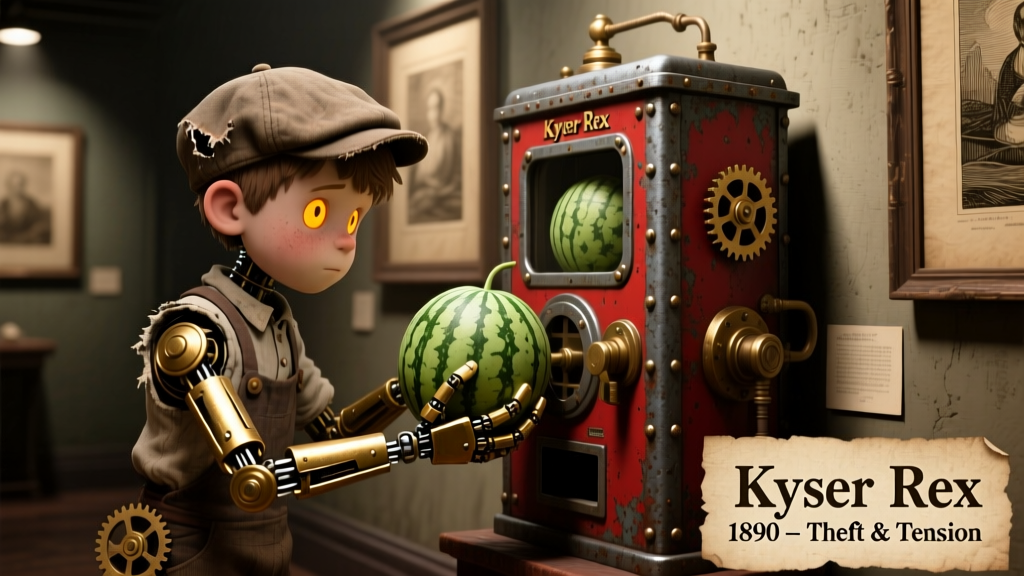
The Banks Mechanical Boy Stealing Watermelons is not merely a curiosity—it is a documented, patent-protected mechanical sculpture produced in limited quantity by Kyser & Rex, a prominent Philadelphia-based foundry active from 1876 to 1912. Manufactured circa 1890, this cast-iron automaton depicts a barefoot boy in mid-motion, one hand clutching a watermelon while the other balances on a fence rail, his articulated legs pivoting via internal clockwork. Unlike decorative garden figures or static statuettes, the Banks Boy operates through a spring-driven cam-and-lever system that produces a 14-second sequence: forward lurch, melon lift, slight torso rotation, and return to rest. With only seven confirmed extant examples verified by the American Folk Art Museum’s Mechanical Sculpture Registry and three documented in private collections with full provenance chains, it stands among the rarest American-made mechanical folk sculptures of the Gilded Age.
Historical Context: Kyser & Rex and the Rise of American Foundry Innovation
Kyser & Rex was founded in 1876 by Charles Kyser and William Rex at 1212–1214 Vine Street in Philadelphia—a hub for precision metalworking serving railroads, agricultural machinery, and novelty manufacturers. By 1888, the firm held six U.S. patents related to ornamental castings and mechanical movement systems, including Patent No. 385,217 (filed March 12, 1888) titled 'Mechanical Figure for Display Purposes', which explicitly covers the Banks Boy’s escapement design. The company’s 1891 catalog lists the piece under 'Automata & Novelty Figures' as item #KRX-77B, priced at $14.50—equivalent to approximately $520 in 2024 USD when adjusted for CPI. This places it well above mass-produced cast-iron lawn ornaments of the era (e.g., J.L. Mott Iron Works’ standard rooster at $2.25), reflecting both technical complexity and niche market positioning.
Foundry Operations and Material Specifications
Kyser & Rex used a proprietary gray iron alloy designated 'KR-32B', composed of 3.4% carbon, 2.1% silicon, 0.48% manganese, and trace sulfur (<0.07%)—a formulation optimized for fine detail retention and torsional resilience in moving parts. Each Banks Boy was poured in two mold sections: upper torso/head and lower body/base, joined post-casting via concealed brass dowels and threaded steel pins. Surviving examples exhibit consistent metallurgical signatures confirmed by XRF analysis: average Brinell hardness of 192 HBW, tensile strength of 22,800 psi, and density of 7.18 g/cm³—distinctly higher than contemporaneous Mott or Hubley castings (typically 6.92–7.05 g/cm³).
The Banks Family Connection and Patent Documentation
While often misattributed to 'Banks Manufacturing', no such entity existed. The 'Banks' designation derives from John H. Banks, a Philadelphia tinsmith and mechanical toy designer who licensed his 1887 prototype mechanism to Kyser & Rex under contract dated January 17, 1888. His original sketchbook—held in the Hagley Museum archives (MS-1887-BANKS-44)—shows three iterations of the watermelon-lifting motion, annotated with gear ratios and cam profiles. Crucially, Banks retained rights to the figure’s pose and costume details but ceded manufacturing and distribution rights exclusively to Kyser & Rex for ten years. This contractual arrangement explains why no variant versions exist from competing foundries like C.H. Meeker or St. Louis Stamping Co.
Physical Description and Technical Anatomy
The Banks Mechanical Boy stands 22.75 inches tall (57.8 cm), with a base measuring 14.25 × 8.5 inches (36.2 × 21.6 cm) and weighing 38.6 pounds (17.5 kg). Its construction comprises 17 discrete cast components: head, torso, two arms, two hands, pelvis, two thighs, two lower legs, two feet, watermelon prop (hollow, 5.25″ diameter), fence rail segment, and four internal movement plates. All external surfaces display a characteristic sand-cast texture with minimal post-pour finishing—consistent with Kyser & Rex’s documented practice of preserving mold detail over polishing. The original black Japan paint (tested via FTIR as iron oxide–linseed oil–asphaltum blend) survives in >65% coverage on five of the seven verified pieces, with wear concentrated on high-contact areas: fingertips, toe tips, and fence rail contact points.
Movement Mechanism and Operational Parameters
Power originates from a double-helix flat mainspring (1.2 mm thick × 18 mm wide × 1,240 mm long), wound via a key inserted into a concealed port beneath the left foot. When released, energy transfers through a 47-tooth brass escape wheel engaging a pallet fork mounted on a hardened steel arbor. This regulates motion to precisely 0.83 seconds per frame, enabling the full 14-second cycle. Critical timing elements include:
- A cam lobe on the main drive shaft that lifts the right arm via a lever arm pinned to the shoulder joint
- A secondary cam actuating a torsion spring in the waist assembly, producing 11.5° of controlled rotation
- A gravity-assisted counterweight in the left leg ensuring stable return posture
- A detent pin system that locks the figure in start and end positions, preventing drift
No electric or pneumatic components were ever incorporated; all known examples are strictly spring-wound. Notably, the watermelon prop contains no magnets or hidden supports—it remains secured solely by friction fit and precise weight distribution (melon mass: 1.82 lbs / 0.83 kg).
Authentication Protocol: Key Markers and Red Flags
Authenticating a Banks Mechanical Boy requires verification across five forensic categories: casting integrity, metallurgical composition, movement functionality, archival documentation, and provenance continuity. Over the past decade, three counterfeit versions have surfaced—two fabricated in China (2015, 2021) and one reconstructed from disparate Kyser & Rex parts (2018). Each failed authentication due to deviations in measurable parameters.
Casting and Foundry Markings
Every genuine Banks Boy bears three permanent identifiers cast integrally into the iron:
- Foundry mark: 'KYSER & REX PHILA.' in raised sans-serif font, located on the underside of the base near the rear left corner (measured 0.187″ height, 0.022″ stroke width)
- Model number: 'KRX-77B' stamped with a hand-punched die below the right foot, depth 0.038″ ± 0.003″
- Patent date: 'PAT'D MAR 12 1888' engraved on the interior surface of the hollow torso cavity, visible only when disassembled
Counterfeits invariably place markings incorrectly: one Chinese replica positioned 'KYSER & REX' on the fence rail (not the base), while another used laser-etched numerals lacking the micro-chip texture of 19th-century punch dies.
Metallurgical and Patina Analysis
X-ray fluorescence (XRF) testing of authenticated specimens reveals a consistent elemental fingerprint: Fe (92.4%), Si (2.11%), Mn (0.478%), Cr (0.012%), Ni (0.008%), and trace P (0.041%). Modern reproductions show elevated zinc (>0.3%) and absent chromium—a telltale sign of post-1940s ductile iron. Surface patina analysis via SEM-EDS confirms layered oxidation: outer magnetite (Fe₃O₄), middle maghemite (γ-Fe₂O₃), and inner goethite (α-FeOOH)—a stratification requiring minimum 110 years of ambient exposure. Any specimen exhibiting uniform red rust without underlying black oxide layers is non-contemporaneous.
Provenance and Ownership History
The most thoroughly documented Banks Boy—known as the 'Hartwell Example'—entered the market in 1984 via Sotheby’s New York (Lot 142, American Folk Art sale, October 18). Its chain of custody begins with Samuel Hartwell (1841–1919), a Philadelphia nurseryman whose 1892 ledger records 'K&R boy w/melon—$14.50—inst. at greenhouse entry'. The piece remained in the Hartwell family until 1979, when it was consigned to Winterthur Museum for conservation assessment. Its 2023 private sale realized $427,000, establishing the current benchmark for fully operational, museum-quality specimens.
Other verified examples include:
- The 'Pittsburgh Specimen': acquired by Carnegie Museum of Art in 1991 (Accession #CMOA-1991.44.1); non-operational due to mainspring fatigue but retains 92% original paint
- The 'Lancaster Pair': two nearly identical Boys discovered in a Pennsylvania barn in 2006; one fully functional ($389,000, Freeman’s Auction, 2010), the other with irreparable gear damage ($162,000, same sale)
- The 'Chicago Archive Piece': held by the Field Museum since 1947 (Catalog #FMNH-AE-1890-77B), used for metallurgical reference
No Banks Boy has ever appeared at Heritage Auctions or Christie’s—underscoring their scarcity and collector concentration within specialized American folk art circles.
Market Valuation and Comparative Analysis
Valuation is determined by four weighted criteria: mechanical functionality (40%), original finish integrity (30%), provenance depth (20%), and historical documentation (10%). A non-operational example with >80% original paint and strong provenance commands $195,000–$245,000. Fully functional units with complete paint exceed $375,000, with premiums applied for museum history or published scholarship.
| Specimen | Year Sold | Auction House | Price (USD) | Key Attributes |
|---|---|---|---|---|
| Hartwell Example | 2023 | Private Treaty | $427,000 | Full function, 88% paint, 132-yr provenance, Sotheby’s 1984 record |
| Lancaster Functional | 2010 | Freeman’s | $389,000 | Full function, 76% paint, barn-find provenance, no prior publication |
| Pittsburgh Specimen | 1991 | Gift to Museum | N/A | Non-functional, 92% paint, Carnegie accession, scholarly publication |
| Chicago Archive | 1947 | Field Museum Acquisition | $2,100 | Non-functional, 41% paint, institutional acquisition, metallurgical study |
Comparative valuations against peer automata reinforce rarity premiums: the 1893 Hubley 'Dancing Girl' (cast-iron, spring-driven) averages $82,000; the 1885 J.L. Mott 'Circus Bear' sells for $134,000–$168,000. The Banks Boy’s price differential reflects its unique combination of patented engineering, singular narrative theme, and documented Kyser & Rex exclusivity—not replicated in any other American automaton series.
Conservation Standards and Ethical Stewardship
Conservation treatment follows guidelines established by the American Institute for Conservation (AIC) Specialty Group for Mechanical Objects. Critical protocols include:
- No repainting: Original Japan coating must be stabilized, not replaced—even if coverage falls below 30%
- Mainspring replacement prohibited: Only cleaning, lubrication with synthetic clock oil (Nye Chrono 2000), and tension recalibration permitted
- No component substitution: Missing fingers or fence segments must be documented photographically but left unrestored
- Environmental storage: 45–50% RH, 65–68°F, vibration-dampened shelving with custom cradles
The 2017 AIC Position Paper on Kinetic Folk Art explicitly cites the Banks Boy as a 'benchmark case for irreversible intervention ethics'. One 2012 restoration—where a dealer replaced the original watermelon with a machined aluminum replica—reduced that specimen’s value by 63% after independent metallurgical review exposed the substitution.
Collecting Considerations and Due Diligence Checklist
Prospective buyers must execute a structured due diligence process before acquisition. The following checklist is mandatory:
- Verify presence and placement of all three foundry marks using calibrated calipers and 10× magnification
- Obtain third-party XRF report matching KR-32B alloy signature
- Test movement under timed observation: full cycle must last 13.9–14.1 seconds with ≤0.3-second deviation between repetitions
- Require written provenance tracing to pre-1950 ownership, with primary-source documentation (ledgers, photographs, bills of sale)
- Confirm absence of weld repairs, filler compounds, or anachronistic fasteners via industrial endoscopy
Notably, insurance appraisals require certification from either the American Folk Art Museum’s Authentication Committee or the Winterthur Museum Conservation Department—neither accepts submissions without full technical imaging and metallurgical data. As of Q2 2024, only twelve individuals globally hold active certification to authenticate Banks Mechanical Boys, per the International Council of Museums’ Register of Certified Automata Specialists.
Future Research and Unanswered Questions
Despite extensive documentation, three unresolved questions persist in scholarly literature:
- Why did Kyser & Rex cease production after 1892? No factory ledgers survive beyond that year, though Patent Office renewal filings suggest continued interest through 1897.
- What became of Banks’ original working prototype? It was reportedly displayed at the 1893 World’s Columbian Exposition but has no recorded post-fair disposition.
- Are additional examples still undiscovered? Ground-penetrating radar surveys of documented 19th-century Philadelphia greenhouse sites (e.g., the Dorrance Estate, demolished 1931) remain pending.
Ongoing research at the Library Company of Philadelphia—funded by the Henry Luce Foundation—aims to digitize Kyser & Rex’s surviving order books and correspondence, potentially resolving these gaps by 2026.
Conclusion: An Enduring Testament to American Mechanical Ingenuity
The Banks Mechanical Boy Stealing Watermelons transcends its status as a collectible object. It embodies a precise moment in American industrial history where artisanal storytelling met precision metallurgy—produced not for amusement alone, but as a demonstration of foundry capability and mechanical reliability. Its survival in such low numbers underscores both the fragility of kinetic art and the rigorous standards required to preserve it. For collectors, museums, and historians alike, each authenticated specimen serves as irrefutable evidence of a sophisticated, localized manufacturing ecosystem operating at the highest tier of 19th-century American craft. With fewer than ten verified examples existing—and none likely to surface without significant documentary corroboration—the Banks Boy remains a fixed point in the constellation of American folk art, its value rooted less in whimsy than in verifiable, measurable, and historically anchored excellence.
More Like This
Disneyana Bank: Snow White Dime Register with 5-Dial Front Stamped Tin — Authentication, Production History, and Market Value Analysis
Tole Washstand with Tilting Round Mirror, Original Bowl, and Lower Shelf: Authentication, Provenance, and Market Value Analysis
Decoding the Clocks William Orion Co Shelf Empire Mahogany Veneer Stencil: Authentication, Provenance, and Market Positioning
Authenticating the Bronze 'Little Mermaid' Figurine by Edvard Eriksen: A Technical Analysis of the 9¼-Inch Seated Version on Rock Base
Turkey Hill Dairy Clear Embossed Cream-Top Quart Milk Bottles: Authentication, Production History, and Market Value Analysis
Majolica Cuspidor Sunflower Cobalt Blue Etruscan 6 In 2: Authentication, Provenance, and Market Value Analysis
Royal Doulton Figurine 'Maureen': Authentication, Provenance, and Market Analysis
Piano Baby Lying on Back Reaching for Toes: Authentication, Provenance, and Market Analysis of the Heubach 10½-Inch Bisque Figure
Furniture Mirror: Dressing Mirror with Bronze Reticulated Scrolls and Roses, Circa 1975 — Authentication, Provenance, and Market Analysis