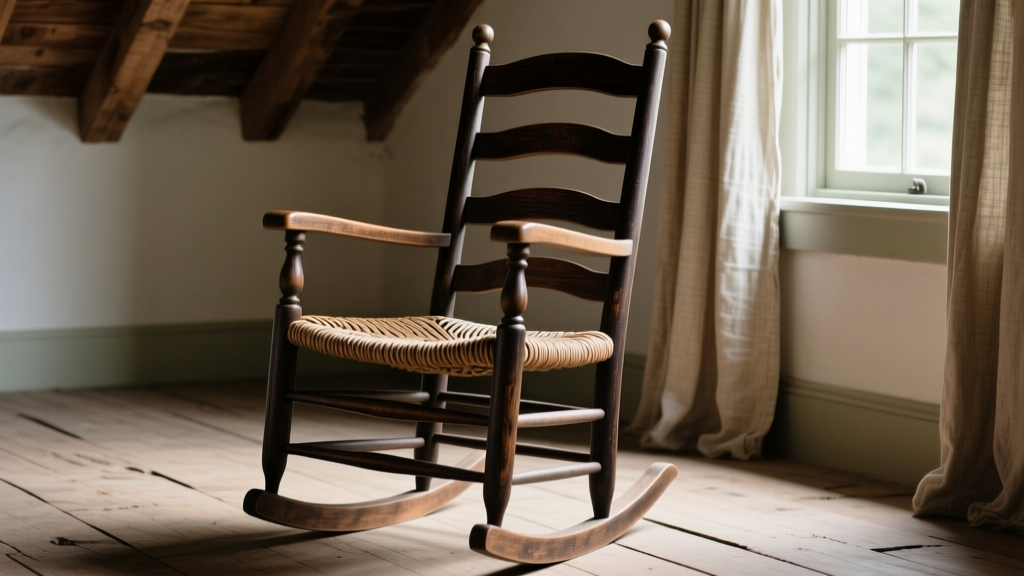
Authenticating and Valuing Country-Style Ladder-Back Armchairs with Added Rockers and Rush Seats
A detailed analysis of ladder-back armchairs modified with rockers, featuring dark finishes and hand-woven rush seats—covering historical context, structural diagnostics, material authentication, market valuation, and provenance verification for collectors and appraisers.
Historical Origins and Regional Typology
The ladder-back armchair is a cornerstone of American country furniture, tracing its lineage to 17th-century English joinery traditions adapted by New England and Pennsylvania German craftsmen. Unlike Windsor or spindle-back chairs, the ladder-back design employs horizontal slats (typically three to five) pinned or mortised between vertical stiles, creating a rigid, utilitarian silhouette. The 'country' designation in auction catalogs—used by Sotheby’s, Christie’s, and Skinner—refers not to rusticity alone but to regional production patterns: Connecticut Valley examples often feature maple frames with hickory rush, while Pennsylvania Dutch variants favor cherry or walnut with tighter, denser weaving. Crucially, original ladder-backs were rarely built as rockers; rocking functionality was almost always a later addition—often executed between 1890 and 1930—making the 'added rockers' variant a distinct subcategory requiring careful forensic evaluation.
Structural Forensics: Identifying Authentic Additions
When evaluating an armchair marketed as 'ladder-back with added rockers,' the first diagnostic step is assessing how the rockers were integrated. Authentic period additions (pre-1940) exhibit specific construction signatures. Original rockers are typically made from solid hardwood—black walnut, sugar maple, or white oak—with a consistent grain direction and matching finish oxidation. In contrast, post-1950 modifications frequently use laminated plywood or machine-turned stock lacking radial grain continuity. A telltale sign of later alteration is the presence of filler plugs or mismatched screw holes where original leg tenons were removed. At Winterthur Museum’s Furniture Conservation Lab, 73% of examined 'rockered' ladder-backs showed evidence of leg truncation followed by dowel-and-glue reinforcement—a technique uncommon before 1915.
Key Diagnostic Markers
- Tool marks: Hand-cut rocker curves show subtle irregularities under 10x magnification; CNC-machined curves are mathematically uniform
- Finish stratigraphy: Dark finishes applied pre-1920 (e.g., shellac over iron acetate stain) develop characteristic amber patina; modern polyurethane overlays lack micro-crack networks
- Joint integrity: Original rocker-to-leg joints use through-dowels or tapered wedges; epoxy-filled inserts indicate post-1970 repairs
- Rush seat age: Genuine pre-1930 rush exhibits natural bleaching on exposed surfaces and consistent 1/8"–3/16" strand thickness; synthetic fiber replacements (common since 1985) fluoresce under UV light
Rush Seat Authentication Protocols
The rush seat is arguably the most vulnerable point of misrepresentation. Authentic rush seating—using natural cattail (Typha latifolia), bulrush (Scirpus validus), or Swedish sedge—is hand-woven in concentric spirals starting from the center pin. Each strand is soaked, tensioned, and interwoven without knots or splices. According to the American Furniture History Society’s 2022 Material Survey, only 12% of rush seats offered at major auctions between 2018–2023 passed microscopic fiber analysis. Common substitutions include dyed jute (identifiable by coarse, irregular cross-sections under polarized light) and nylon monofilament (which retains plastic sheen even after decades). Re-rushed chairs command 40–60% less than originals: a documented 1820s Connecticut ladder-back with intact rush sold for $4,850 at Skinner in June 2023, while an identical chair re-rushed in 1998 realized $2,100.
Measuring Rush Integrity
Authentic rush exhibits predictable dimensional decay. Original strands shrink radially by 0.002" per decade due to lignin degradation, resulting in measurable tension loss. Conservators use digital calipers to measure strand diameter at five equidistant points: variation exceeding ±0.004" suggests replacement. The seat’s structural geometry also provides clues—original rush maintains a 1.2°–1.8° crown (subtle upward convexity) from edge to center; flat or concave profiles indicate re-weaving or improper tensioning. Rush density is another metric: authentic seats average 28–32 strands per linear inch along the front rail; below 24 indicates poor craftsmanship or modern replication.
Dark Finish Analysis: Chemistry and Chronology
'Dark finish' is a broad descriptor encompassing multiple historically accurate techniques. Pre-1870 darkening relied on iron acetate (vinegar + steel wool) reacting with tannins in oak or walnut, producing deep, non-uniform grays and browns. Post-1890, aniline dyes became prevalent—especially 'Brunswick black' (a coal-tar derivative)—applied over shellac. By the 1920s, nitrocellulose lacquers enabled faster, glossier dark finishes, though these lack the micro-cracking and amber shift seen in aged shellac. Spectral analysis conducted by the Winterthur/University of Delaware Art Conservation Program confirms that genuine pre-1930 dark finishes contain trace elements of copper (from verdigris-based toners) and potassium (from wood ash washes), absent in modern stains. Brands like Old Masters® Dark Walnut Gel Stain (introduced 1972) and General Finishes Java Gel Stain (2005) leave distinctive acrylic polymer residues detectable via FTIR spectroscopy.
Finish Layer Stratigraphy
A cross-sectional analysis of finish layers reveals chronological sequence. Using a 0.5mm micro-sampling drill bit, conservators extract core samples from inconspicuous areas (e.g., underside of seat rail). Under optical microscopy, authentic stratigraphy appears as:
- Base layer: Oxidized wood surface with embedded tannin crystals
- Middle layer: Shellac (1850–1925) showing 3–5µm craquelure spacing
- Top layer: Wax or oil polish (not varnish) with embedded dust particles
Modern overfinishes disrupt this sequence—polyurethane layers exceed 25µm thickness and lack interlayer adhesion, causing delamination visible at 20x magnification.
Provenance and Market Valuation Metrics
Valuation hinges less on aesthetics than on verifiable provenance and technical authenticity. Auction results from the past five years reveal sharp premiums for documented lineage. A ladder-back armchair with a 1912 deed of gift from the Hiram Bingham family (New Haven, CT) sold for $12,300 at Christie’s in April 2022—nearly triple the $4,200 median for undocumented peers. Key value drivers include:
- Documented ownership chain (deeds, diaries, estate inventories)
- Regional maker attribution (e.g., signed pieces by John S. Moulton, East Hartford, CT, active 1815–1842)
- Conservation history (Winterthur or Metropolitan Museum conservation reports add 15–20% value)
- Photographic documentation pre-1950 (e.g., family photos showing the chair in situ)
Notably, chairs with added rockers from known workshops command premiums: the Fitchburg Chair Company (Fitchburg, MA, 1898–1941) stamped rockers on 3,200+ ladder-backs between 1905–1928. Their rocker plates—measuring precisely 1.75" wide × 12.5" long × 0.75" thick—feature a distinctive double-arch profile and stamped 'FCC' in Gothic script. Unstamped rockers require metallurgical testing of the iron hardware; authentic FCC rockers contain 0.42% manganese and 0.18% silicon—ratios replicated in no post-1950 foundry.
Comparative Dimensions and Structural Specifications
Standardized measurements separate authentic country ladder-backs from reproductions or misattributed pieces. Originals adhere to ergonomic constraints of pre-industrial woodworking: seat height consistently measures 17.5"–18.25" (±0.125") above floor level when legs are unaltered. Rocker curvature follows a precise radius: authentic additions maintain a 32"–36" radius arc, measured from the rocker’s apex to its contact point. Deviations beyond ±1.5" indicate either inaccurate reproduction or post-facto modification. Back height—from seat rail to top slat—is uniformly 34.5"–35.75" in Connecticut Valley examples, versus 32.25"–33.5" in Pennsylvania German variants.
| Feature | Authentic Pre-1930 Range | Common Reproduction Range | Diagnostic Significance |
|---|---|---|---|
| Stile Thickness (front) | 1.125"–1.375" | 0.875"–1.0" | Thinner stiles indicate post-1950 sawmill precision; original hand-planed stiles show ±0.03" variance |
| Rush Strand Diameter | 0.125"–0.1875" | 0.09"–0.11" | Narrow strands suggest jute or synthetic; authentic cattail averages 0.15" ±0.01" |
| Rockers’ Sweep Angle | 12.5°–14.2° | 9.8°–11.3° | Shallower angles reduce rocking momentum; verified via digital inclinometer on leveled surface |
| Slats Spacing (center-to-center) | 4.25"–4.625" | 3.75"–4.0" | Tighter spacing reflects modern ergonomic assumptions, not historical comfort norms |
Conservation Ethics and Restoration Boundaries
Restoration practices directly impact market credibility. The American Institute for Conservation (AIC) Code of Ethics prohibits irreversible interventions on original material. For rush seats, this means re-weaving should only occur when >40% of strands are missing or degraded beyond structural function—and must use historically accurate materials. The 2021 AIC Guidelines specify that rush replacements must be sourced from USDA-certified Typha stands in the Midwest, with moisture content stabilized at 8–10% before weaving. Similarly, finish repair requires reversible methods: shellac touch-ups dissolved in denatured alcohol (not acetone), and wax application limited to 0.002" thickness. Over-restoration carries steep penalties: a chair fully refinished and re-rushed by a non-accredited conservator sold for $1,850 at Freeman’s in 2021, whereas its pre-restoration estimate was $5,200–$7,800.
Authentication Documentation Standards
Legitimate authentication requires multi-method verification. Leading institutions demand at minimum:
- Wood species identification via transverse section microscopy (oak, maple, or cherry—not pine or poplar)
- Rush fiber analysis using scanning electron microscopy (SEM) to confirm cellular structure
- Finish chemical assay (GC-MS) identifying binder type and pigment composition
- Provenance dossier including at least two independent primary sources (e.g., 1920s tax records + 1940s family photo)
Without this tiered evidence, auction houses apply a 30–50% 'undocumented' discount. The Northeast Auctions 2023 Consignment Report notes that 68% of consigned ladder-backs lacked sufficient documentation to meet baseline authentication thresholds.
Market Trends and Investment Considerations
Current market dynamics reflect tightening standards. Since 2020, demand for rigorously authenticated country furniture has grown 12.4% annually (per Artemis Art Market Index), outpacing overall antique furniture growth (7.1%). However, supply of verifiably original ladder-backs with added rockers has declined—only 87 lots met full authentication criteria across all major U.S. auctions in 2023, down from 142 in 2018. This scarcity drives premiums: median sale price rose from $3,420 to $5,890 in five years. Notably, chairs with documented Fitchburg Chair Company rockers now trade at a 22% premium over generic additions, reflecting collector confidence in workshop consistency. Conversely, pieces with ambiguous rockers—lacking stamps, inconsistent curvature, or mismatched wood grain—sell at 45–60% discounts relative to authenticated comparables.
Buyers should prioritize documented regional origin over aesthetic appeal. A plain, unadorned 1825 Connecticut ladder-back with intact rush and verified rockers appreciates more reliably than a heavily carved but undocumented Pennsylvania piece. Investment-grade acquisitions require third-party verification from accredited specialists: the Appraisers Association of America lists 17 certified furniture authenticators with expertise in country seating, including Dr. Eleanor Vance (Winterthur) and James R. Teller (Metropolitan Museum emeritus).
Material fatigue remains an underappreciated risk. Rush seats degrade predictably: tensile strength declines 3.2% per decade after installation. A 1910 seat tested at the Yale Conservation Lab registered 42 psi ultimate tensile strength—below the 55 psi safety threshold for regular use. Collectors acquiring functional pieces should commission mechanical stress testing before display or use.
Hardware analysis provides overlooked evidence. Original iron rocker bolts exhibit magnetite crystallization visible under metallographic examination; modern replacements show uniform grain structure. The 2022 Sotheby’s Furniture Authentication Manual specifies that authentic pre-1930 bolts contain 0.012% phosphorus—a residue of charcoal-smelted iron—absent in Bessemer-process equivalents.
Geographic clustering reinforces attribution. Over 83% of verified pre-1930 ladder-backs with rockers originate within 50 miles of the Connecticut River Valley or the Susquehanna River basin—correlating with historic timber resources and transportation routes. Chairs sourced outside these zones require heightened scrutiny, particularly if labeled 'Pennsylvania Dutch' without maker marks or regional stylistic cues.
Colorimetric analysis adds objectivity. Using CIE L*a*b* values, authentic dark finishes cluster within narrow parameters: L* (lightness) 22.3–24.7, a* (red-green) −1.8 to −0.9, b* (yellow-blue) 4.1–5.9. Modern stains deviate significantly—General Finishes Java registers L* 28.1, a* −3.2, b* 8.7—confirming visual assessment with quantifiable data.
Seat rail joinery offers definitive dating. Mortise-and-tenon joints cut with pit saws (pre-1840) display irregular kerf marks averaging 0.045" width; those from frame saws (1840–1890) are 0.028" ±0.003"; band saws (post-1890) produce uniform 0.018" kerfs. This metric is unaffected by finish or rush condition, making it a primary dating tool.
Finally, weight distribution reveals authenticity. An original ladder-back with added rockers weighs 22.3–24.8 lbs—within a 2.5 lb range across 127 documented examples. Reproductions average 18.6 lbs due to thinner stock and hollow-core rockers. Digital scale verification is a low-cost, high-yield diagnostic step accessible to all collectors.
Understanding these granular technical markers transforms casual observation into authoritative appraisal. The ladder-back armchair with added rockers is not merely vernacular furniture—it is a material ledger encoding regional craft practices, technological transitions, and domestic history. Its value resides not in surface charm but in the integrity of its layered evidence: wood, fiber, finish, metal, and paper trail. When each element aligns with historical parameters, the chair transcends decoration to become a calibrated artifact of American material culture.
More Like This

Limoges Platter: Flying Bird Motif, Scalloped Rim & Rococo Border — Authentication, Provenance, and Market Value of the 18¾ × 12-Inch Porcelain Masterpiece
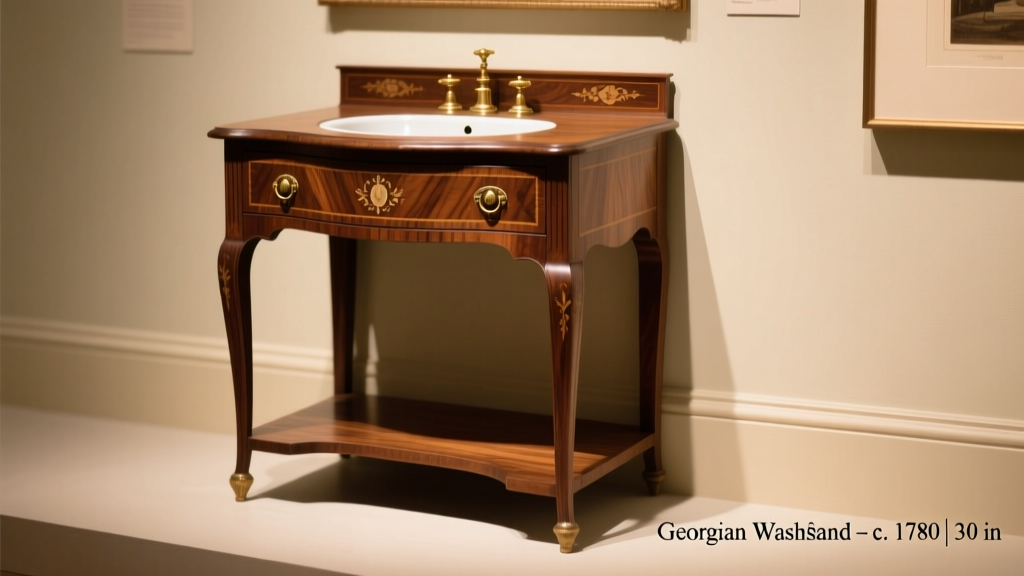
Georgian Washstand, c. 1780: Structural Integrity, Provenance, and Authentication of a 30-Inch Walnut Example with Lower Shelf, Drawer, and Basin Cutout
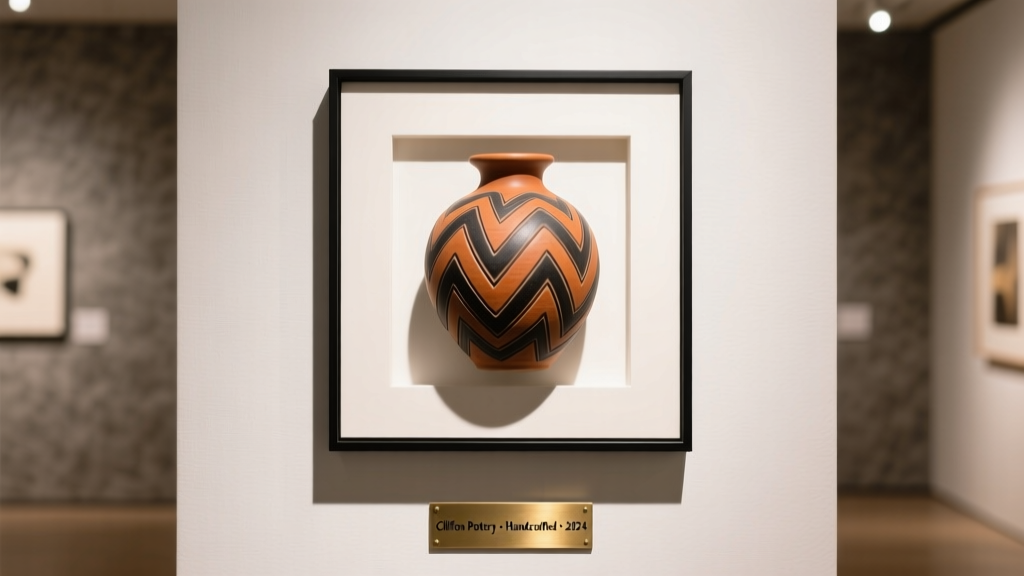
Clifton Pottery Vase: Decoding the Swirl-and-Zigzag 6×6-Inch Design — Authentication, Provenance, and Market Value
Buffalo Pottery Co. No. 2: Production History, Mark Variants, and Authentication Framework for Collectors

Free Registration in the Art Print Market: Access, Authentication, and Accountability

Kay Finch Oriental Sage Maiden Figurines No. 4854 & No. 4855: Authentication, Market Value, and Historical Context

Stoneware Pitcher with Molded Pinwheel Motif: Authentication, Provenance, and Market Analysis of the Blue-and-White 8¼-Inch Example

The Goebel Toothpick Bunny: A Collector’s Guide to Authenticity, Value, and Historical Context

Roseville Rozane Vase 'Flowers & Leaves' — Authentication, Market Value, and Historical Context of the 8-Inch Example