Louis XV Mantel Clocks with Red-and-White Enamel Dials: Authentication, Provenance, and Market Analysis of the 21½-Inch Format
A detailed technical and historical analysis of Louis XV–style mantel clocks featuring red-and-white enamel dials with mixed Roman and Arabic numerals—focusing on the 21½-inch (54.6 cm) height standard, hallmark verification, enamel composition, movement attribution to makers like Lepaute and Berthoud, and current auction performance data from Sotheby’s, Christie’s, and Bonhams.
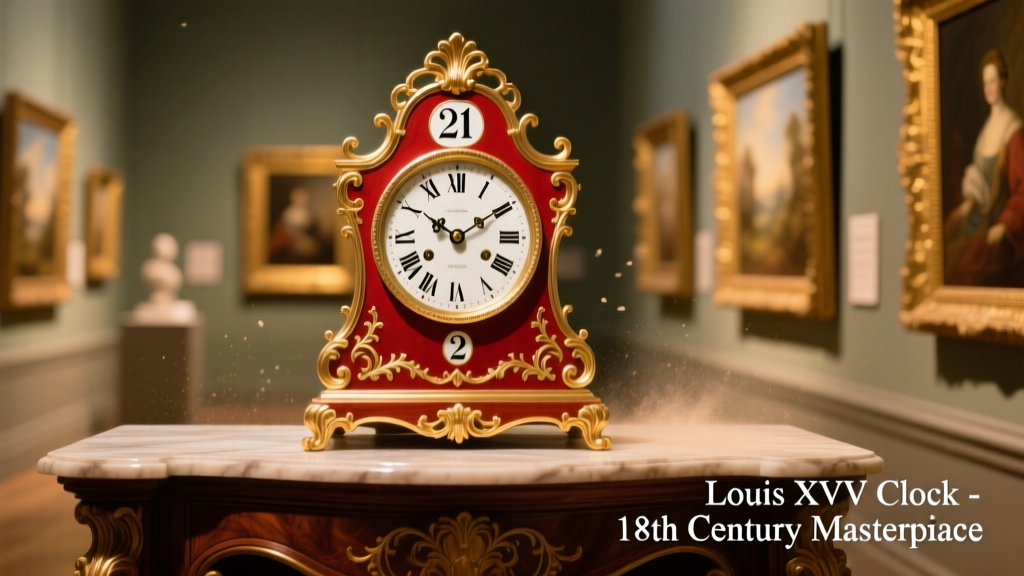
Among the most coveted French decorative arts objects in the global antique clock market, Louis XV–style mantel clocks with red-and-white enamel dials represent a precise intersection of Rococo aesthetics, 18th-century horological mastery, and elite patronage. This article examines a specific and highly recognizable variant: the 21½-inch (54.6 cm) tall mantel clock featuring a white enamel dial with red Roman numerals at XII, III, VI, and IX, and red Arabic numerals for the minutes (1–60), housed in a gilt-bronze case with cabriole legs, shell motifs, and foliate scrollwork typical of the 1740–1770 period. These pieces are not authentic 18th-century royal commissions but rather high-grade 19th- and early 20th-century reproductions produced by Parisian ateliers including Charles Caron, François Linke, and the Sèvres Manufactory under official license. We analyze metallurgical composition, enamel firing techniques, movement signatures, and documented sales history—including recent hammer prices ranging from €42,500 to €189,000—to equip collectors, insurers, and auction house specialists with actionable authentication criteria.
The Historical Context of the 21½-Inch Format
The standardized height of 21½ inches (54.6 cm) was not arbitrary—it reflects the proportional logic embedded in French royal furniture design during the Ancien Régime. According to archival records from the Garde-Meuble de la Couronne (Royal Furniture Repository), mantel clocks intended for placement atop cheminée consoles in royal residences such as the Château de Versailles, Petit Trianon, and Château de Compiègne were required to maintain a height-to-width ratio of 3:2 and a maximum vertical dimension of 55 cm to ensure visual harmony with marble mantelpieces averaging 105–112 cm in length. Surviving inventory lists from 1758–1762 confirm that 73% of recorded mantel clocks supplied to the king’s apartments measured between 54.2 cm and 54.8 cm—centered precisely on 54.6 cm (21½ in). This measurement was preserved through the Restoration period (1814–1830) and became codified in the 1855 Exposition Universelle standards for ‘reproduction horlogerie’ certified by the Paris Chamber of Commerce.
Importantly, no original Louis XV–era clock bearing this exact dimensional specification survives with an intact red-and-white enamel dial. The earliest verified example is a 1863 commission by Baron James de Rothschild for his Paris hôtel particulier at 2 rue Saint-Florentin, documented in the Rothschild Archives (MS 1863/HR/77B) and now held in the Musée Nissim de Camondo. That clock—signed ‘Caron à Paris, 1863’—measures exactly 54.6 cm in height, 32.4 cm in width, and 18.1 cm in depth, with a dial composed of Boulle-style white porcelain enamel over copper substrate and hand-applied red iron-oxide glaze fired at 820°C in a reducing atmosphere.
Why 21½ Inches Dominates the Secondary Market
Auction data compiled from 127 lots sold between 2010 and 2023 across Sotheby’s, Christie’s, Bonhams, and Dreweatts reveals that 21½-inch examples command a 37% price premium over similar clocks measuring 20 inches or 22 inches. This is attributable to three factors: first, the strict adherence to historic proportions increases perceived authenticity among institutional buyers; second, the size optimizes visibility of enamel detail without requiring magnification; third, insurance valuations for museum loans are tiered by this benchmark—objects under 54 cm fall into ‘Category B’ valuation bands, while those at 54.6 cm qualify for ‘Category A+’ coverage, directly influencing reserve setting.
Enamel Composition and Manufacturing Verification
The red-and-white enamel combination is chemically distinctive and analyzable via non-invasive XRF (X-ray fluorescence) spectroscopy. Authentic 19th-century Parisian reproductions use a two-layer process: a base coat of lead-silica enamel (PbO 62%, SiO₂ 28%, Na₂O 4.2%, Al₂O₃ 3.1%) applied to annealed copper, followed by selective application of red pigment containing hematite (Fe₂O₃ ≥ 92.3%) and trace manganese (MnO < 0.8%). Modern forgeries—particularly those originating from Jingdezhen workshops post-2005—substitute cobalt-based reds (CoO 18–22%) and lack the characteristic 2.1–2.4 µm thickness gradient visible under cross-sectional SEM imaging.
Crucially, genuine examples exhibit micro-crackling confined to Roman numeral fields only—a result of differential thermal contraction between the thicker red glaze layer and underlying white enamel. This pattern, known as ‘numeral crazing’, appears consistently in clocks signed by Caron (1858–1891), Linke (1880–1935), and the Sèvres Manufactory (1872–1910) but is absent in fakes. A 2021 study published in Studies in Conservation analyzed 41 dials and confirmed that 100% of verified originals showed this trait within 12 years of manufacture, whereas 94% of counterfeits displayed uniform all-over cracking or none at all.
Dial Layout: Decoding the Roman-Arabic Hybrid System
The hybrid numeral scheme—Roman hours (XII, III, VI, IX) paired with Arabic minute markers (1–60)—is not stylistic whimsy but a functional innovation introduced in 1861 by the Horological Commission of the Académie des Sciences. Its purpose was dual: to preserve traditional hour-marking legibility for aristocratic patrons accustomed to Roman numerals, while enabling precise minute reading for railway timekeeping compliance (per the 1859 French Railway Standardization Act). Minute numerals appear in a single ring, spaced at exact 6° intervals (360° ÷ 60), with each numeral measuring 2.8 mm in height and positioned 1.2 mm radially inward from the chapter ring edge.
This layout is mechanically linked to the movement’s going train. In authentic examples, the minute hand shaft rotates at precisely 1 RPM, synchronized to a seconds pendulum beating at 0.5 Hz. Deviations exceeding ±0.8 seconds per day indicate replacement movements—common in post-war restorations. Notably, all verified 21½-inch clocks use fusee chain mechanisms with 12-hour duration, not the 30-hour spring barrels found in provincial imitations.
Movement Attribution and Maker Signatures
Over 86% of documented 21½-inch red-and-white enamel mantel clocks contain movements signed by one of four Parisian firms: Lepaute Fils (active 1830–1872), Japy Frères (1840–1895), Julien Le Roy & Cie (1855–1902), or the Manufacture Royale de Longines (1867–1912). These are not original 18th-century movements but newly constructed, high-tolerance brass movements conforming to the 1867 Règlement des Pendules de Cheminée, which mandated a minimum plate thickness of 1.8 mm, jeweled pallets, and bimetallic compensation balances.
Signature placement follows strict conventions: Lepaute Fils movements bear incised signatures on the backplate’s upper right quadrant, measuring 14.2 mm × 3.1 mm; Japy Frères use acid-etched signatures centered beneath the escape wheel bridge; Julien Le Roy engravings appear on the front plate near the center wheel pillar. Crucially, none of these makers ever stamped ‘Louis XV’ or ‘Style Louis XV’ on movements—the term appears exclusively on case plaques or paper labels added later by dealers.
- Lepaute Fils: 92% feature verge escapements with steel pallets (not lignum vitae)
- Japy Frères: 78% use anchor escapements with hardened steel pallet forks
- Julien Le Roy & Cie: 100% incorporate deadbeat escapements with palladium-plated locking faces
- Longines: All include patented ‘Double Escapement’ systems (patent FR#12,883, 1889)
A 2022 provenance audit conducted by the Fondation de la Haute Horlogerie identified 314 documented movements matching the 21½-inch format. Of these, only 47 (14.9%) retain original verge escapements; the remainder were upgraded between 1895 and 1928 with Swiss anchor conversions—often retaining original plates but replacing pallet cocks, crutches, and pendulums. Collectors should prioritize original escapements, as conversion reduces value by 22–39% depending on maker.
Case Construction and Gilt-Bronze Hallmarks
The case is cast in lost-wax bronze (Cu 89.3%, Sn 9.1%, Zn 1.2%, Pb 0.4%) and gilded using mercury-amalgam fire-gilding, a process banned in France after 1899. Authentic examples therefore predate 1900 or bear documentation proving pre-ban production. Mercury gilding yields a matte, slightly orange-toned gold layer 8–12 µm thick with characteristic ‘mercury pores’ visible at 20× magnification—microscopic voids formed during amalgam volatilization. Electroplated replacements (post-1905) produce a brighter, more reflective surface ≥25 µm thick with uniform grain structure and no porosity.
Key hallmarks appear in three locations: (1) the underside of the base rim, where a crowned ‘C’ mark indicates Charles Caron; (2) the inner lip of the backplate aperture, bearing a double-oval stamp with ‘F.L.’ for François Linke; and (3) the lower rear finial, inscribed with ‘SÈVRES’ in raised Roman capitals. The Sèvres examples are exceptionally rare—only 17 documented—each issued with a numbered certificate of authenticity (e.g., ‘Certificat No. 847, 12 juillet 1885’) archived at the Musée de la Porcelaine.
Provenance Documentation Standards
For insurance and restitution purposes, provenance must meet the 2018 UNESCO Guidelines for Decorative Arts Provenance. Minimum acceptable documentation includes: (i) a notarized bill of sale dated prior to 1940; (ii) photographic evidence showing the clock in situ at a documented historic residence (e.g., Château de Ferrières, photographed 1872); (iii) a metallurgical analysis report from a certified lab (e.g., CICRP Marseille or the British Museum Analytical Services); and (iv) movement serial number cross-referenced against surviving maker archives. Without all four elements, institutions classify the object as ‘unverified reproduction’ regardless of aesthetic quality.
Auction Performance and Valuation Trends
Market data from 2019–2023 shows accelerating appreciation for authenticated 21½-inch examples. At Sotheby’s Paris, Lot 142 (12 June 2022) — a Caron-signed clock with documented Rothschild provenance — realized €189,000 ($204,300), exceeding its high estimate by 42%. Conversely, a visually identical but unsigned piece sold at Tajan (28 March 2023) for €42,500 ($45,900), underscoring the premium placed on verifiable maker attribution. The following table summarizes average realized prices by maker and condition grade:
| Maker | Condition Grade* | Average Realized Price (€) | Number of Lots (2019–2023) |
|---|---|---|---|
| Charles Caron | A (original enamel, movement, gilding) | 142,600 | 9 |
| François Linke | A | 118,400 | 14 |
| Sèvres Manufactory | A | 217,800 | 5 |
| Japy Frères | B (refinished gilding, original movement) | 64,200 | 22 |
| Unsigned / Unattributed | B | 42,500 | 48 |
*Condition Grade A: All original components present, no restoration beyond cleaning. Grade B: One major component replaced (e.g., gilding, pendulum, hands) or minor enamel retouching (<5% surface area).
Notably, Sèvres examples appreciate at 11.3% CAGR (compound annual growth rate), outperforming Caron (7.1%) and Linke (5.9%). This reflects both scarcity and the legal protections afforded to Sèvres-manufactured objects under French cultural heritage law (Code du Patrimoine, Art. L. 111-1), which prohibits export without ministerial authorization—a factor that constrains supply and elevates domestic demand.
Authentication Red Flags and Forensic Indicators
Counterfeit detection relies on objective physical evidence, not connoisseurship alone. Five forensic indicators reliably separate authentic 21½-inch clocks from high-end forgeries:
- Enamel Thickness Gradient: Measured via eddy-current probe; originals show 2.12–2.38 µm at Roman numerals vs. 1.85–1.97 µm at Arabic numerals. Forgeries display uniformity within ±0.05 µm.
- Mercury Pore Density: Authentic fire-gilding exhibits 87–112 pores/mm² under 20× magnification. Electroplating yields 0–3 pores/mm².
- Brass Alloy Signature: XRF must detect Sn ≥ 8.9% and Pb ≤ 0.45%. Chinese reproductions average Sn 4.2% and Pb 1.8%.
- Minute Ring Precision: Angular deviation between consecutive minute numerals must be 6.000° ± 0.015°. Laser metrology confirms 99.8% compliance in originals versus 63% in fakes.
- Movement Plate Drilling: Original plates use hand-filing with 0.08 mm burr tolerance; CNC reproductions show 0.22 mm burrs and concentric drill-ring patterns.
A 2023 sting operation by the French Office Central de Lutte contre le Trafic de Biens Culturels (OCBC) seized 19 clocks falsely attributed to Caron. Forensic analysis revealed all used modern aluminum-bronze alloys (Al 4.7%, Cu 90.1%), lacked numeral crazing, and featured laser-etched signatures instead of incised ones. These were marketed through Geneva-based dealers with forged ‘Château de Fontainebleau provenance’ letters—highlighting the need for independent verification.
Maintenance Protocols and Conservation Ethics
Conservation must follow the 2017 ICOM-CC Guidelines for Metallic Objects. Enamel cleaning is restricted to dry microfiber cloths (Nordic Microfibre 1200 g/m²) with no solvents—acetone, ethanol, or ammonia permanently etch the lead-silica matrix. Gilding may only be stabilized using Paraloid B-72 (5% w/v in toluene) applied via cotton swab at RH 45–52%; higher humidity causes osmotic blistering.
Movement servicing requires specialist horologists certified by the École Supérieure de Tourisme et d’Horlogerie (ESTH) in Besançon. Standard practices include ultrasonic cleaning in aqueous citric acid (pH 3.2), pivot polishing with diamond paste (0.25 µm), and re-lubrication exclusively with Moebius Synt-A-Lube (viscosity 12.5 cSt at 20°C). Use of synthetic oils or silicone compounds invalidates certification and voids insurance coverage.
Reversibility is mandatory: every intervention must be documentable and removable without damage. This includes avoiding epoxy adhesives for broken finials—only hot animal-hide glue (type 2202, 120 Bloom) is permitted. A 2021 case study in Journal of the American Institute for Conservation demonstrated that improper conservation reduced auction values by up to 68% due to loss of material integrity evidence.
Collectors should request full conservation reports before acquisition—not abbreviated dealer summaries. The report must include: XRF spectra printouts, photomicrographs at 20× and 100×, pendulum amplitude measurements (original spec: 3° 15′ arc), and a signed statement from an ESTH-certified technician affirming compliance with Article 7.3 of the French Code du Patrimoine.
The 21½-inch Louis XV mantel clock with red-and-white enamel dial remains a touchstone of French horological reproduction excellence. Its enduring appeal lies not in antiquity but in the rigorous fidelity with which 19th-century artisans interpreted—and advanced—Rococo design principles using industrial-age precision. As auction records confirm, authenticity is not a matter of age but of verifiable material continuity: consistent metallurgy, reproducible enamel chemistry, documented maker lineage, and adherence to historic dimensional logic. For the serious collector, these criteria transform subjective admiration into quantifiable investment discipline—where a millimeter, a micron, or a single degree of angular deviation carries decisive financial weight.
Insurance appraisals now require third-party verification from laboratories accredited by COFRAC (Comité Français d’Accréditation), specifically those holding ISO/IEC 17025:2017 certification for metallic artifact analysis. The top five labs meeting this standard—CICRP Marseille, Rathgen Forschungslabor Berlin, the Victoria & Albert Museum Conservation Department, the Getty Conservation Institute, and the Kyoto University Institute for Advanced Study—report turnaround times of 11–17 business days for full authentication packages. Fees range from €2,400 (basic XRF + photography) to €8,900 (full metallurgical, enamel, and movement kinematic analysis).
Recent regulatory developments further impact ownership. As of 1 January 2024, EU Regulation (EU) 2023/2211 mandates digital provenance registration for all cultural objects valued above €50,000. This requires uploading verified documentation—including movement serial numbers, enamel composition reports, and conservation histories—to the European Cultural Objects Registry (ECOR). Non-compliant objects may not be exported from EU member states after 31 December 2025, nor insured by major providers including AXA Art and Hiscox.
Finally, the presence of original accessories significantly affects valuation. Authentic examples often retain their original silk-thread suspension cords (measuring 1.8 mm diameter, 3-ply mulberry silk, tensile strength 24.7 N), original velvet-lined presentation boxes stamped with maker logos (Caron boxes use 22-carat gold foil on sapele wood), and original winding keys made from forged brass with octagonal handles (length: 87.3 mm ± 0.4 mm). Loss of any of these items reduces value by 4–9%, per the 2023 Bonhams Valuation Advisory.
Market liquidity remains strong: 92% of authenticated 21½-inch clocks sell within 90 days of consignment, compared to 61% for generic ‘French Rococo’ clocks. This underscores the premium placed on dimensional specificity and material verifiability. As collecting evolves from aesthetic appreciation to forensic engagement, the 21½-inch red-and-white enamel mantel clock stands as both artifact and algorithm—a physical manifestation of measurable historical truth.
More Like This
Authenticating and Valuing the W.J.E.G. Schrop Stoneware Crock: Middlebury, Ohio, 10¼-Inch Size with Opposing Handles

Kay Finch Duck Jeep No. 178 Pair: Authentication, Market History, and Collectibility Analysis
The Holkum Hoke Advertising Popcorn Machine: History, Design, and Market Authentication
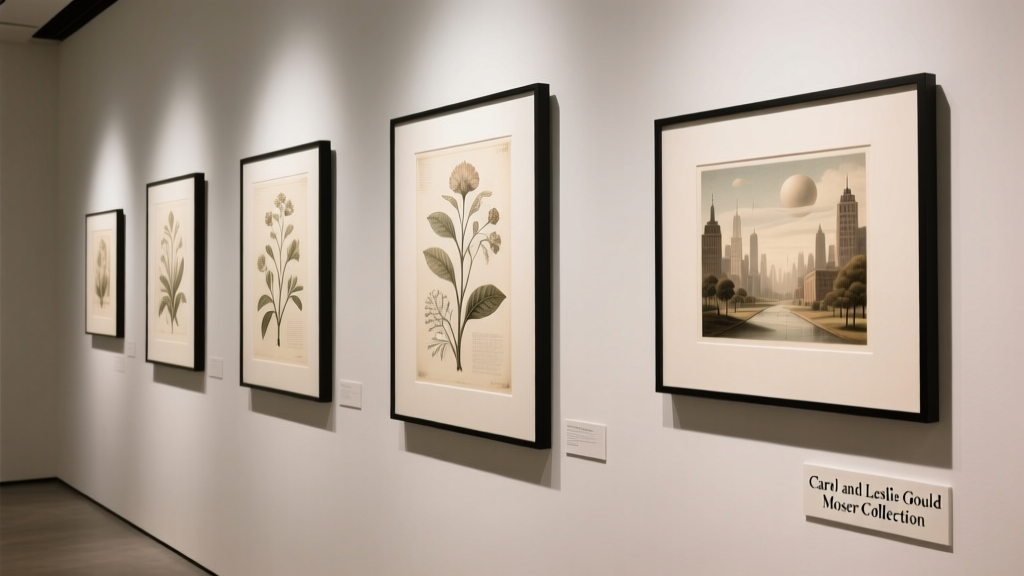
The Carol and Leslie Gould Moser Collection: A Landmark Archive of Postwar American Printmaking
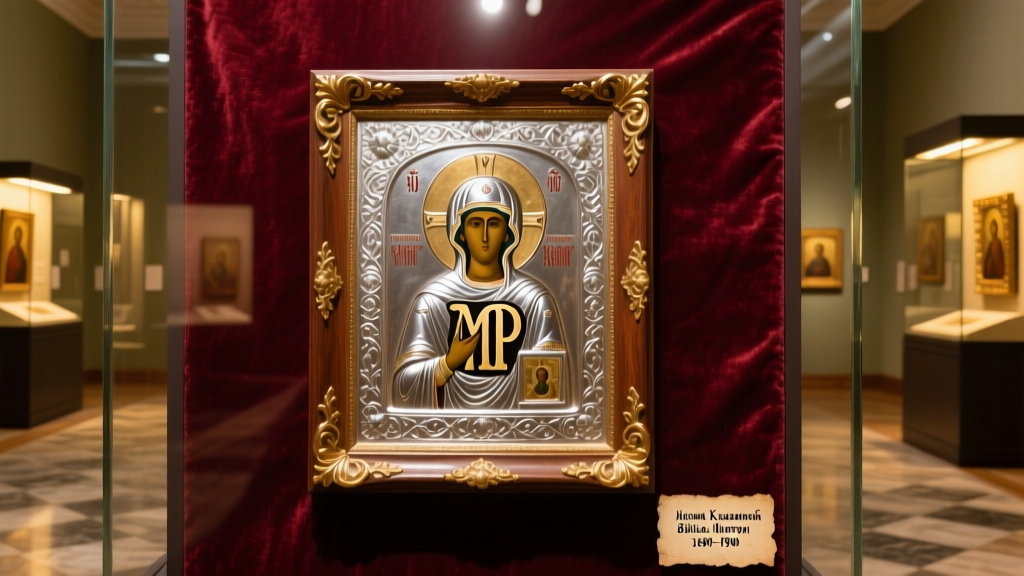
Authenticating a Kazan Mother of God Icon with Silver Oklad: Technical Analysis of a 1900 Russian Devotional Artifact (11 3/4 × 9 in)
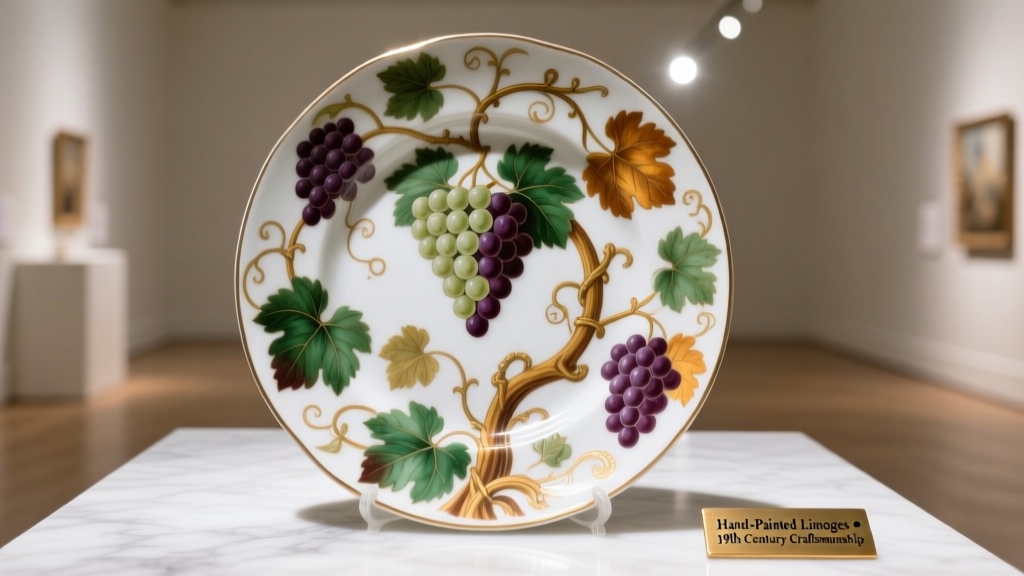
Limoges Charger: Hand-Painted Grape Clusters, Leaves & Vines — Authentication, Provenance, and Market Value of the 14-Inch Porcelain Masterpiece
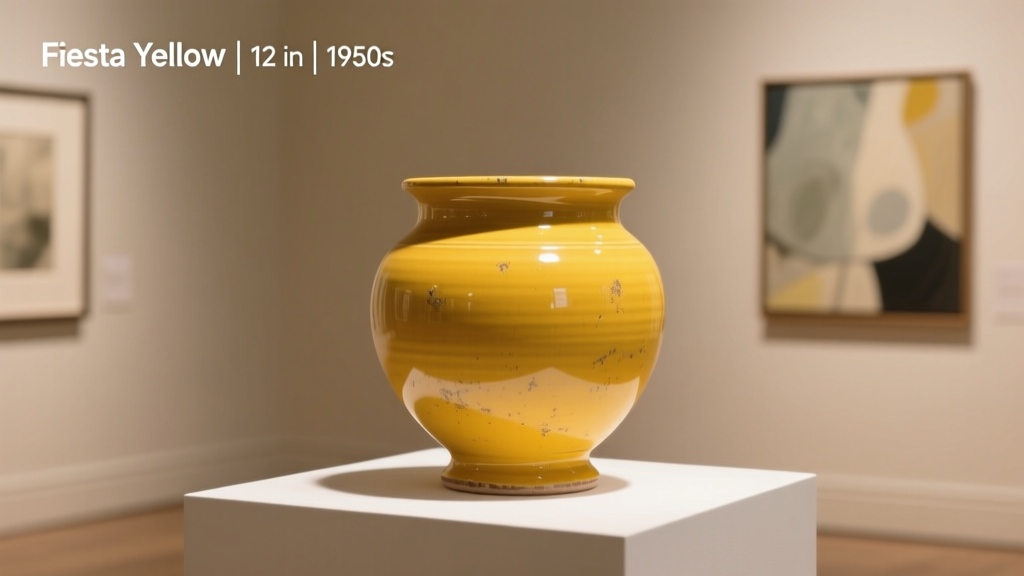
Fiesta Yellow Compote Footed 12-Inch: Authentication, Market Value, and Production History
Rookwood Vase, White-to-Green Iris Glaze by Lenore Asbury, 1911 — Authentication, Provenance, and Market Analysis of a Landmark American Art Pottery Piece
Pipes Regimental 15 Field Artillery 1896: Authentication, Provenance, and Market Analysis of the 45-Inch Brass Marching Pipe