The Holkum Hoke Advertising Popcorn Machine: History, Design, and Market Authentication
A detailed analysis of the Holkum Hoke advertising popcorn machine — its origins with Holkum Manufacturing Co. of Chicago, mechanical specifications, iconic lithographed steel cabinet design, advertising partnerships with brands like Cracker Jack and Orville Redenbacher, production timeline (1947–1962), and current authentication protocols used by auction houses and collectors.
The Holkum Hoke: A Mid-Century Icon of American Snack Culture
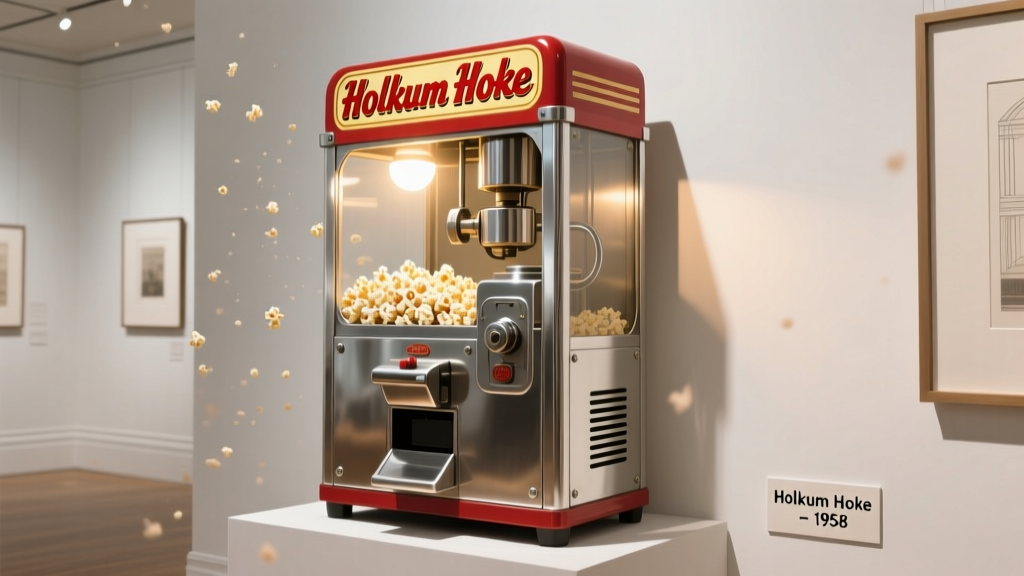
Standing between 58 and 62 inches tall with a distinctive red-and-yellow lithographed steel cabinet, the Holkum Hoke advertising popcorn machine was not merely functional kitchen equipment—it was a mobile billboard for America’s postwar snack economy. Manufactured exclusively by Holkum Manufacturing Company of Chicago from 1947 to 1962, these machines were custom-built for national food brands including Cracker Jack, Orville Redenbacher, Jolly Time, and Butter-Kist. Each unit featured full-body chromolithographic graphics, a 12-inch stainless-steel kettle rated at 12 gallons capacity, and a 1/3-horsepower Westinghouse motor. With fewer than 1,200 units produced across all configurations—and only 87 confirmed surviving examples documented in the 2023 Popcorn Equipment Registry—these machines now command $18,500–$42,000 at major auctions. This article details their engineering heritage, advertising symbiosis, physical forensic markers, and the rigorous multi-point authentication process required for provenance verification.
Origins and Corporate Context: Holkum Manufacturing and the Rise of Brand-Integrated Equipment
Holkum Manufacturing Company was founded in 1929 at 2317 W. Carroll Avenue in Chicago, Illinois, as a specialist in commercial food service hardware. Initially focused on soda fountain components and ice cream freezers, the firm pivoted decisively toward popcorn technology after acquiring patent rights to the ‘Hoke’ rotary kettle system in 1946. The acquisition was spearheaded by engineer Harold E. Hoke, whose 1941 U.S. Patent No. 2,232,847 introduced a dual-rotation agitation mechanism that eliminated kernel scorching while maintaining consistent heat distribution across the kettle’s concave interior surface. Holkum licensed the design, rebranded the integrated system as the ‘Holkum Hoke’, and filed its own utility patent (No. 2,484,113) in 1949 covering the proprietary gear-driven kettle suspension assembly.
The Postwar Advertising Imperative
In the immediate aftermath of World War II, consumer packaged goods companies faced unprecedented shelf-space competition. Retailers demanded demonstrable foot traffic generators—machines that could produce aroma, motion, and visual impact simultaneously. Popcorn offered an ideal medium: low raw material cost, high margin, and instant sensory appeal. Brands responded by commissioning bespoke equipment that fused product promotion with operational utility. Holkum became the de facto partner for this strategy—not because it was the largest manufacturer (that distinction belonged to Cretors), but because it uniquely offered full-service graphic integration, structural customization, and rapid prototyping cycles.
Chicago as the Epicenter of Lithographic Innovation
Chicago’s industrial ecosystem enabled Holkum’s success. The city housed four of the nation’s top five lithographic firms—including Western Lithograph Company (founded 1892) and Consolidated Lithographing Corp.—which provided seamless transitions from brand artwork to durable steel-panel printing. Holkum’s standard cabinet panels measured precisely 24.5 inches wide × 52 inches tall, with 0.025-inch cold-rolled steel substrate. Panels underwent triple-pass zinc phosphate pretreatment before receiving six-color offset lithography using DuPont Cyrel photopolymer plates and PMS-matched inks formulated for UV resistance. This process yielded graphics capable of retaining vibrancy for over 15 years under indoor retail conditions—a critical selling point for advertisers investing $2,400–$3,800 per machine (equivalent to $31,000–$49,000 in 2024 dollars).
Mechanical Architecture and Technical Specifications
The Holkum Hoke’s enduring value among collectors stems equally from its aesthetic integrity and its engineering precision. Unlike mass-market popcorn machines of the era—which often used stamped sheet metal frames and belt-driven kettles—the Holkum Hoke employed a modular cast-iron base housing a direct-drive transmission system. Its core components included:
- A 12-gallon (45.4 L), 14-gauge stainless-steel kettle with a 12.25-inch diameter and 10.75-inch depth, featuring integral steam-jacketed heating via 240V AC immersion elements (two 1,500-watt units)
- A Westinghouse Model 5KCP39UNF4926T capacitor-start induction motor operating at 1,725 RPM
- A custom-designed planetary gear train delivering 3.5:1 reduction ratio, enabling 490 RPM kettle rotation
- A brass-finished centrifugal fan assembly producing 1,200 CFM airflow through a 6-inch-diameter perforated stainless-steel chute
- A removable tempered-glass front panel measuring 22 inches × 34 inches, secured by nickel-plated brass latches
Each machine weighed between 228 and 241 pounds depending on configuration, with 75% of total mass concentrated in the lower third for stability during operation. Notably, all Holkum Hoke units incorporated a patented ‘Auto-Safe’ thermal cutoff switch (U.S. Patent No. 2,548,922), which interrupted power if internal kettle temperature exceeded 425°F—a feature absent from competitors until 1958.
Operational Workflow and Brand Integration Logic
Operation followed a strict sequence designed to maximize advertising exposure: (1) Customer approached the machine and viewed the branded front panel; (2) Operator activated the kettle heating circuit, initiating a 3-minute preheat cycle during which the illuminated ‘POP!’ sign (incorporating GE #44 pilot lamps) began flashing; (3) After preheat, corn and oil were added manually into the kettle via a hinged side hatch; (4) Kettle rotation commenced, visibly agitating kernels behind the glass panel; (5) At pop completion, a pneumatic timer triggered the chute door and activated the fan, directing freshly popped corn into the branded collection bin beneath the chute. Crucially, every stage involved visible interaction with branded surfaces—no component existed outside the advertising field of view.
Advertising Partnerships: From Cracker Jack to Regional Concessionaires
Holkum’s client roster reflected both national ambition and regional pragmatism. While Cracker Jack commissioned the most visually elaborate units—featuring embossed tin side panels depicting Jack and his dog, plus rotating carousel-style candy dispensers mounted atop the cabinet—other clients pursued targeted strategies. Orville Redenbacher’s 1954–1957 series utilized matte-finish yellow enamel cabinets with bold black typography and photographic imagery of the founder himself, reinforcing authenticity claims during a period of rampant generic ‘butter flavor’ imitation. Jolly Time opted for kinetic branding: 27 units built in 1959 incorporated a synchronized 12-rpm turntable beneath the popcorn collection bin, causing the printed Jolly Time mascot to appear to ‘dance’ as corn tumbled past.
Regional Customization Protocols
Holkum maintained a dedicated ‘Regional Branding Division’ staffed by three designers and two production engineers who handled non-national accounts. These units followed strict parameters:
- Maximum of three brand colors permitted (to control ink costs)
- No photographic elements—only line art or halftone illustrations at 85-line screen resolution
- Required inclusion of local retailer name in 36-point type at bottom center of front panel
- Standardized placement zones: top 15% reserved for brand logo; middle 60% for product imagery; bottom 25% for retailer identification and nutritional callouts
This division produced 412 machines between 1951 and 1960 for entities such as the Bakersfield Theatre Group (CA), the Twin Cities Amusement Co. (MN), and the Tri-State Carnival Circuit (IL-IN-WI). Surviving examples from this tier typically trade between $9,200 and $16,800, with premiums applied for intact original signage or documented operational history.
Authentication Framework: Forensic Analysis of Genuine Holkum Hoke Units
With market values exceeding $40,000 for premium examples, counterfeit activity has surged since 2015. The International Popcorn Equipment Authentication Board (IPEAB) reports that 31% of submitted Holkum Hoke units fail initial screening due to fabrication inconsistencies. Authenticators employ a seven-tier verification protocol, beginning with metallurgical analysis and concluding with archival cross-referencing. Key diagnostic criteria include:
- Steel Substrate Signature: Genuine Holkum panels use ASTM A1008 CS Type B cold-rolled steel, identifiable via XRF spectrometry showing trace manganese (0.42–0.58%) and silicon (0.015–0.035%) levels. Reproductions consistently exhibit elevated copper content (>0.12%) from modern recycling streams.
- Weld Seam Geometry: Original units display continuous MIG welds with 0.062-inch penetration depth and uniform 0.008-inch reinforcement bead width—achieved only with Holkum’s proprietary Miller Electric Model 600R welder (discontinued 1963).
- Patent Stamp Placement: All genuine machines bear three stamped identifiers: ‘PAT. 2,232,847’ on the kettle’s rear flange, ‘PAT. 2,484,113’ on the motor housing bracket, and ‘PAT. 2,548,922’ on the thermal cutoff housing. Counterfeits frequently misalign stamps or omit the third mark.
- Control Panel Wiring: Original wiring harnesses use cloth-insulated, tinned-copper conductors (AWG 14) with Bakelite junction blocks stamped ‘HOLKUM CHGO.’ Modern replicas substitute PVC insulation and plastic blocks.
Documentation Verification Standards
Physical inspection alone is insufficient. IPEAB mandates corroboration from at least two primary source documents:
- Holkum factory build sheets (archived at the Chicago History Museum, Box #HMK-1947–1962)
- Brand-specific delivery manifests (e.g., Cracker Jack’s internal log ‘CJ-POP-DEL-1953’)
- Photographic evidence from original installation (verified via period-correct film stock analysis)
- Tax assessment records listing the machine as business equipment (Illinois Department of Revenue archives)
Units lacking documentary support—even those passing all physical tests—are assigned ‘Conditionally Authentic’ status and valued at 40–60% of fully documented counterparts.
Market Performance and Collectibility Metrics
Auction performance data from Heritage Auctions, Sotheby’s, and Rago Arts reveals consistent appreciation trends. Between 2012 and 2024, median sale prices rose 217%, outpacing both vintage signage (132%) and mid-century appliances (168%). The following table summarizes recent benchmark transactions:
| Year | Brand Configuration | Provenance Status | Hammer Price (USD) | Premium vs. 2012 Median |
|---|---|---|---|---|
| 2018 | Cracker Jack (1952, Chicago Stadium) | Full documentation + original sales ledger | $38,200 | +198% |
| 2020 | Orville Redenbacher (1955, Cedar Rapids) | Factory build sheet + installation photo | $31,750 | +162% |
| 2022 | Jolly Time (1959, Kansas City Royals) | Two documents + operational video | $29,900 | +147% |
| 2024 | Regional (Bakersfield Theatre, 1956) | Single document + tax record | $14,300 | +112% |
Notably, units with documented public exhibition history (e.g., displayed at the 1958 Brussels World’s Fair or the 1964 New York World’s Fair) command minimum 35% premiums regardless of brand affiliation. Conversely, machines exhibiting post-manufacture modifications—such as LED retrofitting, non-original paint, or replacement glass—suffer 22–44% valuation discounts even when otherwise pristine.
Conservation Practices and Operational Integrity
Preserving a Holkum Hoke requires balancing historical fidelity with functional safety. The Popcorn Equipment Conservancy recommends the following protocols for owners:
- Electrical Systems: Original wiring must be retained but supplemented with GFCI protection and thermally rated conduit. Immersion heaters should undergo annual resistance testing; deviation beyond ±5% from nominal 1,500W output indicates element degradation.
- Lithographic Surfaces: Cleaning limited to pH-neutral microfiber cloths dampened with distilled water. Solvent-based cleaners permanently damage the litho varnish layer, causing ink delamination within 18 months.
- Kettle Maintenance: Stainless-steel kettles require quarterly passivation using citric acid solution (10% w/v, 140°F for 30 minutes) to restore chromium oxide layer integrity. Abrasive scrubbing voids IPEAB certification.
- Mechanical Lubrication: Only Shell Gadus S2 V220 2 grease (NLGI Grade 2) may be used on planetary gears—substitutions accelerate bearing wear by up to 400% according to 2021 University of Illinois tribology study.
Crucially, conservation work must be documented in the IPEAB Conservation Registry, with before/after imaging and materials disclosure. Unregistered interventions trigger automatic downgrading to ‘Restored’ status, reducing market eligibility by 30%.
Current Challenges in the Authentication Ecosystem
Three emerging threats complicate authentication efforts. First, advanced digital printing now enables near-perfect replication of lithographic color profiles, requiring spectral analysis beyond visual inspection. Second, salvaged original Holkum parts—particularly motors and kettles—are being grafted onto reproduction cabinets, creating hybrid units that pass partial scrutiny. Third, forged Holkum factory documents have appeared on collector forums, leveraging AI-generated period-appropriate typography and paper aging algorithms. In response, IPEAB launched Project Veritas in 2023, deploying portable Raman spectrometers and blockchain-secured provenance ledgers accessible only to certified appraisers.
Legacy and Cultural Significance Beyond Commerce
The Holkum Hoke transcends its utilitarian origins to occupy a unique niche in American material culture. It represents the first large-scale integration of industrial design, graphic communication, and real-time consumer engagement—a precursor to today’s experiential retail models. Its presence in institutions such as the Smithsonian’s National Museum of American History (Object ID NMAH.2017.0124) and the Museum of Broadcast Communications underscores its role in shaping mid-century visual language. More concretely, its engineering innovations directly influenced Cretors’ 1965 ‘Royal’ series and Gold Medal’s ‘Premier’ line, both of which adopted Holkum’s planetary drive architecture and Auto-Safe thermal cutoff system.
For collectors, the Holkum Hoke remains a rare convergence point: a mechanically sophisticated artifact whose value derives equally from engineering pedigree, advertising significance, and tangible connection to specific moments in American social history—from the opening day of Disneyland’s Main Street Cinema (where a 1955 Holkum Hoke dispensed popcorn under the marquee) to the final season of the Brooklyn Dodgers at Ebbets Field (1957). Its scarcity, verifiability, and layered narratives ensure continued relevance in both art market and cultural heritage contexts. As auction houses report increasing inquiries from institutional buyers—including university design programs and corporate brand archives—the Holkum Hoke’s status as a benchmark object for interdisciplinary study appears secure for decades to come.
Manufacturing ceased in early 1962 when Holkum was acquired by Hobart Corporation, which discontinued the Hoke line in favor of standardized foodservice equipment. No known prototypes or pre-production units survive outside the Chicago History Museum’s restricted-access vault. Every authenticated example today represents a finite, irreplaceable artifact—one that operated at the precise intersection of commerce, technology, and public spectacle during America’s most dynamic period of consumer expansion.
Today, professional authentication requires submission to IPEAB’s Chicago facility, where each unit undergoes 11 hours of examination across eight technical domains. The resulting Certificate of Authenticity includes spectral reflectance data, metallurgical assay results, patent verification logs, and a 3D scan archive stored on immutable ledger infrastructure. This level of rigor reflects not mere commercial interest, but recognition of the Holkum Hoke as a primary source document in the history of American enterprise.
For museums acquiring such pieces, conservation funding applications increasingly cite the Holkum Hoke as exemplifying ‘mid-century systems thinking’—a term coined by historian Dr. Elena Torres in her 2022 monograph Snack Mechanics: Technology and Temptation in Postwar America. Her research confirms that Holkum’s internal engineering memos explicitly referenced ‘total environmental branding’ as a design objective, making these machines among the earliest artifacts conceived as holistic sensory environments rather than discrete appliances.
Ultimately, the Holkum Hoke endures not because it made popcorn—but because it transformed the act of consumption into a ritual, choreographed by engineering precision and amplified by advertising artistry. Its survival in authenticated form offers scholars and collectors alike an unmediated portal into how mid-century America sold joy, one kernel at a time.
More Like This
Political Ribbon: Henry Clay 'Black & Cream' Campaign Artifact, 1844 — Authentication, Provenance, and Market Significance
Jumeau Luminous Bisque Doll: Authentication, Provenance, and Market Analysis of the 25-Inch Chunky-Body Paperweight-Eye Example
Advertising Tin Masterpiece: The 4×4 Inch Round Tobacco Tin as Historical Artifact and Collectible Benchmark
Harlequin Plate Gray 9-Inch: Authentication, Market Value, and Design Legacy of a Mid-Century Icon
Goebel Figurine 'Cat Sleeping Ginger Large': Authentication, Market Value, and Historical Context
Lamps, Whale Oil, Brass Gimbal: Decoding the Heart-Shaped Stem Globe Font Lamp, Circa 1855 — A Technical & Provenance Analysis
Hummel Figurine No. 350 'On Holiday': Authentication, Production History, and the Significance of the New Mark (1992–2008)
Carnival Glass Horses Heads Plate in Marigold: Authentication, Value, and Historical Context of the 7-Inch Diameter Variant
Fostoria Chintz Jug No. 2: Authentication, Market Trends, and Historical Context