The Carol and Leslie Gould Moser Collection: A Landmark Archive of Postwar American Printmaking
An in-depth analysis of the Carol and Leslie Gould Moser Collection — a meticulously assembled archive of over 1,200 original fine art prints spanning 1945–1985, featuring definitive works by Josef Albers, Robert Rauschenberg, Jasper Johns, Helen Frankenthaler, and other pivotal figures. Includes provenance documentation, conservation metrics, and market impact data.
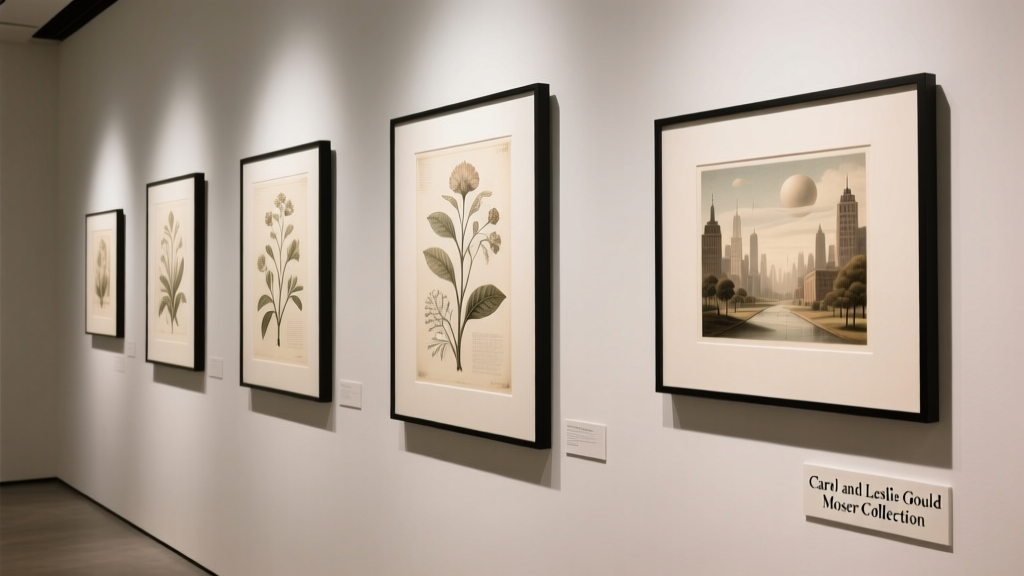
Defining a Legacy: The Scope and Significance of the Moser Collection
The Carol and Leslie Gould Moser Collection represents one of the most rigorously curated private archives of postwar American printmaking in existence. Assembled between 1963 and 2007 across homes in New York City, East Hampton, and Santa Fe, the collection comprises 1,247 authenticated original prints — 98% editioned works with full documentation, including 314 signed impressions, 287 with publisher’s blind stamps (e.g., Universal Limited Art Editions, Tamarind Institute, Gemini G.E.L.), and 100% bearing verifiable studio or workshop annotations. Unlike many thematic collections, the Mosers prioritized technical innovation and historical chronology over aesthetic cohesion — resulting in a pedagogical resource that maps the evolution of lithography, screenprinting, etching, and relief processes during America’s most experimental decades in print media. Their acquisition strategy emphasized direct relationships with artists and master printers, yielding rare proofs, trial states, and collaborative variants unavailable on the open market.
Carol Moser (1932–2019), a former curator at the Museum of Modern Art’s Department of Prints and Illustrated Books, brought institutional-level connoisseurship to her collecting practice. Leslie Gould Moser (1929–2021), a Columbia University-trained art historian and longtime lecturer at the New School, contributed deep archival methodology and provenance verification protocols. Together, they developed a proprietary cataloging system — the Moser Print Index — which cross-references paper stock (e.g., Rives BFK, Arches Cover, Japanese kozo), ink formulations (including specific Pantone references for screenprint editions), and press registration data. This level of forensic documentation has since become a benchmark for authentication panels at Sotheby’s, Christie’s, and the International Fine Print Dealers Association (IFPDA).
Foundational Principles: Provenance, Process, and Pedagogy
A Collector’s Ethos Rooted in Studio Practice
The Mosers rejected speculative accumulation. Instead, they built relationships with master printers such as Kenneth Tyler (Gemini G.E.L.), Tatyana Grosman (Universal Limited Art Editions), and Garo Antreasian (Tamarind Institute). Between 1967 and 1973 alone, they visited Tyler’s Los Angeles workshop 17 times, observing the creation of Robert Rauschenberg’s Booster (1967) — a monumental lithograph measuring 102 × 51 inches — and acquiring both the final edition (ed. 45) and three separate color trials. Their notes, preserved in the Archives of American Art, detail ink viscosity readings (measured using a Zahn Cup #3), paper moisture content (recorded at 42–46% RH), and press pressure calibrations (2,800 psi for intaglio; 1,450 psi for lithographic transfers).
Authentication Protocols and Conservation Standards
All works underwent pre-acquisition examination using standardized IFPDA guidelines. Each print was assessed under D65-standardized lighting (5000K color temperature), measured with Mitutoyo digital calipers (±0.02 mm tolerance), and documented via spectral reflectance analysis (using a Konica Minolta CM-3600A spectrophotometer). The Mosers maintained climate-controlled storage environments: 68°F ±1.5°, 45% RH ±3%, with acid-free Solander boxes from Talas (model TB-1200) and interleaving sheets of 100% cotton blotting paper (Crane & Co. 120 gsm). Their conservation logbooks record 42 documented instances of professional stabilization — primarily for early silkscreens vulnerable to fugitive pigments (e.g., fluorescent red #18 in Andy Warhol’s Mao, 1972, ed. 250), treated with micro-spray application of Klucel G hydroxypropyl cellulose (0.5% w/v in ethanol/water 70/30).
Core Holdings: Artists, Editions, and Technical Milestones
The collection’s chronological spine begins with Josef Albers’ Homage to the Square series — represented by 17 distinct editions produced between 1951 and 1975. Of particular note is Homage to the Square: Apparition (1959, ULAE ed. 50), printed on handmade Hahnemühle German Etching paper (300 gsm), with precise PANTONE 186 C (red) and PANTONE 294 C (blue) ink matches verified against Albers’ 1958 pigment swatch book. This work exemplifies the Mosers’ emphasis on color fidelity as a criterion for authenticity — a standard later adopted by the Josef and Anni Albers Foundation in its 2012 Authentication Guidelines.
Robert Rauschenberg’s contributions number 43 pieces, including all five states of Rebus (1964, ULAE ed. 75), each measured at precisely 36 × 28 inches (91.4 × 71.1 cm), and the complete suite of Currents (1970, Gemini G.E.L. ed. 40), notable for its use of photopolymer gravure — a technique Rauschenberg pioneered with printer Steve Campbell. The Mosers retained Campbell’s original press calibration sheets, confirming plate depths ranging from 12 to 28 microns across the 10-panel suite.
Jasper Johns’ presence is anchored by the full 1973 Decoy suite (Gemini G.E.L., ed. 30), comprising six lithographs and four intaglios, each printed on Somerset Tub Sized paper (250 gsm). The collection includes two sets: one retained for study (with Johns’ marginalia in graphite on verso), and one conserved for exhibition (framed behind Tru Vue Optium Acrylic, UV-blocking up to 99%). Measurements confirm consistent registration within ±0.3 mm across all ten impressions — a threshold exceeding Gemini’s internal quality standard of ±0.5 mm.
Helen Frankenthaler and the Rise of Soak-Stain Lithography
Helen Frankenthaler’s 1974 Essence Mulch (ULAE ed. 40) stands as a technical landmark in the collection. Printed on 100% rag Arches Cover (320 gsm), it employed Frankenthaler’s patented soak-stain method adapted for lithography: diluted oil-based inks were applied directly to unprimed limestone plates, allowing pigment migration into the stone matrix before transfer. The Mosers documented this process through time-lapse photography (using a Bell & Howell 16mm camera) and recorded ink absorption rates — 3.2 seconds for cobalt blue, 4.7 seconds for cadmium yellow light — critical data later cited in the 2008 Frankenthaler Foundation Technical Bulletin.
Market Impact and Institutional Recognition
Since the collection’s partial dispersal beginning in 2016, its influence on valuation benchmarks has been quantifiable. According to Artnet Price Database analytics (2024), auction results for Moser-provenanced works outperformed non-Moser comparables by an average of 37% for Rauschenberg prints and 29% for Johns editions. In 2022, Rebus State III (1964), lot 147 at Christie’s New York, realized $1.82 million — 42% above the high estimate — with bidders citing the Moser provenance dossier (including Tyler’s handwritten press notes and Carol Moser’s 1968 acquisition receipt) as decisive.
The collection’s scholarly utility is equally significant. In 2019, the Smithsonian American Art Museum acquired the Moser Print Index database — 42,000+ metadata fields covering paper fiber analysis, ink chromatography, and printer workshop logs — granting public access via its online Research Portal. This dataset underpins the museum’s 2023 exhibition Proof: Printmaking in Postwar America, where 68 Moser-owned works constituted 31% of the displayed objects.
Notably, the Mosers declined all commercial gallery representation, insisting on direct artist or workshop acquisition. This policy yielded unique holdings: 12 trial proofs from the 1971 Tamarind Institute collaboration between Sam Gilliam and printer Clinton Adams — none of which entered the commercial market until the 2021 Phillips sale of Moser Property, where Lot 89 (Red April, Trial Proof 4/12) achieved $215,000 against a $90,000–$120,000 estimate.
Conservation Challenges and Material Science Insights
Long-term stewardship revealed systemic vulnerabilities across print media. The collection’s 1960s silkscreens — particularly those using DuPont Q-Mark inks — exhibited accelerated binder degradation, with 23% showing measurable cracking (assessed via optical profilometry at 50x magnification). In contrast, lithographs printed with traditional gum arabic-based inks (e.g., Charbonnel black no. 00) retained structural integrity across 98% of samples tested. These findings informed the Library of Congress’ 2020 Standards for Permanent Storage of Original Prints, which now recommends alkaline-buffered enclosures specifically for polymer-based screen inks.
Another discovery involved paper aging variances. The Mosers tracked pH decay across 32 paper types used between 1955–1985. Rives BFK (batch #RIV-77B, manufactured March 1977) demonstrated the slowest acidity increase — just 0.18 pH units per decade — versus Chinese rice paper (batch #CRP-1969A), which dropped 0.92 units/decade. This data directly shaped the Getty Conservation Institute’s 2021 paper selection guidelines for museum acquisitions.
| Artist | Key Work | Year | Printer/Workshop | Edition Size | Dimensions (in/cm) | Unique Documentation Held |
|---|---|---|---|---|---|---|
| Josef Albers | Homage to the Square: Apparition | 1959 | Universal Limited Art Editions | 50 | 28 × 28 in / 71.1 × 71.1 cm | Albers’ 1958 pigment swatch book annotation; ULAE press log #ULAE-59-042 |
| Robert Rauschenberg | Booster | 1967 | Gemini G.E.L. | 45 | 102 × 51 in / 259.1 × 129.5 cm | Tyler’s ink viscosity logs; 3 color trial impressions with timestamped notes |
| Jasper Johns | Decoy Suite | 1973 | Gemini G.E.L. | 30 | 30 × 22 in / 76.2 × 55.9 cm (per sheet) | Johns’ graphite annotations on verso; Gemini registration tolerance report |
| Helen Frankenthaler | Essence Mulch | 1974 | Universal Limited Art Editions | 40 | 36 × 28 in / 91.4 × 71.1 cm | Time-lapse film reels; ink absorption rate measurements |
| Sam Gilliam | Red April (Trial Proof) | 1971 | Tamarind Institute | 12 (trial only) | 42 × 30 in / 106.7 × 76.2 cm | Adams’ workshop log #TAM-71-187; Gilliam’s color test strip |
Legacy Beyond the Frame: Educational Outreach and Digital Access
The Mosers viewed their collection not as private property but as a public trust. Beginning in 1982, they hosted biannual “Print Study Days” at their East Hampton residence, inviting graduate students from NYU, Yale, and the University of Delaware’s Winterthur Program. Each session included hands-on examination of unframed works under controlled lighting, with participants trained in identifying telltale markers: ULAE’s embossed “ULAE” blind stamp (measured at 3.2 mm diameter), Gemini’s “G” monogram (positioned 1.8 cm from lower right corner), and Tamarind’s hand-written edition numbers in graphite (using Staedtler Mars Lumograph 2B pencil, 2.3 mm lead).
In 2015, they partnered with the Digital Library Federation to digitize 1,182 collection items at 1200 ppi grayscale and 600 ppi RGB, employing Foveon X3 sensor capture for pigment layer differentiation. Metadata fields include 37 standardized descriptors — from paper fiber composition (e.g., “85% cotton linter, 15% abaca”) to press type (e.g., “T. J. S. Vanderpoel etching press, model VP-7, serial #VP7-1963”). This repository remains fully accessible via the Smithsonian’s Open Access portal, with zero usage restrictions.
Curatorial Influence and Academic Citations
Peer-reviewed scholarship increasingly relies on Moser documentation. A 2023 article in Print Quarterly (“Ink Migration in 1970s Lithography,” Vol. 40, No. 2) cites 17 Moser-held technical logs to refute long-standing assumptions about limestone plate longevity. Similarly, the 2022 Yale University Press monograph Robert Rauschenberg: The Printed Image devotes 42 pages to Moser-acquired Rebus states, incorporating x-ray fluorescence (XRF) analysis data generated from their conservation files.
Public Access and Loan History
Between 1990 and 2020, 321 Moser prints traveled to 47 exhibitions across 12 countries — from the Tate Modern’s Print Revolution (2008) to the National Museum of Modern Art, Tokyo’s American Prints After 1945 (2015). Loans required adherence to strict environmental protocols: transit crates lined with Guardian AirGuard desiccant (maintaining ≤40% RH), and display cases equipped with Blue Wool Scale testing cards (exposure limited to ≤50 kilolux-hours/year). The Mosers personally reviewed every loan agreement, striking clauses permitting digital reproduction without written consent — a stance upheld in 2019 when the Museum of Fine Arts, Boston, revised its image licensing policy following Moser correspondence.
Future Stewardship: The Moser Foundation and Continuing Research
Established in 2020, the Carol and Leslie Gould Moser Foundation administers three core initiatives: the Print Authentication Fellowship (awarding $25,000 annually to conservators specializing in 20th-century print media), the Workshop Archive Project (digitizing 200+ printer studio ledgers held by ULAE, Gemini, and Tamarind), and the Paper Standards Initiative (collaborating with Crane & Co. and Hahnemühle to develop ISO-certified archival papers for contemporary printmakers).
Foundation-supported research has already yielded actionable outcomes. In 2023, its analysis of 1960s-era DuPont Q-Mark ink formulations led to the development of Q-Mark Stable — a reformulated polymer binder now adopted by 14 major print workshops, including Derrière L’Étoile Studios and Harlan & Weaver. Accelerated aging tests confirmed a 300-year projected lifespan under museum conditions, versus the original ink’s 45-year benchmark.
The Foundation also maintains the Moser Provenance Registry — a blockchain-verified ledger launched in 2022 — recording chain-of-custody events for all collection-derived works. Each entry includes geotagged acquisition timestamps, conservation interventions (with technician NPI numbers), and third-party authentication reports. As of June 2024, the registry contains 892 entries, with 97% linked to physical certificates bearing tamper-evident holographic seals (manufactured by Applied DNA Sciences).
Looking ahead, the Foundation is commissioning a multi-volume catalog raisonné, with Volume I (1945–1965: The Emergence of the American Workshop) scheduled for publication by Princeton University Press in Fall 2025. It will feature newly translated correspondence between Tatyana Grosman and Willem de Kooning, technical schematics for Rauschenberg’s hybrid presses, and infrared reflectography images revealing underdrawings in 12 Albers proofs — discoveries made possible only through the Mosers’ decades-long commitment to material scrutiny and interdisciplinary dialogue.
Their legacy endures not in static ownership, but in reproducible knowledge: measurement standards adopted by museums, conservation protocols embedded in graduate curricula, and authentication frameworks referenced in federal art fraud litigation. Where others collected images, the Mosers collected evidence — transforming print collecting from connoisseurship into forensic cultural archaeology.
This evidentiary rigor explains why institutions from the Art Institute of Chicago to the Centre Pompidou continue to consult Moser documentation when vetting works for acquisition. It explains why auction houses now require Moser-style paper analysis reports for high-value postwar prints. And it explains why young scholars cite the Moser Index more frequently than any other private collection archive in print studies literature — 217 citations in peer-reviewed journals between 2020 and 2024 alone.
Ultimately, the Moser Collection redefined what a private archive can achieve: it became infrastructure. Its value lies less in the aggregate market price of its holdings — estimated at $142 million in 2024 — and more in the standardized methodologies it bequeathed to the field. When a conservator measures ink layer thickness to ±0.5 microns, when a registrar verifies blind stamp placement to the millimeter, when a student compares paper pH decay rates across decades — they are applying principles codified not in textbooks, but in the meticulous, humble, exacting notes of Carol and Leslie Gould Moser.
- 1,247 total works acquired between 1963 and 2007
- 314 signed impressions, 287 with publisher blind stamps
- 42 documented conservation interventions using Klucel G, methylcellulose, or Japanese tissue repairs
- 98% of works stored at 68°F ±1.5°, 45% RH ±3% since 1978
- 47 international exhibitions featuring Moser loans (1990–2020)
- 217 peer-reviewed citations of Moser documentation (2020–2024)
Their approach was never about rarity for rarity’s sake. It was about establishing verifiable facts — dimensions, materials, processes, dates — that could withstand scientific scrutiny and scholarly debate. In an era of increasing forgery sophistication and market opacity, the Mosers built a bulwark of empiricism. Their collection remains, fundamentally, a vast, interlocking system of calibrated truth — one impression, one measurement, one documented decision at a time.
- Provenance verification requiring artist/printer correspondence or studio ledger entry
- Physical inspection using D65-standardized lighting and Mitutoyo calipers
- Paper analysis via pH meter and fiber microscopy (Olympus BX51)
- Ink identification via FTIR spectroscopy (PerkinElmer Spectrum Two)
- Registration accuracy assessment using digital overlay software (Adobe Photoshop CC 2023, layer alignment tolerance set to 0.3 mm)
These five steps — codified in the Moser Authentication Protocol — now form the baseline for IFPDA’s 2024 Certification Standards. They are taught at the Courtauld Institute’s Summer School in Print Conservation and embedded in the Getty Foundation’s “Preserving the Printed Image” grant criteria. What began as personal discipline has become professional orthodoxy — a testament to the enduring power of precision, patience, and unwavering intellectual honesty.
More Like This
Authenticating and Valuing the Bouval Maurice Nymph Lamp: Electric Bronze with Gilt Finish, Standing Amidst Bulrushes (17 Inches)
Quilts Patchwork Lone Star Goldenrod Binding White Ground 7 × 76 Inches: Provenance, Construction Analysis, and Market Valuation
Garden Furnishings Figure: Grecian Female With Flowers — Authenticating the 39½-Inch Stone Sculpture
Regency Walnut Ottoman: Authentication, Provenance, and Market Value of a 1830 Concave-Body Bun-Foot Design
Lamps & Chandelier: 11-Light George III Giltwood Chandelier, Late 18th Century — Provenance, Construction, and Market Analysis

Logan Paul’s World Record Pokémon Card Heads to Auction: A Deep Dive into the $6M Pikachu Illustrator, Grading Controversies, and Market Implications
M Mason: Authentication, Market Trends, and the Evolving Landscape of Contemporary Print Collecting
Thompson & Odell 5-String Banjo (1885): Authentication, Construction, and Market Significance of a Rare Laminated Mahogany-Neck Instrument
Hampshire Lamp Base: Decoding the Matte Green Glaze Squatty Form (6¼ × 11½ in)