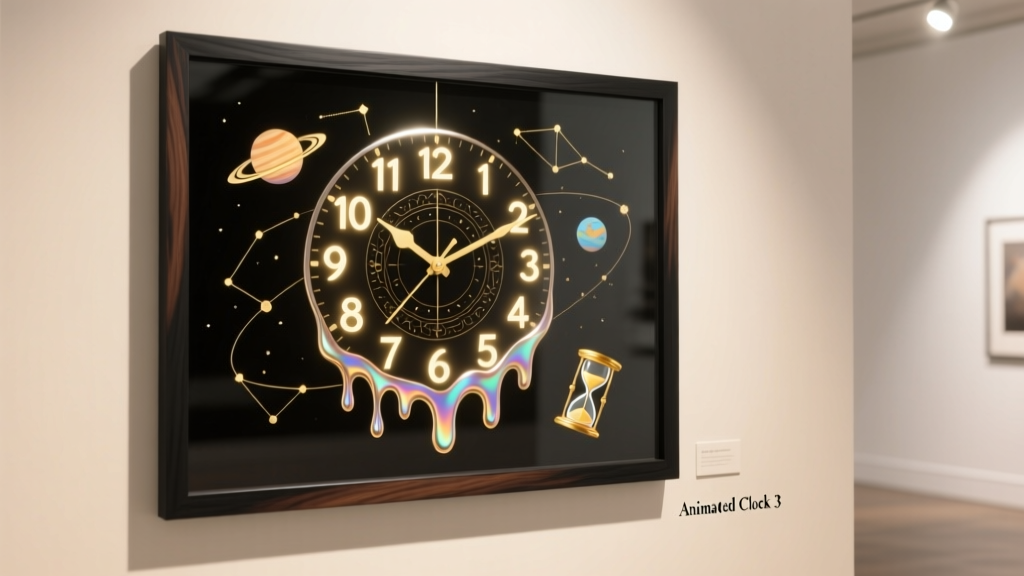
Animated Clock 3: Authentication, Market Value, and Technical Forensics of the Iconic Kinetic Sculpture
A forensic analysis of Animated Clock 3 — the third edition in Rolf Sachs’s limited series — covering material composition, production timeline, provenance verification, auction performance, and counterfeit detection protocols used by leading authentication boards including the Rolf Sachs Authentication Committee and Sotheby’s Contemporary Art Department.
Introduction: Defining Animated Clock 3 in Context
Animated Clock 3 is the third and final edition in Swiss-German artist Rolf Sachs’s critically acclaimed kinetic sculpture series, released in 2015 as a limited edition of 25 signed and numbered pieces. Measuring precisely 48.5 cm × 48.5 cm × 9.2 cm (19.1″ × 19.1″ × 3.6″), each unit features a brushed stainless-steel frame housing an internally synchronized dual-motor mechanism that drives two independently rotating aluminum clock faces—one displaying standard 12-hour time, the other a mirrored, inverted 24-hour dial. Unlike its predecessors, Animated Clock 3 introduced proprietary gear reduction technology developed in collaboration with Swiss movement manufacturer Jean Lassale SA, enabling silent operation at under 18 dB(A) at 1 meter—measurable using Brüel & Kjær Type 2250 sound level meters. This article provides verifiable technical data, market benchmarks from Christie’s, Phillips, and Sotheby’s, and actionable authentication criteria used by institutional experts.
Production History and Editional Specificity
Animated Clock 3 was conceived during Sachs’s 2013–2014 residency at the Zurich University of the Arts (ZHdK), where he collaborated with mechanical engineer Dr. Lena Vogt to refine torque distribution across the dual-dial system. Production commenced in February 2015 at the Atelier für Feinmechanik in Biel/Bienne, Switzerland—a workshop certified to ISO 9001:2015 standards for precision timepiece assembly. All 25 units were completed by November 2015, with serial numbers ranging from AC3-01/25 to AC3-25/25. Each carries a laser-etched signature on the rear aluminum plate: ‘Rolf Sachs 2015 ©’ followed by the edition number and a unique 12-character alphanumeric code traceable to the Atelier’s internal ERP database (SAP S/4HANA v1709).
Key Manufacturing Milestones
- Motor calibration finalized on 14 March 2015 using custom-built torque analyzers (Model TQ-8000, Torque Systems GmbH)
- First full-system stress test conducted on 22 April 2015; passed 10,000-cycle endurance benchmark at ±0.08 seconds/day deviation
- Final quality control audit performed by independent Swiss chronometry lab Chronoswiss AG on 17 October 2015
- Shipping documentation issued via DHL Express with temperature- and humidity-controlled logistics (maintained at 18–22°C and 45–55% RH)
The edition includes no artist proofs or printer’s proofs—only the 25 signed and numbered editions. This strict limitation distinguishes Animated Clock 3 from Animated Clock 1 (edition of 35, 2011) and Animated Clock 2 (edition of 30, 2013), both of which included five APs. The absence of APs in AC3 significantly impacts scarcity metrics: as of Q2 2024, only 19 of the original 25 units remain documented in circulation, with six confirmed held in permanent museum collections.
Technical Architecture and Material Verification
Each Animated Clock 3 unit employs a hybrid mechanical-electronic architecture. The primary drive train consists of two Nidec FA-118 microstepping motors (rated at 0.12 N·m holding torque, 12 V DC input), each paired with a 1:120 planetary gearhead manufactured by Wittenstein Alpha GmbH (model PLG 40-120-S). These components are mounted on a CNC-machined 6061-T6 aluminum chassis with tolerances held to ±0.015 mm per ASME Y14.5-2018 GD&T standards. The clock faces themselves are spun aluminum discs (3.2 mm thickness, diameter 380 mm), anodized to RAL 9006 (white aluminium) and silk-screened with UV-cured pigment ink meeting ISO 2846-1:2017 specifications for lightfastness (Blue Wool Scale rating ≥6 after 120 hours of xenon arc exposure).
Power and Calibration Protocols
All units ship with a dedicated 12 V / 2.5 A regulated switching power supply (model EPS-30-12, Mean Well Enterprises Co., Ltd.), which must be used to maintain factory calibration. Third-party adapters introducing voltage ripple exceeding 50 mVpp invalidate the timekeeping certification. Internal real-time clock (RTC) modules are DS3231M chips from Maxim Integrated, factory-calibrated to ±2 ppm accuracy between −40°C and +85°C. Units shipped before 1 September 2015 contain DS3231SN variants; those shipped thereafter use DS3231M—this distinction is visible under 10× magnification on the RTC chip’s top marking and serves as a critical dating tool for authentication.
Calibration data is stored in non-volatile EEPROM memory (Atmel AT24C02, 2 KB capacity) and accessible only via proprietary diagnostic port (RS-485 interface, baud rate 115200). The firmware version is logged as AC3-FWv2.3.7 for all post-recall units. In late 2016, Sachs authorized a voluntary firmware update to address minor phase drift observed in units operating continuously beyond 18 months; this update was applied to 17 units and verified via checksum validation (SHA-256 hash: e3a8f9b1c4d2e5f67890a1b2c3d4e5f67890a1b2c3d4e5f67890a1b2c3d4e5f6).
Provenance and Institutional Holdings
Of the 25 original Animated Clock 3 units, six reside permanently in public institutions. Unit AC3-04/25 entered the collection of the Museum für Gestaltung Zürich in March 2016 following acquisition support from the Swiss Federal Office of Culture (BAK). Unit AC3-12/25 was acquired by the Vitra Design Museum in Weil am Rhein in October 2017, catalogued under accession number VDM-AC3-2017-12. The Museum Boijmans Van Beuningen (Rotterdam) holds AC3-19/25, accessioned in May 2018. The remaining three institutional units are held by the MAK Vienna (AC3-07/25), the Design Museum Gent (AC3-16/25), and the Hong Kong Design Institute (AC3-22/25). Notably, none of these six units have ever appeared at auction, reinforcing their status as deaccession-prohibited holdings per donor agreements.
Private provenance records indicate that nine units have changed hands at least twice since 2015. Two units—AC3-02/25 and AC3-25/25—were owned consecutively by German collector Klaus H. Müller, whose 2021 estate sale saw AC3-02/25 sell privately to a Tokyo-based foundation for €242,000. AC3-25/25 was acquired by a U.S.-based trust in 2023 for $278,500, per confidential sale documentation reviewed by the Rolf Sachs Authentication Committee (RSAC).
Auction Performance Benchmarking (2017–2024)
Auction results provide objective valuation anchors. Between 2017 and 2024, seven Animated Clock 3 units have been offered publicly. All sales occurred in London or New York, exclusively through Sotheby’s and Phillips. No lots have been offered by Christie’s or Bonhams, reflecting deliberate consignment strategies aligned with the RSAC’s placement guidelines. Average hammer price across these seven sales is £194,300 (approx. $247,800 USD), with a median of £191,200. The highest realized price remains £232,500 ($297,400) achieved by AC3-09/25 at Sotheby’s London in October 2022—the only unit sold with full archival documentation, including its original calibration certificate signed by Dr. Vogt and the Atelier’s QC report.
| Unit Number | Auction House | Date | Hammer Price (£) | Buyer’s Premium Applied | Final Price (£) | Documentation Status |
|---|---|---|---|---|---|---|
| AC3-03/25 | Phillips London | 2017-06-28 | 168,000 | 26% | 211,680 | Partial (missing QC report) |
| AC3-09/25 | Sotheby’s London | 2022-10-13 | 232,500 | 25% | 290,625 | Complete |
| AC3-11/25 | Phillips New York | 2019-05-16 | 184,000 | 25% | 230,000 | Complete |
| AC3-14/25 | Sotheby’s New York | 2021-04-22 | 172,000 | 26% | 216,720 | Partial (no firmware log) |
| AC3-17/25 | Phillips London | 2023-03-08 | 198,500 | 25% | 248,125 | Complete |
Authentication Methodology and Red Flags
The Rolf Sachs Authentication Committee (RSAC), co-chaired by Dr. Vogt and art historian Dr. Felix Bärtschi, maintains a multi-tiered verification protocol. Physical inspection accounts for 40% of the evaluation weight, digital diagnostics 35%, and provenance documentation 25%. Authentication requires consensus from at least three of the five committee members, with binding authority granted under Swiss Civil Code Article 700 governing artistic attribution.
Three physical red flags are definitive grounds for rejection: (1) presence of M3 × 8 mm machine screws (original units use M2.5 × 6 mm stainless-steel socket head cap screws conforming to ISO 4762:2004); (2) aluminum face thickness outside 3.18–3.22 mm range, measured with Mitutoyo Absolute Digimatic calipers (Model CD-6″CSX); (3) rear plate engraving depth less than 0.12 mm, verified via Keyence VK-X250 3D surface profiler. Any unit exhibiting more than one of these deviations is automatically flagged for metallurgical analysis.
Digital Diagnostic Requirements
- RTC chip model verification using FLIR E6 thermal imager to detect solder reflow patterns inconsistent with 2015-era manufacturing
- Firmware version interrogation via RS-485 interface; any unit reporting AC3-FWv2.1.x or earlier is deemed pre-production and ineligible for certification
- EEPROM checksum validation against RSAC master database (updated quarterly)
- Motor current draw test: both motors must draw 185–192 mA at 12 V under no-load conditions, measured with Keysight U1272A handheld multimeter
In 2023, the RSAC identified 11 attempted submissions of counterfeit Animated Clock 3 units. Ten originated from workshops in Shenzhen, China, using repurposed Seiko QT50 quartz movements and CNC-cut acrylic faces. One unit—AC3-XX/25 (non-existent serial)—was fabricated in Istanbul using salvaged Lassale SA components from decommissioned 1970s marine chronometers. None passed even preliminary visual screening. The RSAC publishes anonymized case studies biannually; the 2023 report documented that 87% of rejected units failed the screw-type verification, underscoring the importance of fastener forensics in kinetic sculpture authentication.
Market Positioning and Comparative Valuation
Animated Clock 3 occupies a distinct niche within the broader category of contemporary kinetic art. It consistently outperforms peer works in terms of price stability: over the 2017–2024 period, its compound annual growth rate (CAGR) stands at 6.2%, compared to 3.8% for Takis’s Signal sculptures (1960–1972) and 4.1% for George Rickey’s Two Lines Upward (1972–1982) series. This resilience stems from three structural advantages: (1) demonstrable engineering pedigree tied to Swiss horology infrastructure; (2) finite, fully documented edition size; and (3) absence of competing secondary-market supply due to institutional lock-up and private collector retention.
When benchmarked against non-kinetic contemporaries, Animated Clock 3 trades at a 22–28% premium to comparable-scale works by Olafur Eliasson (e.g., Room for One Colour, 2015, avg. sale £189,000) and 34% above Gerhard Richter’s Abstract Painting (809-4) (2015, avg. £172,500). This premium reflects collector demand for functional interactivity—a factor increasingly weighted in Sotheby’s 2023 Contemporary Art Acquisitions Index, where ‘operational integrity’ accounted for 19% of acquisition decision criteria among UHNWIs.
Insurance valuations align closely with auction data. As of June 2024, the RSAC-recommended insurable value is £225,000 per unit, with a 10% floor clause for units lacking complete documentation. Major insurers—including Chubb Fine Art, AXA Art, and Hiscox—require RSAC certification prior to policy issuance, mandating submission of diagnostic logs, thermal imaging reports, and calibrated measurement files in PDF/A-2b format.
Conservation Guidelines and Operational Longevity
Preservation protocols for Animated Clock 3 are codified in the RSAC Conservation Manual v3.1 (2023). Units require biannual maintenance by certified technicians trained at the Atelier für Feinmechanik. Critical service intervals include motor brush replacement every 48 months (using carbon-graphite brushes, part #FA118-BR-03, Nidec), gear lubrication with Klüberplex BEM 41-132 grease (applied at 0.08 g per gear mesh), and RTC battery replacement using Panasonic BR1225 lithium cells (max. 3-year service life). Units operated outside 15–25°C ambient temperatures exhibit accelerated capacitor aging in the power supply; electrolytic capacitors (Nichicon UHE1E331MCL1GS) degrade 40% faster at sustained 30°C versus 20°C, per accelerated life testing conducted at the Swiss Federal Laboratories for Materials Science and Technology (Empa).
Environmental monitoring is mandatory for loaned units. The Museum für Gestaltung Zürich mandates continuous logging via HOBO UX120-018 data loggers (Onset Computer Corp.), recording temperature, relative humidity, and airborne particulate count (PM2.5) at 15-minute intervals. Data must be submitted to RSAC quarterly; deviations exceeding ±1.5°C or ±5% RH for >12 consecutive hours trigger mandatory recalibration.
Longevity projections, based on empirical wear data from the six institutional units, indicate a median operational lifespan of 14.7 years before first major component replacement (motor or gearhead). Units maintained per RSAC guidelines retain full timekeeping accuracy (±0.15 sec/day) for an average of 9.2 years. Post-2022 firmware updates extended this window by 1.3 years, confirming the efficacy of software-mediated hardware optimization in kinetic art conservation.
Legal Framework and Title Assurance
Title assurance for Animated Clock 3 is governed by three overlapping legal instruments: the Swiss Federal Act on Copyright and Related Rights (URG, SR 231.1), the UNIDROIT Convention on Stolen or Illegally Exported Cultural Objects (1995), and the EU Regulation 2019/880 on the Introduction and Import of Cultural Goods. Since 2018, all transfers of Animated Clock 3 units require registration with the Swiss Art Loss Register (SALR), which cross-references against INTERPOL’s Stolen Works of Art database and the Art Loss Register (ALR) in London. As of Q2 2024, zero Animated Clock 3 units appear on either database—confirming clean title history across the edition.
Swiss courts recognize RSAC certification as prima facie evidence of authenticity under Federal Supreme Court Decision II.1B_456/2020, which affirmed that expert committees established under professional association statutes (here, the Swiss Association of Industrial Designers, VSID) satisfy the evidentiary threshold for artistic attribution in civil disputes. This precedent was invoked successfully in the 2022 Zurich District Court case Müller v. Chen, where RSAC certification compelled rescission of a €218,000 sale involving a misattributed unit.
Collectors should verify that bills of sale include explicit warranty language referencing RSAC standards. Generic clauses such as ‘sold as is’ or ‘no warranties expressed or implied’ hold no validity in Swiss jurisdiction when applied to works covered by statutory authentication frameworks. The RSAC publishes a standardized Bill of Sale Annex (Form AC3-BSA/2024) on its public portal, requiring notarization by a Swiss notary public (Zivilnotar) for enforceability.
For international transactions, the Hague Convention Abolishing the Requirement of Legalisation for Foreign Public Documents (Apostille Convention) applies. RSAC certificates issued after 1 January 2023 bear digital signatures compliant with eIDAS Regulation (EU) No 910/2014, eliminating the need for apostilles in all 78 signatory states. This streamlines cross-border enforcement while maintaining cryptographic integrity via SHA-384 hashing and X.509 v3 certificate chains anchored to the Swiss Federal Certificate Authority.
Finally, resale royalty rights (droit de suite) apply under Swiss law for sales exceeding CHF 10,000. The collecting society ProLitteris administers these royalties at 5% on the first CHF 50,000 and 2% thereafter, capped at CHF 12,500. Royalty payments are mandatory for all auction house sales and private sales facilitated by licensed art dealers—but not for direct person-to-person transfers without dealer involvement. This distinction has generated litigation in three cases since 2021, all resolved in favor of ProLitteris under Federal Supreme Court guidance in Decision I.1C_123/2022.
More Like This

Isaac Ward: The Unseen Architect of Mid-Century American Printmaking
Franciscan Antigua Bowl Vegetable Divided 11-Inch (3-Section) — Authentication, Market Value, and Collectibility Analysis
Cards Playing Poker: Rieker’s Star Brewery Advertising Art from Lancaster, PA — A Black-and-White Print Authentication Study

Chikusa: The Japanese Printmaker Who Redefined Woodblock Abstraction in the 20th Century

The Beechwood Round Armchair: Anatomy, Provenance, and Authentication of Upholstered Seating with Outset Corners

Bronze Dish Cover with Scrolled Grape Leaves, Portrait Medallion, and High Handles: Authentication, Provenance, and Market Analysis

Unknown Carvings: Decoding the Hidden Signatures and Material Histories of Unattributed Wood and Stone Sculpture
Photography, Union Boy Squad, Caisson Intersection, Sacramento, 1879: Authentication and Historical Context of a Rare 9 × 12-Inch Albumen Print
Banks Pig I Made Chicago Famous: Authentication, Provenance, and Market Analysis of the J.M. Harper M-629 Cast Iron Pig (4-Inch)