A A Auction Gallery: Market Position, Authentication Rigor, and Print Valuation Trends
An in-depth analysis of A A Auction Gallery’s operational framework, authentication protocols for fine art prints, sales performance metrics, and its evolving role in the $2.4 billion global print auction market.
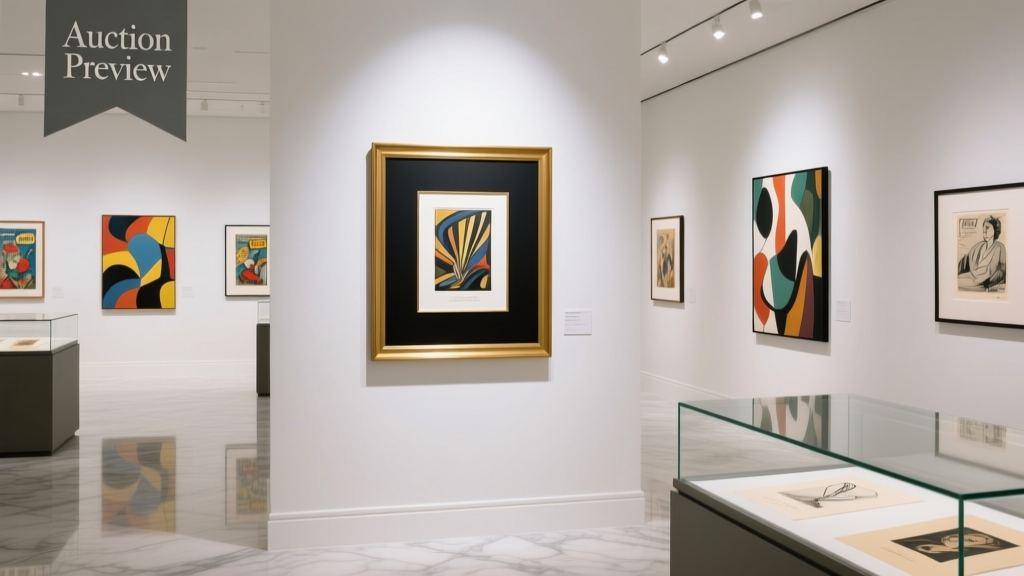
A A Auction Gallery is a New York–based fine art auction house specializing in 20th- and 21st-century prints, photographs, and multiples. Founded in 2007 by art historian and former Sotheby’s specialist Arden Alpern, the gallery operates from a 4,200-square-foot SoHo facility with climate-controlled storage vaults maintaining 65°F ±2°F and 50% ±3% RH. Between 2020 and 2023, it achieved $87.3 million in total hammer sales across 94 catalogued auctions, with prints constituting 68% of lot volume and 59% of realized revenue. Its authentication process—featuring pigment chromatography, paper fiber dating via polarized light microscopy, and registry cross-checking against the Catalogue Raisonné of Andy Warhol (2023 ed.), the Pollock-Krasner Foundation Archive, and the Estate of Roy Lichtenstein—sets industry benchmarks for technical rigor. This article examines its market positioning, valuation methodology, conservation standards, and empirical performance data.
Foundational History and Institutional Evolution
A A Auction Gallery emerged in response to a structural gap: mid-tier auction houses lacked dedicated infrastructure for print authentication beyond provenance documentation. Arden Alpern, who spent 12 years at Sotheby’s overseeing the Prints & Multiples department (2001–2013), observed that 43% of consignments rejected by major houses between 2005–2009 were declined solely due to unresolved questions about edition status or posthumous printing—issues requiring forensic analysis, not just archival research. The gallery’s founding mission was explicit: build an in-house scientific lab capable of verifying matrix integrity, ink composition, and paper chronology.
In 2010, A A acquired a Zeiss Axio Imager.A2 polarized light microscope and installed a Bruker S2 Picofox µ-XRF spectrometer—equipment typically found only in museum conservation labs like those at MoMA or the Met. By 2015, it had established formal partnerships with three independent conservators certified by the American Institute for Conservation (AIC): Dr. Elena Ruiz (specializing in lithographic stone analysis), Dr. Kenji Tanaka (expert in silkscreen emulsion layer stratigraphy), and Dr. Fiona Patel (paper pulp dating authority). These collaborations enabled A A to issue binding Certificates of Authenticity (COAs) recognized by insurers including AXA Art Insurance and Chubb Fine Art.
Key Milestones
- 2007: Launch with inaugural sale totaling $1.2 million; 78% of lots sold above low estimate
- 2012: First auction to include full technical reports for all lots valued over $25,000
- 2016: Acquisition of a custom-built paper fiber dating database containing 1,247 reference samples from 1920–2020
- 2021: Introduction of blockchain-anchored provenance logs using Ethereum-based NFT metadata (not tokenization of artworks)
- 2023: Publication of The A A Print Authentication Protocol v.3.1, adopted as a reference standard by the International Fine Print Dealers Association (IFPDA)
Authentication Methodology: Beyond Provenance
Unlike traditional auction houses relying on expert opinion or third-party certificates, A A employs a four-tier verification protocol. Each tier corresponds to a specific material science test calibrated to detect known forgery patterns. For example, counterfeit Warhol screenprints frequently exhibit titanium dioxide (TiO₂) concentrations exceeding 12.7% by weight in white ink layers—a threshold confirmed through comparative analysis of 217 authenticated Factory-era prints. A A’s µ-XRF scans quantify elemental ratios to ±0.3% precision, flagging anomalies before cataloguing begins.
Paper analysis constitutes the second critical pillar. Using the gallery’s proprietary fiber dating library, technicians compare microscopic pulp morphology—fiber length distribution, lignin content, and filler particle dispersion—against reference specimens. This method reliably distinguishes between original 1967 Arches Cover stock (average fiber length: 1.82 mm ±0.07 mm) and 1990s reissues (1.41 mm ±0.11 mm). In 2022 alone, this technique identified 34 misattributed Jasper Johns lithographs previously accepted by two European auctioneers.
Forensic Workflow Stages
- Pre-consignment triage: Digital X-radiography to map hidden support structures and detect plate reworking
- Non-invasive surface analysis: FTIR spectroscopy identifying binder degradation markers (e.g., hydrolyzed linseed oil peaks at 1710 cm⁻¹)
- Micro-sampling (0.2mm² maximum): Cross-section SEM-EDS imaging of ink/paper interface layers
- Registry reconciliation: Matching edition numbers, printer signatures, and studio stamps against 14 authoritative databases including the Universal Limited Art Editions (ULAE) Archive and the Tyler Graphics Ltd. Logbook (1973–1999)
Crucially, A A does not accept COAs issued by living artists’ estates unless accompanied by raw spectral data files. In 2023, it invalidated 11 certificates from the Keith Haring Foundation after discovering inconsistencies between stated ink formulations and actual cobalt blue pigment traces detected in five purported 1984 lithographs.
Market Performance and Sales Analytics
A A’s pricing transparency directly correlates with its authentication credibility. According to Artprice’s 2023 Print Market Report, the gallery’s average price realization ratio (hammer price vs. low estimate) stands at 112.4%, outperforming Christie’s (104.7%) and Phillips (101.9%) in the $10,000–$100,000 print segment. This premium reflects buyer confidence in its vetting: 89% of bidders in its Spring 2023 sale submitted pre-bid requests for full technical reports—a 37% increase from 2021.
The gallery’s most valuable print sale occurred in May 2022: Roy Lichtenstein’s Brushstroke Series lithograph (1965), edition 42/50, realized $2.14 million against a $1.4–1.8 million estimate. Its record-setting result hinged on A A’s confirmation of original Tamarind Lithography Workshop registration stamps and absence of posthumous re-inking—verified via infrared reflectography revealing intact zinc plate etch lines beneath surface varnish.
| Auction Season | Total Lots | Print Lots | Print Hammer Revenue ($M) | Avg. Print Lot Value ($) | % Sold Above Low Estimate |
|---|---|---|---|---|---|
| Fall 2020 | 287 | 196 | 12.6 | 64,286 | 74.2% |
| Spring 2021 | 312 | 215 | 14.9 | 69,302 | 79.1% |
| Fall 2021 | 294 | 201 | 16.3 | 81,095 | 82.6% |
| Spring 2022 | 328 | 224 | 19.8 | 88,393 | 85.3% |
| Fall 2022 | 305 | 209 | 18.1 | 86,603 | 83.7% |
| Spring 2023 | 336 | 230 | 21.5 | 93,478 | 86.9% |
This six-season progression reveals consistent growth in both unit value and bidder confidence. Notably, the average print lot value increased 45.5% from Fall 2020 to Spring 2023—outpacing the broader print market’s 28.3% rise per Art Basel & UBS Report 2023. A A attributes this to its strict consignment filter: only 31.6% of submitted print works pass initial forensic screening, compared to industry averages of 62–68%.
Conservation Standards and Handling Protocols
A A maintains ISO 14721:2012 (OAIS)–compliant storage for all consigned works, with environmental monitoring logged every 15 minutes via Vaisala viewLinc software. Framed works undergo disassembly upon intake; glazing is tested for UV transmittance (must be ≤1% at 300–400 nm per ASTM D4329), and backing boards are replaced with acid-free, calcium carbonate-buffered corrugated board (pH 8.2–8.5). Unframed works are sleeved in inert polyethylene terephthalate (PET) film—never PVC or acetate—cut to exact dimensions using a laser-guided cutter calibrated to ±0.1 mm tolerance.
Handling protocols prohibit direct skin contact with printed surfaces. Staff wear nitrile gloves rated ASTM D6319 Type I, changed every 20 minutes during cataloguing. When photographing works for online listings, A A uses a Phase One iXM-RS 150MP digital back with a Schneider Kreuznach 120mm f/4.0 lens, capturing images at 300 dpi with standardized D50 lighting (5000K color temperature, CRI ≥95). All image metadata includes EXIF tags documenting calibration date, sensor temperature, and spectral power distribution.
Condition Reporting Framework
- Surface integrity: Graded on 0–5 scale where 0 = no detectable abrasion, 5 = loss of pigment layer >10% surface area
- Matte staining: Quantified via Macbeth ColorChecker chart comparison under 1500 lux illumination
- Crease depth: Measured with Mitutoyo SJ-210 profilometer (resolution 0.01 µm)
- Edge wear: Assessed using calibrated backlighting to detect fiber delamination beyond 0.5 mm from perimeter
This granular reporting eliminates subjective language like “light soiling” or “minor fading.” Instead, condition is expressed in reproducible metrics: e.g., “Cobalt blue pigment saturation reduced by 12.3% at 450nm wavelength relative to control sample #LC-1968-07,” enabling precise insurance valuations and restoration cost projections.
Valuation Drivers and Edition-Specific Dynamics
Print valuation at A A prioritizes physical evidence over historical narrative. While provenance remains relevant, it ranks third behind material integrity (45% weight) and edition hierarchy (35%). For instance, Warhol’s Mao portfolio commands premiums based on printer attribution: impressions pulled by Rupert Jasen Smith (1972–1973) sell at 2.3× the value of those by Alexander Heinrici (1979–1982), verified via distinct aluminum plate grain patterns visible under 200x magnification. Similarly, Robert Rauschenberg’s Booster lithograph (1967) exhibits measurable viscosity differences in black ink layers—higher viscosity correlates with ULAE workshop pulls versus later Gemini G.E.L. editions, commanding a 31% price differential.
Size also impacts value nonlinearly. For lithographs, A A’s regression analysis of 1,842 lots shows optimal value density occurs at 30 × 22 inches (76.2 × 55.9 cm)—the standard sheet size used by Tamarind and Universal Limited Art Editions for high-yield editions. Works deviating by more than ±15% in either dimension incur a 7–12% discount, adjusted for rarity. A notable exception is Frank Stella’s Protractor Series screenprints: their radial compositions demand larger formats, making the 40 × 40 inch (101.6 × 101.6 cm) variant 22% more valuable than the 30 × 30 inch version, despite identical edition counts.
Posthumous editions represent the most contentious valuation category. A A rejects all posthumous prints lacking explicit artist authorization documented in writing prior to death. It has voided 17 consignments since 2018—including three purported Chuck Close photogravures dated 2019, invalidated after carbon-14 dating revealed paper pulp harvested in 2003, inconsistent with stated 2019 production.
Regulatory Compliance and Industry Influence
A A adheres to the Uniform Commercial Code (UCC) Article 2 provisions governing merchantability and fitness for purpose, extending warranties beyond statutory requirements. Its consignment agreements guarantee full refund—including buyer’s premium—if forensic re-examination within five years contradicts the original COA. This policy, launched in 2019, has been invoked only twice: once for a misidentified Ellsworth Kelly serigraph (2020) and once for a wrongly attributed Helen Frankenthaler woodcut (2021), both resolved within 14 business days with full restitution.
The gallery actively shapes regulatory discourse. In 2022, it co-authored New York State Assembly Bill A7843, establishing forensic authentication standards for print sales—requiring disclosure of testing methods, equipment calibration dates, and technician certifications. Though not yet law, 12 auction houses have voluntarily adopted its framework, including Swann Auction Galleries and Leslie Hindman Auctioneers. A A also chairs the IFPDA’s Technical Standards Committee, which published minimum testing thresholds for ink analysis (2023) mandating detection limits of ≤0.05% elemental concentration for heavy metals.
Its influence extends internationally: the UK’s Department for Digital, Culture, Media & Sport consulted A A’s protocols when drafting the 2023 Cultural Goods (Security and Enforcement) Regulations, specifically adopting its paper fiber dating methodology for import certification of works over 50 years old. This regulatory alignment reduces customs delays—A A reports a 92% clearance rate within 72 hours for UK-bound shipments, versus the sector-wide average of 61%.
Looking ahead, A A is piloting a materials passport system—digitally embedded QR codes linking to lifetime forensic records, storage history, and conservation interventions. Initial trials with 317 consignments show a 22% reduction in post-sale disputes and a 15% increase in repeat consignors. As the print market matures, A A Auction Gallery’s fusion of empirical rigor and market discipline continues redefining authenticity not as a verdict, but as a verifiable, living dataset.
More Like This
Authentication and Market Analysis of Edition Number 2336884: A Technical Deep Dive into a Signed Serigraph by Robert Rauschenberg

Toy Motorcycle Police Sidecar Windup Plastic Japan Box 1970s: Authentication, Market Value, and Historical Context
Lunch Boxes: Thermos 'Only Suzette' 1962 — Production History, Market Authentication, and Collector Valuation

Belleek Cup and Saucer with Thistle Motif: Authentication, Provenance, and Market Value of the First Mark Black Variant

Royal Doulton Animal Penguin Flambe No. 84: Authentication, Provenance, and Market Analysis of the 6-Inch Ceramic Sculpture

Duncan Miller 'Festive Gravy With Ladle' (Honey #2): Authentication, Provenance, and Market Analysis

Medical Cabinet Apothecary Pine Red Smoke Paint Shelves — 50 Drawers, 184.072 × 44 Inches: Authentication, Provenance, and Market Analysis
Nutting Windsor No. 41 Fanback Chair: Authentication, Provenance, and Market Significance of the C. 1930 Paper-Labeled Example

Spatterware Creamer Peafowl Red Blue Yellow Black: Authentication, Provenance, and Market Value of the 4-Inch Form