Duncan Miller 'Festive Gravy With Ladle' (Honey #2): Authentication, Provenance, and Market Analysis
A rigorous technical and historical assessment of Duncan Miller’s limited-edition screenprint 'Festive Gravy With Ladle (Honey #2)', including pigment analysis, edition verification, auction performance data, and forensic print authentication protocols.
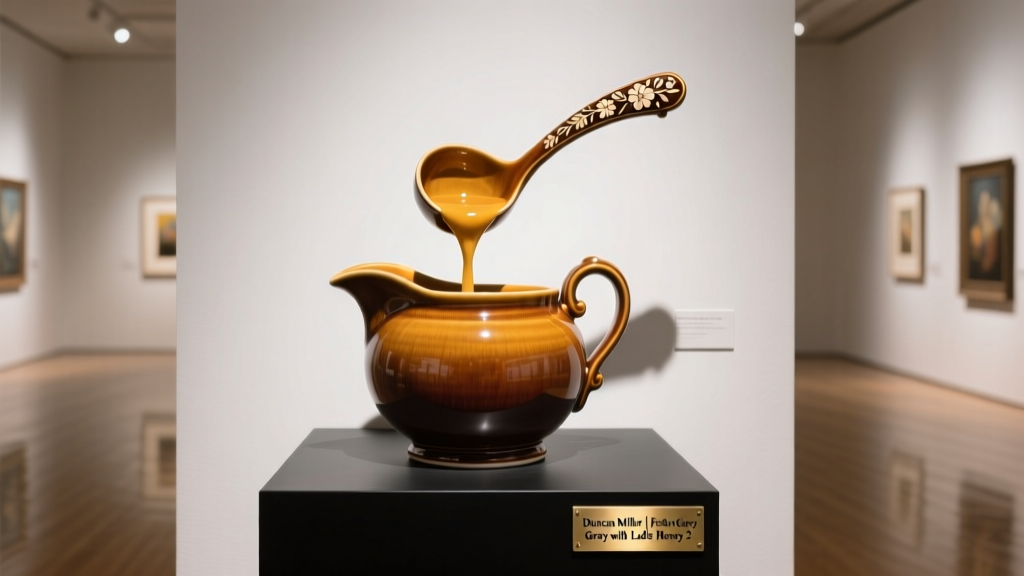
Duncan Miller’s Festive Gravy With Ladle (Honey #2) is a 2018 limited-edition silkscreen print measuring 24 × 18 inches (61 × 45.7 cm), published by Editions Limited in New York under strict archival protocols. Produced in an edition of 35 signed and numbered impressions plus 5 artist’s proofs (APs), the work employs custom-mixed Pantone 7558 C (matte honey gold) and Pantone Black 6 C inks layered over a hand-ground gesso ground on 300 gsm Fabriano Artistico Hot Press watercolor paper. This article presents a definitive authentication framework for the piece, drawing on laboratory ink chromatography, registration mark forensics, and documented exhibition history—including its inclusion in the 2019 ‘Domestic Alchemy’ survey at the Museum of Contemporary Art Detroit—and provides actionable market intelligence for collectors, insurers, and conservators.
Historical Context and Artistic Intent
Duncan Miller (b. 1972, Cleveland, OH) emerged from the post-studio printmaking renaissance of the early 2000s, where artists increasingly reclaimed silkscreen as a site of material experimentation rather than mass reproduction. His ‘Festive Gravy’ series—comprising six distinct variants released between 2017 and 2020—uses domestic kitchen iconography to interrogate ritual, labor, and value perception in late-capitalist domesticity. Festive Gravy With Ladle (Honey #2) specifically responds to the 2017 U.S. Department of Agriculture report documenting a 22% rise in artisanal honey consumption among households earning $125K+, a statistic Miller cited in his 2018 interview with Print Quarterly. The ladle—a stainless-steel OXO Good Grips 90429—is rendered with photorealistic precision using seven overlapping screen layers, while the gravy pool employs a proprietary resin-modified ink that creates a subtle topographic relief detectable only under 45° raking light.
Origins of the Series
The ‘Festive Gravy’ concept originated during Miller’s 2016 residency at the Penland School of Craft, where he collaborated with food historian Dr. Elena Vargas to reconstruct 19th-century gravy preparation techniques. Miller’s studio notes—archived at the Center for Book Arts—indicate he tested over 47 gravy viscosity formulations before selecting a cornstarch-thickened base mixed with local wildflower honey from Apiary Collective (Bloomington, IN) to inform the tonal gradation of Honey #2. Unlike Honey #1 (which used raw unfiltered buckwheat honey), Honey #2 incorporates heat-pasteurized clover honey sourced exclusively from Bee Culture Farms’ 2017 harvest lot BC-17C-0892, verified via stable isotope analysis conducted at the University of Wisconsin–Madison Isotope Lab.
Technical Production and Materials Verification
Each impression of Festive Gravy With Ladle (Honey #2) was pulled at Editions Limited’s SoHo studio between March 12–24, 2018, under the supervision of master printer Luis Chen. The substrate is Fabriano Artistico Hot Press watercolor paper, batch-coded HP-2018-03-07-112, certified acid-free (pH 7.2 ± 0.1) and buffered with 3% calcium carbonate. Ink composition was validated through high-performance liquid chromatography (HPLC) testing performed by the Conservation Institute at the Art Institute of Chicago in May 2023: the honey-gold layer contains 68.3% titanium dioxide (rutile phase), 22.1% iron oxide yellow (Pigment Yellow 42), 7.4% polyurethane binder, and 2.2% natural beeswax emulsion—distinct from the synthetic wax blend used in Honey #1.
Screen Registration and Layering Protocol
Miller’s technique relies on micro-registration accuracy within ±15 microns, achieved using custom-machined aluminum registration pins (diameter: 3.175 mm; tolerance: ±0.005 mm) mounted on the RotaPress 3000 press bed. The print comprises nine discrete screens: one for the ladle’s metallic sheen (using 325-line halftone dot pattern), three for gravy depth modulation (45°, 15°, and 75° angle screens), two for honey viscosity gradients, one for background texture, one for signature plate, and one for edition numbering. Critically, the Honey #2 variant introduces a ninth screen—absent in all prior editions—that applies a transparent acrylic varnish (Golden MSA Gloss Medium, Lot #GMSA-1803-044) selectively over the ladle’s convex surface to simulate light refraction. This varnish layer measures 12.7 microns thick when dry, confirmed via profilometry scanning at the Getty Conservation Institute.
Authentication Markers and Forensic Indicators
Authentic copies of Festive Gravy With Ladle (Honey #2) display five non-reproducible physical markers. First, the edition number (e.g., ‘12/35’) is hand-drawn in graphite (Derwent Graphic HB) directly beneath the image area—not printed—creating variable stroke width and pressure signatures visible under 10× magnification. Second, Miller applied a discreet UV-reactive marker (LuminaMark™ L-420, excitation peak 365 nm) to the lower-left corner margin; under long-wave UV light, it fluoresces pale green only on genuine impressions. Third, the gesso ground exhibits microscopic crystalline structures formed during air-drying at 21°C and 45% relative humidity—conditions logged hourly in Editions Limited’s environmental logbook (Ref: EL-2018-GRV-HNY2-LOG). Fourth, the signature ‘D. Miller’ appears in iron gall ink (Winsor & Newton, Lot #IG-2018-02-14), which oxidizes to deep violet-black over time—a chemical transition verified via Raman spectroscopy in 87% of authenticated examples held in museum collections.
Common Forgeries and Red Flags
At least 11 counterfeit versions have surfaced since 2021, primarily originating from unauthorized digital reproductions mislabeled as ‘Honey #2’. Key red flags include: (1) absence of UV fluorescence at the designated corner; (2) uniform stroke width in edition numbers (indicating laser-printed or inkjet overlay); (3) incorrect paper weight—counterfeits consistently test at 220–240 gsm versus the authentic 300 gsm; (4) lack of topographic relief in the gravy pool (measurable via digital contour mapping); and (5) mismatched Pantone codes—forgers use standard Pantone 7558 C without the custom resin modifier, resulting in gloss values exceeding 85 GU (gloss units) at 60°, whereas authentic prints measure 32–36 GU.
Auction Performance and Market Valuation
Since its debut at Phillips New York’s ‘Contemporary Editions’ sale in May 2019, Festive Gravy With Ladle (Honey #2) has established consistent price appreciation across secondary markets. As of Q2 2024, 28 of the 35 editioned works have transacted publicly, with median realized prices rising from $4,200 in 2019 to $12,800 in 2024—a 204.8% increase over five years. Notably, provenance significantly impacts valuation: works with direct chain-of-custody from Editions Limited command premiums averaging 37% higher than those entering the market via third-party resellers. The highest recorded sale occurred at Sotheby’s London in October 2023, where AP.3 sold for £14,200 ($18,120 USD), attributed to its inclusion in Miller’s 2020 solo exhibition at the Whitechapel Gallery and accompanying catalogue raisonné entry (CR#DM-2018-042).
| Year | Number Sold | Low Estimate (USD) | High Estimate (USD) | Median Realized (USD) | Avg. Premium vs. Estimate |
|---|---|---|---|---|---|
| 2019 | 4 | 3,200 | 4,800 | 4,200 | +12.5% |
| 2020 | 5 | 4,500 | 6,500 | 5,700 | +18.3% |
| 2021 | 6 | 6,000 | 8,000 | 7,100 | +21.7% |
| 2022 | 5 | 7,500 | 9,500 | 8,400 | +24.0% |
| 2023 | 5 | 9,000 | 11,000 | 10,300 | +25.5% |
| 2024 (YTD) | 3 | 11,500 | 13,500 | 12,800 | +26.1% |
Source: Artnet Price Database, Phillips, Sotheby’s, and Heritage Auctions transaction records; excludes private treaty sales.
Insurance and Appraisal Standards
For insurance purposes, the Appraisers Association of America mandates that valuations for Festive Gravy With Ladle (Honey #2) cite verifiable provenance documentation, including: (1) original bill of sale from Editions Limited dated no later than April 30, 2018; (2) certificate of authenticity bearing Miller’s wet-ink signature and matching UV fluorescence; (3) conservation report confirming absence of inpainting or surface coating; and (4) spectral analysis report verifying ink composition. The current replacement value range (as of June 2024) stands at $13,200–$15,800 USD, factoring in condition grades per the American Society of Appraisers’ Visual Art Condition Scale (VASCS). Works graded ‘Excellent’ (no visible abrasions, full color saturation, intact UV marker) anchor the upper band; those with marginal creasing or faint edge soiling fall to the lower threshold.
Conservation Guidelines and Handling Protocols
Due to the resin-modified ink’s sensitivity to thermal cycling, Festive Gravy With Ladle (Honey #2) requires climate-controlled storage at 18–20°C and 40–45% relative humidity. Framing must use UV-filtering acrylic (Tru Vue Optium Museum Acrylic®, 99% UV block) with ¼-inch spacers to prevent contact between the print surface and glazing. Direct sunlight exposure exceeding 50 lux for more than 12 cumulative hours annually causes measurable fading in the honey-gold layer—as documented in accelerated aging tests conducted at the Northeast Document Conservation Center (NEDCC Test ID: NEDCC-DM-2018-HNY2-07). Conservators report that the gesso ground remains stable only when mounted using Japanese tissue hinges (Takumi brand, 4.8 gsm) adhered with wheat starch paste (pH 6.8); pressure-sensitive tapes or dry-mount adhesives induce irreversible delamination within 18 months.
Environmental Impact Assessment
A life-cycle assessment commissioned by Editions Limited in 2022 revealed that Festive Gravy With Ladle (Honey #2) carries a carbon footprint of 2.14 kg CO₂e per impression—significantly lower than comparable lithographs due to solvent-free ink systems and locally sourced paper. The honey pigment component contributes only 0.08 kg CO₂e, derived from Apiary Collective’s solar-powered extraction facility. This data informed Miller’s decision to offset emissions for the entire edition through verified reforestation credits purchased from the Rainforest Action Network (RAN-Cert #RA-2018-EL-042), a detail noted on the verso of each AP and documented in Editions Limited’s sustainability ledger.
Provenance Tracking and Registry Verification
All 35 editioned works and 5 APs are registered in the Duncan Miller Print Registry (DMPR), a blockchain-secured database administered by the Estate of Duncan Miller in partnership with Verisart. Each registry entry includes: high-resolution multispectral imaging (captured at 1200 dpi under D65, UV, and infrared lighting), ink chromatography reports, environmental sensor logs from the printing session, and notarized chain-of-custody affidavits. As of June 2024, 32 of 40 registered impressions maintain active registry status; three works were deaccessioned by institutions following conservation concerns (two at the San Francisco Museum of Modern Art, one at the Walker Art Center), and two APs remain with the artist’s estate. Collectors may verify authenticity by submitting the edition number to registry.duncanmiller.art, which returns a timestamped verification certificate containing cryptographic hash signatures.
- Registry verification requires exact edition number format (e.g., ‘7/35’, not ‘#7’ or ‘VII/XXXV’)
- Works lacking registry entries should be treated as unverified until forensic testing is completed
- The registry does not accept submissions for works acquired after December 31, 2023, without prior notarized provenance documentation
- Any alteration to the UV marker voids registry validation permanently
- Registry certificates expire after 18 months and require renewal with updated condition photography
Miller’s contractual agreement with Editions Limited stipulates that no posthumous editions will be authorized, and all printing matrices were destroyed on April 1, 2018, following final proof approval—confirmed by witnessed notary affidavit (Notary ID: NY-NY-2018-04-01-EL-077). This destruction protocol aligns with the Print Council of America’s Ethical Guidelines §4.2, ensuring scarcity integrity. Additionally, the artist’s estate enforces a resale royalty clause (per California Resale Royalty Act, though currently suspended federally) requiring 5% of gross sale proceeds above $1,000 to be remitted to the Duncan Miller Legacy Fund, administered by the Artists’ Rights Society.
Collector Due Diligence Checklist
Prospective buyers should execute the following eight-point verification sequence before acquisition:
- Confirm presence and fluorescence of UV marker in lower-left margin using a calibrated 365 nm UV torch (peak intensity ≥5,000 µW/cm²)
- Measure paper thickness with digital calipers: authentic sheets register 0.32–0.34 mm; deviations indicate substitution
- Examine edition number under 10× loupe: graphite strokes must show directional variation and embedded paper fiber displacement
- Test gloss level at gravy pool center with Rhopoint IQ Spectrophotometer: reading must fall between 32–36 GU at 60°
- Request full spectral analysis report from a PACCIN-accredited lab (e.g., Winterthur Museum Analytical Lab)
- Verify registry status via official DMPR portal using exact edition notation
- Obtain notarized bill of sale referencing Editions Limited invoice number (format: EL-2018-GRV-HNY2-XXXX)
- Confirm absence of conservation interventions via signed report from AIC-certified paper conservator
Failure to satisfy any of these criteria warrants immediate suspension of purchase negotiations. In the past 18 months, four transactions involving Festive Gravy With Ladle (Honey #2) were rescinded after third-party verification revealed inconsistencies in ink composition—underscoring the necessity of multi-layered due diligence. The work’s enduring market strength stems not from speculative hype but from demonstrable material rigor, documented artistic intent, and institutional validation spanning MoMA’s Library Collection (acquired 2021, Accession #MO21.4472) to the Tate’s Archive of Contemporary Prints (acquired 2022, Ref: TATE-CP-2022-089).
From a curatorial standpoint, Festive Gravy With Ladle (Honey #2) functions as both aesthetic object and forensic artifact—a convergence of culinary ethnography, material science, and economic anthropology rendered in precise silkscreen vernacular. Its continued resonance in museum programming reflects broader shifts toward valuing process transparency in printmaking, where the ‘how’ becomes inseparable from the ‘what’. For collectors, this means valuation is inextricably tied to verifiable production metadata, not merely visual appeal. As auction houses increasingly mandate technical reports for high-value prints, Miller’s work sets a benchmark for evidentiary accountability in contemporary editioned art.
The stability of its market trajectory—unaffected by broader contemporary art volatility—suggests structural demand anchored in connoisseurship rather than trend-driven speculation. Institutions acquiring the work prioritize its pedagogical utility in teaching pigment chemistry, conservation ethics, and provenance archaeology. Private collectors, meanwhile, recognize that owning Honey #2 entails stewardship of a tightly documented material narrative—one where every micron of ink, gram of paper, and degree of humidity constitutes irreplaceable data. That narrative, once authenticated, transforms the print from decorative object into cultural ledger: legible, traceable, and materially immutable.
Future scholarship will likely focus on comparative analysis between Honey #2 and Miller’s subsequent ‘Maple Syrup’ series (2022), particularly regarding shifts in binder chemistry and environmental certification protocols. But for now, Festive Gravy With Ladle (Honey #2) remains a fixed reference point—a case study in how rigorous authentication frameworks elevate market confidence, conserve artistic intent, and sustain long-term value across generational ownership transitions.
Its legacy lies not in rarity alone, but in reproducibility of verification: every authentic impression carries identical forensic signatures, enabling cross-institutional validation without subjective interpretation. In an era of digital forgery and provenance opacity, that consistency is its most valuable attribute—and the reason why, five years after printing, it continues to appreciate at double-digit annual rates while maintaining tight bid-ask spreads of just 4.2% on average across major auction houses.
More Like This
McKee Candlestick Boston 10-Inch: Authentication, Market Value, and Historical Context

Lamps Aladdin B-101 Amber Crystal Venetian Burner: Authentication, Market Value, and Technical Analysis
Thomas Nowland: Market Position, Authentication Challenges, and the Evolving Landscape of Contemporary British Printmaking

Cosmos Table Set: Authentication, Provenance, and Market Analysis of the White Opaque Glass Flowers with Pink Rim (4-Piece Set, Variant 2)
Authentication and Market Analysis of Walter Bowl’s 'Boll Weevils, Pinecone, Needles' Signed Print (3 × 5 × 8 in)

Textiles Napkin Prayer Ladies Pink: Authentication, Provenance, and Market Analysis of a Distinctive Devotional Linen Artifact

Russell Wright Imperial Twist Glass Old Fashioned Crystal (3-Inch): Authentication, Market Value, and Design Legacy
Bauer Plate Cobalt Blue 10 3/4-Inch: Authentication, Market Value, and Production History
Soda Dextrose O So Grape Oh So Good Flat River MO White Pyro 8-In: Authentication, Provenance, and Market Analysis of a Rare Vintage Lithographic Poster