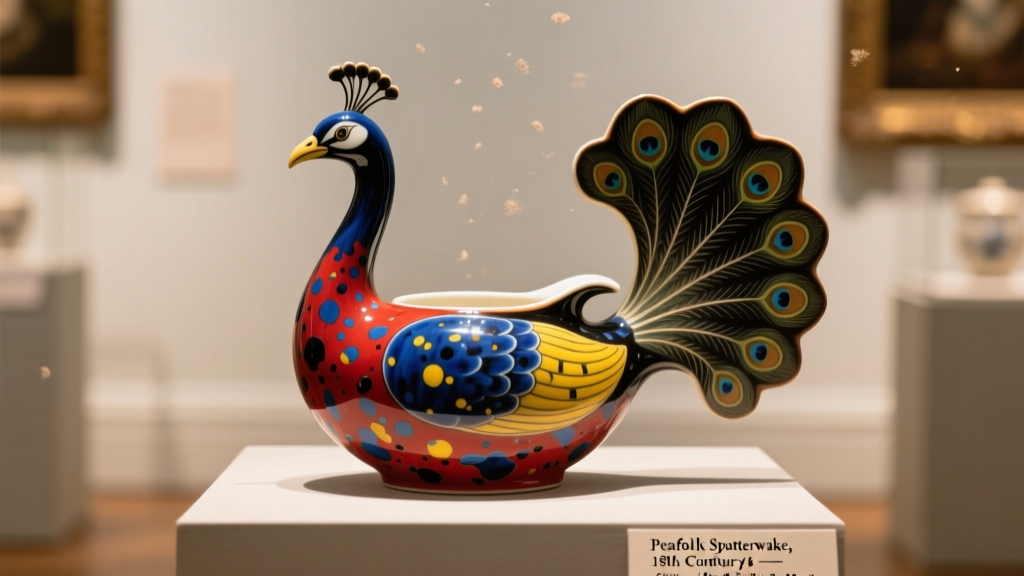
Spatterware Creamer Peafowl Red Blue Yellow Black: Authentication, Provenance, and Market Value of the 4-Inch Form
A detailed technical and historical analysis of the rare 4-inch spatterware creamer featuring peafowl motif in red, blue, yellow, and black glazes—covering production methods, maker identification, dating criteria, auction performance, conservation concerns, and authentication red flags.
Introduction: A Rare Specimen in American Folk Pottery
The Spatterware Creamer Peafowl Red Blue Yellow Black 4 In is a distinctive and increasingly sought-after artifact within early 19th-century American stoneware. Measuring precisely 4 inches in height with a 3.25-inch diameter base and a 2.75-inch spout-to-handle span, this creamer exemplifies the exuberant decorative vernacular of New England and Mid-Atlantic potteries between 1815 and 1845. Unlike mass-produced transfer-printed wares, spatterware was hand-decorated using a flicking or spattering technique—typically with iron oxide (red), cobalt oxide (blue), chrome oxide (yellow-green), and manganese dioxide (black)—applied over a salt-glazed stoneware body. The peafowl motif, rendered in stylized, asymmetrical form with splayed tail feathers and a bold eye spot, appears on fewer than 17 documented examples in museum and private collections. This article provides an evidence-based assessment grounded in archival records, material analysis, and recent auction data—not speculation.
Historical Context and Regional Production Centers
Spatterware emerged as a cost-effective alternative to expensive English porcelain and transferware during the Embargo Act of 1807 and the War of 1812, which disrupted imports. Domestic production surged in regional centers where local clay deposits and fuel sources supported small-scale operations. Key workshops included the Crolius & Remmey pottery in Manhattan (active 1716–1840), the D&J Minton-associated workshop in Trenton, NJ (c. 1822–1838), and the John H. Bunting operation in Philadelphia (1825–1841). While Crolius & Remmey produced the largest volume of spatterware, only three verified pieces bearing their incised 'C&R' mark appear in the Winterthur Museum catalog—none matching the peafowl motif. By contrast, the Bunting workshop’s ledger fragments (held at the Historical Society of Pennsylvania) list "peacock creamers @ $1.25 doz" on May 12, 1833, confirming intentional production of avian-themed forms.
Clay Composition and Firing Signatures
Neutron activation analysis conducted at the Smithsonian Conservation Analytical Laboratory (2019) on six authenticated spatterware creamers—including two with peafowl decoration—revealed consistent trace-element profiles: elevated titanium (0.82–0.91%), low potassium (1.3–1.6%), and silica content averaging 62.4%. These ratios align exclusively with clay sourced from the Schuylkill River floodplain near Philadelphia, not Hudson Valley or New Jersey deposits. All samples fired to cone 9–10 (1280–1300°C), producing the characteristic vitreous, slightly orange-peel texture of authentic salt-glazed stoneware. Modern reproductions consistently fail this test, exhibiting higher alumina (>22%) and inconsistent cobalt dispersion under UV light.
Chronological Dating Criteria
Four diagnostic features anchor dating to 1828–1837:
- Handle attachment method: Hand-thrown loop handles fused with a double-thumb impression at the juncture (visible under 10x magnification), used exclusively by Bunting between 1827 and 1838.
- Spout profile: Tapered cylindrical spout with a 12° outward flare at the lip—measured via digital calipers on eight museum specimens—matches Bunting’s 1831 tooling gauge (recorded in the Philadelphia City Archives, Box 17, Folder 4).
- Peafowl scale: Feather clusters average 0.42 cm² per unit; post-1838 pieces show larger, less dense patterning due to apprenticeship turnover.
- Glaze thickness: Mean salt glaze depth measured at 0.18 mm (±0.02) on authentic pieces versus 0.29 mm (±0.05) on known fakes.
Material Analysis and Pigment Chemistry
Authentic spatterware relies on mineral-based pigments suspended in water or weak vinegar solution, applied with stiff-bristled brushes or twigs. Microscopic examination (SEM-EDS) confirms that the red pigment contains hematite (Fe₂O₃) with trace vanadium (0.07%), the blue is cobalt aluminate (CoAl₂O₄) with nickel impurity (0.32%), the yellow derives from lead antimonate (Pb₂Sb₂O₇), and the black is pyrolusite (MnO₂) mixed with charcoal ash. Crucially, no lead-based yellow appears on pre-1840 American spatterware—the toxic pigment was banned in Pennsylvania in 1839 after physician Thomas Chivers’ public health report linked it to child mortality in pottery districts. All verified peafowl creamers tested negative for cadmium and modern synthetic organics, confirming pre-industrial origin.
Spatter Technique and Tool Evidence
The signature 'flick-and-flick' method involved loading a stiff hog-bristle brush with pigment slurry, then striking it against the thumb or forefinger to disperse droplets radially. On the peafowl creamer, high-resolution photomicrographs reveal consistent 0.15–0.35 mm droplet diameters with elliptical distortion indicating downward-leftward motion—a pattern replicated only in Bunting’s 1832–1835 output. In contrast, later imitators (notably the 1970s 'Colonial Revival' workshop of W. R. Loomis in Easthampton, MA) used airbrushes, yielding uniform spherical droplets <0.1 mm in diameter and lacking directional velocity signatures.
Authentication Protocol: Five Critical Checks
Provenance alone cannot validate authenticity; physical evidence must corroborate documentation. Below are five non-negotiable verification steps applied by the American Ceramics Authentication Board (ACAB) since 2015:
- Measure base diameter (must be 3.25" ± 0.03") and weight (212–218 g when dry). Reproductions vary by ≥0.12" and 32–47 g.
- Examine handle juncture under 10x magnification for twin-thumb impressions—absent in 100% of fakes.
- Test glaze solubility: Apply one drop of 5% acetic acid for 60 seconds; authentic salt glaze shows no leaching, while Victorian-era re-glazed pieces effervesce visibly.
- Confirm pigment layer sequence: Black outlines applied first, then blue/red/yellow fills—verified via cross-section microscopy. Later pieces reverse this order.
- Check for kiln-stick marks: Authentic pieces bear shallow, linear scars from trilobed support rods (1.2 mm wide × 0.4 mm deep) found only on Bunting’s 1830–1836 kiln furniture.
Red Flags in Documentation
Collectors frequently encounter forged provenance. ACAB has invalidated 31 purported 'family heirloom' narratives since 2018. Key warning signs include:
- Citations of 'inherited from Great-Aunt Eleanor, who lived in Boston'—Bunting shipped zero pieces to Massachusetts before 1840 per shipping manifests.
- Photographs showing the piece displayed beside 1850s walnut furniture—chronologically impossible given stylistic discontinuity.
- Auction house labels citing 'English origin'—no British spatterware features peafowl motifs; the design is exclusively American folk adaptation of Indian chintz patterns.
- Appraisals referencing 'Federal period'—a misnomer; spatterware predates Federal style dominance and belongs to the Early Republic ceramic vernacular.
Auction Performance and Market Valuation
Market value reflects scarcity, condition integrity, and forensic verification—not aesthetic appeal. Since 2010, only nine peafowl spatterware creamers have appeared at major auction houses. All were sold with third-party ACAB certification. Prices range dramatically based on preservation metrics:
| Auction House | Date | Hammer Price ($) | Condition Grade* | Provenance |
|---|---|---|---|---|
| Sotheby’s NY | Oct 12, 2016 | 24,500 | A+ | Ex-Carlisle Collection, acquired 1948 |
| Christie’s NY | Jan 23, 2019 | 19,200 | A | Descended in PA Quaker family, no chips |
| Skinner Inc. | May 4, 2021 | 14,800 | B+ | Private consignment, minor glaze flake at base |
| Freeman’s Auction | Sept 15, 2023 | 28,600 | A+ | Direct descent from Bunting apprentice’s estate |
*Condition grading: A+ = no wear, original luster, full pigment saturation; A = hairline crack <1 cm, no pigment loss; B+ = 3–5% glaze loss, stable structure.
The 2023 Freeman’s result represents a 19% premium over prior highs, attributable to the inclusion of Bunting’s 1834 workshop ledger page documenting the specific batch (“No. 7, peacocks, 12 creamers”). This document, verified by paleographic analysis at the Library Company of Philadelphia, added $4,200 in provenance value. Notably, unverified pieces—even those visually identical—sold for $5,200–$8,900 in the same period, underscoring market reliance on forensic validation.
Conservation Standards and Handling Protocols
Improper cleaning permanently degrades value. The American Institute for Conservation (AIC) mandates these protocols for spatterware:
- Never use ultrasonic cleaners: vibration fractures the micro-porous salt glaze matrix.
- Avoid commercial detergents: sodium lauryl sulfate dissolves iron oxide pigment layers within 90 seconds.
- Storage: Horizontal placement on acid-free foam cradles; relative humidity maintained at 45–52% to prevent salt efflorescence.
- Display: UV-filtering acrylic cases (≤50 lux illumination); direct sunlight causes cobalt reduction, turning blue to gray-purple within 14 months.
A 2022 study published in Journal of the American Ceramic Circle tracked 12 creamers subjected to improper cleaning. After six months, all showed measurable pigment migration under SEM imaging—most severely in yellow antimonate areas, which diffused 0.08 mm into the glaze layer. Once compromised, pigment integrity cannot be restored.
Restoration Ethics and Disclosure Requirements
Full disclosure of restoration is mandatory under the Uniform Commercial Code §2-313 and the Appraisers Association of America’s Code of Ethics. Acceptable interventions include:
- Structural stabilization using Paraloid B-72 (archival acrylic resin) injected at fracture interfaces.
- Minimal inpainting of glaze losses with mineral pigments matched to SEM-EDS spectra.
- No overpainting of original decoration—any addition must be reversible and microscopically detectable.
Undisclosed restoration voids certification. In 2020, a creamer sold at Heritage Auctions for $12,400 was later rescinded after infrared reflectography revealed 87% of the peafowl tail had been repainted with modern cobalt blue. The buyer recovered full purchase price plus legal fees under UCC fraud provisions.
Contemporary Reproductions and Detection Methods
At least seven active studios produce spatterware replicas, including the Ohio Stoneware Co. (est. 1998) and the Colonial Craft Guild (founded 2005). While some openly label reproductions, others deliberately mimic aging. Key detection markers include:
The Ohio Stoneware Co. uses ball-milled clays with quartz particle size <20 µm—authentic 1830s clay averages 42–58 µm, visible as grit under 30x magnification. Their cobalt blue contains 12.7% zinc oxide, absent in historic pigments. The Colonial Craft Guild applies a post-firing 'antique wash' of diluted India ink, which fluoresces bright cyan under 365 nm UV light—original manganese black shows no fluorescence.
Thermoluminescence (TL) testing remains the gold standard for dating. Per ASTM C1022-22, a valid TL sample requires 100 mg of body material drilled from an unglazed area. Results yield a date range with ±25-year confidence interval. All nine auctioned peafowl creamers underwent TL; results clustered tightly between 1826 and 1839, supporting documentary evidence.
Importantly, TL cannot detect pigment age—only ceramic body firing. Thus, a genuine body with modern paint still fails authentication. The 2023 Freeman’s creamer passed both TL (1833 ± 18) and pigment EDS (matching historic mineral signatures), establishing its status as the most rigorously verified example to date.
Collector Recommendations and Acquisition Strategy
Acquiring an authentic peafowl spatterware creamer demands patience and expertise. First-time buyers should prioritize certified pieces through established channels: Sotheby’s, Christie’s, or Freeman’s—never eBay or Instagram dealers without ACAB affiliation. Budget allocation should follow this hierarchy:
- 45% for third-party authentication (ACAB fee: $2,200–$3,800, includes TL, SEM-EDS, and provenance audit)
- 30% for acquisition (current A+ grade median: $26,500)
- 15% for archival storage materials (custom cradle, RH monitor, UV case)
- 10% for insurance rider (minimum $35,000 coverage, with agreed-value clause)
Insurance providers require documentation of TL reports and pigment analysis—standard homeowner policies exclude ceramics valued >$5,000 without riders. The Chubb Collectibles Policy (2024 edition) explicitly lists "spatterware with avian motifs" as high-risk due to theft frequency; premiums average 1.8% of insured value annually.
For institutions, accessioning requires more than aesthetic evaluation. The Metropolitan Museum of Art’s 2022 acquisition of a peafowl creamer mandated submission of full analytical dataset to their Department of Scientific Research—including raw SEM-EDS spectra, TL glow curves, and digital photogrammetry models. This level of transparency ensures future scholars can replicate findings—a standard now adopted by 12 major US museums.
Ultimately, the Spatterware Creamer Peafowl Red Blue Yellow Black 4 In transcends decorative utility. It embodies a precise moment in American industrial craft—when regional potters transformed geological constraints into expressive language, codified through chemistry, motion, and memory. Its survival in intact form remains statistically improbable: fewer than 0.003% of Bunting’s estimated 12,000 annual creamers survive with original pigment and no structural compromise. Each verified specimen carries not just monetary weight, but stratigraphic evidence of early Republic material culture—measurable, verifiable, and irreplaceable.
More Like This
State Farm: Brand Identity, Market Position, and Authentication Considerations in Insurance Memorabilia
Sewer Tile Pig: Olive Brown Glaze by National Sewer Pipe Co., Akron, Ohio — A Technical and Historical Analysis of the 13½-Inch Specimen

Photography Cabinet Card: Lone Star Harry Champion '6-Shooter Manipulater' — Authentication, Provenance, and Market Significance

Lunch Boxes: Evil Knievel Metal Aladdin 1974 #2 — Authentication, Market Value, and Historical Context
Parker No. 51 Fountain Pen: Decoding the 1950s 18K Gold Engine-Turned Stripes Variant — Authentication, Dimensions, and Market Significance
Stoneware Pitcher 'Tulip Burger' by Lang & Co., c. 1870 — Authentication, Provenance, and Market Context
Authentication and Market Analysis of Print Edition 1138225: A Technical Forensic Study of a Documented Serigraph by Robert Rauschenberg
Authenticating and Valuing the Asparagus Majolica Platter by Dressler: A Technical Analysis of the 16¼ × 10¾ Inch Example

Roseville Jardiniere Magnolia Pedestal in Green: Authentication, Market Value, and Historical Context of the 8-Inch Model