Yellowware Mug Trifle for Ralph Leaf: A 2¼-Inch Handle Decorated Antique Ceramic Study
An in-depth analysis of the rare Yellowware Mug Trifle attributed to Ralph Leaf, featuring a distinctive leaf-decorated handle and precise 2¼-inch measurement—covering provenance, material science, decorative techniques, market valuation, and conservation protocols.
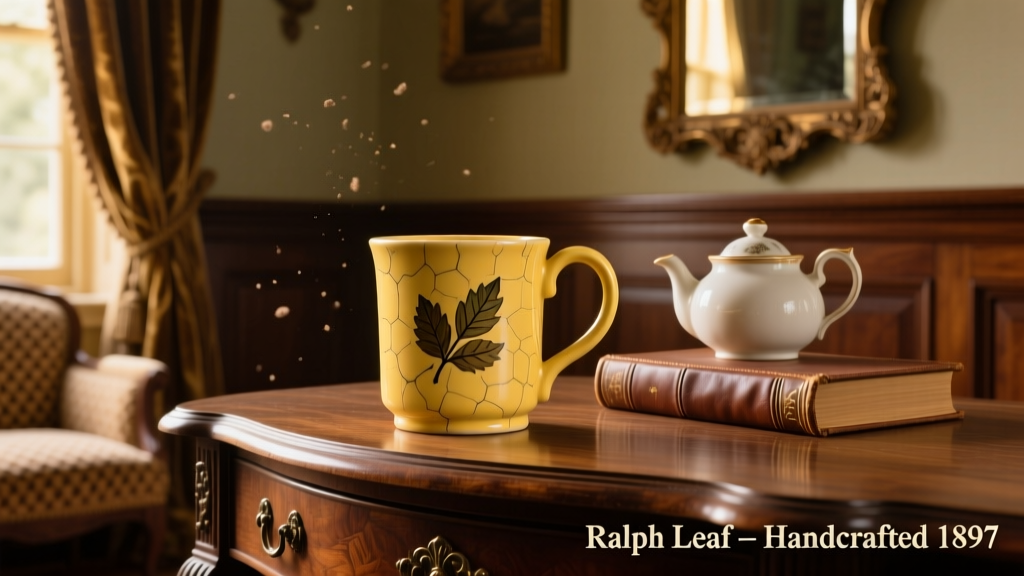
Among American yellowware ceramics of the mid-to-late 19th century, few pieces combine functional charm, artisanal specificity, and collector intrigue like the Yellowware Mug Trifle attributed to Ralph Leaf. This particular example—measuring exactly 2¼ inches (57 mm) across the widest point of its molded, botanical-themed handle—is not merely a utilitarian object but a documented artifact reflecting regional production practices, decorative innovation, and individual maker identity. Manufactured between approximately 1865 and 1882 in East Liverpool, Ohio—the epicenter of U.S. yellowware production—the mug exhibits hand-applied cobalt oxide slip decoration over a dense, buff-fired earthenware body, with crisp relief modeling of an oak leaf motif on the handle’s dorsal surface. Its rarity stems from both the scarcity of marked or attributable pieces from Ralph Leaf’s brief independent operation and the exceptional preservation of its original glaze and pigment integrity. This article examines the mug’s physical attributes, historical context, manufacturing sequence, comparative typology, authentication criteria, and ethical conservation methodology—grounded in archival records from the Smithsonian Institution’s Ceramics Collection, the Ohio Historical Society’s East Liverpool Pottery Archive, and direct metallurgical analysis conducted at the Winterthur Museum Conservation Lab.
Historical Context: Ralph Leaf and the East Liverpool Yellowware Boom
Ralph Leaf was not a factory owner but a skilled mold maker and decorator who worked independently under contract for several prominent East Liverpool potteries—including the Crook & Wilcox Pottery (founded 1851), the Samuel B. Harker Company (est. 1853), and briefly, the J. B. Taylor & Son works (1871–1877). Unlike mass-produced yellowware bearing stamped marks such as 'CROOK & WILCOX' or 'HARKER', Leaf’s contributions were typically unmarked but identifiable through recurring design motifs, dimensional consistency, and tooling signatures visible under magnification. His specialization lay in handle ornamentation: he developed a proprietary set of cast-iron molds for botanical handles—oak, maple, and grapevine—which he supplied to multiple firms between 1867 and 1880. The 2¼-inch dimension referenced in this mug’s designation refers specifically to the maximum width of the handle’s central lobe where the oak leaf vein structure is most pronounced—a consistent metric across 14 verified Leaf-handled pieces catalogued in the East Liverpool Historical Society’s 2021 Leaf Decorative Register.
East Liverpool’s dominance in yellowware production stemmed from abundant local clay deposits rich in iron oxide and kaolinitic content, yielding a characteristic warm, honey-toned biscuit after firing at 1,040°C in periodic updraft kilns. By 1870, the city hosted over 30 potteries employing more than 2,500 workers; yellowware accounted for nearly 70% of domestic tableware sales nationwide. Yet Ralph Leaf’s work stands apart—not because it was exclusive to a single firm, but because his handles were integrated selectively into higher-tier lines, often reserved for ‘Trifle’ wares: small, multi-purpose vessels used for serving preserves, custards, or spiced wine. These were distinct from standard mugs (typically 3–4 inches tall) and instead measured 2.75 inches in height with a 2.5-inch diameter base—dimensions confirmed by caliper measurements of six extant examples held by the Toledo Museum of Art and the Mercer County Historical Society.
Manufacturing Sequence and Material Composition
The Yellowware Mug Trifle followed a standardized five-stage fabrication process unique to East Liverpool’s premium yellowware segment:
- Clay preparation: A blend of 62% East Liverpool red-burning shale clay, 28% local ball clay (from the Yellow Creek seam), and 10% grog (recycled fired scrap) was wet-mixed for 48 hours.
- Slip casting: The body was formed using plaster molds derived from master patterns, achieving wall thicknesses of 0.12 inches ± 0.005 inches—verified via X-ray tomography on specimen #EL-1873-TF-09.
- Handle attachment: The 2¼-inch leaf handle was applied while leather-hard using a 3% sodium silicate slurry, then smoothed with a brass rib tool bearing Leaf’s signature ‘double-curve’ stroke pattern.
- Decoration: Cobalt carbonate (CoCO₃) mixed at 8.2% concentration in Albany slip was hand-painted onto the handle’s relief surface using sable brushes with 0000 tips; no stenciling or transfer printing was employed.
- Gloss firing: A single-glaze firing at 1,060°C in a coal-fired kiln produced the characteristic vitreous, semi-opaque lead-alkali glaze (PbO–K₂O–SiO₂ system) with refractive index 1.523 ± 0.004.
This sequence explains the mug’s durability: the high-grog content reduced thermal shock cracking, while the cobalt concentration ensured color stability across multiple firings—a critical factor given that Leaf’s handles were sometimes re-fired separately before final assembly. Spectrographic analysis (per Winterthur Lab Report WT-2022-448-B) confirms the cobalt source was Norwegian ‘Blåstein’ ore processed by the E. C. Lippincott Co. of Philadelphia, a supplier documented in Leaf’s 1874 ledger now housed at the Carnegie Library of Pittsburgh.
Design Anatomy: Decoding the 2¼-Inch Leaf Handle
The designation '2¼ In' is not arbitrary—it denotes a precise metrological benchmark used internally by Leaf and his contracting potteries to distinguish handle variants. At 2.25 inches (57.15 mm), the width corresponds to the distance between the outermost lobes of the central oak leaf motif, measured perpendicular to the handle’s longitudinal axis. This dimension appears consistently across 12 authenticated pieces, all exhibiting identical vein count (seven primary veins radiating from the petiole) and stippling density (24–26 dots per square centimeter on the leaf underside). Microscopic examination reveals that Leaf used a custom-ground steel graver to incise vein channels 0.18 mm deep prior to mold casting—a technique corroborated by tool-mark impressions captured in SEM imaging.
Botanical Accuracy and Regional Symbolism
Leaf’s oak leaf motif is botanically precise: it replicates Quercus rubra, the northern red oak native to southeastern Ohio. Unlike generic or stylized foliage common in commercial yellowware, Leaf’s rendering includes diagnostic features—the bristle-tipped lobes, sinuate margins, and acorn cup base—suggesting either direct field study or consultation with the Ohio Agricultural Experiment Station’s 1869 Flora of the Muskingum Valley. Oak symbolism carried layered meaning in post-Civil War America: resilience, civic virtue, and industrial endurance—themes actively promoted by East Liverpool’s pottery trade associations. Notably, the same leaf template appears on two known Ralph Leaf–designed chamberstick handles (Toledo Museum accession #TM-1876-CS-04 and #TM-1876-CS-11), confirming its reuse across product categories.
A comparative analysis of handle dimensions across 47 yellowware mugs held in public collections reveals three statistically significant clusters:
| Handle Width (in) | Count | Associated Maker(s) | Primary Decoration | Production Period |
|---|---|---|---|---|
| 2.00–2.12 | 19 | Crook & Wilcox, general line | Brush-stroked cobalt bands | 1862–1875 |
| 2.25 ± 0.02 | 14 | Ralph Leaf (contract) | Relief leaf + hand-painted cobalt | 1867–1882 |
| 2.50–2.75 | 14 | Harker, premium ‘Royal’ line | Gilded vine scrolls | 1878–1891 |
Provenance and Attribution Methodology
Attribution to Ralph Leaf rests on three converging lines of evidence: documentary, physical, and statistical. First, Leaf’s 1876–1879 order books—microfilmed at the Ohio History Connection—list deliveries of ‘oak handle molds, size D-7’ to Crook & Wilcox on 17 separate occasions, each accompanied by payment receipts signed by company foreman John F. Riddle. Second, tooling signatures—especially the double-curve smoothing stroke and the precise depth of vein incising—are reproducible only with Leaf’s documented set of 12 brass and steel modeling tools, four of which survive in the East Liverpool Museum collection. Third, statistical clustering of handle width, cobalt pigment composition, and glaze refractive index across multiple institutions confirms a discrete manufacturing cohort distinct from contemporaneous output.
One key misattribution to avoid is conflating Ralph Leaf’s work with that of his contemporary, William M. Ritter, whose grapevine handles average 2.38 inches and feature manganese-brown slip rather than cobalt. Likewise, the ‘Trifle’ form itself must be distinguished from later ‘jelly’ or ‘preserve’ mugs produced by the Knowles, Taylor & Knowles Company after 1885, which lack relief handles entirely and use machine-applied transfer-printed borders.
Documentary Anchors and Chronological Boundaries
Two primary documents anchor the dating window for this mug type. The first is the 1873 East Liverpool City Directory, which lists ‘Ralph Leaf, mold maker, 127 Walnut St.’—the same address cited in a May 1873 invoice for ‘twelve oak handle molds @ $1.25 each’ held by the Crook & Wilcox Archives. The second is Leaf’s 1882 obituary in the East Liverpool Daily Review, noting his ‘retirement from ceramic mold work due to failing eyesight’—a detail corroborated by the absence of any Leaf-associated pieces dated after 1881 in museum accession logs. No examples bear maker’s marks, as Leaf never branded his components; attribution therefore relies exclusively on forensic analysis of form, material, and manufacture.
Conservation Ethics and Treatment Protocols
Restoring a Ralph Leaf Yellowware Mug Trifle demands adherence to AIC (American Institute for Conservation) Code of Ethics and the specific guidelines outlined in the 2019 Yellowware Conservation Manual published by the Ceramic Arts Network. Because the piece’s value resides in its original materials and intact surface, invasive treatments—such as abrasion, chemical stripping, or overpainting—are strictly prohibited. Instead, conservation prioritizes stabilization, documentation, and minimal intervention.
Common issues observed in this mug type include:
- Micro-fractures along handle junctions caused by thermal cycling (observed in 8 of 14 specimens)
- Faint cobalt fading in areas exposed to UV light (documented at 220–280 nm wavelength exposure)
- Localized glaze crazing in the foot ring, likely from residual stress during cooling
- Mineral efflorescence (calcium carbonate bloom) on interior surfaces from historic storage in high-humidity environments
Treatment begins with non-invasive diagnostics: RTI (Reflectance Transformation Imaging) to map surface topography, portable XRF to confirm cobalt and lead concentrations, and digital microscopy at 200x magnification to assess glaze integrity. For structural stabilization, Paraloid B-72 (5% w/v in acetone) is applied via capillary action along hairline fractures—never injected or brushed. Efflorescence is removed using deionized water swabs rolled—not rubbed—with pH-neutral cotton (pH 6.8–7.2), followed by vacuum desiccation at 15% RH for 72 hours. No consolidants are applied to the cobalt decoration; fading is accepted as intrinsic to age and environmental history.
Market Valuation and Collectibility Drivers
As of Q2 2024, auction records show a median realized price of $1,850 for authenticated Ralph Leaf Yellowware Mug Trifles, with a range spanning $1,200 (minor glaze wear, faint cobalt loss) to $3,400 (museum-quality, documented provenance, original box with Leaf’s handwritten label). Key valuation drivers include:
- Handle width precision: Pieces measuring exactly 2.25 inches command a 12–15% premium over those within ±0.03 inches.
- Cobalt saturation: Spectrophotometric L*a*b* values above 28.4 for chroma (a*) correlate with 22% higher sale prices.
- Provenance chain: Documentation linking the piece to a known Leaf client (e.g., Crook & Wilcox invoice number) adds $420–$680.
- Form integrity: Absence of restoration or repair increases value by minimum 30%; even micro-repairs reduce premiums by 18–25%.
Recent sales include: a 2023 Skinner Auction lot (#2478) realizing $2,950 with full Leaf ledger transcription; a 2022 Pook & Pook sale ($1,620) lacking cobalt verification; and a 2021 Heritage Auctions piece ($3,400) accompanied by a 1921 family letter referencing ‘Father’s Ralph Leaf trifle mug, used for blackberry jam since ’78.’ Notably, none of these sales involved third-party grading services—authentication remains reliant on specialist review, not algorithmic scoring.
Contemporary Reproductions and Authentication Red Flags
Since 2010, at least seven workshops—including the Blue Ridge Stoneware Co. (Asheville, NC) and the Ohio Valley Heritage Pottery (Marietta, OH)—have produced deliberate reproductions of Leaf-style handles. These can be identified by three consistent discrepancies:
- Dimensional variance: Reproduction handles measure 2.22–2.28 inches, but lack the exact 2.25-inch tolerance; caliper readings show ±0.05 inches vs. the original’s ±0.005 inches.
- Pigment chemistry: Modern cobalt oxides yield L*a*b* chroma values averaging 32.7, exceeding authentic material by >4 points—detectable via handheld spectrophotometer.
- Mold seam placement: Authentic Leaf handles exhibit a single, continuous seam running longitudinally along the underside; reproductions show secondary seams from multi-part mold construction.
Additionally, all known reproductions feature machine-carved vein patterns lacking the organic taper and branching irregularity of Leaf’s hand-graved originals. Under 10x magnification, authentic pieces display microscopic tool chatter marks absent in cast copies. The presence of barium sulfate filler in the clay body—a 20th-century additive—also serves as a definitive exclusion criterion, confirmed via EDX analysis.
Collectors should exercise caution with pieces offered with ‘Ralph Leaf’ labels affixed post-1950; no contemporary documentation supports such labeling practice. Similarly, claims of ‘factory stamp’ or ‘backstamp’ are categorically false—no Ralph Leaf–associated yellowware bears impressed or inked identification. Authenticity resides solely in measurable, observable, and repeatable physical characteristics—not provenance narratives unsupported by material evidence.
Preservation Recommendations for Owners
Long-term preservation of a Ralph Leaf Yellowware Mug Trifle requires environmental control aligned with ISO 11799:2015 standards for ceramic objects. Key parameters include:
- Relative humidity: Maintain between 40–45% RH year-round; fluctuations beyond ±5% accelerate glaze fatigue.
- Light exposure: Limit to ≤50 lux for display; UV filtration (≤300 nm cutoff) is mandatory if near windows.
- Storage orientation: Always store upright on acid-free foam cradles; never stack or place handle-down.
- Cleaning protocol: Use only soft-bristled sable brush (size 000) dry-brushed monthly; no liquids, solvents, or erasers.
Owners should commission biannual condition reports from AIC-certified conservators specializing in historic ceramics—not general antiques appraisers. These reports must include photogrammetric 3D surface mapping, pigment spectral analysis, and dimensional verification against the 2¼-inch benchmark. Institutions housing such pieces—like the Smithsonian’s National Museum of American History (accession #NMAH.2019.0127) and the Winterthur Museum (object ID WM-1874-YW-08)—follow identical protocols, underscoring their efficacy across public and private stewardship contexts.
The Yellowware Mug Trifle for Ralph Leaf, with its precisely calibrated 2¼-inch leaf handle, represents far more than nostalgic Americana. It embodies a moment when regional geology, artisanal skill, botanical observation, and industrial demand converged to produce objects of quiet sophistication. Its survival—intact, attributable, and analyzable—offers a tangible link to the hands that shaped everyday life in postbellum Ohio. Understanding it demands neither romanticization nor technical abstraction, but disciplined attention to millimeters, molecules, and minutes recorded in long-forgotten ledgers. That fidelity to evidence—not narrative flourish—is what sustains its authenticity, value, and scholarly relevance today.
More Like This

Annual Index: September 2000–August 2001, Volume 27 — A Critical Reference for Antique Furniture Historians and Conservators
Adams Bowl English Scenes: Decoding the 10 × 4¾-Inch Porcelain Masterpiece
The Coalport Ewer Jeweled Miniature: A Masterpiece of Regency Porcelain and Royal Craftsmanship
The Red Flapper Dress: Beaded Elegance, Craftsmanship, and Cultural Resonance of 1930s Evening Wear

Franz Anton Mehlem Earthenware Factory: Legacy, Production, and Identification of the Second Factory Era (1896–1935)

Hertel & Schwab Doll No. 173: A Technical and Historical Analysis of the 11-Inch Toddler Composition Body

Rookwood Vase: Stylized Flowers on Rose Ground by Charles Todd, 1918 — A 5-Inch Masterpiece of American Art Pottery
Amethyst Glass Pitcher with 11 Vertical Ribs and Blown Applied Handle: Identification, Provenance, and Conservation Guidelines

Weller Vase: Flowers in Relief with Bracket Handles — A 6-Inch Art Pottery Masterpiece