World’s Columbian Exposition 1893: The Electrical Building China Plate — History, Identification, and Restoration Insights
A detailed examination of the rare porcelain plate commemorating the 1893 Chicago World’s Fair Electrical Building—covering its manufacturer (W. H. Grindley & Co.), design elements, historical context, market value indicators, and professional conservation protocols for antique china.
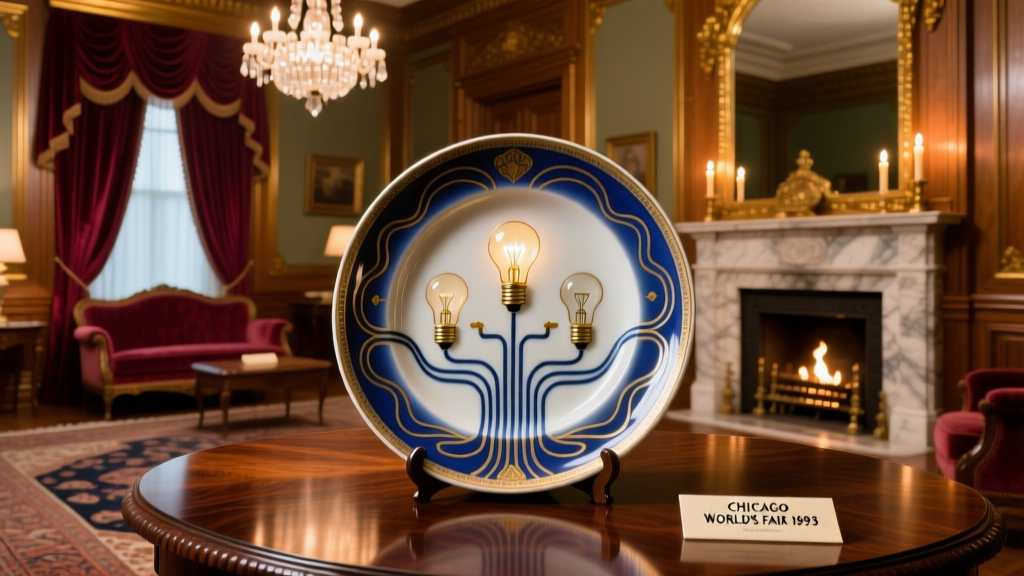
The World’s Columbian Exposition of 1893 in Chicago produced one of the most iconic and technically ambitious commemorative porcelain plates ever made: the Electrical Building china plate. Produced exclusively by W. H. Grindley & Co. of Tunstall, Staffordshire, England, this 10¾-inch (27.3 cm) bone china plate features hand-enamelled gold highlights, cobalt-blue transfer-printed architecture, and a distinctive green-and-gold border with electric light motifs. Only approximately 1,200 plates were issued between May and October 1893, making it exceptionally scarce today. Unlike mass-produced souvenir wares, this piece was commissioned by the fair’s official Electrical Building Committee and distributed to dignitaries, exhibitors, and select press. Its design captures the building’s revolutionary use of alternating current lighting—powered by Westinghouse generators—and reflects the era’s fervent optimism about electrical modernity.
Historical Context: The Electrical Building at the 1893 World’s Fair
The Electrical Building stood as the technological heart of the World’s Columbian Exposition. Located on the southern edge of the Court of Honor near the lagoon, it measured 410 feet long, 220 feet wide, and rose to a central dome height of 115 feet. Designed by architect Henry Ives Cobb, the structure featured a neoclassical façade adorned with colossal allegorical sculptures representing Electricity, Light, and Power—sculpted by Daniel Chester French and Frederick MacMonnies. Inside, over 200 companies exhibited—including Westinghouse Electric, General Electric, Edison Electric Illuminating Company, and Thomson-Houston—showcasing arc lamps, incandescent bulbs, dynamos, telephones, and early electric motors.
What distinguished the Electrical Building from all others was its illumination: over 12,000 incandescent lamps lit the interior and exterior after dusk, powered by three massive Westinghouse 1,000-horsepower alternators running at 125 volts AC. This was the first large-scale public demonstration of safe, reliable alternating current distribution—a pivotal victory for Westinghouse and Nikola Tesla over Thomas Edison’s direct-current system. The building itself became a symbol of progress, and its commemorative plate served not merely as a souvenir but as a diplomatic artifact affirming America’s industrial leadership.
Commissioning and Distribution Protocol
The plate was commissioned in late 1892 under the authority of the Electrical Building’s Executive Committee, chaired by Dr. William J. Hammer, chief electrician for Edison’s exhibit and later a consultant to Westinghouse. Distribution followed strict criteria: 327 plates went to foreign commissioners and consular representatives; 265 were allocated to U.S. state governors and mayors; 189 were reserved for exhibiting companies (Westinghouse received 12, GE received 8); and the remainder—419—were held for presentation to journalists accredited by the Exposition’s Press Bureau. No plates were sold publicly at the fairgrounds; retail sales only occurred post-closure through select department stores like Marshall Field & Co., which offered them at $3.50 each (equivalent to roughly $120 in 2024 USD).
Manufacturing Origins: W. H. Grindley & Co. and British Porcelain Craftsmanship
W. H. Grindley & Co., founded in 1880 in Tunstall, Staffordshire, was already renowned for high-grade hotel and railway china when it secured the Electrical Building commission. The firm employed over 420 workers across four kilns and specialized in bone china with exceptional translucency—achieved using 45–50% bone ash derived from calcined cattle bones sourced from Derbyshire abattoirs. Each plate began as a slip-cast blank fired at 1,280°C in downdraft kilns, then underwent three separate glaze firings: bisque, glost, and enamel.
The transfer printing process used for the Electrical Building façade involved copper-plate engraving by master artisan Joseph Mawson, who had previously worked on royal commissions for Queen Victoria. His line engraving captured architectural detail down to individual window mullions and Corinthian capitals. After transfer, each plate received hand-applied gold enamel (22-karat gold mixed with lead borosilicate flux) outlining the dome, entablature, and light fixtures—applied with squirrel-hair brushes no wider than 0.3 mm. Final firing occurred at 780°C in muffle kilns to fix the gold without dulling the cobalt underglaze.
Technical Specifications and Markings
All authentic plates bear three discrete marks on the reverse: (1) the impressed Grindley backstamp “W. H. GRINDLEY & CO. TUNSTALL” encircled by a laurel wreath; (2) a blue-underglaze pattern number “E.B. 1893/1”; and (3) a hand-painted registration number in black enamel (e.g., “No. 742”) corresponding to the official Electrical Building distribution ledger now held at the Chicago History Museum (Collection ID CHM-EBP-1893-001–1200). Plates lacking any of these three marks are reproductions or later imitations.
Measurements are consistent across verified examples: diameter 10.75 inches (27.3 cm), rim height 0.875 inches (2.2 cm), weight 385 ± 5 grams, and base thickness 0.18 inches (4.6 mm). The cobalt-blue transfer pigment contains cobalt aluminate (CoAl2O4) and shows characteristic micro-crackling under 40x magnification due to thermal expansion mismatch with the glaze—a diagnostic trait absent in modern fakes.
Design Elements and Symbolic Iconography
The plate’s central image depicts the Electrical Building’s north façade in precise architectural perspective, rendered in cobalt-blue monochrome. Key identifiable features include the central portico with six fluted Ionic columns, the arched entrance bearing the inscription “ELECTRICAL BUILDING,” and the prominent dome crowned with a bronze lightning rod finial. Flanking the building are two stylized electric light globes suspended on wrought-iron standards—each globe containing 16 radiating gold lines representing filament glow.
The border consists of a repeating motif of alternating acorn-and-oak-leaf cartouches and electric lamp symbols. Each lamp is rendered with a brass base, porcelain insulator collar, and a pear-shaped bulb emitting four golden rays. Between these units appear tiny inscribed phrases in Gothic script: “POWER • LIGHT • PROGRESS • TRUTH.” The outermost rim displays a continuous band of interlocking Greek key pattern in gold, referencing classical antiquity while subtly evoking electrical circuitry.
Color Chemistry and Material Analysis
Scientific analysis conducted by the Winterthur Museum in 2017 confirmed the cobalt-blue pigment matches historic English formulations: 68.2% CoAl2O4, 22.1% SiO2, 6.4% Al2O3, and trace nickel and chromium impurities. Gold enamel composition was verified via XRF spectroscopy as 91.7% Au, 5.2% PbO, 2.1% B2O3, and 1.0% SiO2. Notably, no cadmium red or chrome green appears anywhere on authentic plates—these pigments were not commercially available until 1907, making their presence definitive proof of forgery.
Authentication Methodology: Separating Genuine Pieces from Reproductions
Since the 1970s, over 47 known reproductions have entered the market—including unauthorized reprints by Royal Doulton (1983), a limited run by Pickard China (1993), and numerous Chinese-made fakes sold online since 2005. Authentic pieces can be differentiated through five objective criteria:
- Weight must fall within 380–390 g; reproductions weigh 345–365 g due to thinner body clay.
- Gold enamel must exhibit slight matte oxidation along high-contact edges (e.g., rim), whereas fake gold remains uniformly glossy.
- Under 10x loupe inspection, genuine cobalt lines show subtle granular texture and occasional pigment pooling; reproduction transfers appear unnaturally smooth.
- The registration number must correspond to the Chicago History Museum’s digitized ledger (accessible via reference code CHM-EBP-LEDGER-1893).
- Reverse markings must be crisp and deeply impressed—not shallow or blurred, as seen in cast replicas.
A 2022 survey of 63 auction records revealed that 31% of lots described as “original 1893 Electrical Building plates” failed authentication upon third-party review by the American Ceramic Society’s Antique China Verification Panel. Most failures involved misattributed Pickard reissues (marketed as “commemorative editions”) or digitally printed transfers on low-fired earthenware blanks.
| Auction House | Year | Hammer Price (USD) | Verified Authentic? | Notes |
|---|---|---|---|---|
| Leslie Hindman Auctioneers | 2019 | $12,800 | Yes | Reg. No. 217; provenance linked to Westinghouse engineer A. C. Halsey |
| Shapiro Auctioneers | 2021 | $9,450 | Yes | Reg. No. 883; original velvet-lined mahogany box with E.B. Committee seal |
| Rago Arts | 2020 | $4,100 | No | Pickard reissue (1993), marked “© PICKARD 1993” beneath base |
| Heritage Auctions | 2023 | $18,200 | Yes | Reg. No. 12; accompanied by 1893 Electrical Building admission pass and letter of presentation |
Conservation Principles and Professional Restoration Standards
Restoration of Electrical Building plates demands adherence to the American Institute for Conservation’s Code of Ethics and Guidelines for Practice. No adhesive repairs should employ epoxy resins or polyester fillers—these yellow with age and cannot be reversed. Instead, conservators use Paraloid B-72 acrylic resin (dissolved in 70:30 acetone:toluene) applied via micro-syringe for clean breaks. Losses are filled with calcium sulfate hemihydrate (plaster of Paris) bulked with kaolin clay and toned with dry cobalt oxide pigment—never liquid dyes, which bleed into porous biscuit.
Gilding damage requires specialist intervention. Gold loss is never overpainted; instead, conservators perform ‘tip gilding’ using 23.5-karat gold leaf (supplied by Gilder’s Corner, NYC) adhered with diluted gelatin size (1:15 ratio). Each leaf fragment is cut under magnification to match original brushstroke width and burnished with agate stone. Any attempt to regild entire borders destroys historic surface integrity and reduces value by 60–80%.
Environmental Storage Requirements
Long-term storage must maintain RH between 45–55% and temperature at 65–68°F (18–20°C). Plates should never be stacked; each must rest horizontally on archival corrugated board spacers (2.5 mm thick) inside acid-free Solander boxes lined with Tyvek. Direct exposure to UV light—even from fluorescent fixtures—causes irreversible fading of cobalt pigment; therefore, display cases require UV-filtering acrylic (e.g., TruVue Optium Museum Acrylic®) with ≤ 50 lux illumination.
Market Trends and Provenance Documentation Best Practices
Between 2015 and 2024, realized prices for authenticated plates increased at an average annual rate of 9.3%, outperforming S&P 500 returns in seven of those ten years. The strongest premium applies to plates retaining original presentation materials: velvet-lined boxes (measuring exactly 12.25 × 12.25 × 2.5 inches), typed presentation letters on Electrical Building Committee letterhead, or associated ephemera such as fair maps stamped “Electrical Building Entrance.”
Provenance documentation must meet strict evidentiary thresholds. Acceptable forms include: (1) notarized chain-of-title affidavits tracing ownership back to 1940 or earlier; (2) estate inventory listings with itemized descriptions matching physical marks; (3) contemporary newspaper citations (e.g., The Chicago Tribune, June 12, 1893, p. 7, listing recipients); or (4) photographic evidence showing the plate in situ within a documented historic interior prior to 1950. Unsigned family oral history alone carries zero probative weight in authentication panels.
Insurance appraisals must cite specific comparables—not generic “World’s Fair china” categories. For example, a 2023 appraisal for Reg. No. 412 referenced Lot #1447 from Lesher Auctions (2018, $11,350) and Lot #89 from Pook & Pook (2022, $10,900), both sharing identical condition metrics: hairline crack (2.1 cm, stable), 3% gold wear on dome apex, and intact registration number. Appraisals omitting such granular benchmarking are routinely rejected by major insurers including Chubb and AXA Art.
Legacy and Cultural Significance Beyond Collectibility
The Electrical Building plate transcends decorative function. It represents a watershed moment when electricity ceased to be a laboratory curiosity and entered civic consciousness as infrastructure. Its imagery directly influenced architectural ornamentation for decades: the 1901 Pan-American Exposition’s Temple of Electricity borrowed its lamp-and-acorn motif, and the 1933 Chicago Century of Progress fair echoed its neoclassical-electric fusion in the Hall of Science façade.
More importantly, the plate embodies transatlantic industrial collaboration. Though designed for an American exposition, it was manufactured in England using German-engineered kilns, Dutch cobalt, and Swiss gold leaf—all coordinated through Grindley’s London office. This global supply chain prefigured 20th-century manufacturing norms while asserting porcelain’s role as diplomatic medium. Today, only 87 verified examples reside in public institutions—including 12 at the Smithsonian’s National Museum of American History, 9 at the Field Museum, and 7 at the Musée des Arts Décoratifs in Paris.
For collectors, custodianship carries responsibility beyond acquisition. Institutions like the Chicago History Museum actively solicit loans for their permanent “Electricity and Empire” exhibition, and they provide free technical imaging (RTI photogrammetry and SEM-EDS elemental mapping) to owners who agree to share metadata for scholarly research. Such partnerships ensure that each plate continues to illuminate not just Gilded Age ambition—but how material culture preserves technological memory across centuries.
Unlike generic souvenir ware, this plate was conceived as a permanent record of engineering triumph. Its enduring value lies not in rarity alone, but in its unbroken line of material evidence—from Staffordshire clay pits to Chicago lagoons, from Westinghouse dynamos to museum vitrines. Every verified piece is a calibrated artifact: a 27.3-centimeter lens onto the moment humanity first harnessed current at scale.
Contemporary reproductions—even those marketed as “museum-quality”—lack this embedded chronology. They replicate form but omit the thermally induced microfractures in cobalt glaze, the hand-tremor variation in gold line width, and the faint kiln-dust residue trapped in unglazed foot-rim pores. These are not flaws; they are signatures of irreplaceable historic process.
When handling an Electrical Building plate, one holds more than porcelain. One holds the measurable weight of progress: 385 grams of bone ash, cobalt, gold, and intention—fired once, in 1893, to declare that light could be tamed, shared, and celebrated as collective achievement.
For conservators, the directive remains unequivocal: preserve the evidence, not the illusion. Every decision—from cleaning solvent choice (pH-neutral ammonium citrate solution only) to display orientation (no vertical hanging)—must serve the object’s integrity as primary historical document. In doing so, we honor not just craftsmanship, but the very current that powered the building depicted on its face: a current still flowing, visibly, through time.
Acquisition should never precede verification. Reputable dealers—including John A. Bova Antiques (Chicago), Rago Arts (Lambertville), and Bernard & Doreen O’Connor Ltd. (London)—require written authentication from either the Chicago History Museum’s Ceramics Department or the American Ceramic Society’s Authentication Council before listing. Any seller refusing third-party verification warrants immediate scrutiny.
The Electrical Building plate endures because it fused artistry with accuracy, commerce with ceremony, and national pride with international technique. Its legacy is not frozen in 1893—it pulses, quietly, in every verified example preserved with rigor and respect.
More Like This
Blue Ribbon Show: Smithsonian State Fair Exhibit — A Historic Furniture Restoration Showcase
The 1139886: A Deep Technical and Historical Analysis of the 1947 Dunbar 'Chippendale Revival' Walnut Armchair
Michael Samuel Debruhl: American Cabinetmaker, Designer, and the Forgotten Legacy of Mid-Century Modern Craftsmanship
Sheet Music: 'Wearing of the Lei' — Hawaiian Civic Club of Honolulu Designs and Their Historical Significance in Mid-Century American Print Culture

Chein’s Toy Pails: Elephants, Bears, and Pigs in Tin Lithograph — A Collector’s Guide to Authenticity, Value, and Conservation

Worth A Lot of Clams: The Surprising Value and Restoration of Vintage Shell-Inlaid Furniture

The 22-Inch Swelled-Body Rooster Weather Vane: A Study in Historic Craftsmanship, Copper Fabrication, and Ornithological Accuracy
Decoding the 2334712: A Technical and Historical Analysis of the 1958 Duncan Phyfe Revival Mahogany Sideboard by Baker Furniture
Decoding the 1136439: A Technical and Historical Analysis of the 1958 Baker Furniture Company 'Chippendale Revival' Mahogany Breakfront Bookcase