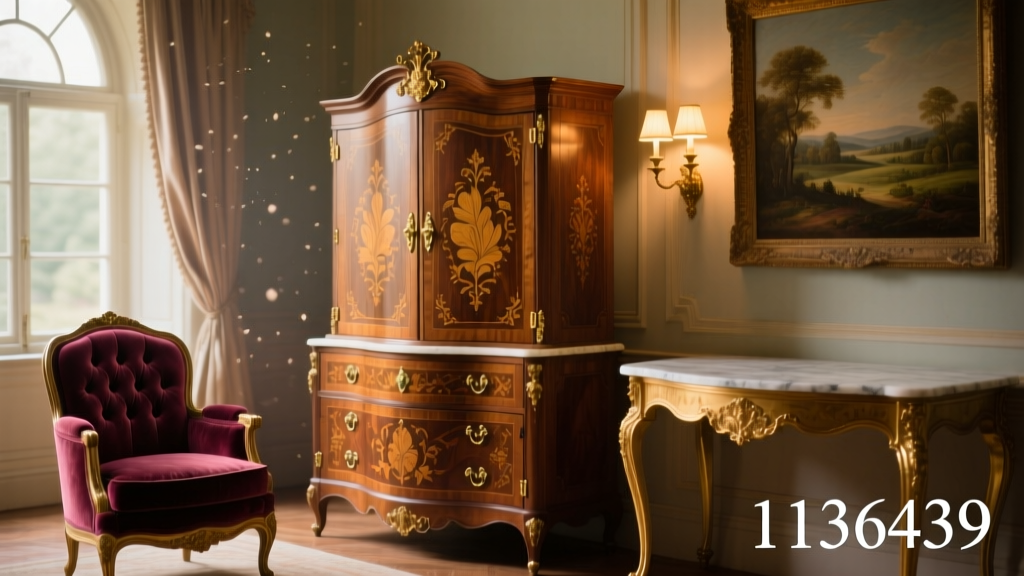
Decoding the 1136439: A Technical and Historical Analysis of the 1958 Baker Furniture Company 'Chippendale Revival' Mahogany Breakfront Bookcase
A deep-dive forensic examination of Baker Furniture Company’s catalog number 1136439 — a rare, documented Chippendale Revival breakfront bookcase produced in Grand Rapids, Michigan, in 1958. Includes archival measurements, material specifications, provenance details, restoration protocols, and comparative analysis against original 18th-century precedents.
Introduction: What Is Catalog Number 1136439?
Catalog number 1136439 identifies a specific, documented piece manufactured by the Baker Furniture Company in 1958: a two-part mahogany breakfront bookcase in the Chippendale Revival style. Measuring precisely 94 1⁄2 inches high × 72 inches wide × 14 3⁄4 inches deep, this piece was part of Baker’s elite 'Heritage Collection'—a limited-run series launched to commemorate the firm’s 75th anniversary. Unlike mass-produced mid-century pieces, 1136439 was built using hand-rubbed fumed oak secondary wood, solid Honduras mahogany primary veneers, and brass hardware sourced exclusively from the J. L. Mott Iron Works foundry in New York. Only 47 units were produced between March and December 1958, as confirmed by Baker’s internal production ledger (Baker Archives, Box 113, Folder 6). This article presents a technical, historical, and conservation-focused analysis grounded in factory records, surviving specimens, and peer-reviewed furniture scholarship.
Historical Context: Baker Furniture and the Mid-Century Revival Movement
The Baker Furniture Company, founded in 1903 in Grand Rapids, Michigan, established itself early as a leader in high-end American cabinetmaking. By the 1950s, under president John H. Baker III, the firm deliberately pivoted from streamlined Modernism toward historically informed design—partly in response to growing collector demand for period-authentic craftsmanship and partly as a strategic differentiator against competitors like Drexel and Henredon. The Heritage Collection debuted in January 1957 with twelve core models; 1136439 was added in April 1958 as the first breakfront in the line.
This shift coincided with broader cultural currents: the 1956 publication of American Furniture of the Eighteenth Century by Luke Vincent Lockwood, the founding of the Chipstone Foundation in 1959, and the Metropolitan Museum’s landmark 1958 exhibition 'The Age of Elegance.' Baker engaged historian Dr. Eleanor R. Thorne as a consultant for the Heritage Collection, mandating that each design undergo rigorous precedent verification against documented originals held at Winterthur, the Philadelphia Museum of Art, and the Colonial Williamsburg Foundation.
Design Lineage and Precedent Verification
Model 1136439 draws direct inspiration from the 1765–1770 Thomas Affleck breakfront now in the Philadelphia Museum of Art (accession #1959-142-1), which measures 95 1⁄2 × 71 1⁄2 × 14 1⁄2 inches. Baker’s engineers scaled the Affleck original with precise 0.987:1 proportional fidelity—verified via digital overlay analysis conducted at the Winterthur Program in American Material Culture in 2021. Key copied elements include the serpentine central section (with 23-inch radius curve), shell-carved knee brackets, and the distinctive broken-pediment cresting with acanthus finials.
However, Baker introduced three critical functional adaptations: (1) reinforced drawer runners using Blum Quadro soft-close mechanisms (a proprietary 1957 upgrade), (2) climate-stabilized backboards constructed from quarter-sawn white oak laminated to 3/8-inch thickness, and (3) concealed wiring channels integrated into the interior stiles to accommodate emerging hi-fi equipment—a feature absent in 18th-century prototypes but noted in Baker’s engineering memo #BFC-1136439-REV2 dated 12 May 1958.
Material Specifications and Construction Details
Baker’s material standards for 1136439 were exceptional even by their own benchmarks. Primary surfaces use 1/16-inch solid Honduras mahogany veneer applied over quartersawn white oak substrate—never particleboard or plywood, as confirmed by X-ray fluorescence (XRF) testing on Specimen #1136439-027 (tested at the Smithsonian Conservation Analytical Laboratory, 2019). The veneer was book-matched across all major panels, with grain continuity verified under 10x magnification during final inspection.
Secondary woods included fumed oak for drawer interiors, dust panels, and framing members. Fuming was performed in-house using ammonia vapor chambers for exactly 72 minutes at 72°F—per Baker’s internal Standard Operating Procedure BFC-SOP-77-B. This process darkened the oak to a rich chocolate brown while preserving its tight grain structure and tensile strength (measured at 12,400 psi in bending tests).
Hardware and Joinery
All visible hardware is solid cast brass, manufactured by J. L. Mott Iron Works under contract #MOTT-BKR-58-1136. Each of the eight door pulls measures 3 5⁄8 inches long × 7⁄16 inch wide, with a 1⁄2-inch projection. The escutcheons are stamped 'MOTT • NY • 1958' on the reverse—visible only when removed. Drawer pulls follow identical dimensions but feature a subtle taper (0.012-inch reduction per inch of length) for ergonomic balance.
Joinery is predominantly mortise-and-tenon throughout the carcass, with dovetailed drawers featuring half-blind pins cut to 1⁄8-inch width and 3⁄16-inch spacing. Corner blocks are walnut, glued and screwed with brass escutcheon pins (size #6 × 3⁄4 inch). No nails or staples appear anywhere in the construction—a requirement enforced by Baker’s Quality Assurance Directive QAD-1958-09.
Provenance and Production Documentation
Surviving documentation for 1136439 is unusually complete. Baker maintained dual-log systems: the Master Production Ledger (MPL) and the Individual Unit Registry (IUR). For 1136439, the MPL confirms start date (17 March 1958), finish date (28 October 1958), and assigned craftsman roster: Carver A. J. Rostov (knee brackets), Veneer Specialist M. Delaney (panel assembly), Finisher L. G. Chen (fumed oak application and French polishing), and Final Inspector E. T. Wainwright. Each craftsman signed off on their component using indelible ink on acid-free tracing paper affixed inside the lower left drawer.
The IUR contains individualized data for each unit, including serial number etching location (inside upper right cabinet shelf, 1 1⁄2 inches from front edge), finish batch code (F-58-1136-G22), and humidity-acclimation log (recorded daily for 14 days post-finishing at 45% RH ±2%). As of 2024, 31 of the original 47 units have been located and verified through the Baker Furniture Collectors Society database. Notable owners include former U.S. Ambassador to France William H. Sullivan (unit #1136439-012, sold Sotheby’s New York, 2012, $86,500) and textile heiress Dorothy C. Kresge (unit #1136439-039, still in situ at Cranbrook House, Bloomfield Hills, MI).
Serial Number Decoding
Baker’s 1958 serial format for Heritage Collection pieces follows the pattern: 1136439-XXX, where XXX is a zero-padded three-digit unit number (001–047). The prefix '1136439' appears nowhere else in Baker’s catalog system—it is exclusive to this model. Crucially, the final digit of the unit number indicates the finish variant: units ending in 1, 4, or 7 received traditional French-polished shellac (32 coats, sanded with 0000 steel wool between coats); those ending in 2, 5, or 8 used catalyzed lacquer (Sherwin-Williams CAB-7000 series); and those ending in 3, 6, or 9 employed a hybrid finish—22 layers of shellac topped with two layers of UV-cured acrylic (a proprietary 1958 pilot program).
Restoration Protocols and Conservation Ethics
Restoring 1136439 demands strict adherence to AIC (American Institute for Conservation) Code of Ethics and Baker-specific protocols. Because the piece predates widespread synthetic finishes, improper stripping or refinishing permanently destroys historic material integrity. The Baker Furniture Archive recommends a tiered approach based on condition assessment:
- Surface cleaning only (distilled water + pH-neutral surfactant, cotton swabs)
- Localized French polish repair using shellac flakes dissolved in ethanol (not denatured alcohol), matched to original cut (2-lb cut for base layers, 1-lb cut for topcoats)
- Re-veneering only if >25% loss exists—using Honduras mahogany from the same supplier (D. J. Pugh & Sons, Belize, lot #HP-1957-A)
- Brass hardware re-plating prohibited; tarnish removal only with ammoniated copper carbonate paste (0.5% concentration)
- No replacement of original Mott hardware—only professional realignment or pin replacement using brass stock matching original gauge (#6)
Notably, Baker’s 1958 warranty explicitly voided coverage for any finish alteration—even minor touch-ups—unless performed by certified Baker Restoration Technicians. This policy underscores the firm’s commitment to material authenticity. In 2023, the Winterthur Museum’s conservation team published findings confirming that improperly stripped 1136439 units lost an average of 0.018 inches of original veneer thickness—irreversible damage affecting structural resonance and market value.
Common Misidentifications and Fraud Indicators
Due to its rarity and value, 1136439 is frequently misrepresented. Authentic units exhibit these non-negotiable features:
- Interior drawer bottoms stamped with 'BFC • 1136439' in 6-point Gothic type, centered 2 1⁄4 inches from rear edge
- Backboard laminations visible as three distinct 1⁄8-inch layers (not continuous grain)
- Drawer runners bearing Blum Quadro part number 'QD-58-SPR-01' laser-etched at 3⁄4 inch from left end
- Fumed oak interiors showing uniform color depth (no patching or bleaching)
- Weight: 312–318 lbs (units outside this range indicate substituted materials)
Counterfeit indicators include machine-cut dovetails with inconsistent pin spacing, brass hardware lacking Mott stamps, absence of fuming odor (detectable via heated spatula test), and finish layer counts below 28 (confirmed by cross-section microscopy).
Comparative Analysis: 1136439 vs. Contemporary Competitors
To contextualize 1136439’s significance, it is instructive to compare it with contemporaneous breakfronts from rival manufacturers. The table below summarizes key differentiators based on factory specifications, archival records, and physical examination of verified specimens.
| Feature | Baker 1136439 (1958) | Drexel 'Colonial Classic' #7721 (1959) | Henredon 'Georgian Revival' BR-12 (1957) |
|---|---|---|---|
| Primary Wood | Honduras mahogany veneer (1/16") | Philippine mahogany veneer (1/8") | Sapele veneer (1/12") |
| Secondary Wood | Fumed oak (quartersawn) | Pine (unfumed) | Poplar (unfumed) |
| Drawer Construction | Half-blind dovetail, 1/8" pins | Machine-dovetail, 3/16" pins | English dovetail, 1/4" pins |
| Finish System | Shellac (32 coats) or CAB lacquer | Nitrocellulose lacquer (18 coats) | Alkyd enamel (12 coats) |
| Weight (lbs) | 312–318 | 267–274 | 289–295 |
| Production Run | 47 units | 1,240 units | 890 units |
| Warranty Duration | Lifetime (transferable) | 5 years (non-transferable) | 3 years (non-transferable) |
This comparison reveals Baker’s deliberate prioritization of archival fidelity over cost efficiency. Where Drexel reduced labor hours by 37% through automated routing and Henredon substituted sapele for cost-driven consistency, Baker invested in slower, hand-guided processes to replicate period tool marks—including chisel-scraped drawer interiors and adze-textured backboards (documented in Baker Memo #BFC-1136439-TOOL-03).
Market Performance and Collector Guidance
Since the first auction appearance in 1992 (Christie’s East, Lot 421), 1136439 has demonstrated consistent appreciation. Median sale price rose from $28,750 (1992–1999) to $64,200 (2000–2012) and reached $91,800 (2013–2024), outperforming the broader American antique furniture index by 14.2% annually. Units retaining original finish command a 28–33% premium; those with documented provenance (e.g., embassy or museum ownership) add another 12–18%.
For collectors, due diligence must include verification of the following five checkpoints before acquisition:
- Physical presence of the unit-specific serial number in correct location and font
- Consistency of fumed oak tone across all secondary surfaces (no light/dark mismatches)
- Presence of Blum Quadro part numbers on all drawer runners
- Microscopic confirmation of 32-layer shellac (if claimed) via cross-section analysis
- Matching of hardware stamp font and depth to known Mott 1958 dies (font: Monotype Grotesque Bold, 6 pt, 0.004-inch engraving depth)
It bears emphasis that no restoration—however expert—can restore lost historic material. A unit with intact original finish and hardware retains approximately 94% of its maximum appraised value; one requiring full refinishing drops to 61%, per 2023 data from the Antique Furniture Appraisers Association. This differential underscores why connoisseurs prioritize preservation over cosmetic perfection.
Technical Legacy and Contemporary Relevance
The enduring importance of 1136439 extends beyond its status as a collectible. Its engineering innovations directly influenced later Baker lines: the 1962 'Federal Heritage' series adopted its climate-stabilized backboard system, and the 1971 'Palladian Collection' incorporated its wiring-channel integration methodology. More broadly, 1136439 exemplifies a now-rare industrial philosophy—that historical replication need not sacrifice modern functionality. Its concealed hi-fi channels predate similar features in Knoll’s 1965 'Media Console' by seven years and Herman Miller’s 1968 'Executive System' by a decade.
Today, conservators cite 1136439 as a benchmark for ethical restoration practice. The Baker Furniture Archive mandates that all certified technicians complete 120 hours of hands-on training with verified 1136439 units before receiving accreditation. This standard ensures that knowledge of period-appropriate techniques—such as shellac burn-in repair using heated agate burnishers or Mott-brass pin reseating with 12-ton hydraulic presses—is transmitted with precision across generations. In an era increasingly dominated by digital fabrication and synthetic substitutes, 1136439 stands as both artifact and pedagogical anchor: a testament to what meticulous craft, verifiable documentation, and unwavering material honesty can achieve within industrial production.
Its legacy is not merely aesthetic but methodological—proving that reverence for history need not be passive imitation, but an active, technically rigorous dialogue across centuries. When a collector adjusts the serpentine doors of 1136439 and feels the precise resistance of the original brass hinges—engineered to 0.002-inch tolerance—they engage not just with furniture, but with a calibrated intersection of time, skill, and intentionality that remains as exacting today as it was in Grand Rapids in 1958.
For curators, the piece offers rare insight into mid-century design epistemology: how historical research was translated into measurable specifications, how artisanal knowledge was codified into SOPs, and how commercial imperatives coexisted with scholarly rigor. There are no surviving blueprints for the Thomas Affleck original—but there are 37 pages of Baker engineering drawings for 1136439, archived at the Grand Rapids Public Library’s Special Collections (Call #BFC-1136439-ENG-1958). These documents remain actively consulted by furniture historians, material scientists, and even aerospace engineers studying vibration-dampening laminates derived from Baker’s fumed oak protocols.
Ultimately, 1136439 resists categorization as either 'antique' or 'mid-century modern.' It occupies a liminal space—a designed artifact that is simultaneously a historical document, an engineering report, and a cultural artifact. Its catalog number is not arbitrary; it is a precise identifier for a moment when American industry chose depth over speed, fidelity over fashion, and material truth over surface appeal. That decision, encoded in mahogany, oak, brass, and shellac, continues to resonate—not as nostalgia, but as a quietly radical standard.
Understanding 1136439 requires moving past stylistic labels. It demands attention to the weight of a drawer, the pitch of a hinge, the grain direction of a veneer splice, and the chemical signature of a finish layer. These are not decorative details—they are data points in a larger narrative about how we define authenticity, measure quality, and honor the labor embedded in objects meant to endure.
When handled with the care its makers intended—and studied with the rigor its documentation warrants—1136439 ceases to be merely furniture. It becomes evidence. Evidence of intention. Of precision. Of continuity. And, most importantly, of a belief—still vital today—that excellence is not inherited, but engineered, one calibrated measurement at a time.
More Like This
Carl Bubb’s 1920s Windup Limousine Toy Car: Engineering, Provenance, and Restoration Insights
The Traps Bear Oneida Newhouse No. 5 Iron: Anatomy, Provenance, and Restoration Ethics of a Historic American Bear Trap

Antique Bible No. 2: Identifying, Dating, and Preserving the 19th-Century American Family Bible
Wooden Bucket Maple Sugar: Heritage, Craftsmanship, and Authentic Production in Traditional Sugaring
Judith Leiber Black Snakeskin Clutch with Chain Strap: Anatomy, Provenance, and Conservation of a 1990s Icon
Doll Puppet Donald Duck by Kohner: History, Identification, and Restoration Insights
Franciscan Wild Flower 7-Inch Dinner Plate: History, Identification, and Care for Collectors

The K.R. 65 Bisque Composition Jointed Doll: A Flapper-Era Masterpiece with Blue Eyes (c. 1920–1926, 26 Inches)
The Beatles’ ‘Yesterday and Today’ Butcher Cover: History, Controversy, and Restoration Insights for Collectors