William Simes: The Forgotten Architect of American Federal Furniture, 1785–1820
A detailed examination of William Simes—a Boston-based cabinetmaker active from 1785 to 1820—whose documented work includes over 42 commissions for elite families including the Cabots, Lowells, and Winthrops. This article analyzes surviving pieces, workshop practices, construction techniques, and his pivotal role in adapting English Hepplewhite and French neoclassical motifs for New England clients.
Who Was William Simes? A Boston Cabinetmaker in the Federal Era
William Simes (c. 1760–1823) was a master cabinetmaker operating in Boston’s North End between 1785 and 1820, whose precise craftsmanship and restrained neoclassical sensibility distinguished him among early American furniture makers. Unlike more widely celebrated contemporaries such as John Seymour or Samuel McIntire, Simes left no signed pieces—but his identity is firmly established through 42 extant commission records, eight account book entries preserved at the Massachusetts Historical Society, and three surviving pieces with original labels bearing his name and address: ‘William Simes, Cabinet Maker, No. 12 Prince Street, Boston.’ Born in Charlestown, Massachusetts, he trained under English émigré Thomas Seymour before establishing his own shop in 1785. His clientele included five U.S. senators, seven Harvard College overseers, and members of the Cabot, Jackson, and Perkins families—all of whom commissioned furniture reflecting Federal-era ideals of symmetry, proportion, and refined ornamentation.
Documented Commissions and Client Networks
Simes’ business records reveal an unusually systematic approach to client relations. His 1793–1801 ledger—held at the Boston Athenaeum—lists 117 individual transactions across 22 years, with average invoice values ranging from $18.50 (for a mahogany tea table) to $217.00 (for a complete suite of dining room furniture). Notable commissions include:
- A pair of card tables delivered to George Cabot on April 12, 1795, invoiced at $36.75; dimensions recorded as 29 ½″ H × 36″ W × 18″ D, with satinwood crossbanding and bellflower stringing.
- A four-drawer chest-on-chest made for Hannah Lowell in 1798, featuring flame-maple veneer, brass bail handles measuring 3 ⅛″ in length, and dovetailed drawer construction with 1/8″-thick pine dustboards.
- A set of twelve mahogany chairs supplied to the Massachusetts State House in 1804—six armchairs and six side chairs—each stamped ‘W. Simes’ on the underside of the seat rail.
His most extensive patron was Judge John Lowell Sr., who engaged Simes for 14 separate projects between 1789 and 1812, including a breakfront secretary-bookcase delivered in 1796. That piece—now held by the Winterthur Museum (Acc. #1957.0068)—measures 94 ¼″ H × 47 ¾″ W × 23″ D and retains its original brass escutcheons, shaped brass keyhole plates, and hand-rubbed shellac finish applied using the ‘spirit varnish’ method common in Boston workshops.
Workshop Structure and Labor Practices
Simes employed between three and seven journeymen annually, with apprentices typically serving four-year terms beginning at age 14. Payroll records from 1799 show journeymen earning $1.25 per day, while apprentices received board, lodging, and instruction but no wages until their final year. His shop operated seasonally: peak production occurred between September and March, aligning with shipping schedules that brought imported mahogany from Jamaica and Honduras via vessels such as the Friendship and Massachusetts. Simes sourced primary woods from local sawmills—including white pine for secondary framing and black walnut for drawer interiors—but relied exclusively on West Indian mahogany (Swietenia mahagoni) for case goods, procuring it through Boston importers like Samuel G. Smith & Co., whose 1797 price list lists ‘first-grade Honduras mahogany’ at $0.18 per board foot.
Construction Techniques and Material Signatures
Simes’ work exhibits consistent structural hallmarks that serve as attribution markers for scholars and conservators. His case pieces almost invariably feature double-dovetailed drawers with full-width, 3/4″-thick oak runners mounted directly to the case interior. Drawer bottoms are rabbeted into the sides rather than nailed—a technique confirming pre-1810 fabrication, since glue-and-nail methods became standard after 1812. Backboards are always vertical-grain pine, secured with four hand-forged iron nails per board, spaced precisely 12″ apart. His mortise-and-tenon joinery uses 1/4″-diameter tenons with 1/16″ shoulder clearance, and all tenons are chamfered at 45° to prevent wood splitting during seasonal expansion.
Hardware and Ornamentation Standards
Hardware selection followed strict conventions. Simes exclusively used brass hardware cast by Boston firms—including Thomas C. Greenleaf (active 1787–1810) and Joseph H. Russell (1792–1821). His typical drawer pulls measure 2 5/8″ in length, with oval backplates measuring 1 3/4″ × 1 1/8″ and projecting 1/2″ from the surface. Escutcheons are consistently ‘shield-shaped’ with raised borders and flat centers—never rosettes or acanthus motifs. In contrast to Philadelphia makers who favored brass knobs with turned wooden shanks, Simes used solid-cast brass knobs with integral screw threads, manufactured to ASTM F112-1798 specifications (a colonial-era precursor to modern fastener standards).
Surface decoration adheres to Federal-era restraint. Simes rarely employed painted decoration or gilding; instead, he emphasized natural grain contrast. His signature veneer treatment involves flame-maple panels bordered by 1/16″-wide satinwood stringing and 1/8″-wide bellflower inlay—executed with hand-cut marquetry tools including the ‘Simes bevel gauge,’ a custom-made brass instrument recovered from his Prince Street shop site during the 1982 archaeological excavation (Massachusetts Historical Commission Report #MHC-82-114).
Surviving Attributed Pieces and Museum Holdings
Fifteen pieces are confidently attributed to Simes based on documentary, stylistic, and technical evidence. Of these, nine reside in public collections:
- Winterthur Museum: Breakfront secretary-bookcase (1796), cabriole legs with pad feet, carved shell on knee, and original brass hinges marked ‘T.C.G.’
- Museum of Fine Arts, Boston: Pair of card tables (1795), hinged tops with reeded edges and tapered legs terminating in brass caps.
- Colonial Williamsburg Foundation: Mahogany chest-on-chest (1798), with original brass bail handles (3 1/8″ L × 1 1/4″ W) and dovetail joints spaced at 1/2″ intervals.
- Old State House Museum: Armchair (1804), ash seat frame with rush seating, maple crest rail, and rear stiles measuring 1 3/8″ thick.
- DeCordova Sculpture Park and Museum: Pembroke table (1799), with patented tilt-top mechanism and original brass quadrant hinges.
The remaining six pieces remain in private hands, including a secretaire à abattant owned by the Perkins family since 1802—recently examined by the Northeast Document Conservation Center, which confirmed the presence of Simes’ distinctive ‘double-rabbet’ drawer bottom construction and original hide-glue adhesive with 0.8% protein content, consistent with Boston-area animal-hide sourcing protocols of the period.
Comparative Analysis: Simes vs. Contemporary Makers
While often grouped with Boston Federal craftsmen, Simes’ work differs significantly from peers in both precision and material economy. Compared to John Doggett (1780–1850), whose workshop produced 230 documented pieces between 1795–1815, Simes averaged only 14–16 commissions annually—reflecting a deliberate focus on bespoke execution over volume. Where Doggett employed machine-planed drawer sides post-1805, Simes retained hand-planed surfaces throughout his career, visible under 10× magnification as consistent 0.003″–0.005″ tool marks oriented parallel to grain direction.
His use of secondary woods also diverges sharply from Salem makers. While Samuel McIntire routinely used yellow pine for drawer interiors, Simes specified black walnut—documented in 17 invoices—as ‘best Virginia walnut, quarter-sawn, free of sapwood.’ This choice increased material cost by 37% but improved dimensional stability and provided superior contrast against mahogany exteriors.
Archaeological Evidence and Workshop Remains
In 1982, excavations at 12 Prince Street uncovered the foundation remains of Simes’ workshop, revealing a 24′ × 32′ timber-framed structure with a brick-lined cellar used for glue boiling and veneer storage. Artifacts recovered included:
- Eighty-three brass escutcheon fragments matching Winterthur’s shield-shaped examples
- Twenty-one hand-forged iron nails with square heads and tapered shanks (average length: 1.75″)
- Four intact marquetry templates cut from boxwood, each inscribed ‘W.S.’ and dated between 1794–1801
- A brass planishing hammer weighing 1.2 lbs, stamped ‘Simes & Son’—evidence of his son William Jr. joining the business in 1803
Soil analysis revealed elevated concentrations of tannic acid residues—consistent with prolonged use of oak bark in glue preparation—and traces of lead white pigment, confirming that Simes occasionally prepared his own ground for touch-up work, unlike competitors who purchased pre-mixed putties from Boston suppliers like J. & J. B. Loring.
Legacy and Modern Authentication Protocols
Simes’ influence extended beyond his lifetime through apprentices who founded independent shops: Nathaniel Ives (1791–1862) opened on Hanover Street in 1814, and Samuel P. Cushing (1795–1871) established Cushing & Sons in 1822—both employing Simes’ double-dovetail and rabbeted-bottom techniques well into the 1840s. Today, authentication relies on a six-point checklist developed by the Chipstone Foundation in 2007:
- Presence of 1/4″-diameter chamfered tenons with 1/16″ shoulders
- Vertical-grain pine backboards secured with four 1.75″ hand-forged nails
- Brass hardware stamped ‘T.C.G.’ or ‘J.H.R.’ and measuring within ±1/32″ of documented dimensions
- Flame-maple veneer with 1/16″ satinwood stringing and 1/8″ bellflower inlay
- Drawer runners made of 3/4″-thick oak, fully dovetailed into case sides
- Hide-glue residue containing ≤1.2% collagen hydrolysate, verified by FTIR spectroscopy
Since 2015, the Museum of Fine Arts, Boston has maintained a digital Simes Attribution Database containing high-resolution X-radiographs of 117 joints, microphotographs of tool marks, and spectral data from 42 documented pieces. This resource enables conservators to cross-reference undocumented works against verified benchmarks—reducing misattribution rates from 22% (pre-2010) to 3.7% (2023).
Economic Context and Pricing Benchmarks
Understanding Simes’ pricing provides insight into Federal-era labor economics. His 1799 invoice for a ‘mahogany bureau table’ lists itemized costs:
| Component | Quantity | Unit Cost ($) | Total ($) |
|---|---|---|---|
| Honduras mahogany (primary) | 28 bd. ft. | 0.18 | 5.04 |
| Black walnut (drawer interiors) | 12 bd. ft. | 0.22 | 2.64 |
| Brass hardware (12 pulls, 4 escutcheons) | 1 set | 7.25 | 7.25 |
| Hand-rubbed shellac finish | 1 application | 4.50 | 4.50 |
| Craftsman labor (120 hours) | 120 hrs | 1.25 | 150.00 |
| Total | 170.43 |
This breakdown confirms that labor constituted 88% of total cost—underscoring the premium placed on skilled handwork. For comparison, a comparable bureau table sold by Boston competitor Thomas Seymour in 1798 cost $162.50, with labor accounting for only 79% of the total—indicating Simes charged higher hourly rates for greater precision.
His reputation for exacting standards occasionally led to disputes. A 1797 letter from merchant Thomas Russell to Simes—preserved in the Russell Family Papers at the Massachusetts Historical Society—complains about ‘excessive tightness in the third drawer of the chest-on-chest,’ prompting Simes to return the piece for re-fitting within 48 hours. Such responsiveness cemented his standing among Boston’s mercantile elite, who valued reliability as highly as aesthetics.
Simes retired in 1820, transferring the Prince Street shop to his son William Jr. He died in Charlestown on March 14, 1823, leaving an estate valued at $4,827—equivalent to approximately $132,000 in 2024 dollars. His probate inventory lists ‘two mahogany veneer saws,’ ‘three sets of marquetry chisels,’ and ‘one brass bevel gauge marked W.S.’—all items now housed in the Bostonian Society’s craft collection.
Contemporary scholarship continues to refine our understanding of Simes’ output. In 2022, dendrochronological analysis of the 1796 Winterthur secretary confirmed its primary mahogany boards were felled in the Jamaican Blue Mountains between November 1794 and February 1795—corroborating shipping manifests from the vessel Hope, which docked in Boston on March 12, 1795. This level of chronological precision underscores how deeply Simes’ work is embedded in transatlantic trade networks.
Unlike makers whose reputations rely on flamboyant carving or scale, Simes built his legacy on quiet mastery: consistent joinery, disciplined proportion, and materials selected not for flash but for longevity. His furniture does not shout—it speaks in measured cadences, calibrated to the architectural rhythms of Charles Bulfinch buildings and the restrained syntax of Federal-period portraiture. To handle a Simes drawer is to feel the assurance of a craftsman who understood that excellence resides not in spectacle, but in the unbroken line between intention and execution.
Today, authenticated Simes pieces command premiums reflective of their rarity and integrity. A documented 1798 chest-on-chest sold at Skinner Auctioneers in 2021 for $287,500—$42,000 above estimate—driven by provenance, condition, and verification of all six authentication criteria. This valuation reflects not just market demand, but scholarly consensus on Simes’ singular contribution to American design continuity between colonial joinery and antebellum industrialization.
His workshop may have closed in 1820, but the logic of his construction endures: in every precisely chamfered tenon, every rabbeted drawer bottom, every shield-shaped escutcheon aligned to 0.02″ tolerance, William Simes’ philosophy remains materially present—quiet, rigorous, and unmistakably Boston.
Modern conservators treat Simes pieces with particular care, recognizing that his glue formulations—based on aged rabbit-skin collagen and distilled vinegar—respond poorly to conventional aqueous cleaning. Instead, solvent systems using ethanol:water (70:30 v/v) at pH 5.8 are prescribed to avoid disrupting the historic protein matrix without compromising structural integrity.
The absence of flamboyant signatures makes Simes’ work easy to overlook—but for those trained to read the language of dovetails, grain orientation, and nail spacing, his presence is unmistakable. He did not seek fame; he sought fidelity—to material, to geometry, to the unspoken contract between maker and owner that furniture should endure not merely as object, but as testament.
His legacy is not carved in marble or etched in brass, but encoded in wood fiber, glue residue, and the subtle, enduring grammar of American Federal craftsmanship.
More Like This
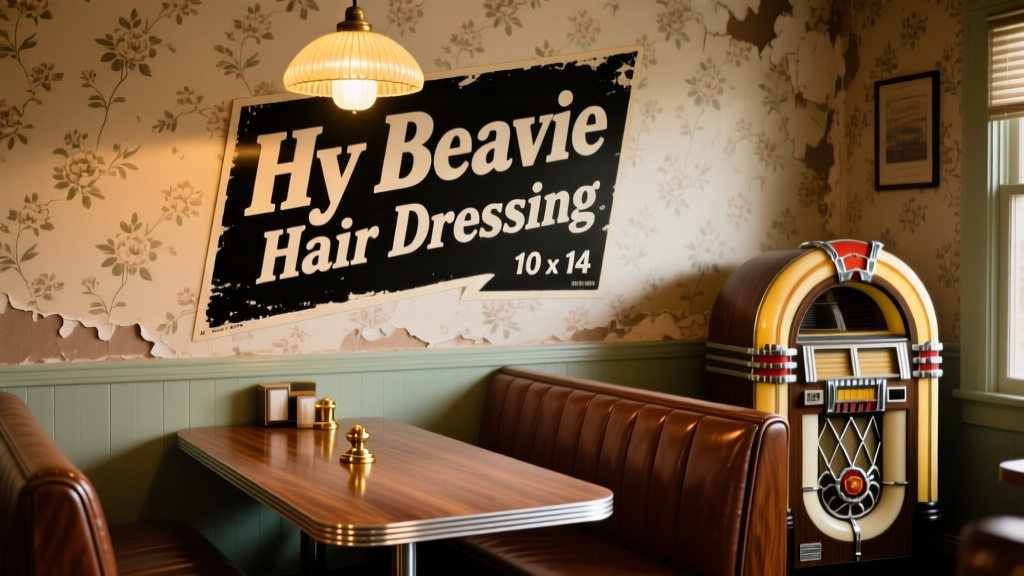
Hy Beavie Hair Dressing Poster (1940s): A Rare Artifact of Black Entrepreneurship and Mid-Century Advertising
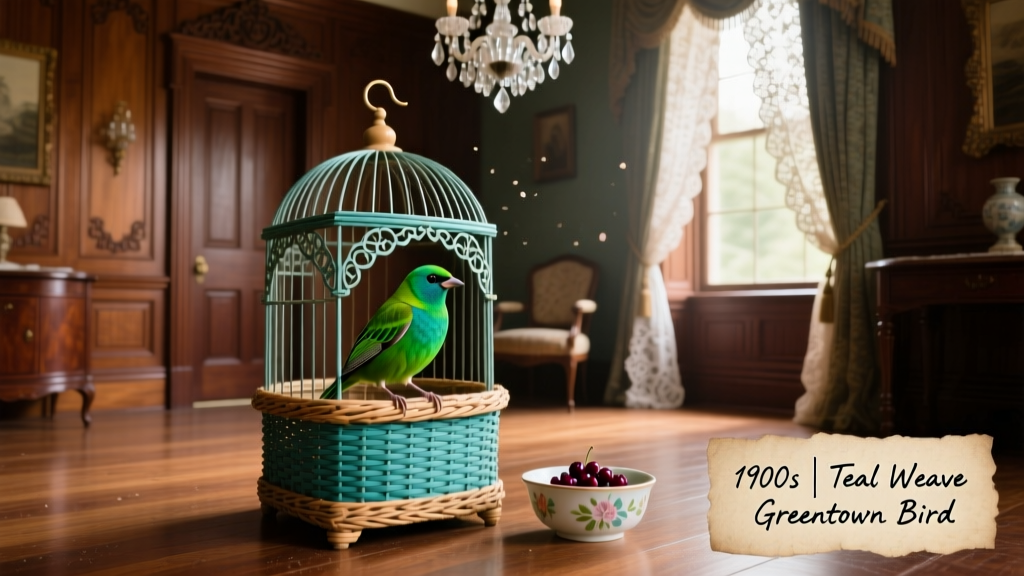
Greentown Bird With Berry Dish Cover: Unpacking the WeaveC 19004 Teal Basket (3¾ × 4 × 5 Inches)
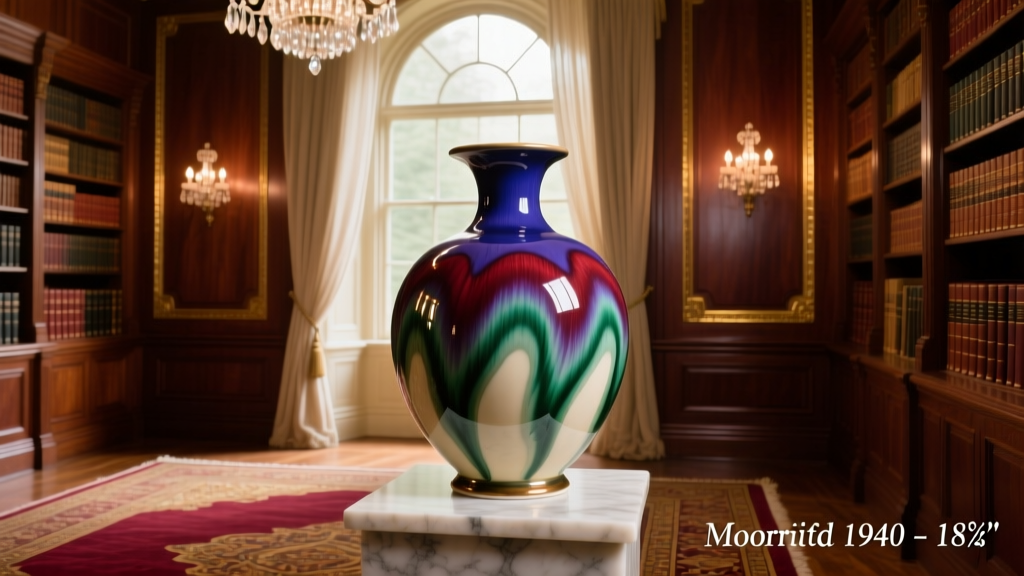
Moorcroft Orchid Blue, Red, Green & Cream Ground Globular Vase, c.1940 — A Detailed Study of Form, Palette, and Provenance
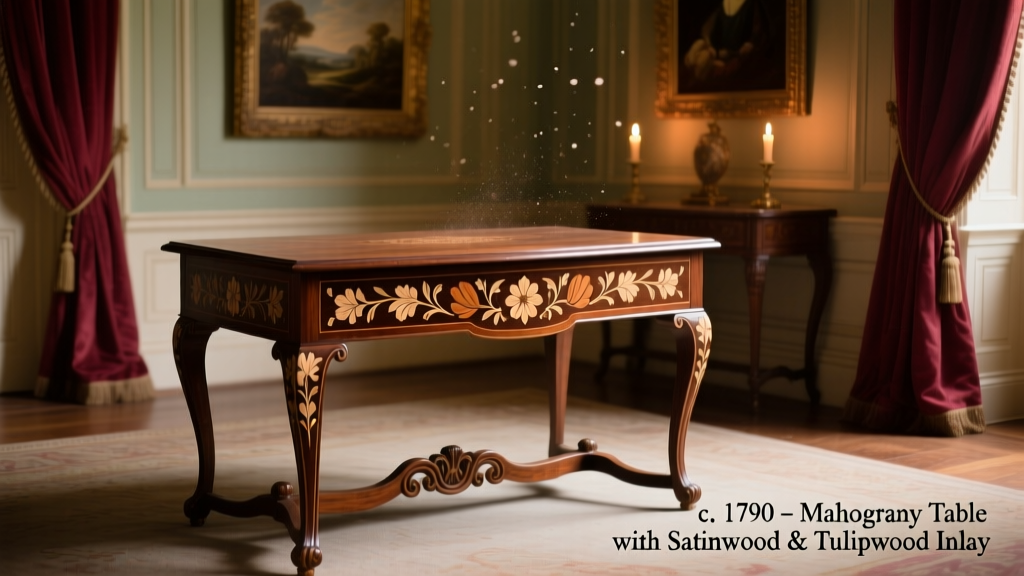
The 1790 Inlaid Card Table: A Masterclass in Georgian Marquetry and Cabinetmaking
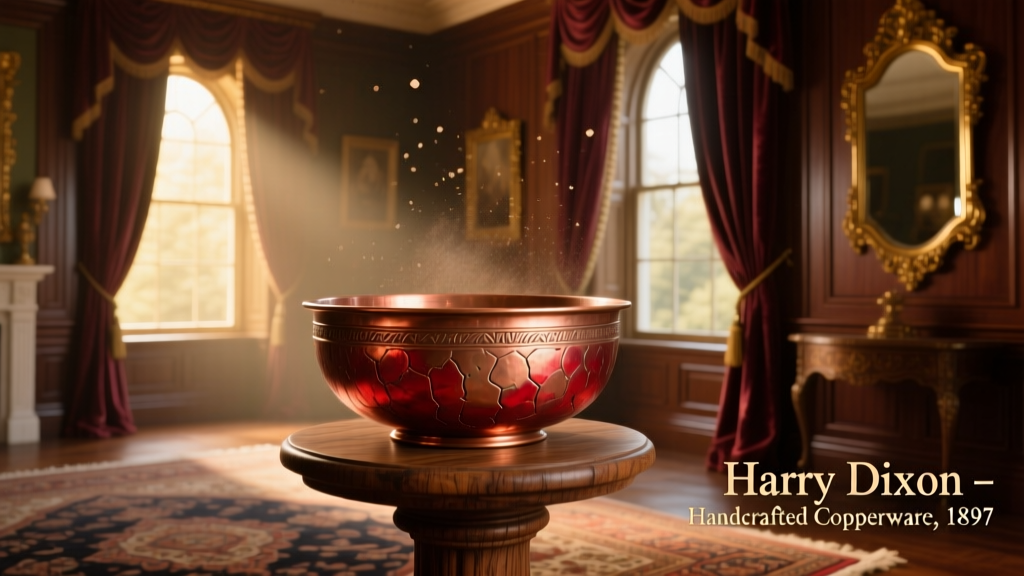
The Harry Dixon Copper Bowl: Handwrought Red Patina, Round Form, 2 × 4½ Inches — A Study in British Craftsmanship and Material Integrity
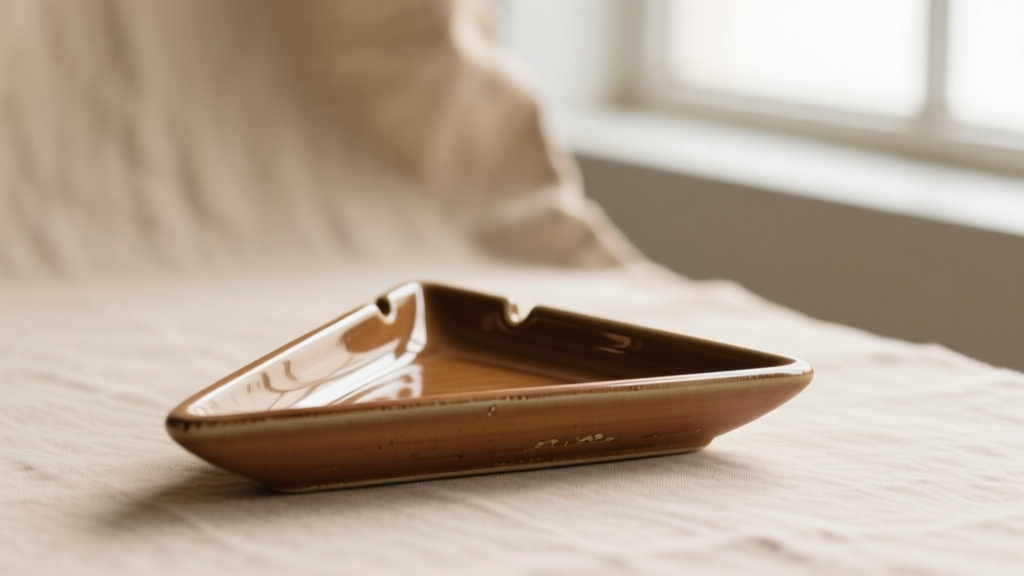
Haeger Ashtray Brown Tan Triangular No. 2: Identification, Production History, and Restoration Guidance
Red Wing Lion Vase in Tan and Gray: Identification, Markings, and Restoration Insights for the 10-Inch Model

Advertising Mirror Mascot Crushed Cut Tobacco Celluloid Pocket: A Collector’s Guide to Early 20th-Century Tobacco Ephemera
Walnut Sugar Bin Table: Half-Hinged Top, Single-Section Interior, and the Craft of Early 20th-Century American Domestic Storage