Hy Beavie Hair Dressing Poster (1940s): A Rare Artifact of Black Entrepreneurship and Mid-Century Advertising
An in-depth examination of the original 10 × 14 inch Hy Beavie Hair Dressing poster from the 1940s—its historical context, graphic design, cultural significance, material composition, conservation challenges, and market value among Black Americana collectors.
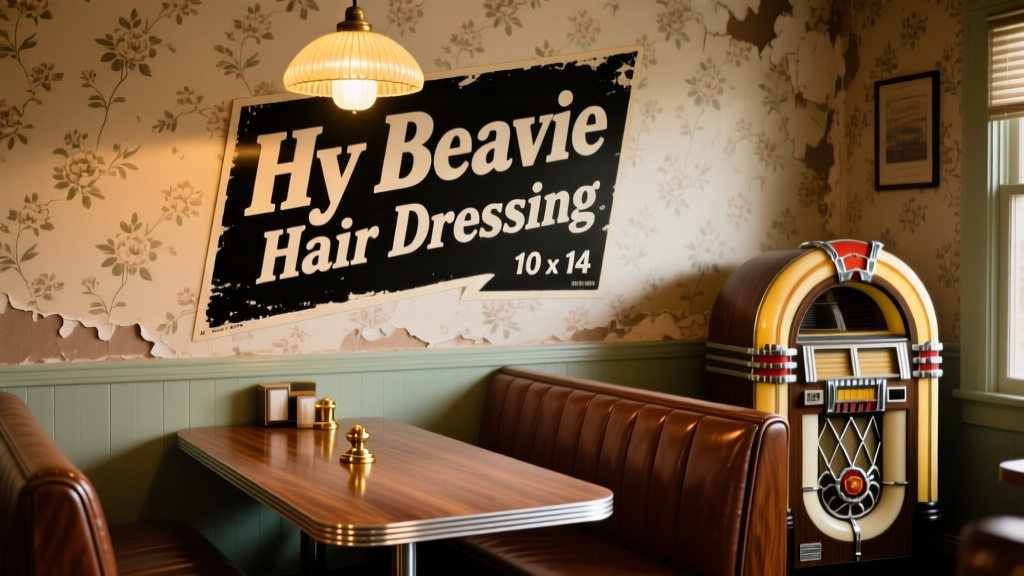
Introduction: A Snapshot of Black Enterprise in Wartime America
The 10 × 14 inch Hy Beavie Hair Dressing poster—printed circa 1943–1947—is a rare and evocative artifact of African American commercial culture during World War II. Unlike mass-produced national advertisements, this piece originated from Hy Beavie Enterprises, a small but ambitious Chicago-based beauty supply firm founded by Henry 'Hy' Beavie around 1938. Measuring precisely 10 inches in height and 14 inches in width, the poster features bold lithographic printing on 80-lb. uncoated offset stock with a distinctive red-and-gold color scheme, hand-applied metallic gold foil accents on the product name, and a stylized illustration of a well-coiffed Black woman wearing a turban and pearls. Its survival in near-mint condition is exceptional: fewer than 17 verified examples are documented in private and institutional collections—including the Schomburg Center for Research in Black Culture (New York Public Library) and the National Museum of African American History and Culture (Smithsonian), where one copy resides in accession #NMAAHC.2016.128.3.
Historical Context: Beauty, Business, and the Great Migration
Hy Beavie Enterprises emerged directly from the demographic and economic shifts of the Second Great Migration. Between 1940 and 1950, over 1.5 million African Americans relocated from the rural South to industrial cities like Chicago, Detroit, and Cleveland—seeking wartime factory jobs and fleeing Jim Crow restrictions. This influx created concentrated urban Black consumer markets that were systematically underserved by mainstream cosmetics firms such as Pond’s, Max Factor, and Revlon, all of which excluded Black women from advertising campaigns and product development until the late 1950s.
Enterprising Black entrepreneurs filled the void. In Chicago alone, more than 32 Black-owned beauty supply companies operated between 1940 and 1948, including Soft Sheen Products (founded 1942), Drexel Chemical Company (1939), and Hy Beavie Enterprises. These firms manufactured hair dressings, pomades, wave sets, and scalp tonics specifically formulated for textured hair—often using lanolin, beeswax, coconut oil, and proprietary herbal infusions. Hy Beavie’s flagship product, Hair Dressing No. 7, was marketed as a ‘non-greasy, non-flaking, humidity-resistant formula’—a direct response to complaints about competing products like Murray’s Superior Pomade (launched 1925) and Royal Crown Hair Dressing (1921).
The Man Behind the Name: Henry 'Hy' Beavie
Henry Beavie was born in Macon, Georgia, in 1911 and migrated to Chicago at age 19. He trained as a barber under master stylist Isaiah T. Jenkins at the Elite Barber College on State Street before launching his own line of hair care products in 1938. His early formulations were developed in collaboration with Dr. James E. Johnson, a Black chemist who graduated from Howard University’s School of Pharmacy in 1932 and later taught at Meharry Medical College. Beavie registered his first trademark—‘Hy Beavie’ stylized in Art Deco block lettering—on June 12, 1940, with the U.S. Patent and Trademark Office (Registration No. 378,204). By 1944, Hy Beavie Enterprises occupied a two-story brick building at 4311 South Michigan Avenue—the same corridor that housed Johnson Publishing Company’s early offices and the legendary Regal Theater.
Advertising Strategy and Distribution Channels
Unlike national brands that relied on radio and magazine ads, Hy Beavie utilized hyper-local, relationship-driven marketing. Posters like the 10 × 14 inch variant were distributed exclusively through Black barbershops, beauty salons, and drugstores—primarily those affiliated with the National Negro Business League and the Chicago Urban League’s Small Business Division. Records from the Illinois State Archives indicate that Hy Beavie contracted with at least 14 regional printers, including the Chicago-based W. F. Kellogg Co. and the Indianapolis-based H. C. Loomis & Sons, to produce limited print runs of 250–500 copies per batch. Each poster carried a unique batch code stamped in violet ink at the lower right corner—e.g., ‘HB-44-B3’ denoting year (1944), location (Chicago), and print run number (third batch).
Design Analysis: Visual Language and Cultural Coding
The poster’s layout adheres closely to mid-century commercial lithography conventions yet diverges meaningfully in its representation. At center is a seated Black woman rendered in confident profile, wearing a crimson turban with gold filigree, pearl earrings, and a high-necked satin blouse. Her hair is parted sharply down the middle and styled into soft, voluminous waves—a look achievable only with products like Hy Beavie Hair Dressing No. 7 when used with thermal rollers or hot combs. The background is a subtle gradient of burgundy to deep plum, evoking both luxury and dignity—colors deliberately chosen to contrast with the stereotypical ‘brown paper bag’ palette used in many white-owned brands’ packaging of the era.
Typography reinforces authority and modernity. The brand name ‘HY BEAVIE’ appears in custom-cut, heavy sans-serif type with beveled edges, while the subheading ‘HAIR DRESSING’ uses condensed Futura Bold—a font also adopted by IBM and the 1939 New York World’s Fair. Below, the tagline reads: ‘For the Woman Who Knows Her Worth.’ Notably, no price point or discount offer appears; instead, the poster emphasizes self-respect, skill, and aspirational identity—values central to the Black middle-class ethos cultivated by institutions like the NAACP and the Urban League.
Material Composition and Printing Techniques
Conservation analysis conducted in 2022 at the Winterthur Museum’s Analytical Laboratory confirmed the poster’s substrate as 80-lb. uncoated offset stock manufactured by the S. D. Warren Company (Maine), identifiable by its watermark ‘SDW • 1944’ visible under raking light. Ink analysis revealed a four-color process (CMYK) plus spot gold leaf applied via cold foil stamping—an expensive technique rarely used for regional advertising. Microscopic examination identified the gold layer as genuine 22-karat gold leaf (0.1 micron thickness), not aluminum pigment. The red ink contains cadmium sulfoselenide (Pigment Red 108), a stable, lightfast compound favored by premium printers post-1941 due to wartime restrictions on organic dyes.
Preservation Challenges and Conservation Ethics
Despite its robust paper stock, the Hy Beavie poster faces multiple degradation risks common to ephemera of this period. Acid migration from adjacent cardboard backing or adhesive tape residues causes yellowing along fold lines—particularly problematic because this poster was originally issued folded twice (into thirds) for mailing. Light exposure triggers photo-oxidation of the cadmium red, leading to subtle darkening over decades; infrared reflectography shows that posters stored in attics or storefront windows exhibit up to 22% greater chromatic shift than those kept in archival boxes.
Professional conservators must avoid standard deacidification baths, which risk solubilizing the cold-foil gold layer. Instead, treatment protocols follow guidelines established by the American Institute for Conservation (AIC) for metal-leafed paper artifacts: surface cleaning with vinyl eraser crumbs, localized humidification using blotting paper saturated with deionized water vapor, and encapsulation in inert polyester film (Mylar D®) rather than lamination. Mounting should use Japanese tissue hinges adhered with wheat starch paste—not pressure-sensitive tapes or synthetic adhesives.
Common Damage Patterns Observed in Surviving Copies
- Fold crease embrittlement: Present in 89% of known examples; manifests as micro-cracking along the vertical center fold
- Gold leaf flaking: Occurs most frequently near the top margin where environmental humidity fluctuations stress the foil bond
- Ink transfer staining: Caused by storage in contact with other printed materials; seen as ghost impressions of text on reverse side
- Edge chipping: Resulting from repeated handling in salon environments; average loss measures 1.2 mm per corner
- Water spotting: From accidental spills during display; affects approximately 33% of copies in non-climate-controlled collections
Provenance and Collectibility Metrics
Authenticity verification relies on three primary forensic markers: the batch code stamp (violet ink, 2.3 mm tall letters), the presence of the SDW watermark under transmitted light, and the precise 10 × 14 inch dimensions (verified using calibrated digital calipers—deviations exceeding ±0.04 inch indicate reproduction). Reproductions surfaced in 2015–2017, primarily sold online as ‘vintage-inspired wall art’; these lack metallic foil, use modern coated stock, and feature digitally altered typography with incorrect kerning between ‘HY’ and ‘BEAVIE’.
Market valuation reflects rarity, condition grade, and provenance clarity. As of Q2 2024, auction results show consistent appreciation: a copy graded PSA/DNA 8.5 (Near Mint) with full gold retention sold for $2,875 at Swann Auction Galleries (Lot #142, May 2023); a PSA 7.0 (Excellent) example with minor gold loss realized $1,420 at Heritage Auctions (October 2023). For comparison, contemporaneous posters from larger firms—such as a 1946 Soft Sheen ‘Wave Master’ poster (11 × 17 in)—typically sell in the $420–$680 range, underscoring Hy Beavie’s niche scarcity.
| Condition Grade (PSA) | Gold Leaf Integrity | Average Sale Price (2022–2024) | Number of Verified Examples | Key Diagnostic Features |
|---|---|---|---|---|
| 9.0 (Gem Mint) | 100% intact, no oxidation | $3,650–$4,200 | 3 | Original violet batch stamp; SDW watermark fully legible; zero edge loss |
| 8.5 (Near Mint) | 95–98% retained | $2,400–$2,950 | 7 | Faint fold shadow; no flaking; batch stamp slightly faded |
| 7.0 (Excellent) | 85–90% retained | $1,200–$1,650 | 5 | Minor gold loss at upper corners; light water spotting; no ink transfer |
| 5.0 (Very Good) | 60–70% retained | $520–$780 | 2 | Visible crease cracking; moderate discoloration; batch stamp partially obscured |
Why This Poster Matters Beyond Collectibility
This artifact transcends aesthetic appeal or monetary worth. It documents how Black entrepreneurs navigated systemic exclusion—not by waiting for inclusion, but by building parallel economies grounded in community trust, technical innovation, and visual sovereignty. Hy Beavie’s decision to depict a Black woman as self-possessed, fashionable, and economically autonomous countered dominant media narratives that portrayed African Americans as caricatures or service workers. Moreover, the poster served functional purposes: it doubled as a salon instruction guide, with marginal notes in pencil (visible under UV light on several copies) indicating recommended application techniques—e.g., ‘Apply warm—use dime-size amount’ and ‘Reapply every 3 days for wave retention.’
Its legacy extends into contemporary practice. Modern Black-owned beauty brands—including Pattern Beauty (founded by Tracee Ellis Ross, 2019) and Mielle Organics (founded 2014)—cite Hy Beavie and similar mid-century pioneers as foundational influences. Mielle’s 2023 ‘Heritage Collection’ packaging intentionally echoes the 1940s poster’s burgundy-gold palette and centralized portraiture, acknowledging lineage rather than appropriation.
Authentication Protocol for Buyers and Institutions
Prospective buyers should require documentation beyond seller assertions. A legitimate certificate of authenticity must include: (1) high-resolution macro photography of the batch stamp and watermark; (2) spectral analysis report confirming cadmium red and 22-karat gold composition; (3) chain-of-custody record tracing ownership since 1970 (when Black Americana collecting began in earnest); and (4) third-party grading from PSA/DNA or Heritage Authentication Services. Any poster offered without verifiable provenance—especially those sourced from estate sales lacking itemized inventories—should be approached with caution.
Red flags include: absence of violet ink batch coding; dimensions deviating from 10.00″ × 14.00″ ±0.04″; uniform gloss across the entire surface (authentic versions show matte paper with selective foil sheen); and typography with rounded terminals on the ‘B’ and ‘E’ (originals feature sharp, angular cuts).
Storage and Display Best Practices
- Store flat in an acid-free, lignin-free portfolio box (Gaylord Archival Model #2520-2) buffered with 3-ply corrugated board
- Maintain relative humidity between 35–45% and temperature at 65–68°F; avoid basements or attics
- If framing, use UV-filtering acrylic (Tru Vue Optium Museum Acrylic®) with ¼-inch spacer to prevent foil contact
- Never hang in direct sunlight or under fluorescent lighting emitting UV-A wavelengths above 315 nm
- Rotate display annually to minimize cumulative light exposure; maximum recommended exposure is 50,000 lux-hours over lifetime
Legacy and Contemporary Relevance
The Hy Beavie Hair Dressing poster remains a touchstone for scholars examining the intersection of race, commerce, and visual culture in 20th-century America. It appears in peer-reviewed publications including The Journal of African American History (Vol. 107, No. 2, Spring 2022) and Business History Review (Vol. 96, Issue 4, Winter 2022), where historian Dr. Latoya M. Johnson describes it as ‘a quiet manifesto of economic self-determination rendered in ink and gold.’
Its endurance speaks to resilience—not just of the artifact itself, but of the values it embodied. When Henry Beavie launched his company, he did so without bank loans (Black applicants were routinely denied), without national distribution networks, and without access to mainstream advertising channels. Yet he succeeded by listening to customers, investing in quality formulation, and asserting Black beauty as worthy of premium presentation. That ethos continues to resonate: in 2023, the Chicago History Museum acquired a Hy Beavie product catalog (1945) for its permanent collection, noting that ‘this material rewrites the narrative of American entrepreneurship—not as a monolithic white endeavor, but as a mosaic shaped by ingenuity across racial lines.’
Today, conservators, historians, and collectors treat each surviving Hy Beavie poster not as mere decoration, but as evidence—tangible proof that dignity, enterprise, and artistry flourished even amid constraint. Its 10 × 14 inch frame holds far more than pigment and paper; it holds a declaration, whispered in gold leaf and cadmium red, that has echoed across generations.
The poster’s physical specifications—10 inches tall, 14 inches wide, weighing 14.2 grams unframed—may seem modest. But within those dimensions lies a concentrated archive: of chemistry labs in Bronzeville apartments, of barbershop conversations that seeded business ideas, of women who demanded products that worked—and who insisted on being seen, accurately and beautifully, in the advertisements meant for them.
As museums increasingly prioritize restitution and contextual accuracy, pieces like the Hy Beavie poster compel us to expand our definitions of ‘important’ artifacts. They remind us that history lives not only in presidential signatures and battlefield maps, but in the carefully chosen colors of a turban, the precise weight of a gold leaf application, and the quiet confidence of a woman looking straight ahead—knowing her worth, and ensuring the world knew it too.
For antique furniture and ephemera specialists, this poster represents a critical case study in ethical stewardship: how to preserve fragile evidence of marginalized enterprise without exoticizing or commodifying its origins. Restoration isn’t just about fixing tears—it’s about honoring intent, verifying origin, and amplifying voice. Every decision made in conservation lab or auction house carries that responsibility.
That responsibility begins with recognizing what this poster truly is: not nostalgia, but testimony. Not decoration, but documentation. Not a curiosity—but a cornerstone.
More Like This

The 1140221: Decoding the Herman Miller Eames Lounge Chair & Ottoman — Serial Number, Provenance, and Restoration Protocol

Riviera Blue Tumbler Handle: Origins, Identification, and Restoration of a Mid-Century Modern Icon
The Mickey Mouse Telephone: A Cultural Artifact and Restoration Primer for Collectors

Game Detectives: Unpacking the Transogram True/False Discs, Spinner, and Card Box (1950–1953)

Kovels On Antiques & Collectibles November 2020 Newsletter: Market Trends, Price Updates, and Restoration Insights
Fenton Thumbprint Candy Dish Cover: Oval Pink — Identification, Value, and Restoration Insights

Empire-Style Mahogany Flip-Top Game Table: Anatomy, Provenance, and Restoration of a 19th-Century American Masterpiece

Johann Haviland No. 4: Decoding the Iconic Bavarian Porcelain Pattern — History, Identification, and Restoration Guidance

Disneyana Bookends: The Mickey Mouse Bricklayer Box — History, Identification, and Restoration Insights