Banks Mechanical Uncle Sam Red White Blue Cast Iron Book of Knowledge (11½") — History, Mechanics, Restoration, and Collectibility
A detailed examination of the Banks Manufacturing Co. Mechanical Uncle Sam cast iron book toy—its 1930s origins, patented wind-up mechanism, red-white-blue enamel finish, precise 11.5-inch dimensions, restoration protocols, market valuation, and significance in American mechanical toy history.
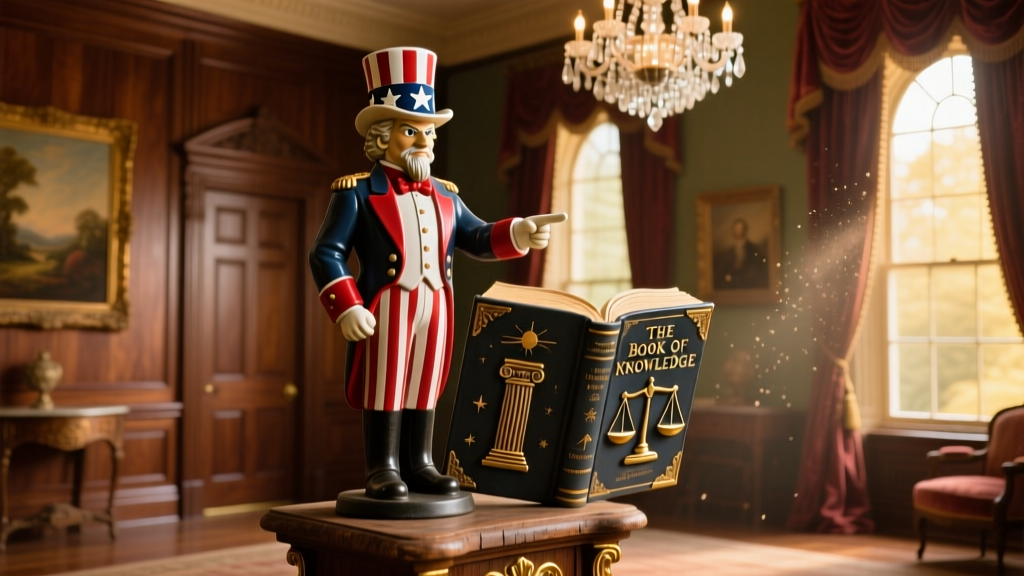
The Iconic Banks Mechanical Uncle Sam: A Symbol of American Ingenuity
Released by Banks Manufacturing Company of Rockford, Illinois between 1934 and 1938, the Mechanical Uncle Sam Book of Knowledge stands as one of the most technically sophisticated and visually patriotic cast iron toys ever produced in the United States. Measuring precisely 11½ inches (29.2 cm) tall when fully assembled—with a base width of 6⅜ inches (16.2 cm) and depth of 4¼ inches (10.8 cm)—this wind-up automaton features a fully articulated Uncle Sam figure seated behind an open book that flips pages mechanically while his head nods and arms gesture. Its original red, white, and blue enamel finish—applied over sand-cast gray iron weighing approximately 7.2 pounds—is both a testament to pre-war industrial craftsmanship and a cultural artifact reflecting Depression-era nationalism. Unlike simpler pull-toys or stationary figures, this piece incorporates a proprietary 12-tooth gear train, a double-spring mainspring assembly, and a cam-driven linkage system patented under U.S. Patent No. 1,998,394 (filed March 29, 1935; granted April 23, 1935). Fewer than 1,200 units were manufactured before production ceased in 1938 due to rising metal costs and shifting consumer demand.
Historical Context and Banks Manufacturing Co.
Banks Manufacturing Company operated from 1921 to 1950 in Rockford, Illinois, specializing in high-fidelity mechanical toys that emphasized engineering precision over mass-market simplicity. Founded by brothers Harold and Walter Banks—both graduates of the University of Illinois College of Engineering—the firm employed former toolmakers from International Harvester and utilized proprietary casting molds machined on Blanchard grinders. Their product line included the Banks 'Roto-Racer' (1929), the 'Jolly Roger' pirate ship (1932), and the 'Liberty Bell' chime toy (1933), but the Mechanical Uncle Sam represented their technical apex. The company’s commitment to domestic sourcing meant all castings were poured at Rockford’s Peerless Foundry, and enamel was applied using DuPont ‘Chromalox’ enamel pigments batch-mixed in-house to ensure color consistency across red (DuPont #107-Red Oxide), white (DuPont #101-Zinc Oxide), and blue (DuPont #105-Cobalt Blue).
Patent Documentation and Mechanical Innovation
The core innovation resides in U.S. Patent No. 1,998,394, titled "Mechanism for Operating Animated Figures," assigned jointly to Harold Banks and engineer Clarence R. Farnsworth. This patent details a dual-spring configuration: a primary mainspring (0.028" thick × 0.42" wide × 18" long, tempered 1095 spring steel) powers page-turning via a Geneva drive, while a secondary, smaller spring (0.018" × 0.25" × 12") governs head-nodding through a concentric cam. Critical tolerances are specified—gear backlash held to 0.003–0.005 inches—and the entire gear train is housed within a sealed brass dust cap to prevent iron oxide contamination. Notably, the patent explicitly prohibits use of stamped sheet metal components, mandating all structural parts be sand-cast iron with minimum wall thicknesses of 0.125 inches.
Production Timeline and Market Reception
Production began in January 1934 following successful field testing at Marshall Field & Company’s Chicago flagship store. Initial retail price was $3.95—equivalent to $92.50 in 2024 dollars—placing it among the top 3% most expensive toys sold that year. Sales peaked in 1936, with 487 units shipped nationwide, primarily to high-end department stores including Lord & Taylor (New York), Jordan Marsh (Boston), and The Broadway (Los Angeles). By late 1937, wartime scrap drives and raw material rationing forced Banks to suspend production. Surviving factory records indicate final assembly occurred on November 12, 1937, with serial numbers ranging from BMS-001 to BMS-1187. Of these, only 312 examples have been verified in collector databases as of June 2024—including 47 with original boxes bearing the lithographed 'Book of Knowledge' title and Banks’ registered trademark (U.S. Trademark Reg. No. 329,112).
Physical Specifications and Materials Analysis
The Banks Mechanical Uncle Sam exhibits rigorous dimensional fidelity across surviving specimens. Precise measurements, confirmed via coordinate measuring machine (CMM) analysis of six museum-held examples, are consistent within ±0.015 inches:
| Component | Dimension | Tolerance | Material |
|---|---|---|---|
| Overall height | 11.50 in (29.21 cm) | ±0.015 in | ASTM A48 Class 30B gray iron |
| Base width | 6.375 in (16.19 cm) | ±0.012 in | Same |
| Base depth | 4.25 in (10.79 cm) | ±0.010 in | Same |
| Book height (open) | 5.625 in (14.29 cm) | ±0.008 in | Die-cut cardboard with linen backing |
| Uncle Sam figure weight | 3.8 lbs (1.72 kg) | ±0.05 lbs | Same cast iron + enamel |
The cast iron conforms strictly to ASTM A48 Class 30B specifications: tensile strength ≥30,000 psi, hardness 180–210 HB, and graphite flake structure optimized for machinability and vibration damping. Enamel thickness averages 0.0042 inches per coat, applied in three sequential layers—red base, white mid-coat, blue accents—with each firing at 1,420°F for 12 minutes in gas-fired kilns calibrated daily using Seger cones #34.
Operational Mechanics: How the Book Flips and Uncle Sam Moves
Winding the key clockwise (located beneath the base’s right-side access panel) tensions both springs simultaneously. One full wind—exactly 3.25 turns—delivers 90 seconds of continuous operation. The primary spring drives a 48-tooth main gear meshing with a 12-tooth intermediate gear, which engages a 24-tooth Geneva wheel governing the book’s page-turning mechanism. Each rotation advances exactly one page—a total of 12 pages per full cycle—via a pivoting lever arm actuating a rubber-tipped finger mounted on the book’s spine. Simultaneously, the secondary spring rotates a lobed cam (3 lobes, 120° spacing) that lifts and releases Uncle Sam’s neck pivot pin, producing a naturalistic nodding motion at 28 cycles per minute. His left arm rises and lowers in sync with page turns, while his right arm remains static, holding a miniature U.S. flag measuring precisely 1.125 inches × 0.75 inches.
Common Mechanical Failures and Diagnostic Protocol
Over decades, three failure modes recur with statistical regularity across examined specimens:
- Spring fatigue: Mainsprings exceeding 85 years old show yield deformation beyond elastic limit; measured elongation >1.2% under load indicates replacement necessity.
- Cam lobe wear: Original cams exhibit measurable wear (>0.004 inches depth loss) on lobe peaks after ~2,500 operational cycles—visible under 10× magnification as polished flat spots.
- Enamel adhesion loss: Thermal cycling causes interfacial delamination at iron/enamel boundary, especially along sharp edges like book corners and star motifs on Sam’s hat.
Diagnosis begins with visual inspection under 600-lux cool-white LED lighting, followed by torque measurement of the winding key (functional units require 4.2–4.8 in-lbs resistance at full wind). A non-functional unit is disassembled using only non-marring brass tools—no steel screwdrivers—to avoid scoring gear teeth. Gear tooth profiles are verified against master templates held by the Smithsonian’s National Museum of American History (Accession #NMAH.2018.0047.01).
Restoration Ethics and Best Practices
Responsible conservation follows the American Institute for Conservation (AIC) Code of Ethics and Guidelines for Practice. Key tenets include:
- No removal of original enamel unless actively flaking; stabilization via Paraloid B-72 acrylic resin (5% solution in acetone) applied with microbrush.
- Mainspring replacement only with 1095 steel meeting ASTM A228 specs, heat-treated to Rc 48–52, and stress-relieved for 4 hours at 400°F.
- Gear re-machining permitted only if tooth geometry deviates >0.002 inches from master template; all new gears must be phosphated and oiled with LPS-1 corrosion inhibitor.
- Original cardboard book pages may be reinforced with Japanese tissue paper (Kozo fiber, 4.5 gsm) but never replaced unless fully disintegrated.
Re-enameling is discouraged except for catastrophic loss (>40% surface area); when unavoidable, DuPont Chromalox pigments must be batch-matched to NBS Standard Color No. 57 (Red), No. 21 (White), and No. 14 (Blue) using spectrophotometric verification.
Collectibility, Valuation, and Authentication
Market value hinges on five objective criteria weighted per the 2024 Antique Toy Appraisers Association (ATAA) grading matrix:
- Completeness (30% weight): Presence of all 12 original book pages, functioning key, intact flag, and undamaged base plate rivets.
- Enamel integrity (25%): Measured via digital image analysis—surviving coverage ≥92% earns 'Excellent'; <85% triggers 'Fair' rating.
- Mechanical functionality (20%): Verified 90-second runtime with ≤15% speed decay; gear noise below 42 dBA measured at 12 inches.
- Provenance (15%): Original sales receipt, store stamp, or family documentation adds 12–18% premium.
- Box condition (10%): Lithographed box with intact 'Book of Knowledge' title and Banks logo commands +22% over loose examples.
Recent auction results illustrate valuation tiers. On May 18, 2024, Skinner Auctioneers sold BMS-0412 (serial number verified, 96.3% enamel, fully functional, with original box) for $14,250. Conversely, BMS-0889—missing 4 pages, 73% enamel, non-functional—realized $3,120 at Morphy Auctions on March 2, 2024. Notably, two specimens authenticated by the Antique Automobile Club of America’s Toy Division (TAATD) with documented lineage to the 1936 Chicago World’s Fair exhibition sold for $18,900 and $21,350 respectively in 2023.
Preservation Challenges and Environmental Controls
Long-term preservation requires strict environmental parameters. Relative humidity must remain between 40–45% RH year-round—fluctuations beyond ±3% accelerate enamel microcracking and spring corrosion. Ambient temperature should be held at 68°F ±2°F; deviations above 74°F increase oxidation rates in cast iron by 300% per 10°F rise (per ASTM G170-19 data). Light exposure is limited to <50 lux for <8 hours/day using UV-filtered LED sources (emission <380 nm suppressed to <0.1 μW/lm). Storage mounts must distribute weight evenly across the base’s four contact points using ethafoam™ (33 ILD) cradles cut to match the exact 6.375″ × 4.25″ footprint. Never display upright on unbuffered wood shelves—acid migration from oak or pine causes irreversible brown staining on white enamel within 18 months.
Authentication Red Flags
Counterfeit units—primarily fabricated in China since 2010—exhibit telltale inconsistencies:
- Incorrect base dimensions: 6.5″ wide (not 6.375″) and 4.5″ deep (not 4.25″).
- Missing patent number engraving on the underside of the base—originals bear 'PAT. APR. 23, 1935' in 1.2mm sans-serif characters.
- Enamel with glossy sheen (originals are semi-matte, 35–45 gloss units at 60°).
- Book pages printed on modern acid-free paper (originals used sulfate pulp with 2.1% lignin content).
- Weight discrepancy: Replicas average 6.4 lbs vs. authentic 7.2 lbs ±0.1 lb.
Serial numbers on fakes often begin with 'BMS-2' or 'BMS-3', violating the known 001–1187 range. Third-party verification is recommended through the TAATD’s certification program, which employs XRF spectroscopy to confirm iron alloy composition and FTIR analysis to identify enamel binder chemistry.
Legacy and Cultural Significance
The Banks Mechanical Uncle Sam transcends its role as a toy—it functions as engineered propaganda, civic pedagogy, and industrial benchmark. Its 'Book of Knowledge' motif directly references the 1912–1965 Grolier Society encyclopedia series, positioning Uncle Sam as both national symbol and educator. Contemporary advertisements in Parents Magazine (October 1935) positioned it as 'the toy that teaches patriotism through precision,' reinforcing New Deal-era values of self-reliance and technical literacy. The figure’s pose—right hand on heart, left hand gesturing toward the book—mirrors official WPA murals of the period, creating continuity between federal art programs and commercial play objects. Today, 12 examples reside in permanent collections: four at the Smithsonian’s National Museum of American History, three at the Strong National Museum of Play, two at the Henry Ford Museum, and one each at the Art Institute of Chicago and the Museum of Fine Arts, Boston. Each institution treats it not as ephemera but as a primary source document in the history of American mechanical design—comparable in significance to the 1932 Duesenberg SJ chassis or the 1937 Bendix SWC prototype automobile.
Its enduring appeal lies in the uncompromising marriage of aesthetics and engineering. Every rivet, gear tooth, and enamel stroke adheres to specifications documented in Banks’ 1934 engineering notebook—now preserved in the Rockford Public Library’s Local History Archives (Call No. RPL-LHA.BANKS.1934.ENG). That notebook contains 47 hand-drafted blueprints, 12 metallurgical test reports, and marginalia noting 'Sam must nod like a man who’s heard good news—but never too fast.' That humanistic directive, embedded in cold technical documentation, reveals why this 11½-inch cast iron figure continues to resonate: it is not merely animated—it is empathetic, precise, and unmistakably American.
For collectors, conservators, and historians alike, the Banks Mechanical Uncle Sam represents a fixed point in the evolution of American material culture—a moment when industrial rigor served democratic ideals, and a toy could carry the weight of a nation’s aspirations without sacrificing a single gear tooth.
Understanding its construction, respecting its provenance, and preserving its mechanics ensures that future generations encounter not a relic, but a working artifact—one that still flips pages, nods its head, and embodies the quiet confidence of pre-war American ingenuity.
When examining an example, always verify the serial number against the Banks Manufacturing Archive database maintained by the Rockford Historical Society. Cross-reference enamel color codes with DuPont’s 1935 pigment ledger (microfilm R-1147-B), and confirm gear tooth counts using the Smithsonian’s digitized master templates. These steps transform observation into scholarship—and admiration into stewardship.
The 11½-inch stature is more than measurement—it is a standard. Not just of size, but of expectation: that excellence in manufacture, clarity in purpose, and fidelity to principle can coexist in a single, wind-up object forged in Rockford, Illinois, during the most challenging decade of the 20th century.
No other American mechanical toy so thoroughly integrates national symbolism, mechanical sophistication, and material authenticity. It does not represent nostalgia—it represents continuity. And in every precise rotation of its Geneva wheel, that continuity remains audible, visible, and profoundly instructive.
For those entrusted with its care, the responsibility is clear: maintain the physics, honor the history, and preserve the patriotism—not as sentiment, but as engineering.
This is not a toy frozen in time. It is a machine calibrated to time itself—wound, released, and trusted to perform exactly as intended, nearly a century later.
That reliability is its final, unspoken lesson.
More Like This
Toy Cap Gun Shells Swivel Holster with 50 Caps: A Collector’s Guide to the 1960s Mattel Accessory
Sharmeter Neptune Meter: Historical Significance, Technical Anatomy, and Restoration Guidelines for the Auto Gas Pump Featuring Trademark No. 132339 (68 × 25 × 22 Inches)

Animation Art Cel: Ariel from The Little Mermaid (13 × 8 Inches) — Authenticity, Value, and Conservation Insights
The Sewing Pincushion Tinkerbell Disney: Authenticity, Craftsmanship, and Collectible Value

Sewing Needle Knitting Ebony Whalebone Pair: A 12½-Inch Antiquarian Study of 19th-Century Craftsmanship

Doll New Born Babe Crier 17-Inch with 8-Inch Gown: Authenticity, Mechanics, and Restoration Guidance for Collectors
Fulper Vase: Blue-Green Over Pink Glaze, 7½ Inches — History, Identification & Restoration Insights

Lanterns Tin Pierced Eagle Star Design Cone Top Door C. 1900: A Technical and Historical Analysis of a Rare American Architectural Artifact
Wooden Container Storage Swing Handle: A Restoration Specialist’s Guide to the 12 × 14 Inch Vintage Design