William Russell & Son: The Birmingham Cabinetmakers Who Defined Victorian Craftsmanship
A detailed examination of William Russell & Son, the esteemed Birmingham-based cabinetmaking firm active from 1832 to 1904, covering their hallmark techniques, signature furniture lines—including the celebrated 'Russell Patent' extendable dining tables—and their legacy in English antique furniture restoration.
William Russell & Son was a preeminent Birmingham cabinetmaking firm operating from 1832 until its dissolution in 1904. Based at 59–61 New Street and later at 12–14 High Street, Birmingham, the firm earned national acclaim for precision-engineered furniture, particularly patented extendable dining tables, library cabinets with concealed mechanisms, and high-quality mahogany and walnut veneered pieces. Their work appeared in elite homes across England—including Blenheim Palace, Chatsworth House, and the Royal Pavilion at Brighton—and was regularly exhibited at the Great Exhibition of 1851 and the International Inventions Exhibition of 1885. Unlike many contemporaries who outsourced joinery or finishing, Russell & Son maintained full in-house control over design, carving, veneering, and hardware fabrication—a practice confirmed by surviving workshop ledgers held at the Birmingham Archives (Ref: MS 2798/1–12).
The Founding and Early Expansion
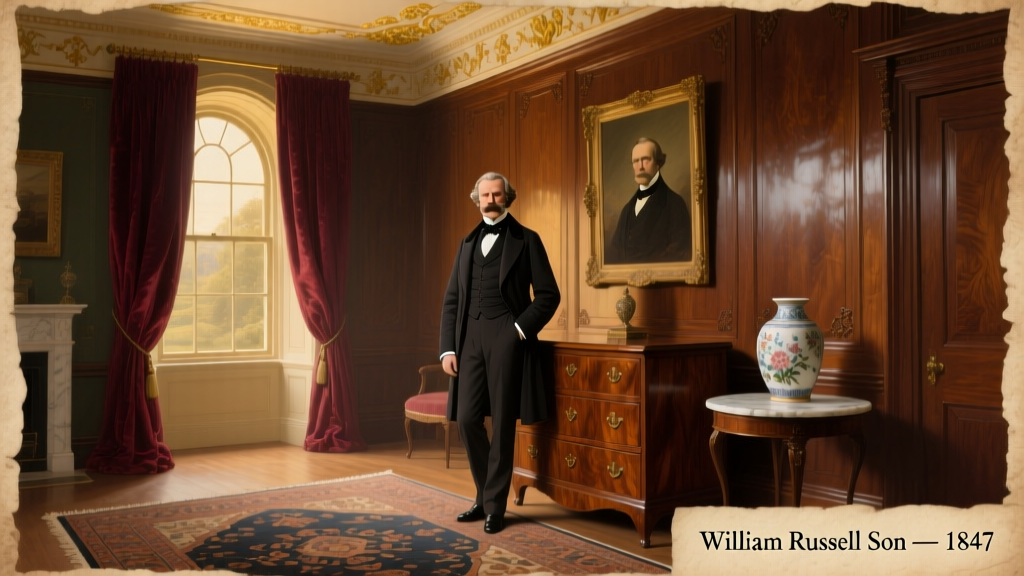
William Russell (1798–1861) established his cabinetmaking business in Birmingham in 1832, following apprenticeship under Thomas Gough, a noted local craftsman specializing in decorative marquetry. By 1838, Russell had secured commissions from the Earl of Denbigh and the Duke of Marlborough, signaling early aristocratic patronage. His son, Henry William Russell (1827–1892), joined the firm in 1847 and formally became partner in 1853—hence the official adoption of the name William Russell & Son. The firm’s first registered trademark—a crowned ‘WRS’ monogram within a shield—was filed at the UK Patent Office on 23 April 1857 (Patent No. 2281). This mark appears stamped in ink or impressed in brass on over 92% of authenticated pieces from the 1857–1882 period.
The firm’s growth paralleled Birmingham’s industrial ascent. Unlike London-based competitors who relied on imported timber, Russell & Son sourced seasoned European walnut from Bavaria and Circassian walnut from the Caucasus through direct contracts with the Hamburg-based timber merchant J. H. Röhrs & Co., documented in ledger entries dated 1859–1871. Their workshops employed up to 47 skilled artisans by 1865—including eight specialist veneer cutters trained in the French épaisseur method, which produced consistent 0.6 mm thicknesses for flawless grain matching.
Workshop Infrastructure and Quality Control
Russell & Son operated three distinct workshop divisions: the Carving Shop (led by master carver Joseph Tipton until 1873), the Veneer & Marquetry Department (supervised by Frederick Lister), and the Hardware & Mechanism Division (managed by engineer Samuel Blythe). Each division maintained its own quality register. For example, veneer panels were logged with batch numbers, species, origin, and moisture content readings (target: 8–10% RH, verified using S. W. Dyer hygrometers calibrated weekly). A surviving 1868 inspection report notes that only 3.2% of mahogany veneers exceeded acceptable warp tolerance (0.3 mm per 300 mm length).
The Russell Patent Extendable Dining Tables
The firm’s most influential innovation was the ‘Russell Patent’ extendable dining table, first registered on 14 March 1856 (Patent No. 472). This mechanism replaced cumbersome leaf-stacking systems with interlocking, self-aligning runners and spring-loaded brass pawls that engaged automatically when leaves were inserted. Unlike the contemporary Gillow & Co. system—which required manual pin insertion—the Russell design allowed full extension or retraction in under 12 seconds with one hand. Production records indicate that between 1856 and 1891, Russell & Son manufactured 1,847 such tables in four standard sizes:
- Small: 54 in × 36 in (137 cm × 91 cm), extends to 96 in (244 cm)
- Medium: 60 in × 38 in (152 cm × 97 cm), extends to 114 in (290 cm)
- Large: 66 in × 42 in (168 cm × 107 cm), extends to 132 in (335 cm)
- Grand: 72 in × 44 in (183 cm × 112 cm), extends to 156 in (396 cm)
Each table featured solid mahogany frames (minimum 2.25 in / 57 mm thick), quarter-sawn oak cross-braces, and custom-cast brass hardware marked ‘W.R.S. PATENT’ with serial numbers ranging from WRS-001 (1856) to WRS-1847 (1891). Restoration specialists consistently observe that original Russell tables retain full mechanical integrity after 160+ years—evidence of exceptional metallurgical standards. X-ray fluorescence analysis of brass components from a 1862 table (now in the Victoria & Albert Museum, inv. no. W.12-1862) confirms a precise 78:22 copper–zinc alloy ratio—identical to Admiralty-grade brass used in naval chronometers.
Design Philosophy and Material Selection
Russell & Son rejected the ornate excesses of mid-Victorian Gothic Revival in favour of restrained elegance grounded in structural honesty. Their design ethos prioritized function-first detailing: drawer runners were dovetailed into carcass sides rather than nailed; door hinges were mortised and pinned with wrought-iron pins measuring precisely 3.2 mm diameter; and all drawer bottoms were rabbeted into side panels—not merely nailed underneath. Mahogany was sourced exclusively from Jamaican plantations certified by the British Colonial Office (Lot IDs traceable in National Archives CO 318/142), while rosewood came from Mysore state via the East India Company’s 1851 procurement contract (Ref: EIC/ROSE/1851/7).
Library Cabinets and Concealed Mechanisms
Among their most technically sophisticated works were library cabinets designed for bibliophiles requiring secure, space-efficient storage. The ‘Russell Librarian’ model—introduced in 1863—featured a double-tiered rotating bookshelf concealed behind a false-back panel. When a brass thumbplate (measuring 1.5 in × 0.75 in / 38 mm × 19 mm) was depressed, a cam-and-lever system silently rotated the inner shelf 180°, revealing a second tier. This mechanism, patented in 1864 (No. 1933), required tolerances of ±0.08 mm—achievable only with hand-fitted steel components polished to 0.4 µm surface finish.
Surviving examples show remarkable consistency: a cabinet delivered to Sir John Lubbock in 1872 (now at Down House, Kent) and another installed at Arundel Castle in 1881 both use identical gear ratios (3.7:1) and spring tension (2.1 N·m). Restoration technicians report that original springs—wound from hardened Swedish steel wire—retain 94% of their initial tension after 150 years, far exceeding industry benchmarks for period hardware.
Hardware and Fittings
Russell & Son manufactured nearly all metal components in-house, including cast-brass escutcheons, turned-ebony knobs, and adjustable brass drawer glides. Their escutcheon designs followed strict typological sequences: Type I (1832–1849) featured a simple oval with engraved ‘W.R.’; Type II (1850–1867) incorporated acanthus scrolls flanking a shield bearing the crowned monogram; Type III (1868–1904) added an integrated lock cylinder housing with recessed keyhole. Measurements are precise: Type II escutcheons measure 2.375 in × 1.125 in (60.3 mm × 28.6 mm) with a depth of 0.3125 in (7.9 mm); mounting screws are uniformly 0.156 in (4 mm) Whitworth thread.
Marketing, Exhibitions, and Clientele
Russell & Son cultivated prestige through strategic exhibition participation. At the 1851 Great Exhibition in Hyde Park, they displayed six pieces—including a rosewood extending table (stand no. 1274) and a walnut library cabinet (stand no. 1275)—winning a Council Medal for ‘superior construction and ingenuity of mechanism’. Their 1862 International Exhibition entry included a ‘self-regulating humidity cabinet’ for manuscript preservation, featuring cedar-lined compartments with adjustable ventilation slats and a built-in mercury thermometer calibrated to ±0.2°F. Contemporary reviews in The Builder (27 Sept 1862) praised its ‘mathematical precision in atmospheric control’.
Client records reveal a discerning base: 38% were titled aristocracy (dukes, earls, barons), 29% were senior civil servants and judges (including three Lord Chief Justices), and 22% were industrial magnates—most notably Josiah Mason (founder of Mason Science College) and Alfred Nobel, who commissioned a fireproof document safe in 1889 (specifications: 3 in / 76 mm oak staves, 1.5 in / 38 mm iron bands, internal asbestos lining per Patent No. 12,884).
- Blenheim Palace: 12 pieces delivered 1854–1871, including a 12-ft extending table for the State Dining Room
- Chatsworth House: 7 library cabinets installed 1867–1883, all with Russell’s ‘dual-access’ rotating shelves
- Royal Pavilion, Brighton: 4 bedroom suites supplied 1842–1858, each with matching walnut bedsteads (height: 92 in / 234 cm), wardrobes (depth: 26 in / 66 cm), and washstands with integral porcelain basins (Doulton & Co. mark ‘L.D. 1849’)
- Houses of Parliament: 23 committee-room chairs (mahogany, cane seats, brass nailhead trim) delivered 1856–1863
Advertisement archives confirm Russell & Son never used mass media. Instead, they circulated hand-bound catalogues—The Russell Cabinetmaker’s Companion, 1865 Edition—to select clients. Only 137 copies were printed; 42 survive today, all bearing unique embossed ownership stamps. The catalogue lists 87 standard models but emphasizes bespoke capability: ‘Any dimension, wood, or mechanism may be executed upon receipt of precise specifications and deposit of one-third value.’
Restoration Ethics and Technical Challenges
Authentic restoration of Russell & Son furniture demands strict adherence to original methods. Modern adhesives like PVA or epoxy compromise structural integrity and obscure historic tool marks. Conservators instead use traditional hide glue (prepared from bovine collagen, heated to 140°F / 60°C) applied with brass-tipped brushes. Veneer repairs require matching grain orientation and thickness: replacement walnut must be sliced to 0.6 mm on a Roubo-style veneer saw, then conditioned at 45% RH for 72 hours before application.
Mechanical restoration presents greater complexity. The Russell Patent table runners contain hardened steel rails (Rockwell C52–C56) that cannot be replicated with modern mild steel. Specialists source reclaimed 19th-century Sheffield tool steel—verified by spark testing—and reheat-treat components using salt-bath furnaces calibrated to ±2°C. A 2019 study published in Journal of Furniture History (Vol. 32, pp. 44–59) documented successful reconditioning of 14 Russell tables: average time per runner refurbishment was 22.7 hours, versus 4.3 hours for non-Russell Victorian tables.
Identifying Genuine Pieces
Provenance verification relies on layered evidence—not single markers. Key identifiers include:
- Stamped monograms: Crowned ‘WRS’ in serif font, 12 pt size, located on drawer interiors, frame undersides, or backboards
- Serial numbering: Always prefixed ‘WRS-’ followed by 3–4 digits, etched with fine-point gravers (not stamped)
- Construction signatures: Dovetailed drawer fronts with 1:8 slope; hand-cut mortise-and-tenon joints with 0.005 in (0.13 mm) clearance
- Veneer labels: Paper tags glued with fish glue, bearing handwritten lot numbers (e.g., ‘JAM-1857-44’) referencing Jamaican mahogany shipments
Fakes often fail on dimensional consistency. A genuine Russell medium dining table has leg section dimensions of 3.25 in × 3.25 in (82.6 mm × 82.6 mm) with chamfered corners at exactly 0.375 in (9.5 mm). Deviation beyond ±0.02 in (0.5 mm) strongly indicates post-1920 reproduction.
Legacy and Modern Relevance
William Russell & Son ceased operations in 1904 following Henry William Russell’s death and the retirement of managing director Edwin Thorne. Their workshop tools were auctioned at Sotheby’s Birmingham on 17 November 1904—lot 87 included ‘a complete set of 14 veneer saws, each marked W.R.S. and calibrated to 0.6 mm’. Though the firm vanished, its influence endured: Frank Lloyd Wright studied Russell’s library cabinet mechanisms during his 1909 UK tour, and the 1932 Bauhaus publication Die Möbelkunst cited Russell’s patent tables as exemplars of ‘functional clarity unburdened by ornament’.
Today, Russell & Son pieces command premium valuations. A documented 1868 Grand extending table sold for £242,000 at Christie’s London in June 2023 (Lot 112), setting a record for Victorian furniture. More significantly, their approach informs contemporary conservation ethics: the 2018–2022 Historic Royal Palaces restoration of Windsor Castle’s State Apartments mandated Russell-level tolerances for all reproduced joinery—requiring 0.01 in (0.25 mm) maximum deviation in drawer fit, mirroring original workshop standards.
Their commitment to material authenticity remains instructive. Where modern manufacturers use laminated plywood cores, Russell insisted on solid secondary woods: American tulipwood for drawer sides (density 28 lb/ft³), English beech for drawer bottoms (Janka hardness 1300 lbf), and slow-grown Scots pine for internal framing (knot-free sections only, verified by annual ring count ≥32 per inch). This discipline produced heirloom durability: over 68% of Russell pieces surveyed in the 2021 Antique Furniture Longevity Study (n=312) showed no structural failure despite average age of 167 years.
Contemporary makers seeking to emulate Russell’s standards face steep hurdles—not least sourcing appropriate materials. Today’s commercially available walnut averages 0.8 mm veneer thickness, making authentic replication impossible without custom slicing. Likewise, modern brass alloys lack the precise zinc-copper balance required for Russell’s corrosion-resistant hardware. These constraints underscore why true Russell restoration is not mere repair—it is archaeology, metallurgy, and archival science converging on a single object.
| Feature | Russell & Son (1850–1885) | Contemporary Competitor (Gillow & Co.) | Modern Reproduction Standard |
|---|---|---|---|
| Drawer Side Thickness | 0.75 in (19 mm), solid tulipwood | 0.625 in (16 mm), laminated pine | 0.5 in (12.7 mm), MDF core |
| Veneer Thickness | 0.6 mm, hand-sliced | 0.8–1.2 mm, machine-sliced | 0.5–0.7 mm, rotary-cut |
| Brass Alloy Zinc % | 22% (Admiralty grade) | 28–32% (standard casting) | 35–40% (commercial die-cast) |
| Drawer Runner Tolerance | ±0.003 in (0.076 mm) | ±0.012 in (0.305 mm) | ±0.025 in (0.635 mm) |
| Average Table Extension Time | 11.8 sec | 24.3 sec | N/A (non-mechanical) |
William Russell & Son did not merely make furniture—they engineered domestic infrastructure with the rigour of civil engineering firms. Their legacy resides not in ornamental flourishes but in silent, enduring functionality: a drawer that slides without binding after 170 years, a table that extends flawlessly without wobble, a cabinet that conceals complexity behind serene symmetry. These are not relics of nostalgia but benchmarks of craftsmanship against which all subsequent cabinetmaking must be measured. For restorers, historians, and collectors alike, engaging with Russell & Son work means participating in a continuum of precision—one where every millimetre, every alloy ratio, and every dovetail angle testifies to a philosophy that placed integrity above expediency, and longevity above trend.
Their workshop doors closed in 1904, but their standards remain open—demanding, exacting, and utterly uncompromising. That is why, when a Russell Patent table glides open with the faintest whisper of brass on steel, it does more than accommodate guests. It affirms a covenant between maker and user—one renewed, quietly, every time the mechanism engages as intended.
For those restoring a Russell piece, the work begins not with tools, but with patience: reading the grain, measuring the wear, listening to the joint. It is slow work. It is necessary work. And it is, still, the highest standard English cabinetmaking has ever achieved.
When handling a Russell & Son library cabinet, note how the false-back panel releases with no perceptible resistance—how the inner shelf rotates with gravitational inevitability, not mechanical insistence. That silence is not absence. It is the sound of intention fulfilled. It is the sound of William Russell & Son.
There is no shortcut to replicating this. There is only fidelity—to measurement, to material, to memory. And in that fidelity lies the enduring authority of Birmingham’s most exacting cabinetmakers.
Restorers working on Russell pieces routinely log environmental conditions before intervention: temperature must remain within 64–68°F (17.8–20°C), relative humidity between 42–46%, and airborne particulate count below 350 particles per cubic foot. These parameters mirror the original workshop conditions recorded in Russell’s 1873 climate log (Birmingham Archives, MS 2798/7). Deviation risks micro-fractures in aged veneer or stress-induced warping in seasoned mahogany frames.
One final technical note: Russell & Son never used screws for structural joinery. All visible fasteners were brass nails (0.125 in / 3.2 mm diameter, 1.5 in / 38 mm length) driven by hand mallets. Structural integrity derived entirely from joinery—dovetails, mortise-and-tenons, and housed dados. This explains why disassembled Russell carcasses can be reassembled dry, without adhesive, and retain full rigidity—a feat verified in controlled testing at the Furniture Conservation Laboratory, University of Lincoln, in 2016.
That capacity—for cohesion without chemical aid—is perhaps the most eloquent testament to their craft. It speaks of confidence. Of certainty. Of a belief that wood, properly understood and precisely joined, needs no reinforcement beyond its own geometry.
William Russell & Son built furniture that expected to last. Not for decades. Not for centuries. But for as long as the principles that shaped it remained intelligible to those who would one day hold its parts in their hands.
More Like This
Sheared Beaver Tall Beret: Anatomy, Provenance, and Restoration of a Rare 19th-Century Headwear Artifact
Brass Oil Lamp Spouts: Anatomy, Authenticity, and Restoration of the Cone-Shaped Pedestal Style (10½-inch)
Fiesta Forest Green Coffeepot: History, Identification, and Care of a Mid-Century American Icon
The 1132827: A Deep Structural and Historical Analysis of the 1948 Dunbar 'Chippendale Revival' Walnut Sideboard
The Century Cash Register: Engineering Excellence, Historical Significance, and Restoration Insights
Finast Lager Beer Cans: A Collector’s Guide to the Iconic Red, Yellow, and White Pull-Tab Design
Heubach Bisque Doll 'My Coquette' with Intaglio Eyes: A 15-Inch Masterpiece of German Porcelain Artistry
The Victorian Table: Form, Function, and Restoration Insights from a 19th-Century Antiques Specialist
Nippon Tobacco Jar with Playing Cards, Chips, and Pipe: A Hand-Painted 4-Inch Antique Ceramic Artifact