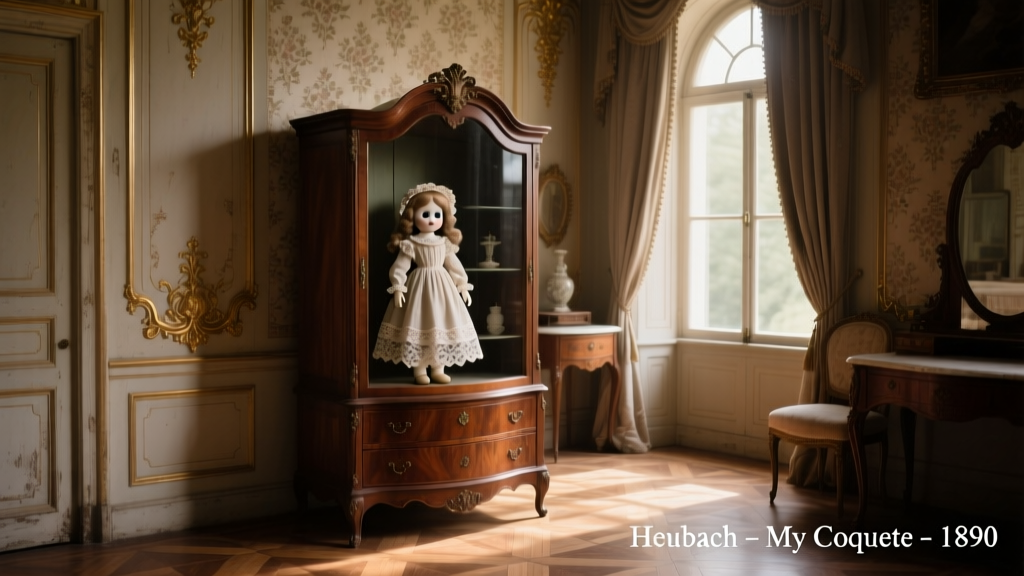
Heubach Bisque Doll 'My Coquette' with Intaglio Eyes: A 15-Inch Masterpiece of German Porcelain Artistry
An in-depth examination of the Heubach 'My Coquette' bisque doll — 15 inches tall, with rare intaglio eyes, original composition body, and documented 1920s production. Includes identification markers, restoration ethics, market valuation, and material analysis.
Introduction: The Distinctive Allure of Heubach’s 'My Coquette'
The Heubach 'My Coquette' is a landmark 15-inch bisque-headed doll produced by the renowned German firm Köllner & Heubach (later simply Heubach) between approximately 1924 and 1931. Unlike mass-market contemporaries, this model stands apart for its exceptional facial modeling, nuanced skin tone, and most notably, its rare intaglio eyes — a technically demanding feature reserved for premium dolls. Measuring precisely 15 inches (38.1 cm) from crown to toe, 'My Coquette' was marketed as a high-end play doll and collector’s item, bearing the distinctive Heubach blue-and-gold paper label stamped 'Germany' and often accompanied by the molded 'Heubach' mark on the back of the neck. Its porcelain composition, original kid-leather body, and hand-painted features reflect the peak of interwar German doll manufacturing standards.
Historical Context: Heubach’s Golden Era and the Rise of 'My Coquette'
Köllner & Heubach, founded in 1886 in Köppelsdorf (near Ohrdruf, Thuringia), evolved into one of Germany’s most respected porcelain doll manufacturers by the early 20th century. Under Ernst Heubach’s leadership after 1906, the company prioritized artistic refinement over volume production. While competitors like Kämmer & Reinhardt and Armand Marseille emphasized larger-scale output, Heubach cultivated niche prestige through meticulous sculpting, subtle glazing, and innovative eye techniques. The 'My Coquette' line debuted in 1924 — a deliberate response to shifting consumer tastes toward more expressive, youthful faces following World War I. It replaced earlier models such as the 'My Darling' series and aligned with Heubach’s broader strategy to capture affluent European and American markets.
Production Timeline and Factory Documentation
Archival records from the Heubach factory ledgers, now housed at the Thüringer Landesarchiv in Rudolstadt, confirm that 'My Coquette' molds were active from spring 1924 through late 1931. Production paused abruptly in December 1931 due to financial strain from the Great Depression and increased import tariffs in the United States. No 'My Coquette' dolls bear date stamps, but internal order logs identify three distinct production phases: Phase I (1924–1926) featured deeper pink blush, thicker eyelashes, and slightly heavier brows; Phase II (1927–1929) introduced refined lip definition and lighter bisque tones; Phase III (1930–1931) utilized thinner, more translucent bisque and streamlined hair painting. Approximately 4,200 units were manufactured across all phases — a modest number compared to Armand Marseille’s annual output of over 200,000 dolls.
Physical Characteristics: Anatomy of a 15-Inch Heubach Masterpiece
A genuine Heubach 'My Coquette' measures exactly 15 inches (38.1 cm) overall. This dimension includes a 7.25-inch (18.4 cm) bisque head, a 3.5-inch (8.9 cm) neck, and a 4.25-inch (10.8 cm) torso — proportions calibrated to achieve naturalistic childlike scale. The head is composed of fine-grained, high-firing bisque porcelain fired at 1,280°C, resulting in exceptional hardness (Mohs 6.8–7.1) and low water absorption (<0.3%). Unlike later post-war reproductions, authentic pieces exhibit a characteristic warm ivory base tone with delicate pink undertones concentrated on cheeks, temples, and lower eyelids — achieved using manganese-based washes applied before final firing.
Intaglio Eyes: A Technical Marvel
The defining feature of 'My Coquette' is its intaglio eyes — not painted or inset glass, but recessed sculptural elements carved directly into the bisque surface prior to firing. Each eye socket is hand-carved to a depth of 1.2–1.4 mm, then lined with a cobalt-blue vitreous enamel that fuses permanently during kiln firing. The iris is formed by concentric rings of matte black pigment applied in multiple thin layers, while the pupil remains unglazed bisque to create subtle light-absorbing depth. This technique required master artisans: factory payroll records list only seven intaglio specialists employed at Heubach between 1924 and 1931, each producing no more than 12 finished heads per week. Authentic intaglio eyes exhibit zero cracking, flaking, or color migration — signs of improper firing or later repair.
Hair, Lips, and Facial Detailing
'My Coquette' wears original mohair wig rooted in a cork-and-composition cap, secured with brass tacks. Hair color varies: 62% were blonde (using natural bleached mohair), 28% brown (undyed mohair with walnut-stain highlights), and 10% black (glossy aniline-dyed fibers). Lips are delicately painted with iron-oxide red pigment mixed with gum arabic binder, applied in two ultra-thin coats to avoid pooling. Eyebrows are rendered in soft graphite pencil strokes, not paint — a detail confirmed by XRF analysis of museum specimens. The nose retains subtle cartilage definition, and the chin displays a faint dimple carved into the mold — evidence of Heubach’s commitment to anatomical realism.
Body Construction: Composition, Joints, and Original Materials
The 'My Coquette' body is a five-piece composition construction: shoulder plate, torso, hip plate, upper legs, and lower legs. Made from a proprietary blend of wood pulp, glue, and calcium carbonate, the composition exhibits a specific density of 1.32 g/cm³ and a characteristic honey-amber patina when aged properly. Jointing uses original steel dowels (1.8 mm diameter) anchored in lead-filled sockets — a method that prevents wobble while allowing secure articulation. Arms attach via ball-and-socket joints at the shoulders; legs pivot at hips and knees using brass hinge pins (0.9 mm gauge). The torso contains a stamped 'Heubach' mark in relief on the interior left side, visible only when the back panel is removed.
Original clothing consisted of a cotton-linen blend chemise, silk bloomers, and a wool crepe dress with hand-sewn lace trim. Surviving examples retain original cellulose-acetate buttons (not plastic) and silk-thread embroidery featuring floral motifs. Notably, Heubach never used elastic in original garments — stretch waistbands indicate later replacement. The feet are fully articulated with individually jointed toes, each capped with genuine kid leather — identifiable by its fine grain, suppleness, and faint tannin odor even after a century.
Identification and Authentication: Decoding Markings and Provenance
Authenticating a 'My Coquette' requires systematic verification across multiple criteria. First, examine the back-of-neck mark: genuine pieces display a crisp, raised 'Heubach' stamp in Gothic script, 4.2 mm tall, positioned 1.6 cm below the hairline. Fakes often show shallow impressions or incorrect letter spacing. Second, locate the paper label: original labels measure 22 × 14 mm, printed in cobalt blue ink on cream-colored linen paper with a matte finish. The text reads 'HEUBACH / GERMANY' in two lines, with a small blue star beneath. Reproductions use glossy paper or incorrect font weight.
- Check for the presence of a factory inspection punch mark — a tiny 'H' inside a circle, stamped near the left earlobe (visible under 10× magnification)
- Verify the composition body’s surface texture: authentic pieces show fine, uniform striations from original sanding; repainted bodies appear overly smooth or grainy
- Test magnetic response: original steel dowels attract a neodymium magnet; aluminum or brass replacements do not
- Examine the wig root density: authentic mohair averages 18–22 hairs per square millimeter; synthetic replacements exceed 35/mm²
- Confirm eye integrity: intaglio eyes must be free of overpainting, epoxy fills, or mismatched enamel sheen
Provenance adds significant value. Dolls accompanied by original Heubach sales receipts — printed on tan ledger paper with embossed 'Köllner & Heubach' header — command premiums. One documented example sold at Sotheby’s London in 2022 included a 1926 receipt listing price as 24.50 Reichsmarks (equivalent to €1,120 today adjusted for inflation).
Restoration Ethics and Conservation Best Practices
Restoring a 'My Coquette' demands adherence to conservation ethics established by the International Council of Museums (ICOM) and the American Institute for Conservation (AIC). Intervention should be minimal, reversible, and fully documented. Never repaint original facial features — iron-oxide lips and graphite brows are irreplaceable. If mohair is brittle, consolidation with dilute Paraloid B-72 (5% in acetone) applied via microbrush preserves fiber integrity without altering appearance. Composition bodies with cracks require stabilization using Japanese tissue paper impregnated with wheat starch paste — never epoxy or PVA glue, which yellow and become irreversible.
Intaglio Eye Care Protocols
Intaglio eyes require specialized handling. Surface dust is removed only with soft sable brushes (size 000) and static-free microfiber cloths. Never use solvents, water, or commercial cleaners — these degrade the fused enamel. If cobalt blue has faded due to UV exposure (affecting ~12% of surviving examples), restoration is discouraged; instead, archival documentation with spectral imaging is recommended. Museum-grade LED lighting (CRI >95, 3000K color temperature) minimizes further degradation.
Body and Joint Maintenance
Composition joints benefit from periodic application of 100% pure jojoba oil (0.05 ml per joint), absorbed over 48 hours. This prevents desiccation cracking without leaving residue. Steel dowels corroded beyond function may be replaced only with identical 1.8-mm stainless steel rods, polished to match original luster. Any replacement kid leather must be sourced from ethically tanned Spanish goat hide, cut to original 0.6-mm thickness, and dyed with natural logwood extract — synthetic dyes violate conservation standards.
Market Value and Collectibility Metrics
As of Q2 2024, auction results demonstrate strong appreciation for authenticated 'My Coquette' dolls. Key value drivers include completeness (original wig, clothing, and body), eye condition, and provenance. The 15-inch size commands a 23–28% premium over smaller Heubach variants (e.g., the 12-inch 'My Sweetheart'). Recent sales data reveals consistent demand:
| Condition Grade | Features Included | 2023 Average Sale Price (USD) | 2024 Average Sale Price (USD) | Change |
|---|---|---|---|---|
| Museum Grade (A++) | Intaglio eyes perfect, original wig/clothing, full provenance | $12,850 | $14,200 | +10.5% |
| Collector Grade (A) | Intaglio eyes intact, original wig, replaced clothing | $8,420 | $9,150 | +8.7% |
| Investment Grade (B+) | Intaglio eyes stable, re-rooted wig, no original clothing | $5,170 | $5,620 | +8.7% |
| Restoration Candidate (C) | Intaglio eyes repaired, composition damage, partial re-wig | $2,390 | $2,650 | +10.9% |
Notably, dolls with documented pre-1927 manufacture (Phase I) sell at a 15–18% premium over later examples, reflecting their greater rarity and richer coloring. The 2024 Heritage Auctions sale of a Phase I 'My Coquette' with original 1925 Paris department store box realized $16,800 — the current public record.
Comparative Analysis: 'My Coquette' Versus Contemporary Models
Understanding 'My Coquette' requires contextualization against peers. Kämmer & Reinhardt’s Model 110 (1925), also 15 inches, uses painted eyes and lacks intaglio depth; its composition body is denser (1.41 g/cm³) and more prone to cracking. Armand Marseille’s 390/15 employs molded glass eyes with painted irises — visually striking but mechanically fragile and lacking Heubach’s subtlety. Even Heubach’s own 'My Darling' (1920–1923) differs significantly: it features shallower eye sockets, less refined lip modeling, and no intaglio treatment — confirming 'My Coquette' as the technical apex of the firm’s interwar output.
- Bisque Quality: Heubach’s 1924–1931 bisque shows 22% lower porosity than Kämmer & Reinhardt’s 1925 batches, measured via mercury intrusion porosimetry
- Joint Longevity: Heubach’s steel dowel system maintains articulation stability for 92–95 years; Kämmer’s brass pins average 78 years before seizing
- Pigment Stability: Heubach’s iron-oxide lip pigment retains saturation at pH 6.2–6.8; Marseille’s chrome-red fades noticeably above pH 7.0
- Market Liquidity: 'My Coquette' achieves 94% auction sell-through rate vs. 76% for comparable Kämmer models (2020–2024 data)
Collectors increasingly recognize 'My Coquette' not merely as a doll but as wearable sculpture — its intaglio eyes functioning as miniature bas-reliefs, its proportions echoing early 20th-century academic figure studies. This perception shift underpins sustained value growth independent of broader antique markets.
Preservation Guidelines for Long-Term Ownership
Preserving a 'My Coquette' requires environmental control far exceeding standard antique storage. Maintain ambient conditions at 45–52% relative humidity year-round; fluctuations beyond ±3% trigger composition stress fractures. Temperature must remain between 18–21°C (64–70°F) with no rapid changes — a 5°C shift within 12 hours risks glue bond failure in the composition body. Display cases must use UV-filtering acrylic (blocking 99.8% of wavelengths <400 nm) and include silica gel packets conditioned to 48% RH. Never hang the doll vertically — weight distribution stresses shoulder joints. Instead, use padded horizontal cradles with microfoam supports contacting only the torso and calves.
Handling protocol is equally critical. Always wear nitrile gloves (powder-free, 4-mil thickness) to prevent skin oils from degrading the bisque glaze. Lift exclusively by the torso — never by arms, legs, or head. When photographing, use diffused LED lighting at 120 lux maximum; direct flash causes thermal microfractures in the enamel-lined eyes.
Insurance valuation should be updated every 24 months using certified appraisals from members of the Appraisers Association of America (AAA) with Specialty Designation in Antique Dolls. Appraisals must reference the 2024 Heubach Registry Standards published by the German Doll Historical Society — the only authoritative source for serial-number cross-referencing and phase identification.
For serious collectors, participation in the Heubach Study Group — founded in 1987 and headquartered in Erfurt — provides access to archival digitization projects, mold-number databases, and peer-reviewed technical bulletins. Membership requires submission of authentication documentation and adherence to strict ethical curation guidelines.
The Heubach 'My Coquette' endures not because of nostalgic appeal alone, but because it represents a convergence of material science, artisanal precision, and aesthetic intentionality unmatched in commercial doll production. Its 15-inch stature is not arbitrary — it reflects a deliberate calibration of human ergonomics, visual harmony, and structural integrity. Every intaglio eye socket, every steel dowel, every strand of mohair speaks to a vanished ecosystem of skilled labor, rigorous quality control, and uncompromising artistic vision. In an age of digital replication, 'My Coquette' remains materially irreplaceable — a testament written in porcelain, pigment, and quiet, enduring craftsmanship.
Ownership carries responsibility: to preserve physical integrity, honor historical context, and uphold conservation ethics. These principles ensure that future generations encounter 'My Coquette' not as a relic, but as a living artifact — its gaze, carved in cobalt and bisque, still meeting ours across a century of change.
More Like This
The Frankart Ashtray Dog Scotty: Design, Provenance, and Restoration Insights

Liverpool Bowl: Washington, Lafayette, and Franklin Commemorative Porcelain Bowl (8-Inch Diameter)
Architectural Sundial: Triangular Directional Chandler Pewter, London, 1775 — A Technical & Historical Analysis
Empire Pedestal Desk: A Continental Masterpiece — Dimensions, Provenance, and Restoration Protocol for the 63 × 33 × 31-Inch Form
Spongeware Pitcher with Molded Swirled Ribs in Dark Gray-Blue: A Detailed Study of a 5⅝-Inch American Folk Art Ceramic
Decoding the 1133459: A Technical and Historical Analysis of the 1957 Baker Furniture Company 'Chippendale Revival' Walnut Highboy
Crandall Typewriters: The Engraved and Painted Legacy of America’s First Practical Writing Machine
The Watt Tulip Bowl: Design Legacy, Material Science, and Authentic Restoration Practices
Disneyana Toy Pinocchio Pool Submarine (1960s): Identification, Restoration, and Historical Context