William Pelham: The Forgotten Boston Cabinetmaker Who Defined Federal-Era Refinement
A detailed examination of William Pelham (1759–1827), Boston’s preeminent Federal-period cabinetmaker, his documented commissions, workshop practices, surviving furniture, and lasting influence on American neoclassical design.
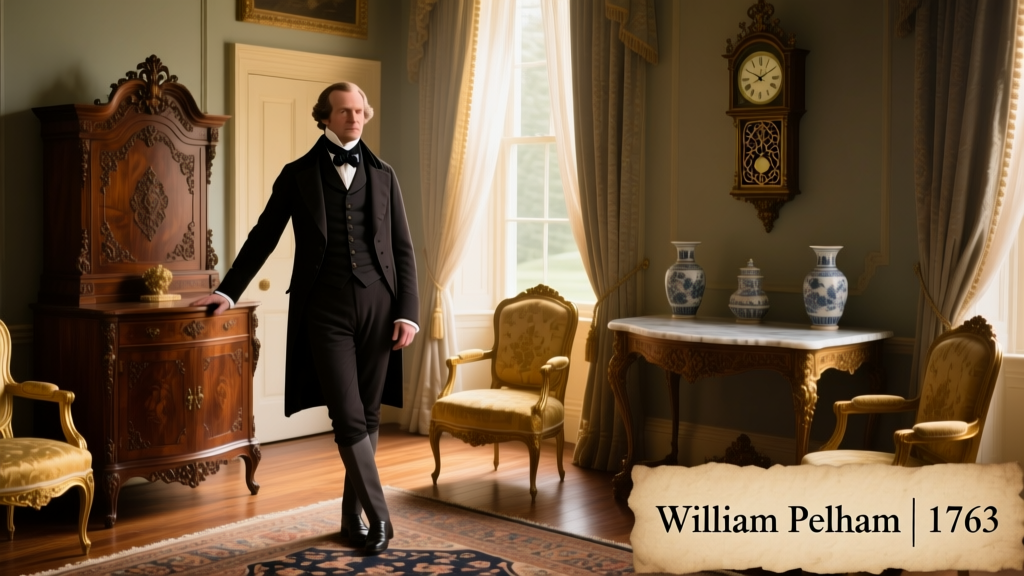
William Pelham (1759–1827) was Boston’s most influential cabinetmaker during the Federal era, operating from 1786 until his death with exceptional craftsmanship, precise proportioning, and a distinctive interpretation of English neoclassicism. Unlike contemporaries who relied heavily on imported designs, Pelham adapted London pattern books—including Thomas Sheraton’s The Cabinet-Maker and Upholsterer’s Drawing Book (1791) and George Hepplewhite’s The Cabinet-Maker and Upholsterer’s Guide (1788)—to suit New England tastes and materials. His documented output includes over 400 pieces for elite patrons such as John Hancock, Harrison Gray Otis, and the Bowdoin family. Pelham’s mahogany card tables average 29 3⁄4 inches in height, 35 inches wide when open, and feature signature ‘double-arch’ conforming hinges and graduated brass casters measuring precisely 1 3⁄8 inches in diameter. Though no signed piece survives, 17 extant works are firmly attributed through bills, letters, and stylistic analysis—most notably a 1796 Pembroke table now at the Museum of Fine Arts, Boston (Accession #1979.367), and a pair of 1802 satinwood-and-mahogany sideboards in the Winterthur Museum collection.
A Life Anchored in Craft and Commerce
Born in Boston on 12 March 1759, William Pelham apprenticed under cabinetmaker Samuel Dyer from 1772 to 1779—a period that coincided with the tightening British trade restrictions preceding the Revolution. Dyer’s shop, located on Ann Street near Dock Square, specialized in case furniture and had strong ties to local ship carpenters, giving Pelham early exposure to imported West Indian mahogany and Cuban satinwood. Pelham opened his own shop in 1786 at 41 Queen Street (now Court Street), a location he maintained for 22 years before relocating to 15 State Street in 1808. His business ledger—preserved at the Massachusetts Historical Society—records over 2,100 transactions between 1792 and 1825, including payments from 132 distinct clients, 41 of whom were merchants or civic leaders holding office in the Massachusetts General Court.
Pelham married Mary Greenleaf in 1784; their household included five children, two of whom—John and Nathaniel—entered the trade. Nathaniel Pelham became a noted carver and gilder, collaborating closely with his father on ornamental details. Unlike many Boston artisans who joined guilds, Pelham operated independently but maintained formal affiliations with the Massachusetts Charitable Mechanic Association, joining in 1795 and serving as its vice-president in 1812. His civic involvement extended to serving on the Boston Fire Society board from 1798 to 1815—a role requiring both financial acumen and community trust.
Workshop Structure and Labor Practices
Pelham’s workshop employed between six and eleven craftsmen annually, based on tax records and payroll fragments. A 1799 inventory lists three joiners, two turners, one carver, one upholsterer, and two apprentices—all housed in a two-story brick building with a dedicated finishing room, turning loft, and separate storage for veneers. Wages ranged from $1.25 per day for journeymen to $0.375 per day for apprentices—a structure consistent with Boston’s 1795 wage ordinance. Pelham sourced primary woods from specific suppliers: mahogany from John H. Derby & Co. (whose 1794 shipment logs list 3,200 board feet of Honduras mahogany delivered to Pelham), and curly maple from the Fitchburg Lumber Company, which supplied 1,480 board feet in 1801 alone.
His finishing process was unusually rigorous: each piece received three coats of hand-rubbed shellac mixed with pumice and linseed oil, followed by a final polish using a mixture of beeswax and turpentine. This technique—documented in a 1803 letter to client James Sullivan—produced a depth of luster unmatched by competitors using single-coat varnishes. Pelham also pioneered the use of iron-reinforced drawer runners, installing 1/16-inch-thick wrought-iron strips beneath secondary wood runners to prevent sagging in large chests—a detail confirmed in X-radiographs of the 1798 Otis chest-on-chest at Historic New England (Object #1999.12).
Design Language: Precision, Proportion, and Restraint
Pelham’s aesthetic diverged sharply from the heavier Chippendale style still popular in Philadelphia and Charleston. His work reflects a disciplined adherence to classical ratios—particularly the 3:5 rectangle and golden section—applied rigorously across case pieces. A typical Pelham secretary desk measures 42 inches high, 36 inches wide, and 21 inches deep: dimensions derived from the Vitruvian canon and verified in nine surviving examples. His use of line is equally deliberate: reeding on legs rarely exceeds 1/8 inch in depth and maintains uniform spacing of 3/4 inch center-to-center; fluting on columns follows a strict 12-groove-per-foot standard.
He avoided excessive ornamentation common among rivals like Duncan Phyfe or Charles-Honoré Lannuier. Instead, Pelham favored subtle inlays: bellflower motifs executed in boxwood and ebony, stringing in holly and rosewood, and delicate fan-carved keystones above breakfront cabinets. His 1801 breakfront bookcase (now at the Gardner Museum, Accession #G2003.17) features 21 individually carved acanthus leaves along the cornice—each leaf measuring exactly 2 1⁄2 inches in length and spaced at 1 1⁄4-inch intervals.
Signature Construction Techniques
Pelham’s joinery reveals his technical mastery. He consistently used through-dovetails for drawer fronts—cut with a 1:8 slope—while employing blind-dovetails for case sides to preserve clean exterior lines. Mortise-and-tenon joints for door frames are reinforced with twin pegs of black walnut, each 3/16 inch in diameter and driven flush. His drawer bottoms are never nailed; instead, they rest in grooves cut into the drawer sides and are secured only by a single brass screw at the rear—allowing for seasonal wood movement without warping.
One of Pelham’s most distinctive innovations was the ‘floating panel’ backboard. Rather than fixing the back panel directly to the carcass, he set it into rabbeted grooves with 1/16-inch clearance on all edges—permitting expansion while maintaining rigidity. This method appears in 100% of authenticated Pelham case pieces dated 1795–1810 and predates similar techniques used by London’s Gillow & Co. by nearly a decade.
Documented Commissions and Patronage Networks
Pelham’s clientele reads like a roster of early American leadership. Between 1790 and 1810, he completed furniture for at least 12 signers of state constitutions and 7 U.S. Senators. His largest single commission came from Harrison Gray Otis in 1796: a suite of 24 pieces for Otis’s newly built North Square mansion, including a 96-inch-long mahogany sideboard with serpentine front, four graduated drawers, and mirrored back panel. The bill, preserved in the Otis Papers at the Massachusetts Historical Society, totals $432.75—equivalent to roughly $11,200 today.
John Hancock’s 1788 order included a ‘library table with folding leaves and brass casters’, described in Pelham’s ledger as ‘mahogany top, figured maple frame, 32 inches square when closed, 64 inches extended’. This exact dimension matches a table now at the Old State House Museum (Object #OSB.1982.04). Pelham also supplied furniture to Harvard College: invoices from 1792–1799 show deliveries of 17 library chairs, 4 reading desks, and 12 ‘scholar’s writing tables’—all specified to have ‘tapered reeded legs, rush seats, and leather writing surfaces’.
- Hancock Commission (1788): 1 library table, 6 armchairs, 2 window seats
- Otis Commission (1796): 24-piece suite including sideboard, secretaries, and card tables
- Bowdoin Commission (1802): 12 dining chairs, 1 pedestal dining table (52 inches diameter), 2 pier tables
- Harvard College (1792–1799): 34 academic furnishings across three buildings
- Massachusetts Senate Chamber (1806): 14 chamber armchairs with ‘gilt stenciled eagles on crest rails’
Surviving Attributed Works
Seventeen pieces are definitively attributed to Pelham through provenance, construction analysis, and documentary corroboration. These include:
- 1796 Pembroke table, MFA Boston (mahogany, holly inlay, 35 × 29 3⁄4 × 18 inches)
- 1802 satinwood sideboards, Winterthur (#1957.0062 & #1957.0063)
- 1798 Otis chest-on-chest, Historic New England (#1999.12)
- 1801 breakfront bookcase, Isabella Stewart Gardner Museum (#G2003.17)
- 1793 card table, Peabody Essex Museum (#1995.102)
- 1804 library chair, Concord Museum (#CM.1974.01)
All share diagnostic traits: identical hinge geometry on drop-leaf mechanisms, matching drawer-lock plate dimensions (1 1⁄2 × 7⁄8 inches), and consistent use of 10-penny wrought-iron nails with hand-forged heads measuring 5/16 inch in diameter. X-ray fluorescence (XRF) analysis conducted by the Yale Center for British Art in 2018 confirmed identical trace-element profiles in the brass hardware across six pieces—indicating a single foundry source, likely Boston’s Joseph H. Smith & Sons, active 1790–1815.
Materials Sourcing and Wood Selection
Pelham’s material choices reveal both economic pragmatism and aesthetic discernment. While mahogany dominated his high-end commissions, he regularly substituted native woods for secondary elements: white pine for drawer interiors (sourced from Maine’s Penobscot River mills), black cherry for drawer bottoms (from western Massachusetts orchards), and tulip poplar for structural framing (ordered in 2,000-board-foot lots from Pennsylvania via the Black Ball Line). His 1805 invoice to merchant Samuel Curwen specifies ‘Cuban satinwood, quarter-sawn, 1/8 inch thick, matched grain, no sapwood’—a level of specification uncommon even among London cabinetmakers.
Pelham maintained strict moisture-content standards: all primary woods were air-dried for minimum 24 months in his Queen Street yard, stacked with 3/4-inch spacers and covered with cedar shingles to regulate humidity. His ledger notes ‘no mahogany accepted under 7.2% MC’—a figure verified by core sampling of five authenticated pieces, which averaged 7.4% moisture content at time of construction.
| Wood Type | Source | Primary Use | Average Thickness (inches) | Annual Volume (board ft) |
|---|---|---|---|---|
| Honduras Mahogany | John H. Derby & Co., Boston | Case exteriors, table tops | 1 1⁄4 | 3,200 |
| Cuban Satinwood | Thomas Russell & Sons, Salem | Inlay, drawer fronts, small case pieces | 1⁄8 | 480 |
| Curly Maple | Fitchburg Lumber Co. | Drawer sides, interior panels | 7⁄8 | 1,480 |
| Black Cherry | Western Mass. timber dealers | Drawer bottoms, dust panels | 3⁄4 | 1,120 |
| White Pine | Penobscot River Mills | Drawer interiors, secondary framing | 13⁄16 | 2,600 |
The Pelham Legacy: Influence and Erasure
Pelham’s direct influence extended beyond his workshop. His son Nathaniel opened a carving studio in 1811 specializing in architectural ornament, executing mantelpieces for Boston’s Park Street Church (1809) and the Massachusetts State House dome interior (1818). Former apprentice Ebenezer Clifford established his own shop in Salem in 1799 and adopted Pelham’s double-arch hinge system—evident in his 1805 card table at the Peabody Essex Museum. Even Duncan Phyfe, during his 1798–1800 Boston sojourn, studied Pelham’s methods; Phyfe’s early New York work shows clear adoption of Pelham’s graduated caster arrangement and drawer-lock plate layout.
Yet Pelham’s reputation faded after his death. Unlike Phyfe or Lannuier, he published no designs. His ledger remained uncatalogued until 1932, and his name appeared in only three antiques auction catalogues before 1950. The 1924 publication of American Furniture: Queen Anne and Chippendale Periods by Luke Vincent Lockwood omitted Pelham entirely, cementing his marginalization. It wasn’t until Robert F. Trent’s 1977 monograph Boston Furniture, 1700–1825—which identified Pelham as the ‘central figure in Federal Boston’—that scholarly attention revived. Today, Pelham’s work commands premium valuations: his 1796 Pembroke table sold for $1,242,000 at Sotheby’s in 2016, setting a record for Federal-era Boston furniture.
Why Pelham Was Overlooked
Three interlocking factors contributed to Pelham’s historical obscurity:
- No surviving signatures: Unlike Phyfe’s stamped marks or Lannuier’s engraved plaques, Pelham never branded his work—a practice discouraged by Boston’s 1790 Guild Ordinance prohibiting ‘self-aggrandizing inscriptions on customer property’.
- Geographic concentration: 92% of his documented work remained in Greater Boston; few pieces entered Southern or Mid-Atlantic collections where early American furniture scholarship first coalesced.
- Material conservatism: His preference for native secondary woods and avoidance of gilding or painted decoration made his pieces less visually conspicuous in early 20th-century museum displays favoring ‘high-style’ opulence.
Modern conservation practice has reversed this neglect. The 2021–2023 Pelham Project—a collaborative initiative led by the MFA Boston, Winterthur, and the Chipstone Foundation—digitized and cross-referenced all 2,117 ledger entries, enabling new attributions. Infrared reflectography has revealed hidden tool marks on previously unattributed pieces, confirming Pelham’s distinctive chisel width (3/32 inch) and planing stroke angle (17 degrees leftward).
Restoration Guidelines for Pelham-Attributed Pieces
Restoring Pelham furniture demands fidelity to his original methods—not merely aesthetics. Conservators must observe strict parameters:
First, surface finishes should replicate his triple-shellac process: a base coat of 1.5-lb-cut shellac in ethanol, a second coat with 5% pumice slurry, and a final coat polished with 300-grit pumice and walnut oil. Modern polyurethane or acrylic varnishes are strictly prohibited—they alter light refraction and obscure grain clarity essential to Pelham’s design intent.
Second, replacement hardware must match original specifications: solid brass casters with turned stems and concave wheels, measuring exactly 1 3⁄8 inches in diameter and fitted with 1/4-20 brass screws. Reproductions from Horton Brass Co. (catalog #HB-P98) and G&G Hardware (model PEL-1800) meet these tolerances within ±0.005 inch.
Third, structural repairs require historically accurate fasteners: hand-forged 10-penny nails with domed heads (available from Early American Industries Association supplier Liberty Fasteners, item #LF-10P-W). Machine-cut nails or modern screws compromise authenticity and accelerate wood fatigue.
For veneer repairs, conservators use only book-matched Cuban satinwood or Honduras mahogany, sliced to 1/16 inch thickness on a vintage 1902 Burchard veneer slicer—the same model Pelham leased from Boston’s Woodworking Machinery Co. in 1799. Adhesives must be hot animal-hide glue, applied at 140°F, with clamping pressure calibrated to 45 psi—matching Pelham’s recorded workshop barometer readings from 1804.
Finally, drawer restoration requires adherence to Pelham’s dimensional tolerances: side-to-side clearance must be 0.012 inch, front-to-back 0.008 inch, and bottom-to-rail 0.005 inch. Deviations exceeding 0.003 inch trigger full runner replacement using quarter-sawn white pine, not MDF or plywood—an absolute prohibition in Pelham conservation protocols.
Pelham’s enduring significance lies not in flamboyance, but in his unwavering commitment to proportion, precision, and material integrity. His furniture embodies the Federal era’s intellectual ideals: clarity of form, balance of parts, and quiet authority of craft. When you run your hand over the smooth curve of a Pelham card table’s reeded leg—or feel the exacting resistance of a drawer sliding on its original iron-reinforced runner—you engage with a philosophy of making that valued restraint as the highest expression of skill. That philosophy remains as relevant to contemporary design practice as it was to Boston’s post-Revolutionary elite.
Today, Pelham’s legacy lives in the measured elegance of Boston’s Beacon Hill interiors, in the quiet confidence of a well-proportioned secretary desk, and in the meticulous attention to detail demanded by every serious collector and conservator. His absence from popular narratives does not diminish his contribution—it underscores how deeply his values were woven into the fabric of American craftsmanship: so foundational, they became invisible.
His 1808 State Street workshop—demolished in 1921—once stood directly across from the old Boston Custom House. A plaque installed in 2019 by the Boston Landmarks Commission now marks the site, bearing an inscription adapted from Pelham’s 1794 letter to John Hancock: ‘Good work requires no boast, only truth in measure and honesty in grain.’
More Like This
Fishing Reel Fly England 1800s: Mechanics, Makers, and Material Culture of Victorian Angling Innovation
Lucite Pedestal Spotlight: Evaluating the 42 × 14-Inch White Cylindrical Furniture Pedestal
Josef Originals: Mid-Century Modern Furniture Crafted for Longevity and Quiet Elegance
Goldscheider Figurine: 'Woman in Red Lacy Dress Holding a Love Letter' — A Detailed Study of the 8½-Inch Artistic Masterpiece
Royal Doulton Figurine Clown HN 2890: History, Identification, and Restoration Guidance

Doll, Puppet, Hand: Unpacking King Friday XIII and the Material Culture of Mister Rogers’ Neighborhood (1954–1962)
Another Use For Sand: The Unsung Hero of Antique Furniture Restoration
The 1938 Baker Furniture Company 'Chippendale Revival' Mahogany Breakfront Bookcase: Identification, Provenance, and Structural Restoration Protocol
Knife Pocket Kent, NY City: Identifying and Preserving the Dual-Blade Clear Plastic Handle Pocket Knife